Archive
Joel Goldsmith, 1957-2012
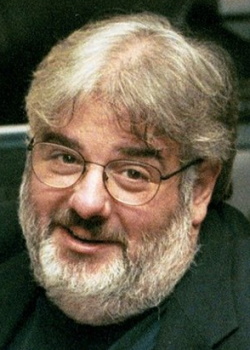 Composer Joel Goldsmith died at his home in Hidden Hills, California, on April 29, 2012, at the age of 54, following a long battle with cancer.
The son of legendary film composer Jerry Goldsmith, he established a substantial career of his own in film, television and video games, becoming particularly associated with science fiction and fantasy. His most enduring achievement was his music for the Stargate television franchise, which occupied him for more than a decade and earned him three Emmy Award nominations.
Joel King Goldsmith was born in Los Angeles on November 19, 1957. Growing up around his father’s work gave him an unusually early introduction to film scoring, and as a teenager he became fascinated by synthesizers and electronic music. He sometimes assisted Jerry with electronic elements on scores during the 1970s, and later contributed to his father’s pioneering all-electronic score for Runaway (1984). Joel’s own professional career began in 1978 when he worked with Richard Band on the low-budget science-fiction film Laserblast, while his first solo feature assignment was Ulli Lommel’s Olivia in 1981.
Much of Goldsmith’s early work embraced electronics, although he gradually developed a muscular orchestral style inevitably influenced by his father. Roland Emmerich’s science-fiction thriller Moon 44 (1990) became an important early symphonic assignment, followed by films including Maniac Cop III: Badge of Silence (1992), Joshua Tree (1993), Man’s Best Friend (1993) and Kull the Conqueror (1997). The latter gave Goldsmith an opportunity to write on a broad fantasy-adventure scale, combining large orchestral forces, vigorous action writing and electronic textures.
Robert B. Sherman, 1925-2012
 Composer Robert B. Sherman, one of the greatest and most influential songwriters in the history of Hollywood, died on March 6, 2012, at his home in London, after a short illness. He was 86 years old.
Robert Bernard Sherman was born in New York, New York, in December 1925, the son of Russian Jewish immigrants. His father, Al, was a composer and arranger in Tin Pan Alley in New York, and was a contemporary of George Gershwin; the Shermans eventually relocated to Los Angeles in 1937, and Robert attended Beverly Hills High School. Robert joined the Army in 1943 aged 17, and was awarded the Purple Heart medal after being shot in the knee in 1945, an injury which forced him to walk with a cane for the rest of his life. After completing his national service, Sherman and his brother Richard started a songwriting company, and they enjoyed success writing popular songs for artists including Annette Funicello. This success brought them to the attention of producer Walt Disney, who eventually hired them as staff songwriters for the Walt Disney Studio. Read more…
John Barry, 1933-2011
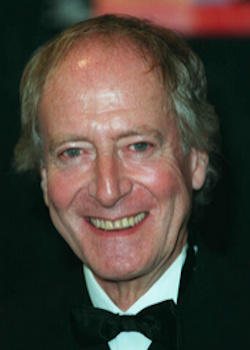 Composer John Barry died on January 30, 2011, at his home in Oyster Bay, New York, after suffering a heart attack. He was 77.
John Barry Prendergast was born in York, England in November 1933, where his father owned a chain of cinemas. He played the organ at York Minster and, after spending some time as a classical pianist, formed a jazz band, The John Barry Seven in 1957. The Seven had a number of popular instrumental hits in the UK, including a cover of “Walk Don’t Run” and the theme from the TV show Juke Box Jury, “Hit and Miss”, before moving into cinema.
Barry made his film music composing debut in 1960 writing music for the Adam Faith film Beat Girl at the age of 27, before establishing himself as a major force in the British film industry when he was brought in to arrange the theme for Dr. No, the first Bond film, in 1962. Though the “James Bond Theme” is credited to Monty Norman, Barry’s unmistakable arrangement—brassy, rhythmic, and insouciantly cool—established the sound of the series. He wrote the entire score for the second James Bond film, From Russia With Love, in 1963, and went on to score ten more, including Thunderball, Goldfinger, You Only Live Twice, On Her Majesty’s Secret Service, Diamonds Are Forever, Octopussy, and The Living Daylights. Read more…
Geoffrey Burgon, 1941-2010
 Composer Geoffrey Burgon died on September 21, 2010, following a short illness. He was 69.
One of the most distinctive voices in British television music, Burgon was responsible for the celebrated scores for Tinker Tailor Soldier Spy and Brideshead Revisited, as well as The Chronicles of Narnia, Longitude and The Forsyte Saga. His film work included Monty Python’s Life of Brian, The Dogs of War and Robin Hood, while alongside his screen career he maintained a substantial body of concert, choral and operatic music.
Geoffrey Alan Burgon was born in Hambledon, Hampshire, on July 15, 1941. As a teenager he became fascinated by jazz and taught himself the trumpet, eventually studying the instrument at London’s Guildhall School of Music and Drama. There he also studied composition with Peter Wishart, and later received encouragement from Lennox Berkeley. Burgon initially supported himself as a professional trumpeter, performing with orchestras and jazz ensembles, but by the early 1970s had abandoned performing to concentrate entirely on composition.
His first significant recognition came outside film and television. Burgon’s Requiem, premiered at the Three Choirs Festival in 1976, established him as a serious concert composer and demonstrated the affinity for voices that would remain central to his work. Around the same period television commissions began to arrive, including two memorable Doctor Who serials, Terror of the Zygons (1975) and The Seeds of Doom (1976), for which his atmospheric music combined small instrumental ensembles with electronic treatments. Read more…
Vic Mizzy, 1916-2009
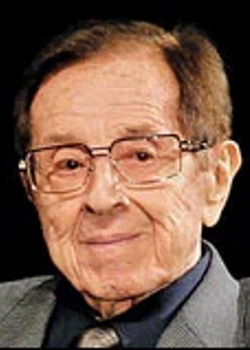 Composer and songwriter Vic Mizzy died at his home in Bel-Air, California, on October 17, 2009, at the age of 93, from heart failure.
A prolific writer for popular music, film and television, Mizzy created two of the most instantly recognizable television themes of the 1960s, The Addams Family and Green Acres. His film career was dominated by comedy and light fantasy, including a celebrated series of scores for Don Knotts, but his wonderfully eccentric musical personality could also be heard in horror films such as The Night Walker and The Spirit Is Willing.
Victor Mizzy was born in Brooklyn, New York, on January 9, 1916, the son of immigrant parents. He began playing accordion and piano as a child and, while attending New York University, formed a songwriting partnership with Irving Taylor. The pair wrote sketches and songs for variety shows and appeared on radio programs including Major Bowes’ Original Amateur Hour. Mizzy subsequently became a successful Tin Pan Alley songwriter, producing hits such as “Three Little Sisters,” “There’s a Faraway Look in Your Eye” and “Take It Easy.”
During World War II Mizzy served for four years in the United States Navy while continuing to write songs. He later collaborated with lyricist Mann Curtis on hits including “My Dreams Are Getting Better All the Time,” “Pretty Kitty Blue Eyes,” “The Whole World Is Singing My Song” and “The Jones Boy.” His songs were recorded by performers including Doris Day, Perry Como, Dean Martin and Billie Holiday, establishing him as a successful popular songwriter long before Hollywood became his principal occupation. Read more…
Maurice Jarre, 1924-2009
 Composer Maurice Jarre died on March 29, 2009, at his home in Malibu, California, after a battle with cancer. He was 84.
Maurice Alexis Jarre was born in Lyon, France, in September 1924, and originally studied engineering at the Sorbonne before turning to music at the Conservatoire de Paris, where he studied composition, percussion, and conducting. His early career included work in French theatre, notably as musical director for Jean-Louis Barrault’s Théâtre National Populaire.
Jarre’s began scoring films in France in the 1950s, notably for acclaimed director Georges Franju, and came to international prominence in 1962 for his epic, percussive, sweeping masterpiece score for director David Lean’s Lawrence of Arabia. The film’s stirring main theme, performed by a full orchestra and augmented with Middle Eastern instruments, became one of the most recognizable in cinema and won Jarre his first Oscar. He capitalized on the success again in 1965 with another David Lean film, Doctor Zhivago, where his romantic and melancholic “Lara’s Theme” became a popular standard. Read more…
Angela Morley, 1924-2009
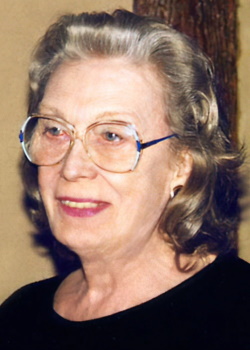 Composer, arranger, orchestrator and conductor Angela Morley died in Scottsdale, Arizona, on January 14, 2009, at the age of 84. She had suffered a heart attack while undergoing surgery following a broken hip.
One of Britain’s most accomplished arrangers, Morley’s remarkable career encompassed big bands, radio, records, film and American television. She received two Academy Award nominations, won three Emmy Awards, and contributed behind the scenes to some of the most famous film scores of the late twentieth century.
Morley was born Walter Morley Stott in Leeds, Yorkshire, on March 10, 1924, and developed an early fascination with big-band music. Largely self-taught at first, she became a professional saxophonist at 15 and by 17 was playing lead alto with Oscar Rabin’s orchestra. She joined Geraldo’s celebrated band in 1944, increasingly concentrating on arranging, and later studied composition with Mátyás Seiber and conducting with Walter Goehr. By the early 1950s she had abandoned performing to concentrate entirely on writing.
Under her former professional name, Wally Stott, Morley became enormously familiar to British radio audiences. She was musical director for Philips Records, arranged for singers including Rosemary Clooney and Mel Tormé, and provided music for The Goon Show. Most famously, she wrote the theme and incidental music for Hancock’s Half Hour, including its memorably lugubrious opening tuba motif. She also produced a series of light-orchestral compositions and arrangements that established her as one of Britain’s leading practitioners in the field. Read more…
Isaac Hayes, 1942-2008
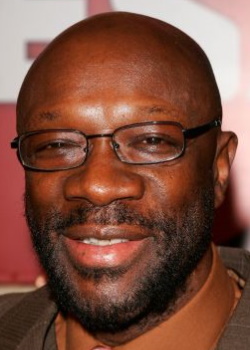 Composer, singer, songwriter, arranger and actor Isaac Hayes died in Memphis, Tennessee, on August 10, 2008, at the age of 65.
One of the defining figures of 1970s soul music, Hayes also made an indelible contribution to cinema through his groundbreaking score for Shaft, whose combination of funk, jazz, orchestral writing and rhythm-and-blues profoundly influenced the sound of American film music. He became the first African-American to win an Academy Award in a music category when “Theme from Shaft” won Best Original Song in 1972.
Isaac Lee Hayes Jr. was born in Covington, Tennessee, on August 20, 1942, and grew up in the Memphis area. A multi-instrumentalist who played piano, organ and saxophone, he joined Stax Records during the early 1960s, initially as a session musician. With lyricist David Porter he became one of the label’s most successful songwriting teams, creating songs including “Hold On, I’m Comin’,” “When Something Is Wrong with My Baby” and “Soul Man” for Sam & Dave. By the end of the decade Hayes had emerged as a recording star in his own right, with the landmark 1969 album Hot Buttered Soul establishing his distinctive mixture of extended song structures, deep vocals, psychedelic soul and elaborate orchestral arrangements.
His entry into film music came with Gordon Parks’s Shaft (1971), starring Richard Roundtree as private detective John Shaft. Hayes approached the project with the same musical freedom that characterized his solo albums, combining wah-wah guitar, driving hi-hat rhythms, brass, strings, jazz improvisation and lengthy instrumental grooves. Rather than merely providing conventional dramatic underscore, he created a complete musical environment for the film, giving its urban New York setting a confidence and contemporary energy rarely heard in mainstream Hollywood scoring at the time. Read more…
Alexander Courage, 1919-2008
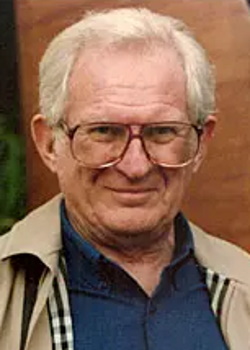 Composer, arranger and orchestrator Alexander “Sandy” Courage died in Pacific Palisades, California, on May 15, 2008, at the age of 88, following several years of declining health.
During a career spanning more than half a century he worked on hundreds of film and television productions, but remains immortal for one of the most recognizable pieces of music in television history: the soaring theme for the original Star Trek.
Courage was born in Philadelphia on December 10, 1919, and grew up in New Jersey. He studied composition at the Eastman School of Music, graduating in 1941, before serving during World War II as a bandleader in the United States Army Air Forces. After settling in Los Angeles he began arranging and composing for CBS radio and in 1948 joined MGM as an orchestrator.
At MGM, Courage became one of the craftsmen responsible for the celebrated sound of the studio’s golden-age musicals. His credits included Show Boat (1951), The Band Wagon (1953), Seven Brides for Seven Brothers (1954), Kismet (1955) and Gigi (1958), while he also worked on Guys and Dolls and Funny Face. His sophisticated command of the orchestra later made him a valued collaborator of composers including John Williams and Jerry Goldsmith.
Courage also composed original film scores, most notably for Arthur Penn’s western The Left Handed Gun (1958), starring Paul Newman, and André de Toth’s stark Day of the Outlaw (1959). Although original film composition never became the principal focus of his career, these scores demonstrated a muscular dramatic style quite distinct from the elaborate musical arrangements for which he was already renowned. Read more…
Leonard Rosenman, 1924-2008
 Composer Leonard Rosenman died on March 4, 2008, at the Motion Picture & Television Country House and Hospital in Woodland Hills, California. He had been suffering with dementia for many years, and died of a heart attack. He was 83.
Leonard Rosenman was born in September 1924, in Brooklyn, New York, to Jewish immigrants from Poland. After service in the Pacific with the United States Army Air Forces in World War II he studied piano and composition at Brooklyn College, and later at the University of California, Berkeley. Among his most influential teachers were Arnold Schoenberg and Roger Sessions – figures whose serialist and atonal techniques deeply informed Rosenman’s own compositional voice.
Rosenman’s entranc into the film world came through his friendship with actor James Dean; the two had met at a party for the cast of a Broadway play, and two weeks later Dean appeared at Rosenman’s doorstep wanting to take piano lessons. Dean later personally recommended him to director Elia Kazan for East of Eden in 1955, which proved to be a major breakthrough for the composer. Rosenman followed it later that year with Rebel Without a Cause, further establishing his reputation as a composer capable of capturing psychological intensity through unconventional harmonic language. These early scores were groundbreaking in their integration of dissonance and modernist techniques into mainstream Hollywood cinema. Read more…
Remembering Brian May, 1934-1997
 Composer Brian May died ten years ago today, on April 25, 1997, in his home in Melbourne, Australia, after a short respiratory illness. He was 62.
May was born in Adelaide, South Australia, in 1934. A classically trained musician and conductor, May studied at the Adelaide Elder Conservatorium and later joined the ABC (Australian Broadcasting Corporation), where he served as conductor of the ABC Showband. He made his transition to film scoring in the early 1970s and quickly became a key figure in the Australian New Wave cinema movement, alongside fellow composers such as Peter Best and Bruce Smeaton, through scores like The True Story of Eskimo Nell (1975) and Patrick (1978).
May’s most famous contributions to film came at the end of that decade, with his scores for George Miller’s Mad Max (1979) and Mad Max 2: The Road Warrior (1981). May’s propulsive, percussive orchestral style that matched those films’ raw, dystopian vision, and when they earned global acclaim and popularity, May became one of the first Australian film composers to enjoy a major international career.
Known for his dramatic orchestration and effective use of tension and rhythm, May was equally adept in the horror, action, and suspense genres. His film credits post-Mad Max include Roadgames (1981), Gallipoli (1981), The Survivor (1981), Turkey Shoot (1982), Cloak & Dagger (1984), Sky Pirates (1986), and Freddy’s Dead: The Final Nightmare (1991), among many others. Read more…
Remembering Toshiro Mayuzumi, 1929-1997
 Composer Toshiro Mayuzumi died in Kawasaki, Japan, ten years ago today, on April 10, 1997, at the age of 68.
One of the most important figures in post-war Japanese music, Mayuzumi was both an adventurous concert composer and an exceptionally prolific contributor to cinema, writing more than 100 film scores. His work ranged from Japanese art-house classics to major international productions, and in 1967 he became the first Japanese-born composer nominated for an Academy Award for Best Original Score.
Mayuzumi was born in Yokohama on February 20, 1929. He studied composition with Kunihiko Hashimoto, Tomojiro Ikenouchi and Akira Ifukube at the Tokyo Music School and Tokyo National University of Fine Arts and Music, graduating in 1951 before continuing his studies at the Paris Conservatoire. Exposure to Olivier Messiaen, Pierre Boulez and musique concrète profoundly affected him, and on returning to Japan he became one of the country’s pioneers of electronic and avant-garde music.
Cinema accompanied him almost from the beginning. His score for Hideo Oba’s Homecoming (1950) won a Mainichi music prize even before he completed his studies, and during the following decade he became one of Japan’s busiest screen composers. His credits included Kenji Mizoguchi’s The Woman in the Rumor (1954) and Street of Shame (1956), Kon Ichikawa’s Enjo (1958), Yasujirō Ozu’s Good Morning (1959), and Mikio Naruse’s When a Woman Ascends the Stairs (1960). Read more…
Herman Stein, 1915-2007
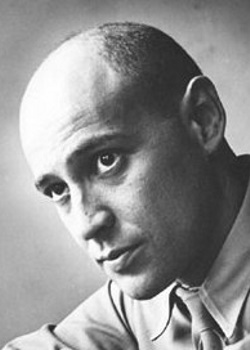 Composer and arranger Herman Stein died at his home in Los Angeles on March 15, 2007, at the age of 91, from congestive heart failure.
One of the largely unsung architects of Universal’s science-fiction and horror sound of the 1950s, Stein contributed music to nearly 200 films and shorts, including It Came from Outer Space, Creature from the Black Lagoon, This Island Earth, Tarantula and The Incredible Shrinking Man. Much of his work went uncredited under the studio system, but his music became inseparable from a generation of monsters, aliens and atomic-age nightmares.
Stein was born in Philadelphia on August 19, 1915. A child prodigy, he began playing piano at three and was performing publicly by six. By his teens he was arranging professionally, eventually working in radio and with musicians including Count Basie, Bob Crosby and Fred Waring. After military service during World War II he moved to Los Angeles in 1948 and studied composition with Mario Castelnuovo-Tedesco before entering the film industry.
Universal-International hired Stein as an arranger in 1950 and promoted him to staff composer the following year. He worked alongside musicians including Henry Mancini, Hans J. Salter, Frank Skinner and Irving Gertz, often dividing individual films between several composers. Studio music supervisor Joseph Gershenson generally received the principal screen credit, leaving Stein and his colleagues anonymous even when they had written substantial portions of a score. Read more…
Shirley Walker, 1945-2006
 Composer Shirley Walker died on November 30, 2006, in Reno, Nevada, from complications following a stroke. She was 61.
Born Shirley Anne Rogers in April 1945, in Napa, California, Walker was a musical prodigy. She had an early start performing as a teenager at various hotels, jazz and art bands in tje 1960s, and later attended both San Francisco State University and Berkeley. She began her professional music career in the late 1970s, and for several years she wrote jingles and composed for industrial films.
Her career in film began in 1979, when she was hired to play the synthesizers on Carmine Coppola’s score for Apocalypse Now, and she quickly established herself as one of the most in-demand arrangers, conductors, and orchestrators in Hollywood, working notably with composers such as Danny Elfman, Hans Zimmer, and Brad Fiedel. Notably, she is credited for being a major influence on the symphonic style Elfman adopted on scores like Scrooged, Batman, and Edward Scissorhands.
Walker was one of the few female film score composers working in Hollywood during her career, and became one of the first female composers to earn a solo score credit on a major Hollywood motion picture when she was hired to score John Carpenter’s Memoirs of an Invisible Man in 1992. Her work on the animated super-hero film Batman: Mask of the Phantasm (1993) remains a standout achievement, praised for its operatic intensity and emotional complexity; this film also initiated her long-standing relationship with DC Animation, as over the course of the next decade she would write music for shows such as Batman: The Animated Series, Superman: The Animated Series, The Flash, The New Batman Adventures, and Batman Beyond, among many others. Read more…
Basil Poledouris, 1945-2006
 Composer Basil Poledouris died at his home in Los Angeles on November 8, 2006, at the age of 61, following a battle with cancer.
One of the most distinctive American film composers of the 1980s and 1990s, Poledouris became renowned for muscular orchestral writing, powerful choral music and an unusually direct melodic style. His scores for Conan the Barbarian, RoboCop, The Hunt for Red October, Free Willy and Starship Troopers remain among the most admired works of their respective genres.
Vassilis Konstantinos Poledouris was born in Kansas City, Missouri, on August 21, 1945, into a Greek-American family. He began playing piano as a child and moved to Los Angeles in 1964 to study filmmaking and music at the University of Southern California. There he became friends with aspiring directors including George Lucas, John Milius and Randal Kleiser, relationships that would prove important throughout his career. He briefly considered filmmaking and even appeared as an extra in an episode of Star Trek, but increasingly concentrated on composition.
After graduation Poledouris spent several years writing for educational films and television before receiving his first significant feature assignment from Milius. Big Wednesday (1978), the director’s nostalgic surfing drama, began a particularly important collaboration and allowed Poledouris to combine broad orchestral writing with music reflecting the California surfing culture of the 1960s. Randal Kleiser’s The Blue Lagoon (1980) followed, providing a very different opportunity for lush romantic and tropical music. Read more…

Shop at the Movie Music UK Store

Member of the


