Joel Goldsmith, 1957-2012
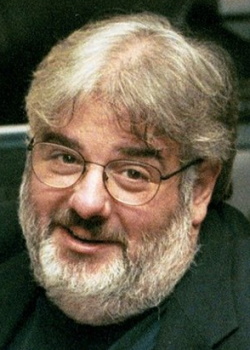 Composer Joel Goldsmith died at his home in Hidden Hills, California, on April 29, 2012, at the age of 54, following a long battle with cancer.
The son of legendary film composer Jerry Goldsmith, he established a substantial career of his own in film, television and video games, becoming particularly associated with science fiction and fantasy. His most enduring achievement was his music for the Stargate television franchise, which occupied him for more than a decade and earned him three Emmy Award nominations.
Joel King Goldsmith was born in Los Angeles on November 19, 1957. Growing up around his father’s work gave him an unusually early introduction to film scoring, and as a teenager he became fascinated by synthesizers and electronic music. He sometimes assisted Jerry with electronic elements on scores during the 1970s, and later contributed to his father’s pioneering all-electronic score for Runaway (1984). Joel’s own professional career began in 1978 when he worked with Richard Band on the low-budget science-fiction film Laserblast, while his first solo feature assignment was Ulli Lommel’s Olivia in 1981.
Much of Goldsmith’s early work embraced electronics, although he gradually developed a muscular orchestral style inevitably influenced by his father. Roland Emmerich’s science-fiction thriller Moon 44 (1990) became an important early symphonic assignment, followed by films including Maniac Cop III: Badge of Silence (1992), Joshua Tree (1993), Man’s Best Friend (1993) and Kull the Conqueror (1997). The latter gave Goldsmith an opportunity to write on a broad fantasy-adventure scale, combining large orchestral forces, vigorous action writing and electronic textures.
One of his most significant film projects came in 1996 when he collaborated directly with his father on Star Trek: First Contact. Jerry Goldsmith’s schedule left him insufficient time to complete the entire score, and Joel was brought in to provide substantial additional music, much of it associated with the Borg. The younger Goldsmith’s darker electronic and orchestral material blended remarkably seamlessly with his father’s score, and the collaboration remained a particularly important personal memory for him.
Goldsmith’s defining career opportunity arrived with Stargate SG-1 in 1997. David Arnold’s themes from the original Stargate feature provided the basis for the television main title, but Goldsmith rapidly developed an extensive musical vocabulary of his own as the series expanded its mythology. Working within television budgets, he combined sophisticated synthesizer and sampled-orchestra technology with live instrumentalists, creating music of considerably greater scale than was typical for weekly television. His score for the first-season episode “The Nox” earned him his first Emmy nomination.
He subsequently became the musical voice of the entire franchise. For Stargate Atlantis (2004–2009), Goldsmith wrote an original main theme as well as the episodic scores, earning Emmy nominations for both the title music and dramatic underscore. The soaring Atlantis theme demonstrated his particular gift for combining heroic orchestral writing with the sense of wonder essential to science fiction. He later scored Stargate: The Ark of Truth and Stargate: Continuum in 2008 and continued with Stargate Universe from 2009 to 2011, developing a darker and more atmospheric sound for the franchise’s final television incarnation.
Outside Stargate, Goldsmith’s television work included The Untouchables, The Outer Limits, Diagnosis Murder, Witchblade, Helen of Troy and Sanctuary. He also entered video-game scoring with Call of Duty 3 in 2006, bringing his experience with large-scale action and military music to the enormously successful game franchise.

Shop at the Movie Music UK Store

Member of the


