Archive
SPY KIDS – Robert Rodriguez
 Original Review by Jonathan Broxton
There’s a saying in Britain – I don’t know how widespread it is in the rest of the English-speaking world – which states that “too many cooks spoil the broth”. What this means, basically, is that if too many people try to take part in one thing at once, the end result can be diminished by the contributions of its many creators. This old adage can be applied to Spy Kids, an enjoyable children’s action score which is rendered just a little overly-schizophrenic through the use of eight – count ’em – eight different composers. Basically, Spy Kids is a James Bond adventure story with a difference – the protagonists are pre-teens. What some people may find surprising is the fact that it was written and directed by Robert Rodriguez, the man who previously brought the world such dark, violent movies as El Mariachi, Desperado, From Dusk Till Dawn and The Faculty. The plot is simple: Gregorio and Ingrid Cortez (Antonio Banderas and Carla Gugino) are semi-retired spies with two precocious children, Carmen (Alexa Vega) and Juni (Daryl Sabara). Gregorio and Ingrid still occasionally blast off on an adventure when duty calls but unfortunately, their sabbatical has made them a little rusty – so much so that they end up being captured by the diabolical Fegan Floop (Alan Cumming), a children’s TV show host who is planning to use an army of robot children to take over the world. The only solution? The kids to rescue, armed with a load of cool gadgets and the espionage know-how inherited from mom and dad. Read more…
Academy Award Winners 2000
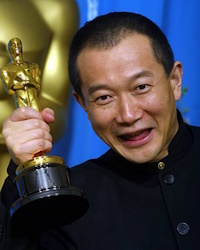 The Academy of Motion Picture Arts and Sciences (AMPAS) have announced the winners of the 73rd Academy Awards, honoring the best in film in 2000.
In the Best Original Score category, Chinese composer Tan Dun won the Academy Award for his score for Ang Lee’s Crouching Tiger, Hidden Dragon. In his acceptance speech Tan said:
I prepared something exactly forty-five seconds. My music is to dream without boundaries. Tonight, with you, I see boundaries being crossed. As a classical music composer I’m thrilled to be honored here. “Crouching Tiger” bridged East and West, romance and action, high and low cultures. Thank you, Ang Lee, Yo-Yo Ma, Peter Gelb, Michael Gorfaine, James Schamus, Bill Kong. Thank you, Sony Classical, CAMI and G. Schirmer for their long support. Last, this is for two tigers in my family: my wife Jane, Ian, [my] son, both born in the year of tigers. Thank you, Academy.
The other nominees for Best Original Score were Rachel Portman for Chocolat, Hans Zimmer for Gladiator, Ennio Morricone for Malèna, and John Williams for The Patriot.
In the Best Original Song category, legendary singer-songwriter Bob Dylan won the Academy Award for “Things Have Changed” from Curtis Hanson’s Wonder Boys. Dylan was touring Australia at the time of the ceremony and appeared from Sydney by satellite.
The other nominees for Best Original Song were Randy Newman for “A Fool in Love” from Meet the Parents; Björk, Lars von Trier and Sjón Sigurðsson for “I’ve Seen It All” from Dancer in the Dark; Jorge Calandrelli, Tan Dun and James Schamus for “A Love Before Time” from Crouching Tiger, Hidden Dragon; and Sting and David Hartley for “My Funny Friend and Me” from The Emperor’s New Groove.
THE DISH – Edmund Choi
 Original Review by Jonathan Broxton
Composer Edmund Choi has had an unusual career to date. After graduating, he wrote music for Praying With Anger and Wide Awake, Sixth Sense director M. Night Shyamalan’s first two films, and the romantic comedy Down To You in early 2000. However, it was his re-scoring of the Australian comedy The Castle in 1999 (Miramax asked him to replace Craig Harnath’s original music for the American market) that landed him this assignment writing the score for Rob Sitch’s follow-up. Unfortunately, despite his undoubted talent, Choi has fallen into the trap many fledgling composers find themselves facing, and succumbed to a bad case of temp-track fever. Set in 1969, The Dish is a warm and appealing comedy starring Sam Neill as Cliff Buxton, an amateur astronomer from rural Parkes, NSW, Australia, who is the man in charge of the large satellite transmitter which sits proudly in the community’s main sheep paddock. Then, suddenly, Parkes is put on the map when NASA contacts Buxton to ask him to provide backup technology for Neil Armstrong’s historic walk on the face of the moon. With the help of his good natured but slightly inept assistants (Kevin Harrington, Patrick Warburton), Buxton is only too pleased to be of service to the Americans – but gets more than he bargained for when a technical glitch back home in Houston leaves the Parkes Dish solely responsible for sending out the lunar TV pictures to a world holding its collective breath. Sitch’s endearing film was one of 2001’s sleeper successes, at least critically – it did very little at any box-office, despite receiving glowing reviews – and boasts a charming lead performance from Neill, a world away from the histrionics of Jurassic Park and its sequels. Read more…
Remembering Howard Ashman, 1950-1991
 Lyricist, playwright, director and producer Howard Ashman died in New York City ten years ago today, on March 14, 1991, at the age of 40, from complications related to AIDS.
Although his career was tragically brief, Ashman played a crucial role in revitalizing both the American musical theatre and Disney animation. With composer Alan Menken he wrote the songs for Little Shop of Horrors, The Little Mermaid and Beauty and the Beast, while his final work on Aladdin was completed shortly before his death. He won two Academy Awards for Best Original Song, the second posthumously.
Howard Elliott Ashman was born in Baltimore, Maryland, on May 17, 1950, and developed an early interest in theatre. He studied at Boston University and Goddard College before earning a master’s degree from Indiana University. Moving to New York in 1974, he worked briefly in publishing while writing plays and became involved with the small WPA Theatre, eventually serving as its artistic director.
Ashman’s first collaboration with Alan Menken was the 1979 musical God Bless You, Mr. Rosewater, adapted from Kurt Vonnegut’s novel. Their breakthrough came three years later with Little Shop of Horrors, based on Roger Corman’s low-budget 1960 comedy about a man-eating plant. Ashman wrote the book and lyrics and directed the original production, while Menken composed the music. Its mixture of 1960s pop, Motown, comedy and horror became an enormous Off-Broadway success. Read more…

Shop at the Movie Music UK Store

Member of the


