NIGHT PASSAGE – Dimitri Tiomkin
 GREATEST SCORES OF THE TWENTIETH CENTURY
Original Review by Craig Lysy
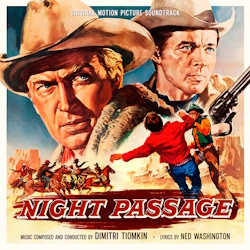
Producer Aaron Rosenberg decided that he wanted to cast the stars of Universal Pictures’ recent hits – “The Glenn Miller Story” (James Stewart) and “To Hell and Back” (Audie Murphy) – together in a Western. He saw an opportunity in the 1956 novel “Night Passage” by Norman A. Fox. Universal gave the green light; Rosenberg would manage production, Anthony Mann was tasked with directing, and Borden Chase was hired to write the screenplay. For the cast, James Stewart would star as Grant McLain, and Audie Murphy would co-star as the Utica Kid (Lee McLain). Joining them were Dan Duryea as Whitey Harbin, Diane Foster as Charlotte “Charlie” Drew, Elaine Stewart as Verna Kimball, Brandon de Wilde as Joey Adams, and Jay C. Flippen as Ben Kimball. Production went off the rails quickly when Mann left the project, believing that Audie Murphy was miscast and that the screenplay was weak. To his credit, his opinion was later validated by critics and the box office. Consequently, James Neilson was brought in to direct.
The film is set in the post–Civil War era in Colorado during America’s period of railroad expansion westward to California. Railroad tycoon Ben Kimball has been unable to pay his workers for three months. This is due to Whitey Harbin and his gang of outlaws, including the fast-draw shootist the Utica Kid, who repeatedly hold up the train and steal its payroll. Kimball recruits Grant McLain, his former railroad employee who was fired in disgrace, to secretly shepherd the payroll through. He succeeds with the help of Joey, a young boy who hides the money in a shoebox.An enraged Whitey retaliates by kidnapping Kimball’s wife. Eventually, Grant and the Kid – who turns out to be his younger brother – join forces and take down Whitey, but at great cost, as the Kid dies in Grant’s arms. The film was a commercial failure, and critical reception was no better, with critics calling the plot hackneyed and Stewart’s performance lacking intensity. The film received no Academy Award nominations.
The years from 1948–1958 marked Dimitri Tiomkin’s “Golden Decade,” during which he composed at the peak of his career. He was hired as the composer for “Night Passage” due to his status as Hollywood’s premier composer of Westerns. Universal Pictures management wanted a big, thunderous score, and Tiomkin was renowned for delivering, as evidenced by his scores for “Red River” (1948), “High Noon” (1952), “Giant” (1956), and “Gunfight at the O.K. Corral” (1957).
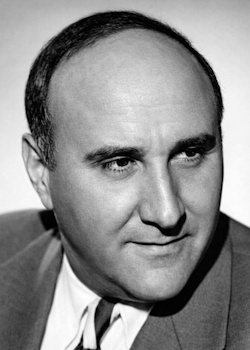 Rosenberg tasked Tiomkin with creating a song identity for the film, which resulted in yet another collaboration with lyricist Ned Washington on two songs: “Follow the River” and “You Can’t Get Far Without a Railroad.” For his soundscape, Tiomkin chose to utilize these two songs as primary themes, which are woven into the score’s tapestry and permeate the film from first reel to last. “Follow the River,” which serves as the Main Theme, provides a soulful, sweeping ballad that offers an epic, panoramic perspective. He often employs it with grandeur to support the film’s majestic cinematography. Composed in an ABA structure, Tiomkin either presents the full song or deconstructs it, using the A and B phrases as individual leitmotifs.
The second song, “You Can’t Get Far Without a Railroad,” is folksy, comedic, and more rustic, thereby providing a lighthearted, rhythmic counterpoint to the more dramatic “Follow the River.” To enhance the sense of scale, Tiomkin brought in his friend and longtime collaborator Jester Hairston as choral master. He employed a four-part men’s chorus to evoke epic grandeur and complement the sweeping vistas showcased by the expansive Technirama format, a high-resolution widescreen process introduced by Technicolor in 1957. Lastly, Tiomkin continued his practice of incorporating indigenous instruments such as the fiddle, accordion, and harmonica to provide a folksy sensibility and underscore the film’s rustic setting. Notably, the accordion – performed on screen by James Stewart – helps establish his vagabond, musician persona, although his vocals and actual playing were dubbed against his wishes.
“Main Title” offers a masterpiece cue, where Tiomkin and Washington create a profoundly moving cinematic moment, which perfectly establishes the tone of the film. It opens with a bold declaration of the Main Theme B Phrase, which supports the display of the Universal Pictures Logo. At 0:15 we flow into the opening credits, which reveal Grant McLain (James Stewart) riding alone against an autumnal panorama of the Colorado Rocky Mountains. An instrumental prelude of the Main Theme supported by men’s wordless chorus supports. At 0:32 a fortissimo declaration of the A Phrase’s final statement supports the display of the Film title. At 0:40 we flow into the song “Follow The River”, initially sung by a men’s chorus. The song continues as an instrumental rendering with wordless men’s chorus as we see Grant riding past railroad track layers hard at work.
An assessment of the lyrics reveals powerful emotions are at play, and offered from a woman’s perspective. They speak of a deep desire for reunion, and a steadfast hope that her wayward, separated lover will return. It also speaks of the loneliness of a “great love” lost, with the singer expressing deep emotional pain, as evidenced by an “empty heart” despite the fullness of the moon. Lastly, the song uses the symbology of a river – a natural guide meant to lead the absent lover back home, offering hope that their love is enduring, and meant to be rekindled. Tiomkin’s A and B melodies find a perfect confluence with the song lyrics, achieving a deeply moving testament to the loneliness of two hearts yearning to once again, be one.
Grant gets an earful of complaints from friends and workers who complain of not being paid in months because of that outlaw Whitey and his gang. Grant moves on, sits down and pulls out his accordion, and we flow into “Follow The River”, which he plays with slow dance tempo. Four couples come out and begin dancing. A man comes over, and says he wants him to play something livelier, and so Grant shifts to a spirited gig performance singing the folksy “You Can’t Get Far Without a Railroad”. An assessment of the song reveals that unlike “Follow The River”, there is no deep meaning to be found. Instead, it offers lyrics, which emphasize that the railroad is the essential engine of opportunity, of advancing civilization, and westward expansion; the only way to cross the vast distances of the frontier in comfort.
While playing, Grant gets a telegram from Tim, which states that railroad tycoon Ben Kimball wants to meet, as a brawl breaks out among the dancers. Grant stops, thanks Tim, packs up his accordion and departs to meet with Kimball. On the way he meets Miss Vittles, who operates a mobile chuckwagon business. She is a sly, rough-around-the-edges older woman who invites Grant for coffee. In Short Cut”, he departs after she makes a pass, grateful for her describing a shortcut through the mountains. A tranquil Main Theme B Phrase carries his departure. He stops and proceeds walking his horse through the mine tunnel she describes. At 0:37 he exits the mine, and resumes his journey carried by carefree rendering of the Main Theme A Phrase. At 0:47 “Bully, Bully”, strings energico propel a spritely riding scherzo as we see Grant riding through the wooded mountains. At 0:57 the scherzo assumes a more aggressive contour as he sees below a boy running with a horseman, Concho, a member of Whitey’s gang, in pursuit. The boy, named Joey, is lassoed, and Grant prepares his lasso and rides towards them. He lassoes Concho, pulls him off his horse, and manages to dislodge his pistol. At 1:22 they talk, the boy warns that Concho has a knife, and the music surges with interplay of both the A and B Phrases as Grant proceeds to rope whip, and then kick him down unconscious. He offers Joey a ride, and he declines, saying he is beholden, and to please leave. As he rides off the B Phrase supports against a gorgeous mountain lake vista, and carries him into town.
“Four Bits A Night” reveals Grant reacquainting with Charlie in a café, as she serves him apple pie and coffee. He asks about the Utica Kid, but she is evasive, and shifts the discussion to Ben Kimball and his wife. The B Phrase supports playfully in the background with quotes of the A Phrase. She is happy he is meeting with Ben, believing that the railroad would be good for him. As he departs, he says it was, but somehow, I lost it. “You Belong To The Railroad” offers a score highlight with exquisite instrumental interplay of the A and B Phrases, draped with subtle romantic adornment. It reveals Grant joining Ben in his plush railroad car, along with company number two, Jeff. The conversation is tense as it was Jeff who fired Grant for allegedly helping the Utica Kid escape. Given the bad blood, Grant gets up to leave, but is coaxed to stop by Verna Kimball who joins them. She offers him an opportunity to work for the railroad again, which he accepts to Ben’s delight. He briefs him on the outlaw Whitey Harbin and offers his plan. He gives Grant the company payroll of $10,000 and says he is to transport it on a supply train. No one would suspect you of carrying so much cash. Jeff and armed men will hide in a box car to provide the guns necessary. Grant agrees with the proviso, that if he succeeds, Ben makes him the company number two. “The Bargain” offers a score highlight where Tiomkin infuses romanticism with an undercurrent of regret, into the interplay of the A and B Phrases. Ben agrees and departs. Outside he is intercepted by Verna and we learn they had intended to marry. She still harbors feelings, however he is bitter as she did not back him when Jeff had him fired. She kisses him for ‘old times sake’, but we see he has moved on as he walks away.
“Risky Ride” reveals Grant granting Joey free passage on the open-air flatbed car as the train prepares to depart to the mining camp. The engine and Kimball’s plush caboose lock the trailing cars in, and they set off. Concho, Whitey’s number two, rides up behind the train, catches it, and boards. He then climbs atop the roof and proceeds to make his way forward to the first-class car. He climbs down, and is joined by the conductor who says pay two bits for the first-class cabin, or ride free on the open car. Concho pays, and enters the car. Tiomkin sow a suspenseful musical narrative, embedded with brief quotes of the A Phrase to support. Outside, Joey opens Grant’s accordion case, plays discordantly, and asks if he plays this? “Follow The River (Film Version)” offers a score highlight with a sweeping and sumptuous exposition of the Main Theme melody. Grant says yes, offers an accordion prelude, joined by Grant singing a folksy rendering of the first stanza. Then at 1:48 the camera pans out to reveal the train winding through a gorgeous mountain pass over a river and Tiomkin provides a sweeping string led rendering of the melody empowered by wordless men’s chorus, which offers a grand cinematic moment. We shift on a soft on a diminuendo as the B Phrase and A Phrase interplay. Later, the wind shifts direction, and engine smoke engulfs them and Grant invites Joey into the first-class car to escape, carried by a brief quote of “You Can’t Get Far Without a Railroad”. We end darkly at 3:56 as Grant locks eyes with Concho.
“Train A-Winding” reveals the Utica kid riding along the train and Tiomkin propels him with a galloping A Phrase empowered by horns. The phrase carries his ride to an abandoned and decaying train stop. In the barn he joins Whitey and his fellow gang men. At 0:54 we segue into “What’ll It Be?” atop pizzicato strings as Tiomkin sow a comic interlude as the gang drinks whiskey, and then votes to mount a fourth train robbery. “You Can’t Get Far Without The Railroad II” reveals him playing his accordion and singing the folksy “You Can’t Get Far Without the Railroad” song to Joey. We flow into “Tanked”, which offers a dynamic score action highlight. Whitey and his gang are chopping the support struts of a train station water tank that sits along the tracks. The plan is to collapse it as the train nears, force it to stop, and then to storm it and steal the payroll. Once again Tiomkin adopts an energetic scherzo form, to propel the musical narrative within which is woven repeating quotes from both songs. They use horse to pull down the water tank, which falls as planned atop the tracks. Tiomkin ratches up the tension as the train speeds to the water tower as Whitey and two men ride and board the train. They lock the doors of Jeff’s car, and then detach and separate it from the train. The engineer sees the water tank, says full steam ahead, and rams through it, shattering it into pieces as the train plows on. At 1:00 a diminuendo of suspense supports as we see the Utica Kid observing from a bluff above. He jumps down into the coal car, and then places the engineer and helper at gunpoint. At 1:34 the propulsive action music resumes as he orders them to deploy the brake. The train stops at 2:04 and tension resumes a Concho shoots the conductor in the arm and orders the safe opened. At 3:00 Concho informs Whitey that the cash was not in the safe. The music surges with anger a Whitey orders everyone off the train and searched.
“In The Box” reveals Grant sneaking the cash from his pocket into a shoebox Joey is carrying. Tiomkin sow tension as they passengers are lined up and the train searched. The Utica Kid takes Ben and Verna prisoner and alerts Whitey that they have hostages. Whitey orders the passengers to board and as Grant reaches the steps, Concho pistol butts his head causing him to tumble down the embankment unconscious. At 0:35 “Do It Yourself Kid” Tiomkin shifts the musical tension under the dialogue as Whitely decides to take Verna hostage. He threatens Ben to bring him the cash if he wants to see his wife back alive. “Coming To” reveals Grant regaining consciousness, as Whitey rides off with Verna, while the Utica Kid rides joins with Joey. Tiomkin scores the scene from the stuporous Grant’s perspective, with a beleaguered and stumbling A Phrase. Grant climbs up the hill and finds himself abandoned. He picks up his accordion from the brush, and we close on a dogged A Phrase as he begins walking. “Railroaded” was dialed out of the film and features interplay of the A and B Phrases. At 1:11 we segue into “Charlie My Girl” atop an energetic staccato rhythmed narrative as Charlie arrives at the abandoned train depot, and hides as she sees Whitely and his gang ride in. Once again Tiomkin weaves quotes of the two songs together. At 2:28 the music softens and becomes more child-like on the B Phrase as the Utica Kid and Joey share a tender moment together.
“Looking For Trouble” reveals Grants watching in the shadows as gang man Howdy practices his fast draw. A horse neighs at 0:27 and strings rapido and woodwinds energetic propel his run to investigate. He discovers Charlie in the barn and draws his pistol. At 0:58 a sad B Phrase joins as she says she is looking for Utica the kid. He asks why, and she says she is a friend. He drops his pistol and at 1:12 a crescendo dramatico erupts as Grant dives down from the hay loft and crashes Howdy to the ground. He is unconscious and Grant asks Charlie for a rope and then proceeds to tie him up. He criticizes her for hooking up with the kid, and asks that she stay away until he stops being a thief. At 2:20 pleading strings express the B Phrase as she says she is concerned for both his, and Utica’s safety. The Railroad song joins as he relates his indignity having to make a living playing the accordion, living off donations thrown in his hat. He takes Howdy’s revolver and departs, and Charlie asks that he tell the Kid that she is here. At 3:21 we close darkly as Grant walks into the saloon and is greeted by Whitely and his men.
In “Fast Gun” they demand the cash, he says he does not have it, and that Kimball did not send him. He asks to join the gang as he has a score to settle with Kimball. When asks why should we? Music enters with a sad rendering of the B Phrase as he says, ask him, and Utica answers that he was Grant’s younger brother. Utica objects to Grant joining the gang, which causes a spiteful Whitey to take him on. At 1:04 dire horns sound as Concho objects, saying he has a score to settle. Grant moves towards him carried by foreboding horns, and at 1:20 violence erupts as he pummels Concho to the ground. Tiomkin sow tension as he gets up, as Grants stands ready, and orders someone to give him his gun, which Utica does. Concho hesitates and says he is not going to take him on alone, but no one comes to his aid. He turns, starts walking out, yet at the swing doors he turns and at 2:37 draws his gun. Grant kills him, which Tiomkin punctuates. He asks Whitey to meet with Utica, and says he has no objections. They walk out supported by a sad musical narrative.
At 3:22 we segue into “For Joey’s Sake” where we see Grant and Utica talking. Grant informs him he is working for the railroad and that the money is stashed in Joey’s shoe box, hoping to reform him. He asks him to release Joey to his care so he can live an honest and decent life. They then rehash the old argument of living a good life versus an evil life. These efforts fail as Utica gives him the same break Grant gave him, ten minutes to escape. Yet Grant calls his bluff, says he will stay, and then advises that Charlie is waiting for him in the barn. Tiomkin supports the pathos of two brothers unable to reconcile with a plaintive and aching rendering of the “You Can’t Get Far Without The Railroad” melody. We end darkly at 5:20 as Grant walks back to join Whitey and his men. At 5:32 we segue into “Marry Me Now” atop yearning strings as Utica enters the barn and Charlie runs to him. They join in a kissing embrace and he promises $10,000, marriage, fine clothes and a new life. Yet it goes south when she asks to marry now, and then defends Grant, saying it would be good if you could be more like him. This ignites his long simmering grievance as he relates that as the kid brother he was repeatedly told by his parents to be more like Grant. Adding, the day I learned to use this (holds up his pistol) I became very good, and was no longer the kid brother anymore. When he says this gun is going to get us everything we ever wanted, she objects, saying she does not want it that way. She says it’s not right to steal, and asks why he does it. She is saddened when he says he likes to steal, and see the expression of the face of his victims when he does. He asks her to marry him, and she turns away and says, no. Adding Grant was right, that you’ll never change. Tiomkin shifts the musical narrative to a softer, more yearning romantic tone, and yet undercurrents of tension, and melancholia well up as it becomes clear that his refusal to change his life path creates an insurmountable impediment, which means their romance is over.
“You Can’t Get Far Without The Railroad III” reveals Grant playing his accordion for the gang. Utica walks in, and demands he play something for him. Grant begins singing a spirited rendering of “You Can’t Get Far Without The Railroad”. “Pursued” offers a dynamic score action highlight, and tour de force. It reveals Will Renner, Whitey’s informant bursts in, and demand the $1,000 Whitey promised him. He recognizes Grant, and blows his cover. The gang turns towards him and Grant throws his accordion smashing the chandelier and a gunfight breaks out as the lamp oil erupts in flames. Lee flees on horseback with Joey and the money, while Grant and Verna escape through some loose floor planks. They enter the barn, and then ride off with Charlie as Whitey and his men run to the barn to obtain horses. Tiomkin scores the fight with spirited interplay of phrases from both songs, embellished with his signature methods; flutter-tongued horns, frenetic strings, and kinetic xylophone. At 1:18 racing strings propel a galloping B Phrase contesting with the A Phrase as we shift to a complex flee and pursuit musical narrative, with the camera shifting its view between the three groups; Grant, Verna and Charlie pursuing Lee and Joey, and Whitey’s gang pursuing Grant. Whitey shifts to the shorter back road to the mill seeking to ambush the others. At 3:16 we segue into “Mill Town” on a diminuendo as all three groups arrive at the mill.
“Flying Bullets” reveals Whitey’s men opening fire at Grant’s group. The previous musical narrative is sustained, dissipating on scurrying pizzicato strings as they run and take cover in the ore delivery building. Music pauses as he retrieves an ore car suspended on cables and says he will send them down one at a time. He pulls the release lever, Verna departs first, and they wait for the second cart to arrive from the valley below. He tries to return fire as he waits but is outgunned by withering fire and forced to retreat inside again. Charlie frets that he will kill his own brother, and Grant brushes her off, saying to pull the lever when the cart arrives and get out of here. At 0:39 we segue into “Sure As Shootin’ Part 1” as Grant reloads and the music resumes, although it is more strident, aggressive and filled with more tension, and percussive embellishment as he goes out to fight. He takes out two, and Whitey sends a man to flank Grant. Grant is saved by Charlie alerting him, and grants kills him by thrusting an ore cart, which pummels him and knocks him tumbling down the hillside. She says she will not abandon him and helps by loading bullets to his pistol. Lee and Joey watch, and Joey exhorts him to help his brother. At 2:05 horns dramatico resound as Lee debates whether to help Grant who is fighting furiously against the odds. At 2:45 Joey has had enough and rides down to join the fight propelled by the B Phrase. Whitey shoots the horse from under Joey and he tumbles down. Grant rushes to his aid, Lee rides up, pulls his gun, and Grants yells not the kid as he shields Joey. However, Lee shoots an outlaw behind them and a thud at 2:58 punctuates this.
“Sure As Shootin’ Part 2” opens with urgent strings propelling Lee as he joins Grant and Joey. Grant tells Lee to take the kid while I pin them down, and Lee counters, for once let me be the older brother. Grant smiles, hands Lee his revolver and scampers away with Joey. The dissonant fight music resumes with clashing A and B Phrases and flutter-tongue horns as Lee shoots a gang member off a roof. At 0:34 pizzicato strings support Grant and Joey scurrying to the ore building, joined by Lee as Whitey and two men arrive. Grant kills one, as does Lee, and the music retreats under the dialogue as they resume their bickering over old grievances. A foreboding B Phrase joins as we see Whitey sneaking up on his stomach. He dislodges a rock, which alerts them of his presence, and at 1:28 horns of doom resound as he mortally wounds Lee. Grant tries to fire but is out of bullets, and we flow at into “Count Your Bullets” as Lee counsels to always count your bullets as he hands him his pistol, saying I have one left. At 1:39 wailing horns sound as he kills Whitey. A lament borne by A Phrase French horns, with elegiac trumpets support Grant’s grief as Lee dies in his arms. He instructs Charlie and Joey to get the horses while he takes care of his brother. At 2:55 an solemn A Phrase lament draped with regret supports Grant placing the final boulder on the grave marker, as Joey and Charlie watch. Mournful stings affanato carry their departure. At 3:34 warm French horns nobile declare the A Phrase as Grant arrives at the railroad camp, and hands the payroll money to Ben. He orders the men paid at once, shakes Grant’s hand, and he and Verna thank him. Jeff says he has earned his job, but Grant declines, saying it is not a good fit. Jeff then offers him his old job back, and Grant accepts. And we close with the A Phrase crowned with a bright chord. In “End Title” concludes the film evocatively in inspired style. Grant sends Joey off to water the horses, and then walks away, arms wrapped with Charlie, as a prelude usher in a stirring, noble reprise of “Follow The River” by men’s chorus, which concludes in a flourish as “The End displays.
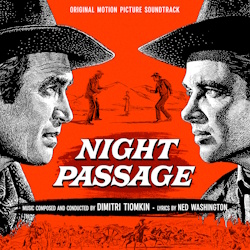 The CD was produced by Chris Malone using the original mono session masters stored in pristine condition at Universal Pictures. The mastering has produced an album with excellent monaural audio. Tiomkin made the following comment in a 1953 interview: “That because of all the cowboy pictures he’s written for he is known as the ‘killer’ composer. When someone is going to get shot, they think of Tiomkin. I had to write music for the chase and the showdown. At one point they did not pay any attention to the music. Then after the success of “High Noon” they changed. Now they call me and say, ‘Tiomkin save our picture’. At first, I would say ‘It can’t be done with music’, but now I reply, ‘I’ll try”.
Such was the case here with “Night Passage”, a film, burdened with a truly lame screenplay which dragged down everything with it. Yet the ever-resourceful Tiomkin employed all his innate talents to compose songs and music, which in many ways almost succeeded in achieving the impossible – saving the film. The two songs “Follow the River” and “You Can’t Get Far Without A Railroad” were brilliantly conceived, and masterfully integrated into the film in a multiplicity of ways; song form, instrumental form, and in deconstructed melodic phrases, which were employed as leitmotifs. This served to create a cogent and unifying musical narrative, as well as providing musical propulsion, which empowered the film’s narrative pacing and fueled its forward momentum. These melodic motifs were very malleable working well in both intimate forms, as well as kinetic action drivers. Their dynamic interplay in the film’s final chapters was just extraordinary, treating us to a tour de force. Folks, Dimitri Tiomkin’s score for Night Passage is a quintessential Hollywood Western, which features an epic, and sweeping Main Theme, folksy vocal numbers, and intense and kinetic action cues with dynamic thematic interplay. Renowned for his capacity to evoke the spirit of Americana, Tiomkin incorporated accordion and harmonica to create a folksy ambiance and match the film’s rustic setting. The score, is praised for its emotional resonance, and epic feel, which includes two prominent and iconic songs by Academy Award winning lyricist Ned Washington. For lovers of Tiomkin, and westerns, this score is an essential purchase. Take in the film also to see Tiomkin’s amazing wizardry in action.
For those of you unfamiliar with the score, I have embedded a YouTube link to a suite: https://www.youtube.com/watch?v=dc2oCxUuG-M&list=RDdc2oCxUuG-M&start_radio=1
Buy the Night Passage soundtrack from the Movie Music UK Store
Track Listing:
- Main Title (Follow The River) (written by Dimitri Tiomkin and Ned Washington) (2:34)
- Short Cut / Bully, Bully (2:13)
- Four Bits A Night (1:22)
- You Belong To The Railroad (3:04)
- The Bargain (2:26)
- Risky Ride (1:41)
- Follow The River (3:12)
- Train A-Winding/What’ll It Be? (1:33)
- Tanked (3:33)
- In The Box/Do It Yourself Kid (2:09)
- Coming To (2:16)
- Railroaded/Charlie My Girl (2:57)
- Looking For Trouble (3:35)
- Fast Gun/For Joey’s Sake/Marry Me Now (7:42)
- Pursued/Mill Town (3:42)
- Flying Bullets/Sure As Shootin’ Part 1 (3:13)
- Sure As Shootin’ Part 2/Count Your Bullets (4:00)
- End Title (Follow The River) (0:56)
- Follow The River (Vocal) (written by Dimitri Tiomkin and Ned Washington) (2:29) BONUS
- You Can’t Get Far Without A Railroad (Vocal) (written by Dimitri Tiomkin and Ned Washington) (3:53) BONUS
- Take 203 – Follow The River (0:37) BONUS
- Take 154 (3:55) BONUS
- Sweet Betsy From Pike/Follow The River (1:43) BONUS
- Follow The River (Film Version) (written by Dimitri Tiomkin and Ned Washington, performed by James Stewart) (4:08) BONUS
- Follow The River – Scene With Joey (written by Dimitri Tiomkin and Ned Washington, performed by James Stewart) (1:50) BONUS
- You Can’t Get Far Without A Railroad I (written by Dimitri Tiomkin and Ned Washington, performed by James Stewart) (3:11) BONUS
- You Can’t Get Far Without A Railroad II (written by Dimitri Tiomkin and Ned Washington, performed by James Stewart) (0:35) BONUS
- You Can’t Get Far Without A Railroad III (written by Dimitri Tiomkin and Ned Washington, performed by James Stewart) (0:49) BONUS
Intrada Special Collection Volume ISC 507 (1957/2024)
Running Time: 75 minutes 55 seconds
Music composed and conducted by Dimitri Tiomkin. Orchestrations by Dimitri Tiomkin. Recorded and mixed by XXXX. Edited by XXXX. Score produced by Dimitri Tiomkin. Album produced by Chris Malone.

Shop at the Movie Music UK Store

Member of the


