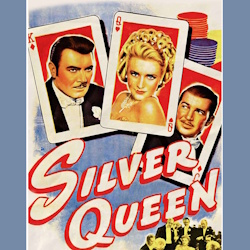
SILVER QUEEN – Victor Young
 GREATEST SCORES OF THE TWENTIETH CENTURY
Original Review by Craig Lysy
In 1942 Paramount Pictures decided to approve for production, a western by Forrest Halsey and William Allen Johnston, which offered a story about a woman gambler. To implement their vision the purchased a package deal from Warner Brothers, who loaned them actors Pricilla Land and George Brent, along with director Llyod Bacon. Independent producer Harry Sherman was assigned production and writers Cecile Kramer and Bernard Schubert would write the screenplay. George Brent would star as James Kincaid with Priscilla Lane as Coralie Adams. Joining them would be Bruce Cabot as Gerald Forsythe and Lynn Overman as Hector Bailey. For reasons I could not discover, Paramount in the end did not distribute the film. Instead, United Artists is listed as the production company, which suggests the film was one of several sold to United Artists from 1942 – 1943. Read more…
Under-the-Radar Round Up 2025, Part 9
 Original Reviews by Jonathan Broxton
I’m pleased to present the latest installment in my on-going series of articles looking at the best under-the-radar scores from around the world.
This article, the ninth and last of 2025, is a bumper crop, and covers another nine scores released last year from a wide array of genres and countries, including a short film from the Netherlands about magical paintings, a short film from Canada that makes the directorial debut of an Emmy-winning composer, a comedy-drama film from Denmark about a bank robber with dissociative identity disorder, a supernatural murder mystery from Vietnam about a 19th-century detective, and a short film from Mexico about a little girl and a heroic horsewoman who wields a magical lasso.
Then there’s an Australian sci-fi action horror film about a group of American soldiers encountering dinosaurs during the Vietnam war, an animated sex comedy from Norway about two sperms on an epic adventure trying to find their way to an un-fertilized egg, a Spanish TV series about a detective investigating a series of murders in a rural community, and an action horror film from Norway about a pair of gargantuan trolls terrorizing the fjords! Read more…
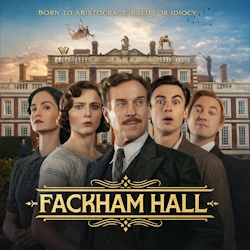
FACKHAM HALL – Oli Julian
 Original Review by Jonathan Broxton
The lives of the British aristocracy, and those who serve them, have been an endless source of fascination for decades, through films and books and television. The ITV drama series Upstairs Downstairs, which premiered in 1971, was enormously popular when it first aired, but this was then eclipsed by Downton Abbey, which debuted in 2010 to massive Emmy-winning acclaim and global fame. The British have always excelled at these types of soapy period costume dramas, where stiff collars and even stiffer upper lips mask all kinds of shenanigans and debauchery behind closed doors. The British are also exceptionally good at poking fun at themselves with parody, which brings us to Fackham Hall. Read more…
BAFTA Nominations 2025
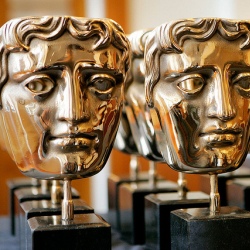 The British Academy of Film and Television Arts (BAFTA) has announced the nominations for the 79th British Academy Film Awards, honoring the best in film in 2025.
In the Best Original Music category, which is named in memory of the film director Anthony Asquith, the nominees are:
- JOSCELIN DENT-POOLEY (JERSKIN FENDRIX) for Bugonia
- ALEXANDRE DESPLAT for Frankenstein
- LUDWIG GÖRANSSON for Sinners
- JONNY GREENWOOD for One Battle After Another
- MAX RICHTER for Hamnet
This is the first BAFTA nomination for Richter, the second nomination for Dent-Pooley and Göransson, the fourth nomination for Greenwood, and the 13th nomination for Desplat. Desplat previously won for The King’s Speech in 2010, The Grand Budapest Hotel in 2014, and The Shape of Water in 2017, while Göransson won for Oppenheimer in 2023.
The winners of the 79th BAFTA Awards will be announced on 22 February, 2025.
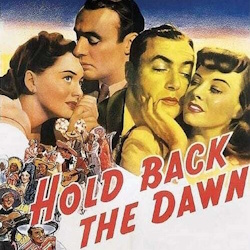
HOLD BACK THE DAWN – Victor Young
 GREATEST SCORES OF THE TWENTIETH CENTURY
Original Review by Craig Lysy
The genesis of Hold Back the Dawn was writer Ketti Frings’ story, “Memo to a Movie Producer”. Paramount executives decided that the romantic drama would translate well to the big screen, and so paid $5,000 for the film rights. After the novel was published and well received, the working title of the movie was changed to the novel’s title, “Hold Back the Dawn”. Arthur Hornblow Jr. was assigned production, Mitchell Leisen was tasked with directing, and Charles Brackett, Billy Wilder and Richard Mailbaum wrote the screenplay. A stellar cast was hired, which included Charles Boyer as Georges Iscovescu, Olivia de Havilland as Emmy Brown, Paulette Goddard as Anita Dixon, Victor Francen as Van Den Lueken, and Walter Abel as Inspector Hammock. Read more…
Academy Award Nominations 2025
 The Academy of Motion Picture Arts and Sciences (AMPAS) have announced the nominations for the 98th Academy Awards, honoring the best in film in 2025.
In the Best Original Score category, the nominees are:
- JOSCELIN DENT-POOLEY (JERSKIN FENDRIX) for Bugonia
- ALEXANDRE DESPLAT for Frankenstein
- LUDWIG GÖRANSSON for Sinners
- JONNY GREENWOOD for One Battle After Another
- MAX RICHTER for Hamnet
This is the first nomination for Richter, the second nomination for Dent-Pooley, the third nomination for Greenwood, the fourth nomination for Göransson (the third in this category), and the twelfth nomination for Desplat. Göransson previously won for Black Panther in 2018 and Oppenheimer in 2023. Desplat previously won for The Grand Budapest Hotel in 2014 and The Shape of Water in 2017
In the Best Original Song category, the nominees are:
- NICK CAVE and BRYCE DESSNER for “Train Dreams” from Train Dreams
- EUN-JAE KIM (“EJAE”), MARK SONNENBLICK, SOON-HEON JEONG (“24”), GYU-KWAK JOONG, YU-HAN LEE, HEE-DONG NAM (“IDO”) and TEDDY PARK for “Golden” from K-Pop Demon Hunters
- NICHOLAS PIKE for “Sweet Dreams of Joy” from Viva Verdi!
- RAPHAEL SAADIQ and LUDWIG GÖRANSSON for “I Lied to You” from Sinners
- DIANE WARREN for “Dear Me” from Diane Warren: Relentless
The winners of the 98th Academy Awards will be announced on March 15, 2026.
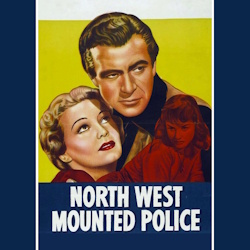
NORTH WEST MOUNTED POLICE – Victor Young
 GREATEST SCORES OF THE TWENTIETH CENTURY
Original Review by Craig Lysy
In 1939 legendary director Cecil B. DeMille decided that his next project, which would be his first film shot in technicolor, would be an epic Western. He purchased the film rights for the 1938 novel The Royal Canadian Mounted Police by R. C. Fetherstonhaugh and sold his vision to Paramount Pictures. DeMille would manage production with a smaller budget than he wanted. As such due to budget restrictions, the movie was filmed on sound stages at the Paramount lot as well as on location in Oregon and California, even though the film was based on a real-life incident in Saskatchewan, Canada. Demille would also direct and narrate, and Alan Le May, Jesse Lasky Jr. and C. Gardner Sullivan would write the screenplay. For the cast, Gary Cooper would star as Texas Ranger Dusty Rivers, joined by Madeleine Carroll as April Logan, Paulette Goddard as Louvette Corbeau, Preston Foster as Sergeant Jim Brett, Akim Tamiroff as Dan Duroc, and Lon Chaney Jr as Shorty. Read more…
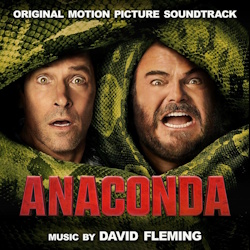
ANACONDA – David Fleming
 Original Review by Jonathan Broxton
Despite being a reasonable box office success when it was first released, the 1997 film Anaconda has become something of a cult classic in the almost 30 intervening years, not because it was good, but because it was very, very bad. From its awkwardly written characters, implausible plotting, and scientific nonsense to its unrealistic creature effects, and especially Jon Voight’s wildly unhinged performance, the film is now remembered as – and this is me being very charitable – a ‘camp classic’. However, two genuine fans of the original movie are writer/director Tom Gormican and writer Kevin Etten, and they have now come together to present this film, an action-comedy meta-reboot of the franchise starring Jack Black and Paul Rudd. Read more…
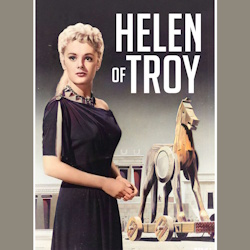
HELEN OF TROY – Max Steiner
 GREATEST SCORES OF THE TWENTIETH CENTURY
Original Review by Craig Lysy
In 1955 Warner Brothers undertook a massive international collaboration with Italian and French partners to bring the timeless tale of Helen of Troy to the big screen. Ancient epics were very popular and they sought to capitalize with a massive undertaking of their own. The film would be shot in Rome, Giuseppe De Blasio and Maurizio Lodi-Fè were assigned production with a massive $6.0 million budget, Robert Wise was tasked with directing, and N. Richard Nash was hired to adapt a story by Hugh Gray and John Twist, which drew inspiration from Homer’s Iliad. An international cast was assembled with Italian actress Rosana Podestà starring as Helen. Joining her would be Frenchman Jacques Sernas as Paris, Englishman Sir Cedric Hardwicke as King Priam, Welshman Stanley Baker as Achilles, Irishman Niall MacGinnis as Menelaus, Englishman Robert Douglas as Agamemnon, and even a young Brigitte Bardot as the slave girl Andraste. Read more…
Golden Globe Winners 2025
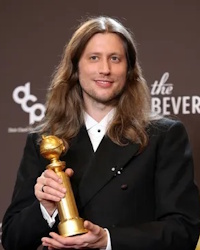 The Golden Globe Foundation (GGF) has announced the winners of the 83rdd Golden Globe Awards, honoring the best in film and American television of 2025.
In the Best Original Score category composer Ludwig Göransson won the award for his incredibly authentic score for Sinners, director Ryan Coogler’s historical horror-drama about a pair of brothers who return home to depression-era Mississippi to open a juke joint blues club, only to see it attacked by vampires and members of the local Ku Klux Klan. This is the second Golden Globe win for Göransson – he previously won for Oppenheimer in 2024. In the acceptance speech Göransson, said:
“Wow wow. Thank you. I mean, first of all, Ryan Coogler, you wrote an incredible movie, directed an incredible movie about a guitar player, about a musician. I think everyone here and everyone in this industry is just… I feel we’re grateful to be living in a timeline with you in it right now. Thank you, Ryan. I also wanted to thank our producers Zinzi Evans, Sev Ohanian, and our executive music producer and my partner Serena Göransson, and also Raphael Saadiq for writing such an incredible song for this film, “I Lied To You.” I also just want to take a little moment to just thank our incredible cast that was amazing to work with. Miles Caton, he learned how to play a guitar in three and a half months, and that was not easy. What you saw there is live! I mean, he played with a slide, and that was amazing. Wunmi Mosaku, every time you were on screen you were just… the music was just coming to me, it was so inspiring. I was on set for almost three months for this film,and being there while Michael B. Jordan was playing two characters was weird… because it was so incredible to witness and your devotion to the craft and how incredible your performance was really made my job easy, so thank you. Thank you.”
The other nominees were Alexandre Desplat for Frankenstein, Jonny Greenwood for One Battle After Another, David Letellier (“Kangding Ray”) for Sirāt, Max Richter for Hamnet, and Hans Zimmer for F1.
Controversially, the organizers of the Golden Globes decided to present the Best Original Score award during a commercial break, and as such the presentation and Göransson speech was not shown during the television broadcast airing of the ceremony. This decision was heavily criticized by almost all members of the film music community. Talking to a reporter from Variety before the ceremony, nominee Hans Zimmer said:
“I think it’s a shame not to honor those people – my friends – who work so hard to become a voice. As a person who has been making films forever, everybody who works on a film works their utmost, doesn’t get any sleep, there are no weekends. I think the work should always be acknowledged. This year is a fantastic year for composers — don’t ignore them, you don’t have a movie without them.”
In the Best Original Song category, the winners were Eun-Jae Kim (Ejae), Mark Sonnenblick, Joong-Gyu Kwak, Yu-Han Lee, Hee-Dong Nam (Ido), Jung-Hoon Seo (24), and Teddy Park for “Golden” from the smash hit animated film K-Pop Demon Hunters.
The other nominees were Nick Cave and Bryce Dessner for “Train Dreams” from Train Dreams; Miley Cyrus, Andrew Wyatt, Mark Ronson, and Simon Franglen for “Dream as One” from Avatar: Fire and Ash; Raphael Saadiq and Ludwig Göransson for “I Lied to You” from Sinners; and Stephen Schwartz for “No Place Like Home” and “The Girl in the Bubble” both from Wicked: For Good
K-POP DEMON HUNTERS – Marcelo Zarvos
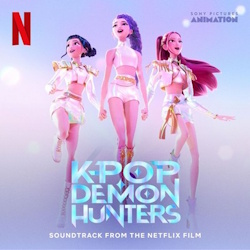 Original Review by Jonathan Broxton
One of the most fascinating trends to emerge in recent years has been the emergence of Korean popular entertainment into the western mainstream. When I was a kid, there were no really popular films from countries in East Asia – China, Japan, South Korea – outside of highbrow movies by directors like Akira Kurosawa, and to the best of my recollection no widely known Japanese or Korean pop songs charted in the UK as mainstream hits in the 1980s or 1990s, with the possible exception of a couple of instrumentals by Kitaro and Ryuichi Sakamoto. The first truly massive mainstream Asian pop hit was Psy’s “Gangnam Style” in 2012, which soared to #1 on the UK Singles Chart and stayed in the charts for many weeks. Read more…
HEAT – Elliot Goldenthal
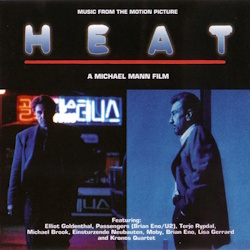 THROWBACK THIRTY
Original Review by Jonathan Broxton
Widely considered one of the best action thrillers of the 1990s, and notable for marking the first time that legendary actors Robert De Niro and Al Pacino appeared together in the same scenes on screen (they were both in The Godfather Part II but did not feature in the same scenes), Heat follows the intense cat-and-mouse conflict between a meticulous professional thief and a relentless police detective in Los Angeles. De Niro plays Neil McCauley, a highly disciplined career criminal who leads a small crew of expert thieves. After a planned armored car robbery goes disastrously wrong, the gang attracts increased attention from law enforcement in the shape of Vincent Hanna (Pacino), an LAPD robbery-homicide detective. As Hanna becomes obsessively focused on tracking McCauley and his team – alienating his wife and daughter in the process – McCauley’s crew prepares for an even bigger and more dangerous bank heist, placing both men in each other’s crosshairs. Read more…
Under-the-Radar Round Up 2025, Part 8
Original Reviews by Jonathan Broxton
I’m pleased to present the latest installment in my on-going series of articles looking at the best under-the-radar scores from around the world.
This article, the eighth of 2025, covers another five scores released this year from a wide array of genres and countries, including a Korean romantic fantasy TV series about a time-travelling chef, the latest season of a long-running British period TV series about midwives serving London’s working poor, a Norwegian Christmas action-comedy caper about a family of mischievous mice, the third film in a series of films from Finland about a young girl who can transform into a flying guinea pig super hero, and a Chinese period TV drama series about the marriage between a son and a daughter from rival clans. Read more…
THE MAN IN THE GRAY FLANNEL SUIT – Bernard Herrmann
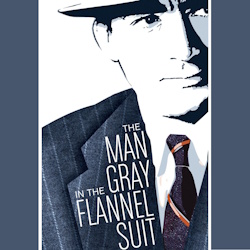 GREATEST SCORES OF THE TWENTIETH CENTURY
Original Review by Craig Lysy
The best-selling 1955 novel “The Man in the Gray Flannel Suit” by Sloan Wilson caught the imagination of Nunnally Johnson, a producer, director, screenwriter, and playwright. He believed that its story of a man and wife struggling to find life meaning and purpose following WWII would resonate with the public. He sold his conception to Darryl F. Zanuck of 20th Century Fox, the film rights were purchased, and Zanuck would personally oversee production with a $2.6 million budget. Johnson would direct and also write the screenplay. A fine cast was hired, with Gregory Peck starring as Tom Rath. He would be joined by Jennifer Jones as Betsy Rath, and Fredric March as Ralph Hopkins. Read more…
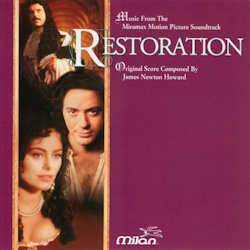
RESTORATION – James Newton Howard
 THROWBACK THIRTY
Original Review by Jonathan Broxton
Restoration is a period drama film directed by Michael Hoffman, adapted from the 1989 novel of the same name by Rose Tremain. The film is set during the Restoration period in England, which began in 1660 when Oliver Cromwell’s Commonwealth – which had overthrown the monarchy of King Charles I a decade or so previously – came to an end and Charles II was restored to the throne as king. The restoration was known for its cultural renewal, scientific curiosity, and political change, but also for its sometimes vulgar and obscene decadence, something which stood in polar opposition to the dourly stringent and sometimes cruel Puritan morality that Cromwell enforced during his time in power. The story follows the experiences of Robert Merivel, a young aspiring physician from a lowly background who, after he inadvertently saves the life of the king’s dog, is summoned to the royal court, and quickly becomes surrounded by a new world of wealth and indulgence. Read more…

Shop at the Movie Music UK Store

Member of the

 MOVIE MUSIC UK