SILVER QUEEN – Victor Young
 GREATEST SCORES OF THE TWENTIETH CENTURY
Original Review by Craig Lysy
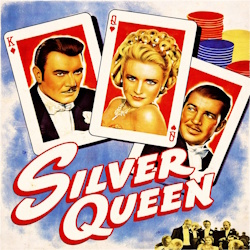
In 1942 Paramount Pictures decided to approve for production, a western by Forrest Halsey and William Allen Johnston, which offered a story about a woman gambler. To implement their vision the purchased a package deal from Warner Brothers, who loaned them actors Pricilla Land and George Brent, along with director Lloyd Bacon. Independent producer Harry Sherman was assigned production and writers Cecile Kramer and Bernard Schubert would write the screenplay. George Brent would star as James Kincaid with Priscilla Lane as Coralie Adams. Joining them would be Bruce Cabot as Gerald Forsythe and Lynn Overman as Hector Bailey. For reasons I could not discover, Paramount in the end did not distribute the film. Instead, United Artists is listed as the production company, which suggests the film was one of several sold to United Artists from 1942 – 1943.
The story takes place circa 1870 and follows the fortunes of Coralie Adams, who comes from a wealthy family. A stock market crash wipes out the family fortune and so she gives up on romance for card games, hoping to recover the family fortune. Two men compete for her affections: James Kincaid, a dapper gambler she admires, and Gerald Forsythe, a scion her father has chosen for her to marry. Things go south when her father loses the family’s last asset, the deed to a silver mine in a card game. With nothing left to lose Coralie ups the ante by purchasing her own gambling hall, only to find herself a prize as James and Gerald compete for her. The film was commercially successful and had a critically reception favorable with the film receiving two Academy Award Nominations for Best Art Direction and Best Scoring of a Dramatic Picture.
Paramount Pictures stalwart composer Victor Young was assigned to the project. Upon viewing the film, I believe he understood that this was Coralie’s story of a filial and selfless daughter sacrificing love to dutifully pay off her father’s massive debt after he dies. To do this she challenged gender rules by taking a role society judged to be within the domain of men, a gambler host. I believe Young also understood that he would need to speak to the love triangle between Coralie and suitors James and Gerald. With the film set in the 1870s gambling halls and saloons, I believe Young realized he would have to infuse ragtime-style piano tunes, saloon music, and atmospheric western themes.
 For his soundscape, Young composed one primary theme for the film, and two secondary themes. Coralie’s Theme, offers an exquisite and free flowing valzer elegante. She is the nexus of the film’s narrative and so her waltz is in reality, the score’s Main Theme. It is pervasive, woven within the very fabric of the film’s tapestry, and provides a unifying musical narrative. Her waltz is very malleable and throughout the film Young alters its tempo, instrumentation and emotionality to convey a wide spectrum of feelings and circumstances. The first secondary theme, Mr. Adams Theme, a meandering eight-note musical narrative led by cello, which palpable in its sadness, and never resolves. It speaks to his dark, hidden secret of being a gambling addict, who has squandered the family’s wealth. The second, secondary theme is heard early in the film that supports the black servants of House Adams. It offers a lighthearted, soulful, folksy quality, which brings these characters to life. Young also incorporated a number of classical pieces into the fabric of his score to provide the requisite cultural sensibilities, including.
There is no bona fide commercial release of the score. As such I will use scene descriptors with film time indices for musical reference. 00:00 “Main Title” offers a score highlight. We open with the Red Rocket Media logo supported by a simulated roar of a rocket engine, and the flow seamlessly into the opening credits, which display as black script against white satin. Young graces us with his Main Theme, a valzer elegante, which concludes grandly to support the Producer and Director credits. 01:02 “New York 1873” reveals a black butler from the wealthy Kincaid mansion retrieving the morning paper, which Young supports with the Servant Theme, a folksy dance tune. Portentous horns announce and usher in a misterioso as we see a stunning headline; “President Grant Declares National Debt Reaches Fantastic Total of $3 billion”. The Servant Theme takes him back into the house, only to answer the doorbell and sign for a telegram for Mr. James. He signs, calls fellow servant Toby, and directs him to deliver it immediately to the master. The folksy Servant Theme carries him to the bedroom, where he wakes up James, advises that it is not morning, but instead 6 pm, and then hands him the letter. He orders a sumptuous steak dinner and discusses last night’s winnings from his gambling casino with his manager Blackie. He then advises that he will not be attending tonight as he will be attending a charity ball.
05:37 “Charity Ball” reveals the herald announcing the arrival of dignitaries. Young establishes an elegant ambiance by interpolating the “Emperor Waltz” by Johann Strauss. Gerald arrives, acquaints himself with host Mr. Adams, and then accepts a solicitation to dance with his mother. She encourages him to attend to courting Miss Coralie Adams. 09:04 “Cards Gentlemen” reveals Carolie dealing cards at a poker table supported by her waltz. Gerald arrives, invites her to join him and they depart as the remaining players are amazed that a woman can play as well as a man. They take to the dance floor empowered by her valzer elegante, which supports pleasantries and chit chat. He disapproves of her playing cards with men, she deflects, and he replies that he only seeks to protect her, as any man would do. James arrives, his name is not on the invitation list, however his $5,000 donation provides access. Coralie sees him chatting with her father and we see she is attracted to him. She says she is hot; Gerald goes to fetch her a cold drink, and she goes over to talk to James. During pleasantries we discern a mutual attraction. When Gerald joins with two drinks, she introduces him as her fiancé. Undeterred, James asks her for a dance, and she accepts. They chit chat and I discern there is greater chemistry between them than the pairing with Gerald. When the topic of poker comes up, she surprises him with her love of the game and exhilaration playing against men. He happily accepts, and they walk to the gambling room.
Later in 18:01 “Poker”, we see that James has amassed an enormous pile of chips and we see in his eyes that he also wants to win her heart. Her father and Gerald also see this, are displeased and walk away. She tells him that his luck cannot last forever, and they continue to play supported with Coralie’s Waltz. Mr. Adams takes Gerald into his study, and the waltz wafts in as they speak. Adams tells him he wants security and wealth for his daughter and reaffirms his intention to ensure Gerald marries her and joins the family. He exhorts him to marry her quickly, and Gerald is most agreeable. Back in the gambling room Coralie concedes as Gerald joins. He advises that she should rejoin as her guests are leaving. James agrees, donates his massive winnings to the charity and say good evening. Gerald then surprises her with the declaration that after six months of engagement, they are getting married tonight. She deflects, kisses him, and says she must say goodbye to her guests. She says goodbye to James who charms her as he departs. She kisses her father good night and asks that he tell Gerald not to wait as she is going up to bed.
22:15 “A Fateful Choice” reveals Mr. Adams unlocking the safe in his office and pulling out the deed to the family estate. Young introduces his theme, a meandering eight-note musical narrative, palpable in its sadness, that never resolves. James returns home and Coralie’s waltz plays in his mind. Blackie joins him and is instructed to go out and purchase two dozen long stem roses and to delivery this to Miss Coralie Adams. Toby interrupts and advises James that Mr. Adams has arrived and is anxious to see you. 25:10 “The Crash” offers a montage where Young masterfully supports an unfolding disaster and panic with a frenetic musical narrative. We shift to the New York Stock Exchange as a newspaper headlines display; “Fear Grips Stock Exchange as Many Brokers Fail”. The currency exchange rate display at the exchange steadily drops as investors watch in horror. Swirling strings usher in a new headline; “Stock Market Crashing!” The currency exchange display plummets, and investors panic as a new headline displays; “Panic in Wall Street, Worst Day in History!” Equity Exchanges close their doors as panicked investors try to reclaim their money.
Back at home, uncle Hector asks Coralie if she has seen her father. She worries as he did not return home last night and Hector departs, saying it is urgent that I speak to him. Later in the parlor, Gerald advises that the market crashed when the European Exchange stopped buying American bonds. He fears her father’s investment of $100,000 is endangered and asked for her to retrieve the deed to the silver mine to try to salvage the situation. When she searches his desk for the key to the safe, she is horrified to discover numerous unpaid bills and that they are in massive debt. 27:31 “All Is Lost” reveals Mr. Adams returning with a look of devastation, unable to speak. Gerald advises of the market crash and the need to use the silver mine deed to reopen the mine to recover their losses. Adams says, we can’t as I no longer own the mine, having lost the deed gambling. Young supports with Mr. Adam’s Theme, expressed with a musical narrative of despair, an aching Pathetique. The scene ends with Coralie embracing her father as a stunned Gerald looks on. The Pathetique is sustained as we flow seamlessly to the bedroom where Dr. Hartley completes his examination, and tries to comfort Mr. Adams saying tomorrow is another day, and we will all get through this. Outside Dr. Hartley offers a grave prognosis saying for years he ignored his counsel to reduce the strain on his heart and now he fears it may be too late. He departs and says he will return in two hours.
30:07 “Carry On” offers a romantic score highlight. It reveals Coralie returning to her father’s room carried by a cello triste rendering of his theme. He asks for his pants, and then a cigar, and is denied both. She encourages him to rest and heel, promising him a box of the finest Havana cigars. He is thankful, and asks her to carry on the family tradition, to fight, and hold your head upright whether you win lose or draw. It is an intimate father – daughter moment and Young offers a violin led romanza of filial love that is exquisite and beautiful. The music more than the acting empowers this scene. The next day uncle Hector is meeting with a dozen angry creditors, demanding immediate payment from Adams. Hector tries to reason and assure the men, to no avail. 33:26 “My Father is Dead” reveals Coralie entering the lion’s den and making a somber announcement that her father, Steven Adams, is dead. Weeping strings del lamento support her tearful declaration that she will ensure every single penny owed, and that all of you will be paid. We close with uncle Hector offering a comforting embrace. The next day Gerald meets with James who informs him that he won Adam’s Silver mine deed and that he regrets to learn that he, and now Coralie is financially destitute. Gerald informs James of his and Coralie’s wedding date, and for a wedding gift tries to buy back the mine deed for $50,000. James rebuffs this and Gerald’s secondary offer to buy James’s gambling hall is also rebuffed. As Gerald departs, James offers to him, his wedding gift for Coralie – the mine deed, which shall be recorded in her name. Gerald agrees, departs, and it is clear bad blood between the two remain. Afterwards he informs Blackie that he is closing the gambling saloon as they are moving on. Back at the Adams house, Gerald arrives to find that Coralie is also packing. She informs him that she, and she alone will pay off the creditors, that this may take years, and offers back his engagement ring. He will not have it, is angry, but she is adamant and firm in her resolve. She departs and informs him that she will contact him when ready, but he is free to choose another for his wife should he tire of waiting.
Coralie and Ruby are heading to San Francisco by train to start a new life. She decides to embrace her father’s advice to meet the future head on, win, lose or draw. She has an epiphany when she realizes everything in life is a gamble, and that the way out of this mess, is gambling. 39:34 “A New Life” reveals a churning locomotive motif propelling passage of train tracks as they head west. A festive scherzo unfolds as we shift to a river paddlewheel boat where she decides to earn a living at the ship’s gambling room. The scherzo shifts to a saloon piano driven iteration and then strings rapido as we see a montage of Coralie earnings piling up as she wins at poker and roulette and craps, followed by checks of deposit for $3,500, $13,000, and $18,900. At 40:55 we shift to her theme, again rendered as a valzer elegante as she relocates to upscale San Francisco gambling parlors and continues to win, depositing a $13,000 check. She deposits another check for $10,800 and asks the teller to wire it to Gerald Forsythe like the others. In three unscored scenes Gerald drops a bombshell while eating breakfast with his mother; he needs her to give him $30,000. She asks why and he relates that instead of paying off the Adams estate creditors with the money Coralie has been sending, he has instead invested it in a silver mine. (We learn here that he took James’s wedding gift to Coralie and kept it for himself.) Mother is stunned, and declines. He counters by asking if she wants him to go to jail, knowing that it will forever damage the family name? Yet she does not blink, saying that he knew what he was doing when he got himself into this mess, and will have to get himself out of it, on his own. She punctuates this refusal saying; that he will not get a single penny from her. He departs for his office where he receives Coralie’s latest check for $10,800 with a request for acknowledgement. He then receives his mine’s superintendent Dan Carson and demands he cut costs and regain the silver vein as he needs money urgently.
45:32 “The Silver Queen” reveals James’s arrival at a San Francisco hotel where he receives his room key. As he departs a gentleman asks the hotel receptionist if they delivered his two dozen red roses to the Silver Queen, to which he answers, yes. James passes by the bar and overhears a man offering advice to his friend; “If you really want to gamble for big money, go to the Silver Queen where it costs $100 a chip. James then overhears a rich gentleman advise his friends that he has to depart as he has an appointment with the Silver Queen. James is clearly befuddled, and we see his mind gears churning as he returns to his room. Young supports the extended scene with a wonderful reprise of his Main Theme waltz. Back at his room James advises Blackie of his meeting with a competitor – the Silver Queen. 47:35 “James Returns” reveals James’ arrival at the exclusive gambling club. He asks to be seated at the grand table, but is refused as it is by the Silver Queen’s invitation only. Not be deterred, James offers the maître d’ a tip and gains access. Coralie appears above in a resplendent gown and descends the grand staircase with regal bearing as a captivated James looks on. Young supports the elegant ambiance of the grand gambling room with Chopin’s gentile Waltz No. 2 in C-Sharp Minor. At 49:50 a solo violin introduces the Main Theme rendered as a romanza as James introduces himself to Coralie who is pleasantly surprised, and very happy to see him. She introduces him as a dear friend, and James reminds her of their dinner engagement. She then apologizes to the table, saying she has to leave and asks Andre to manage the table tonight.
51:00 “Reacquaintance” reveals to two reacquainting and James being surprised to find that she never married Gerald. She adds that she finally sent the last check to pay off her father’s creditors. Adding gambling is the only talent I have, and that is why I never married. She asks about him and he said he sold everything and has been traveling. They decide to dine and she departs to change clothes. Young supports the scene with the Main Theme but I discern both tenderness, and a more romantic guise. 52:12 “Dinner” reveals them seated at the restaurant and the Main Theme waltz supports. They realize it was the waltz that played the first night they met, and so take to the dance floor. This iteration of the Main Theme resumes its original form as a valzer elegante. As they dance, James proposes, to Coralie’s delight a series of dates; tomorrow a visit to the Exposition, Thursday a picnic on the sand dunes of Golden Gate Park, and Friday attending Opera House for opening of Gilbert and Sullivan’s new musical H.M.S. Pinafore. 52:57 “A Night On The Town” we shift to a montage of the two merry making; a carnival along the piers, which is supported by a carnivalesque tune, the Folies Bergère, which is supported by a cabaret tune, an elegant night club, which is supported by a valzer felice, and last, a play that closes dramatically. We shift to the romanza version of the waltz as they arrive outside her apartment door, and join in a kissing embrace. She is thankful, as is he, and they partake in another kissing embrace. She opens the door, they exchange good nights, and join in one last kiss. As she closes the door, he says I’ll see you tomorrow. When the door closes the melody shifts to minor modal as he seems disappointed. Inside her apartment, the waltz abounds with happiness as she smiles, calls to Ruby, and exclaims that she is so happy that she does not know what to do. Adding that she believes James is going to propose.
When James returns to the hotel, he meets Hector in the lobby. He invites him up for a steak dinner in his room so they can re-acquaint. Hector is down on his luck and informs James that he and none of Adam’s creditors were ever paid. When asked about a silver mine during liquidation, he says he has no recollection of any silver mine. Hector asks for and is given Coralie’s address, and leaves $1,000 richer as James deliberately lost a bet as a pretext to gift an old friend down on his luck some money. James then instructs Blackie to pack as they are going to Nevada City to inquire about the silver mine, he gifted Coralie. 58:24 “Hector is Killed” reveals him walking through the fog as he crosses the street he is run down by a carriage. He is lifted off the street and taken to hospital for treatment. Young sow an unsettling musical narrative that exacerbates the lurking danger in the fog, which crests dramatically when he is run over. 59:04 “Coralie is Distraught” reveals her weeping at her make-up table, telling Ruby she does not understand why after all James’s courting, that he would just leave town without a word. Young supports with a distraught rendering of the Main Theme, which surges with desperation as the hotel maître d’ advises that a friend has been injured and a request has arrived for her to come to hospital. 1:00:02 “Uncle Hector Dies” reveals her arrival at hospital, and a nurse asking her to wait outside the door for the doctor to come out. A distraught musical narrative supports her arrival and wait as Coralie believes the injured friend to be James. When the doctor emerges, he advises that he has only a short time to live. As she enters, a warm and tender rendering of the Main Theme supports. She is shocked to discover that the patient is not James, but Uncle Hector. The music shifts to a weeping lament as Hector says with his dying breaths that he was never paid off, and that James asked her to stay and not follow him.
Gerald arrives at Coralie’s residence and is happily welcomed by Ruby who asks him to come up. Ruby informs Coralie that a gentleman, who will make you very happy, is here. Coralie is ecstatic and runs to the door, only to be shocked to find it is Gerald, not James. He kisses her, but she is cold, and non-receptive, which disappoints him. She informs him of Uncle Hector’s death, and he confirms he is aware of it. She then says that he told her that he was never paid. Gerald lies, telling her he was the first paid, but he lost all the money gambling. 1:03:59 “The Lie” reveals that he bought her a wedding present – her father’s mine. When she asks how, he said he bought it from James. She turns aways, utters “Kincaid?” and then Gerald says that he has lived up to his side of the bargain, and that they are going to get married without delay. She accepts on one condition, that they marry in Nevada City where her father bought the mine. He accepts and the scene ends with their kissing embrace. Young supports the revelation and scene with a dispirited rendering of the Main Theme, shorn of its vitality by James’s abandonment. Shifting to Nevada City, James is advised by the town doctor after a game of horse shoes, that the “Gambler’s Luck” silver mine was back in operation under a new owner – Gerald Forsythe. Later at the newspaper office, James is advised by the editor, that the “Gambler’s Luck” mine had struck a new vein, that Forsythe, the mayor, and the sheriff are conspiring to keep it a secret, and that Forsythe went to San Francisco and bought up all the available stock at the exchange. Later in James’s room the mayor and sheriff make threats to stay away from the mine, and to leave town. Afterwards, James orders Blackie to pack immediately as they are returning to San Francisco.
Gerald, Coralie and Ruby arrive at the Nevada City hotel, and he sends her and Ruby up to their suite to refresh and rest while he attends to business. 1:12:08 “James Confronts Gerald” reveals James leaving his room and just missing Coralie, who just walked in to the next room. As he descends the grand staircase dire horns of retribution sounds as he sees Gerald at the main desk reading a letter. They reacquaint with Gerald informing him of his upcoming marriage to Coralie, with James countering that he took the mine deed intended for Coralie, absconded with the money she sent to pay off the creditors to her father’s estate, invested that money in the mine, and have discovered a new vein. James declares that he intends to expose Gerald as a fraud to Coralie, and Gerald starts a fist fight on the stairwell. They tumble down the stairs, and James gains the advantage as the entire town rushes in to see the fight. Blackie, the sheriff and the mayor all join in the brawl. Coralie runs down the stairs when she sees Gerald and James fighting. Gerald pummels James to the floor, grabs the sheriff’s pistol and shoots only to have the surging crowd push Coralie into the bullet’s path. 1:16:50 “Coralie is Shot” reveals Blackie buttressed by horns eroica taking the badge off the sheriff, and then declaring he is the new sheriff. Gerald flees, and Blackie arrests the mayor and sheriff. Strings dramatico propel an urgent musical narrative as James and the doctor carry Coralie up to her room where they discover that the bullet only grazed her. As the doctor departs, he asks what all the fighting was about? James details all of Gerald’s crimes, and how he loves her, earning the doctor’s approval. Coralie overhears everything, but feigns being asleep. Young supports James’s forthright testament, and declaration of love with an exquisite passage for solo violin romantico. Her waltz brings him to bedside where he takes her hand and she wakes. She asks if all he said was true, and he says rest, and we will discuss it later. She proposes, and he says she must be ready for a groom with two black eyes. They join in a kissing embrace as the door opens to reveal Ruby, who smiles, and softly closes the door as the film concludes with one last declaration of the waltz punctuated by “The End”.
Well, we are again disappointed to not have a commercial release of a Victor Young, Academy Award nominated score. Young composed a Main Theme for our heroine Coralie, and what a theme it was. This classic exquisite free flowing valzer elegante offers the feminine grace, that brought Coralie to life, and endeared he to us. This film is her tale, a tale of selfless filial devotion and sacrifice, and her waltz, is the essential thread woven into the film’s narrative, which gives the film heart, and endears Coralie to us. Masterful how well Young alters the Waltz’s tempo, instrumentation and impetus to express a multiplicity of emotions. A sad, nuanced, and cello led theme for her father, perfectly captured his misfortune and tragedy his gambling brought to the family. The music used to support the montage of James courting Coralie was masterfully conceived and executed, with each date achieving a perfect confluence of music and film narrative. Folks, this effort offers a fine example of a score empowered by a dominant Main Theme, which permeates the film from reel to reel, and achieves a wondrous synergy right down to the film’s narrative sinews. If you like waltz’s, Young’s romantic melodies, love stories, and filial heroism, then this is the film for you. Until a score is recorded, take in the film on one of the streaming services.
I regret that, for those of you unfamiliar with the score, I cannot find a YouTube link to Victor Young’s music.
Track Listing:
- NOT AVAILABLE
Music composed and conducted by Victor Young. Orchestrations by Herman Hand and George Parrish. Additional music by Charles Bradshaw and Leigh Harline. Recorded and mixed by XXXX. Score produced by Victor Young.

Shop at the Movie Music UK Store

Member of the


