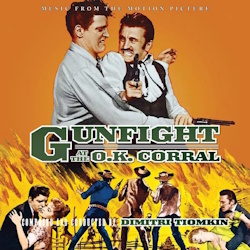
GUNFIGHT AT THE O.K. CORRAL – Dimitri Tiomkin
 GREATEST SCORES OF THE TWENTIETH CENTURY
Original Review by Craig Lysy
Producer Hal Wallis came upon a magazine article, “The Killer,” written in 1954 by George Scullin, which explored the relationship between Doc Holliday and Wyatt Earp, as well as the infamous gunfight at the O.K. Corral. Despite the bloodbath, Wallis decided to take a gamble and purchased the film rights for $500. He took personal charge of production and secured a $2 million budget from Paramount Studios. Leon Uris was hired to write the screenplay, and John Sturges was tasked with directing. An exceptional cast was assembled, including Burt Lancaster as Wyatt Earp, Kirk Douglas as Doc Holliday, Rhonda Fleming as Laura Denbow, Jo Van Fleet as Kate Fisher, and John Ireland as Johnny Ringo.
The story is set in the American West circa 1879 and tells a grim tale of family blood feuds that end predictably in bloodshed. The first feud involves Ed Bailey, who seeks out Doc Holliday for the murder of his brother, only to be slain himself. Wyatt Earp is joined by Holliday, whom he deputizes to pursue bank robbers they ultimately gun down. When Wyatt receives a telegram from his brother Virgil requesting help in Tombstone to clean up the crime-ravaged town, he agrees out of filial duty. However, his partner Laura refuses to go unless he changes his ways, saying she will wait for him in California.
In Tombstone, Wyatt, his three brothers, and Holliday come into conflict with the Clanton family, who kill Wyatt’s younger brother James. Subsequently, Wyatt, his brothers Virgil and Morgan, and Doc Holliday face off against Billy Clanton and five men, killing all six, although both Virgil and Morgan are wounded. Later, Wyatt and Doc share a final drink at the bar, after which Wyatt departs to join Laura in California. The film was a massive commercial success, earning a profit of $8.7 million. Critics praised the film, especially the performances of Lancaster and Douglas, and it earned two Academy Award nominations for Best Sound Recording and Best Film Editing.
Producer Hal Wallis evaluated a trio of composers for the project – Leonard Rosenman, Alex North, and Dimitri Tiomkin – and ultimately selected Tiomkin despite his salary demand of $175,000 because of his impressive record of evoking Americana in Western films. As in “High Noon,” Wallis tasked Tiomkin with writing a classic song that would define and permeate the score. However, screenwriter Leon Uris had already collaborated with Milton Raksin on a song, which Tiomkin adapted musically, while his usual lyricist Ned Washington provided new lyrics. Tiomkin used it as the film’s title song and reprised it after the end of each act. He also acknowledged his status as an iconic composer in the genre, as he noted in a 1961 interview with Art Buchwald:
“That because of all the cowboy pictures he’s written for he is known as the ‘killer’ composer. When someone is going to get shot, they think of Tiomkin. I had to write music for the chase and the showdown. At one point they did not pay any attention to the music. Then after the success of “High Noon” they changed. Now they call me and say, ‘Tiomkin save our picture’. At first, I would say ‘It can’t be done with music’, but now I reply, ‘I’ll try”.
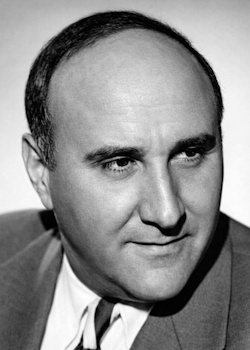 As was his practice, Tiomkin utilized specific orchestral colors to establish a rugged, atmospheric soundscape, including his iconic flutter-tongue and dissonant harmonic horns, which presage danger and tension; a whistling tune used as a prelude to the vocal sections, adding a folk-like, rustic quality to the frontier setting; and sharp, slashing motifs with rippling harp glissandi to underscore quick, violent actions. In conceiving his score, Tiomkin provided a quintessential example of a monothematic style, in which a single central melody is woven into the musical narrative to create a unified emotional experience.
To that end, the score is dominated by the titular “Gunfight at the O.K. Corral” ballad, conceived by screenwriter Leon Uris, with Ned Washington providing alternative lyrics. In a masterstroke, Tiomkin used the song as an idée fixe, functioning like the Greek Chorus of antiquity by serving as a bridge between actors and audience through commentary, narration, and emotional context. He deconstructs the song so that one of its five parts appears at the beginning, end, and during key act breaks, thereby propelling the film’s forward momentum and providing narrative cohesion.
For the architecture of his soundscape, Tiomkin composed five themes, as well as five motifs derived from the titular ballad. Wyatt Earp’s musical identity is heroic in bearing and derived from the ballad. It utilizes the driving, two-word rhythmic flow of the ballad’s Motif B (“O.K. Corral,” “Boot Hill”), which gives his theme a sense of steadfast and inevitable forward motion. The theme is highly malleable, and Tiomkin masterfully shapes its orchestration to express grief, remorse, and an implacable commitment to personal integrity when enforcing the law. Doc Holliday’s musical identity is characterized by tragic brooding and restlessness. Tiomkin imbues it with a lonely, wandering quality that reflects his internal struggle with mortality, a dishonored past, his dysfunctional relationship with Kate, and his complex friendship with Wyatt. Because he is impulsive, he often functions as an unpredictable element in the narrative, creating an atmosphere of tension and impending doom. Yet in more reflective moments, Tiomkin humanizes him, evoking sympathy through soft, warm woodwinds.
Laura Denbow’s musical identity features long-lined, legato phrasing that provides a feminine juxtaposition to the score’s dominant masculine identities and the story’s violence and brutality. It also serves as a love theme for her and Wyatt, employing warm, lyrical, and lush romantic strings, often adorned with solo oboe or flute and kindred woodwinds. Kate Fisher’s musical identity is deeply tragic. Tiomkin offers a more tonal than melodic expression, reflecting her vulnerability and her complex, volatile, and conflicted love-hate relationship with Doc Holliday. Its expression is slow, minor-modal, and filled with loneliness and unfulfillment, as she is beset by alcohol addiction and a twisted, unrequited love.
Lastly, Ike Clanton’s musical identity supports the cattle-thieving villain and, by extension, his clan and henchmen. As Wyatt’s antagonist, Tiomkin provides a minor-modal signature that is sinister, menacing, and ominous, evoking tension and conflict. The titular ballad serves as a somber prologue that sets a tone of inevitable conflict and presages grievous losses for the Earp, Clanton, and McLaury families. The lyrics offer a poignant exploration of Wyatt’s conflicted psyche, portraying a man tragically trapped by circumstance and caught between the ruthless demands of his profession and his filial duty, both of which contend with a desperate yearning for love and a better life. Despite these dark undercurrents, the theme also conveys heroism through the male chorus, suggesting destiny in the making and creating a sense of mythic grandeur. I believe the song is a masterwork of the Western genre, capturing its essence, folksiness, and unbridled Americana. It evokes a trotting, horseback-riding cadence, and Frankie Laine’s vocals achieve a perfect confluence. I now provide an analysis of the five deconstructed motifs derived from the ballad.
We begin with Motif A, which offers a folksy whistling tune – a usage that presages Ennio Morricone’s similar technique a decade later in his iconic Spaghetti Westerns. Motif B is drawn from the song’s opening, which Tiomkin uses to propulsively drive the narrative and maintain forward momentum. Motif C, also derived from the opening stanza, underscores the fateful confrontation at the O.K. Corral. Motif D reflects a man conflicted by honor, filial loyalty, and love, with a palpable sadness in both its notes and lyrics. Motif E, drawn from the second stanza, expresses hope that the righteous will prevail and return to their loved ones.
Lastly, to provide the requisite Americana and folk sensibilities, several songs were incorporated into the tapestry of the score, including “Buffalo Gals” (1844); “Kingdom Coming” (1862) by Henry Clay Work; “The Fountain in the Park (While Strolling Through the Park)” (1884) by Robert A. King; “Varsovienne” (Varsoviana), traditional; “Tombigbee River” (1847); and “The Girl with the Flaxen Hair” (La Fille Aux Cheveux de lin) by Claude Debussy (1910).
“Gunfight at the O.K. Corral” offer a score highlight where Tiomkin masterfully sets the tone of the film with a perfect confluence of song melody, lyrics and vocals. The Paramount Picture and VistaVision logos are supported with bravado by resounding flutter-tongued horns declarations of the Main Theme. At 0:16, we flow into the ballad atop the whistling of Motif A, underpinned by a quirky bouncing rhythm, and set against a cloud swept panorama of vast prairie plains. As Frankie Laine begins singing the ballad, the opening credits flow as red script set against the vast plains, as we see three riders approaching. The men tear down a barbed wire fence and cross into its interior. At 1:03 we enter the film proper seamlessly, concluding on the last stanza of the ballad as they ride past a sign displaying; “Boot Hill Cemetery, Griffin Texas”. After the ballad concludes, Ed Bailey, Alby and Wayne arrive at Fort Griffin. At 3:00 the ballad shifts instrumentally into a jaunty traveling motif, which carries their ride through town as wary town folk watch. They are looking to settle a score with Doc Holliday, and the music ends as they tie their horses up and go into a saloon operated by John Shamssey. Inside, they pressure John to get Doc Holliday, and we see Ed is spoiling for a fight. They demand whiskey, and John serves them after they check their guns.
We shift to a hotel room where Kate, Doc’s woman frets over Ed’s gang hunting him down. Doc has been drinking, and is surprisingly indifferent as he practices throwing daggers into the door. Their argument soon degenerates into very personal insults. When she disparages his parents, we flow into “Remorse”, with an angry orchestral gesture as he throws one of his daggers past her face, and she pulls it from the wall and charges him, only to be subdued. At 0:09 her Theme borne by strings tristi join as she begs him to leave while there is still time. Her theme shifts to a Pathetique full of yearning as he grabs another bottle of whiskey as she pleads that she loves him and doesn’t want to lose him, to which he callously replies; because you would lose your free meal ticket. He never the less gives her a kiss, some money and dispatches her to inform John that he will arrive soon. At 1:35 he pulls out his pocket watch, and we see him deeply moved. The watch reveals portraits of his parents with an engraving “To our beloved son and doctor, John Holliday. Tiomkin supports with Doc’s Theme rendered as a wistful passage bore by woodwinds teneri joined by Motif B. At 1:52 we segue with menace into “Wyatt Earp” atop a grim and foreboding exposition of his theme, which is derived from Motifs [B] and [C] as he, a Texas Marshall, rides into the town and heads to the Sherriff’s office. Inside he and Sheriff Wilson reacquaint. Wyatt is angry that the Sheriff released Ike Clanton, and then discovers from Wilson’s shaking hands, that he is not the sheriff he used to be, and is no longer strong enough or healthy enough to do his job. He tells Wilson to resign if he can no longer do the job. Wilson he replies that all he has after twenty-five years of service is a $12 a month room and a tin badge, and then adds that you’ll end up like this too someday. This effects Wyatt, who becomes ponderous as he departs.
Back at the saloon, Ed and his gang have nearly drained a whiskey bottle, as Ed frets why hasn’t Doc showed up. A number of source songs are heard, played on a piano unseen in the film, including; “Memphisiana”, “Barroom Piano”, Tombigee”, and Dolly Day”. Wyatt walks into the saloon, Ed and his gang, hear John greet him, see his badge, and turn away their heads. They sit and the discussion turns to the Clanton gang, and John directs him to Doc Holliday at the hotel. Wyatt departs and arrives to find Doc playing Solitaire. He attempts to garner information regarding the Clanton’s but is rebuffed each time, even though he advises that Ed hides a derringer pistol in his left boot, indicating that he is left-handed. Doc makes it clear he has no love lost for Marshalls, and to leave him alone. Wyatt wishes him well, and departs as we shift to the saloon and see Ed and his men are half way through another bottle of whisky. In “Doc Holliday”, he wins a game of solitaire, which is supported by a xylophone glissandi flourish. A woodwind borne Motif B carries his nonchalant departure from the hotel towards a confrontation with Ed. In “Whistling”, as he walks to the saloon at 0:47, the Motif B shifts to a casual whistling version. He meets John outside and is warned as to what awaits him. Doc smiles and walks past him. Inside the sheriff checks for a gun, finds none, and allows him in. He walks to the bar, orders the usual, and as he pours, Ed reaches into his boot to retrieve the Derringer.
Doc purposely publicly calls him a yellow belly sow and we flow into “Ed Bailey’s Death”. Ed stands and raises his Derringer only to have Doc throws a dagger into his heart, killing him, supported by a savage stabbing motif, flowed by a cascade descent as he falls unto death. The Sheriff arrests him on charges to be determined, and Doc walks out escorted. Kate begs Wyatt for help, as a lynching mob assembles, but is rebuffed when he says, no, and that he does not even like the guy. At 0:17 we segue into “Doc Holliday Escapes” as John informs Kate that he will provide two saddles for their escape. Tiomkin supports with an undercurrent of benign indifference as the Wyatt observes the Sherriff lock Doc up in his hotel room. At 0:36 a grim statement of Wyatt’s Theme carries his arrival upstairs in the hotel to his room. Tension enters on tremolo strings at 1:20 as Kate barges in, supported by her theme borne by pleading strings, as she begs for Wyatt’s help, and points to a lynch mob swelling on the street below. At 1:54 a menacing marcia della morte commences as town folk begin moving toward the Sheriff’s jail. It also empowers Wyatt ambushing a deputy, knocking him out, and pulling him into Doc’s room. He informs him that he is rescuing him from a lynching, and tosses him a key to unlock his handcuffs. The march is oppressive until 3:02 when a shrill crescendo di torrore surges as Wyatt observes a man delivering a hanging rope on the street below. At 3:08 a dire musical narrative unfolds as Wyatt waves an oil lamp in the window, which signals Kate to start a fire in the town stables. At 3:24 swirling string vortices express flames expanding rapidly in the stable. At 3:35 Tiomkin unleashes an aggressive, and intense musical narrative of urgency with rich orchestration and contrapuntal embellishment as the crowd spots the fire, and races to free the horses and put out the fire. Doc thanks Wyatt whose parting words are; “Stay out of Dodge City” At 4:18 Doc and Kate ride off propelled by the Motif B. At 4:28 we segue into “Gunfight at the O.K. Corral” (End of Act I) as Doc and Kate ride off across the plains, Lane reprises the last two stanzas of the ballad with new lyrics, which speak to the narrative of Act I. The camera shifts to Wyatt crossing the Deadline – the entry checkpoint into Dodge City where all visitors must surrender their weapons at the Marshall’s office.
In Dodge City Wyatt learns that Doc Holliday is in town, which violates his order to stay out of town. He confronts him in the barbershop and orders him out of town. Doc counters that he is broke, and makes him a business proposition; fund him $1000 for poker, and they’ll split the winnings 50-50. Wyatt marvels at his gall, the two bond, and make the deal, with the caveat; no knives, no guns, and no killing. Later Wyatt is alerted that a woman is gambling, which is forbidden north of the deadline. He visits the saloon, and orders the game shut down over the protests of the owner, who relates that this is the famous Laura Denbow. Wyatt arrests her for disturbing the peace, and she is flippant in her derision as she departs. In the jail, he offers her freedom if she relocates her gambling south of the Deadline. She refuses, saying she’ll see what the judge decides. As he locks her up, she tosses him money to buy a new halo, because the one he is wearing is too tight. In the saloon Doc makes a $1,000, double or nothing bet to pay off his debt with the saloon order; that he can get Denbow out of jail. He walks into the jail with a bottle of whiskey and deck of cards. He plays black jack with Deputy Charlie, who refuses to drink, or spring Denbow. After Charlie departs, Doc convinces Wyatt to free Denbow and they return to the saloon side room to gamble.
“A Cold Trail” reveals that the next day we see Doc drinking coffee at the saloon. Wyatt comes in and asks for Luke Short to go after Ritchie Bell and two boys who held up a bank in Salina, and killed the cashier. He says Luke is in Abilene and unavailable. Doc offers his services, and Wyatt grudgingly deputizes him. Music enters as we see Wyatt and Doc on a trail hunting the three bank robbers against beautiful prairie vistas. Tiomkin offers a jaunty and lush exposition employing interplay of the E and B Motifs rendered as a travel Motif. At 0:35 we close on a diminuendo as nightfall causes them to stop and make camp for the night. After some repartee, Wyatt tells Doc to shut up and go to sleep. At 0:47 we segue into “The Ambush” as we see the three robbers sneaking up. Tiomkin sow an eerie tension with rippling harps misterioso embellishment. As they close, a crescendo of suspense slowly swells as we see Wyatt open his eyes. They draw their guns, and as their hammer clicks to fire at 1:34, Doc opens fire killing two as Wyatt takes out the third, supported by orchestral death strikes. Motif B borne by woodwinds in lutto speak to the gang’s demise as Wyatt checks the bodies. Afterwards Wyatt turns in to get some sleep, and we close with uncertainty upon the B Motif. (*) “Kate is Missing” reveals Doc’s hacking cough has worsened and he asks Charlie for Kate’s whereabouts. He advises that no one has seen her for days, and strings tristi join as Doc walks away to the hotel.
“Intro to a Romantic Interlude” reveals that Laura has ridden out of town and becomes stranded when her horse goes lame. It turns out that Wyatt followed her, and comes to her rescue. Tiomkin uses interplay of Motifs D and E to support, with the D Motif empowering his forthright ride, which softens at 0:15 as he sees her walking her horse. At 0:29 a soft, and tender rendering of the E Motif by strings brings him to her. She is thankful, he came along, and he surprises her by saying he follows her everyday as he knows she comes here daily. She is moved by this revelation, and as he hoists her up on his horse, and asks her to hold on to him tightly, which she does. The E Motif carries their departure, but within its notes I discern a growing romanticism. The music in the film ends at 0:47 and I believe the remaining part of the cue was attached to “A Romantic Interlude”, which I believe was sadly edited out of the film. Tiomkin offers beautiful interplay of Motifs D and E, a romantic tête-à-tête. The musical dialogue never really culminates or resolves, which suggest that true love has yet to be realized.
“Thoughts of Kate” reveals Doc learning that Kate had finally abandoned him for Johnny Ringo. Tiomkin supports with his theme empowering a sombre musical narrative full of regret as we see Doc ponder his future. As he walks through town a piano carried “Dodge City Bars” along with “Oh Dem Golden Slippers” by solo accordion, and “Lulu” on a piano waft out from saloons as he walks to her room at the hotel and confronts her. His demand she leaves with him is rebuffed as Johnny emerges from the bedroom and she stands with him. Doc calls her a slut, which angers Johnny. At 0:32 we segue harshly into “Dishonored” as Johnny tosses him a pistol to defend himself. Doc is conflicted as he recalls his promise to Wyatt; “No knives, no guns, and no killing”. Tiomkin expresses this with a conflicted D Motif, which is exacerbated when Johnny flings whiskey into his face trying to provoke him. He departs humiliated supported by a coda of Motif B. (*) “Dance and Church Bazaare” reveals Wyatt sitting outside the event as a spirited fiddle led “Buffalo Gals” wafts out. Laura departs and Wyatt asks if he can take her somewhere, saying he has to ride out to the bluffs. We segue into “The Love Scene” as we see them travelling by carriage at night supported by Motif E offered as a pleasant travel motif. At 0:10 Tiomkin graces us at 0:59 with their Love Theme, a gorgeous romanza borne by lush strings romantico, with nocturnal woodwinds and harp adornment. She said she glad they’re here as he lifts her down. When he asks why she came out here with him, she answers, I wish I knew, and he takes her into a kissing embrace, which she reciprocates as the romanza crests on a beautiful statement of Motif E.
(*) “Charlie is Killed” reveals that in town, deputy Charlie stands watch outside the Bazaar as the waltz “Varsovienne” wafts out to the street. A large group of men led by Shanghai Pierce ride in and begin shooting up the Front Street. Charlie informs the mayor to find Wyatt. On the street Charlie confronts Pierce, says he is under arrest, but as he pulls his gun, Ringo shoots and wings him. Inside the saloon Doc continues his winning streak at cards as the place is shot up around him. Pierce crashes the party, and his men begin shooting up the place, He orders the piano player to play “Kingdom Come” and make it lively! Wyatt walks in, a Pierce says it is time for repayment of the face scare he gave him in Wichita. He directs his twenty men to take him when Doc arrives from behind, steals a gun and shoots. He disarms another, and tosses the gun to Wyatt. Wyatt says disarm now, or Pierce and Ringo die. He starts a countdown from five and on one, Pierce blinks and orders everyone to drop their guns. They do so except Ringo, who pulls his pistol, but is winged by Doc. The townsmen collect all the weapons, and the gang is led away at gunpoint, with Kelly told to lock them up for the night.
“Men and Their Women” offers a score highlight, which attests to Tiomkin’s genius. It reveals Wyatt informing Doc that he is resigning as sheriff to begin a new life with Laura in California. He says that Laura and him will marry in a few days and asks that he attend the wedding. This revelation stirs up the unhappiness of his relationship with Laura, yet he regains his composure and offers his well wishes. Tiomkin supports subtlety under the dialogue with poignant interplay pf the A, D and E Motifs. At 1:19 we shift to Doc entering Kate’s hotel room carried by a plaintive Motif D. She asks; “Take me back Doc? Please. Give me another chance?” As he sits and ponders, we begin an impassioned, yet tortured crescendo on Motif D, which is ingenious when you consider the song lyrics associated with the motif; “Oh, my dearest one, must I lay down my gun or take the chance of losing you forever?” He responds fatalistically, saying it’s too late for both of them, and tells her to move on to a better man. Her theme becomes molto tragico as she begs, but he callously discards her, and tells her to go. As she opens the door to leave, she offers parting words; “I’ll see you dead.” We close as he ponders her words with a sad coda of Motif B.
“The Telegram” reveals Charlie delivering a telegram to Wyatt. As he opens it to read, foreboding horns resound with an ominous Motif B. After he reads the telegram, we conclude with a portentous Motif E. At 0:18 we segue into “The Sad Parting” a score highlight. Wyatt informs her that he is delaying the wedding as he must come to his brother’s aid in Tombstone. She loses faith and despairs that he will ever free himself from his desire for law enforcement, and relinquish his gun. She makes it clear that she will not marry him as long as he wears one. Tiomkin scores the pathos of this scene eloquently with interplay of his D and E Motifs. We close with Wyatt saying he loves her, but that filial duty must be honored. As he departs, he is empowered by an anguished statement of Motif E; “Keep the flame let it burn, Until I return, From the gunfight at O.K. Corral”. At 2:18 we segue into “Gunfight at the O.K. Corral” (End of Act II), which reveals Wyatt riding in a wagon across the prairie expanse with his horse in tow. Frank Lane reprises the last two stanzas of the ballad with new lyrics, which speak to the narrative of Act II. At 3:06 the song shifts to a galloping instrumental rendering as Doc rides up and accepts Wyatt’s invitation to join him. At 3:40, Frank Lane once more reprises the last two stanzas of the title song, with new lyrics, which presage what may await the two men;
At 3:58 the tune shifts to whistling set against eerie contrapuntal impressionist woodwinds as they pass by a sign; “Boot Hill Graveyard Tombstone”. As they ride on and eventually enter town, Tiomkin dazzles us with amazing interplay of all the song motifs. Wyatt stops, and Doc gets off, tells him to sell his horse, and heads into the saloon. To end the scene. Wyatt has dinner with his three brothers Virgil, Morgan and James at Virgil and Betty’s house. The brothers are all deputies, and they discuss the business at hand – Ike Clanton, in cahoots with the Sheriff Cotton Wilson who he has bought off, plan to move a herd of stolen Mexican cattle through town. They inform Wyatt that they have the mayor and leading citizens support, and ask him to lead the town’s resistance. Wyatt meets with Sheriff Wilson who offers a bribe of $20,000 for his support or the alternative, a six-foot hole in Boot Hill.
“The Poster” reveals Wilson mocking Wyatt for his sanctimony. Wyatt replies by throwing down his gauntlet by offering a poster for Wilson to give to his boss. Music enters atop ominous horns as Ike reads; “FIREARMS” are Forbidden in the City Limits of Tombstone”. Motifs B and C empower a foreboding musical narrative as Ike decides to pick up the gauntlet. The cue stops here at 0:16 for an intervening source cue; “While Strolling Through the Park” reveals Clanton and his armed gang riding into town and arriving at the Schiefelin Music Hall, where the tune on piano with vocal wafts out into the street. At 0:17 we segue into “Clantons” with ominous horns as he and his armed gang walks to the entrance of the music hall, as Wyatt stands guard. Tiomkin ratches up tension with snare drums buttressing Motifs A, D, and E to empower a foreboding musical narrative as Wyatt blocks Clanton and Ringo’s path. They refuse to disarm and at 0:49 a slashing crescendo violento erupts as Wyatt yanks Clanton aside, and pulls his gun. Clanton’s gang pulls out their pistols, but are ambushed by the arrival of the Earp brothers and several other towns folk bearing rifles. Outgunned, Wyatt orders them out of town with Clanton issuing a death warrant.
“Brotherly Advice” reveals Virgil and Morgan observing Kate arriving by stagecoach and exiting into the arms of Ringo. They enter the saloon where Doc is playing poker. Ringo, and Kate flaunt their relationship with she mocking our “Little Deputy”. Ringo then begins mocking him and Doc gets up, faces him, and says get your gun and meet me in the street in five minutes. As Doc departs, Kate says; “I said I’d see you dead”. As Doc descends the stairs of his hotel, Virgil confronts him. After he pushes Doc back, he convinces him that this fight is the last thing Wyatt needs right now, and if you care for him, leave town. Music enters with a dispirited musical narrative uses Motifs A, D and E as we see Doc change his mind and return upstairs to his room, where he is visited by Wyatt. Doc says he is leaving town despite the fact Wyatt wants him to stay. Wyatt, with regret wishes him good luck as he downs a shot of whiskey.
“A Friendly Call” reveals Wyatt receiving a letter as Ike’s brother Billy is brought in drunk. He stuns his brothers by saying instead of locking him up, he’ll take him back to the Clanton ranch without a gun, saying this telegram is all he needs. As he departs, Tiomkin chooses to play against the danger of Wyatt’s gambit, with a surprisingly bold, and optimistic musical narrative empowered by his theme with quotes of Motif C. At 0:28 we segue into “A Friendly Call – Part 2” as he enters into the expansive Clanton ranch where he rides by a large heard of stolen Mexican cattle. The music becomes harsh and dissonant, reflecting he has trespassed into a hostile domain. He arrives, wakes the kid up with well water, and joins him and his mother inside where he lectures him on the short-life span of a gunslinger. He convinces the boy using his own experiences and earns Mrs. Clanton’s thanks. As Wyatt departs, Ike arrives spoiling for a fight. Wyatt presents him with the telegram appointing him U.S. Marshall for the Arizona Territory. Ike offers a bribe, but Wyatt rebuffs him, ordering him to take his stolen cattle back to Mexico. Later Ike, Ringo, Cotton, Billy, Frank and Tom decide that the only way to get their cattle to market is to kill Earp.
“James Earp’s Death” offers a poignant score highlight. Wyatt and James have the night watch. James brings Wyatt some coffee and Tiomkin supports subtlety with a nocturne that incorporates Motifs B and C, in which we discern undercurrents of tension that presage danger. At 0:47 the music softens, shifting to woodwinds teneri as James talks of his girl in California, whom he plans to marry. He and offers to do the city rounds, and relieve Wyatt of the night watch. As James heads out, the opening tension motif resumes, though with a lurking, intangible presence. At 1:57 the C Motif erupts on a crescendo violento as the Clanton gang rides in guns drawn and kills James in a hail of bullets before he could draw. Horns bellicoso carry their departure, fading away as they ride off. Tiomkin offers a dreamy state as Wyatt wakes, which slowly at 2:16 escalates into urgency as he realizes that he heard gun shots. He sees a lifeless James laying in the street, runs to him, and finds him dead. Tiomkin supports with an anguished molto tragico rendering of Motif D. An aching Motif B joins as Wyatt gets up and turns away, overcome with grief as Doc and other towns people arrive. Wyatt is enraged, and promises revenge. Doc tries to remind him of his duty to the Law, but is rebuffed. Wyatt caresses James’ face, and then picks him up and carries him away empowered by a molto tragico Motif D.
“Hatred” reveals an angry Doc pounding on Kate’s door, and finally breaking it in. He demands she tell it, she breaks down, and admits she was complicit with their plan to murder Wyatt, because she loves him. She adds that she said nothing because she thought with Wyatt out of the way, he would come back to her. He demands to know who, and she rattles of the names of Ike and his gang. He screams, was Ringo there? And music enters as she says, yes. Horns usher in strings, which slowly surge of on a crescendo di rabbia as Doc erupts in a tempest of rage and jealousy. He throws her against the wall and begins a stalking walk toward her at 0:30 as she cries to not kill her. At 0:44 the music dissociates as we see him overtaken by a severe coughing fit. He falls to the floor, and Kate runs out carried now by musical urgency. Yet she stops in the hallway, and we segue at 0:53 into “A Tragic Duo” as impassioned strings render her theme and bring her back to him, offering a testament that she still loves him. She holds him and says, it is all right honey. Yet Tiomkin does not allow the music to resolve, instead ending on a diminuendo of uncertainty. In an unscored scene Billy surprises Wyatt and delivers a message from Ike; we will all meet to settle this once and for all at the O.K Corral. He says they will bring five men and Wyatt agrees. He asks, who are the six men, and Billy states; his brothers Ike and Finn, Billy Claiborne, Frank McLaury and Tom McLaury. When Wyatt says that is only five, Billy adds he will be joining. Wyatt tries to dissuade him, but when he mentions filial duty, Wyatt, who is guided by the same duty, says he understands.
“Night Thoughts” reveals Betty arguing for more men, and as lawmen you must be guided by the Law, not pride. Virgil counters that this is personal. When she continues to protest, saying all that will be left is widow’s, Virgil orders her out of the room. A forlorn musical narrative unfolds with a kernel of hope expressing the Motif E. Its lyrics are unheard, but its melody, deeply felt; “Keep the flame let it burn, Until I return, From the gunfight at O.K. Corral”. The music carries a contemplative Wyatt to see Doc, joined by a sad joining of Motifs B and C as he reaches his hotel room, and enters. He finds him sick, drunk, and unresponsive. He shakes him and says, “Wake Up! I need you!” Kate then speaks and says, he’s dying. He leaves carried once more by a somber Motif E as he realizes that Doc will not be at his side. We flow seamlessly into “The Night Before” as Wyatt contemplates the three Earps facing six Clantons and McLaurys. He looks into his hotel room mirror and we see the realization that he is betraying the Law his had steadfastly enforced and no longer recognizes himself. Tiomkin joins Motifs A, C, D and E into a poignant musical narrative of great pathos.
At 1:01 we segue into “A Walk to Eternity”, the first of two consecutive score highlights where Tiomkin demonstrates mastery of his craft with perhaps the score’s most inspired and complex thematic writing. The extended, ever-shifting, multi-scenic, and climatic end of the conflict would challenge the compositional skills of any composer, and yet Tiomkin creates a musical narrative, which is ingenious and flows effortlessly, shifting adeptly from one scene to another. He employs all his five motifs, in varied interplay, altering tempo and rhythm, shifting orchestration and enriching with counterpoint. We open with a panorama of a gorgeous desert sunrise. We shift to Ma Clanton hearing her boys ride out with dissonant trepidation. At we shift to a confident, trotting rendering of Motif D, which supports Ike and his gang riding into town. At 1:22 we shift to Doc getting up and preparing to join over Kate’s objections, saying Wyatt was the only friend he ever had. Tiomkin speaks to his weakened and infirm health by distorting the sound of the musical narrative and fragmenting the motifs, until 2:26 when the Motif D finally coalesces and struggles to emerge. At 2:42 strings tristi support Betty holding her son in her arms. At 2:57 Motif D expressed as a marcia cupa with Motif B horns supports the Clanton gang arrival at the O.K. Corral, and then Wyatt departing. Clanton deploys his men, including a wary Cotton. At 3:47 Doc startles Wyatt as he enters his hotel room, again supported by a distorted Motif D, as he remains unwell. At 4:28 muted trumpets declare Motif B as the two depart from the hotel room. At 6:11 Wyatt, Virgil, Morgan and Doc commence their walk to destiny empowered by a forthright Wyatt’s Theme. A foreboding, plodding march supports Wyatt and his men approaching. At 6:40 a tense Motif D joins as they arrive and are greeted by Ringo. At 7:11 Tiomkin sow tension as Doc speaks against Ringo’s proposal for Wyatt to meet with Ike. Wyatt refuses and Ringo returns to their position behind a wagon. Tiomkin sustains the tension as they cross a bridge, and the Clantons open fire causing them to dive off into the dry river bed. Most of the fight is unscored. Ike, Finn, Cotton, and both McLaurys die. Doc is winged, and Virgil and Morgan both wounded.
“End of Gunfight” reveals the aftermath of the gun fight; Wyatt pursues Billy who flees into town mortally wounded, while Doc hunts down Ringo. Tiomkin now unleashes his orchestra for a kinetic hunt and kill musical narrative. Doc and Ringo engage in a cat and mouse fight, with Ringo hiding behind horses attached to a hitching rail. Doc fires his pistol into the rail causing the horses to bolt, shearing off the rail and exposing Ringo. At 0:55 horn declarations of Motif B resound to punctuate Doc gunning down Ringo, with two additional shots for good measure. We shift to Billy fleeing with Motif C rendered on a crescendo of desperation as Wyatt closes in. Billy breaks into a photography shop, and is trapped on the second floor. The musical narrative shifts to repeating statements of a portentous, string borne Motif D as Wyatt tries to talk the boy down as he cannot bear to shoot him, but Billy seals his fate as he seeks filial revenge for the death of his two brothers. Billy struggles to cock his pistol trigger and at 2:41 dire horns resound as Doc arrives and shoots Billy as he takes aim at Wyatt. A harp glissando carries his death fall from the balcony. We close on a molto tragico statement of Motif D as a distraught Wyatt removes his Marshall badge and tosses it onto Billy’s dead body. We segue into “Gunfight at the O.K. Corral” (Finale), again sung by Frankie Lane with revised lyrics to reflect the conclusion of Act III. The song ends with a fortissimo declaration of the last line, from which a last, dramatic and grand declaration of Motif E, which ends in a flourish.
The original monaural masters had been stored in the Paramount vaults for a half century. While the mastering significantly improved audio quality, a discerning ear will detect some tape hiss on the album’s monaural tracks. The 73-minute CD includes 19 tracks from the film, plus bonus material, which include surviving stereo tracks (20-27), that offer enhanced audio quality. Overall, I believe the rerecording offers a faithful and improved listening experience, which allows the listener to fully appreciate Tiomkin’s handiwork. Symphonies of the Classical and Romantic eras had musical constructs, in which the composer employed cyclicism; musical motifs or melodies that reappear across different movements to bind the work together structurally and thematically into a cogent and unified musical narrative. What is heard in Tiomkin’s score is the embodiment of cyclicism. He deconstructs the titular song, extracting five melodies, which he employs as reoccurring motifs for his musical narrative. Previously Tiomkin, and fellow film score composers such as Max Steiner, Alfred Newman, and Miklós Rózsa to name a few, had taken a song melody and employed it as a single leitmotif. What is unique here, is that Tiomkin utilizes not one, but five melodic themes drawn from the song, with each offering different emotional dynamics to empower his musical storytelling; Motif A is folksy, Motif B is propulsive, Motif C is portentive and fateful, Motif D offers moral conflict between filial duty and love, and Motif E offers hope. Additional, for each of the three acts of the film, Tiomkin offers a reprise of two song stanza, with new lyrics, which summarize the act’s narrative, and then presages what awaits in the next act; Act I opens with the full ballad, which speaks of the lore of “The Gunfight at O.K. Corral and ends with the forging of a fateful bond of friendship between Wyatt and Doc. Act II opens with Wyatt’s renown power as a Law enforcer who longs for a quiet life, and ends with Wyatt’s sadness as he is compelled by filial honor to abandon Laura. Act III opens with uncertainty asking whether Wyatt and Doc will survive, and closes with a testament to the demise of the fallen outlaws. Folks, this score offers a testament to Tiomkin’s genius. His score in every scene captures the film’s emotional dynamics down to its very sinews, enhancing the film in every way, which allowed director Sturges to realize his vision. I highly recommend you purchase this film score masterpiece as it is one of the Golden Age’s Holy Grails.
For those of you unfamiliar with the score, I have embedded a YouTube link to an excellent fifteen-minute suite: https://www.youtube.com/watch?v=ESx0WnJcTN0
Buy the Gunfight at the O.K. Corral soundtrack from the Movie Music UK Store
Track Listing:
- Gunfight at the O.K. Corral (written by Dimitri Tiomkin and Ned Washington, performed by Frankie Laine) (3:47)
- Remorse/Wyatt Earp (2:26)
- Doc Holliday/Whistling (1:06)
- Ed Bailey’s Death/Doc Holliday Escapes/Gunfight at the O.K. Corral (End of Act I) (5:39)
- A Cold Trail/The Ambush (2:28)
- Intro to a Romantic Interlude/A Romantic Interlude (2:03)
- Thoughts of Kate/Dishonored (1:26)
- The Love Scene (1:43)
- Men and Their Women (3:23)
- The Telegram/The Sad Parting/Gunfight at the O.K. Corral (End of Act II) (5:01)
- The Poster/Clantons (1:33)
- Brotherly Advice (1:46)
- A Friendly Call/A Friendly Call – Part 2 (1:22)
- James Earp’s Death (4:40)
- Hatred/A Tragic Duo (1:53)
- Night Thoughts (1:49)
- The Night Before/A Walk to Eternity (7:42)
- End of Gunfight (3:29)
- Gunfight at the O.K. Corral (Finale) (written by Dimitri Tiomkin and Ned Washington, performed by Frankie Laine) (0:55)
- Doc’s Watch (unused) (0:33) BONUS
- The Ambush (1:45) BONUS
- A Romantic Interlude (1:33) BONUS
- Dishonored (1:16) BONUS
- Devotion (unused) (0:40) BONUS
- The Telegram (0:21) BONUS
- The Poster (0:19) BONUS
- A Tragic Duo (1:13) BONUS
- Memphisiana (Union Pacific) (1:23) SOURCE
- Barroom Piano (Cherokee Strip) (0:55) SOURCE
- Tombigee River (Copper Canyon) (0:54) SOURCE
- Dolly Day (The Redhead and the Cowboy) (0:21) SOURCE
- Dodge City Bars (0:40) SOURCE
- Oh Dem Golden Slippers (Run for Cover) (0:36) SOURCE
- Buffalo Gals (0:50) SOURCE
- Varsovienne (The Furies) (0:15) SOURCE
- Kingdom Coming (0:18) SOURCE
- While Strolling Through the Park (0:25) SOURCE
- Gunfight at the O.K. Corral – Demo 1 (written by Dimitri Tiomkin and Ned Washington, performed by Rex Allen) (1:36)
- Gunfight at the O.K. Corral – Demo 2 (written by Dimitri Tiomkin and Ned Washington, performed by Tony Romano) (1:38)
La La Land Records LLLCD-1280 (1957/2013)
Running Time: 71 minutes 42 seconds
Music composed and conducted by Dimitri Tiomkin. Orchestrations by George C. Parrish, Paul A. Marquardt, Charles Henderson, Herbert Taylor, Michael Heindorf, Leonid Raab, Jack Hayes and Lucien Cailliet. Recorded and mixed by XXXX. Edited by XXXX. Score produced by Dimitri Tiomkin. Album produced by Neil S. Bulk.

Shop at the Movie Music UK Store

Member of the


