EXECUTIVE DECISION – Jerry Goldsmith
 THROWBACK THIRTY
Original Review by Jonathan Broxton
Executive Decision is a rather far-fetched and very silly high-concept action thriller built around a hijacked airplane and a ticking bomb, directed by veteran film editor Stuart Baird, in what was his directorial debut. The film centers on a high-stakes crisis when a commercial airliner is hijacked by a group of terrorists demanding the release of a captured leader. What initially appears to be a political hostage situation quickly escalates when authorities discover the plane is carrying a highly dangerous weapon, putting countless lives at risk if it reaches its destination. In response, a specialized military team is assembled, led by U.S. Army Special Forces Lieutenant Colonel Travis (Steven Seagal), which carries out a daring midair operation to secretly board the aircraft. One of the team members is intelligence analyst David Grant (Kurt Russell), who becomes an essential part of the mission despite having little field experience. Once aboard, the team must work carefully to assess the situation, deal with the unpredictable hijackers, and find a way to regain control of the plane without triggering disaster.
Despite its somewhat formulaic premise, the film found both critical approval and commercial success at the time; it struck a tone that balanced tension with just enough unpredictability to keep audiences engaged and was aided by a strong cast that also included a young Halle Berry as a plucky flight attendant, John Leguizamo as Travis’s assistant Lopez, and veteran British character actor David Suchet, taking a break from playing Poirot on TV to give gravitas to the lead terrorist Nagi Hassan.
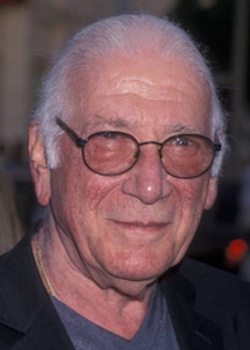 The score for Executive Decision was by composer Jerry Goldsmith, and was the first in a series of modern action scores he composed during this period, alongside works like Chain Reaction, Air Force One, and U.S. Marshals. While some of those later entries – particularly Air Force One – would stand out more prominently, this score occupies an enjoyable middle ground: professionally crafted and effective in context, but perhaps less compelling when isolated on album.
Goldsmith’s approach leans heavily into the action style he established over the course of the 1990s, blending orchestral power and prominent, heroic thematic writing with more modernistic electronic elements, especially in the percussion. The score is anchored by a bold main theme introduced early on in “The Map”, which is carried by confident brass writing and staccato strings, and is reinforced by driving rhythmic support, where he blends live snares with electronic pulses. This theme recurs frequently, notably in cues like “Drill Team,” parts of “Starting Over,” and the outstanding “The Remora,” the latter of which remains one of the most exciting action moments of this period of Goldsmith’s career.
Alongside this main theme is a great deal of energetic militaristic action writing, which helps propel many of the film’s set pieces. There’s some superb action material in cues like “All Aboard,” parts of “Starting Over,” and then in the darker and more intense “The Sleeper,” all of which again blend beefy brassy explosions with rhythmic string patterns and clattering percussion. This sound has its roots in scores dating all the way back to the late 1960s and 1970s, including Patton and Capricorn One, but was especially dominant in this period, where variations on it appeared in essentially every action score he wrote.
For the terrorist antagonists, Goldsmith incorporates touches of Middle Eastern instrumentation (possibly a sitar, possibly what sounds like a ney flute, maybe an oud) and exotic percussion into the mix, adding a layer of cultural color, though these elements sometimes feel more conventional than inspired. Cues like the aforementioned “Drill Team” and “The Sleeper” feature this ‘terrorist music’ quite prominently.
Some of the mid-album cues – “Do It” and “Pick It Up,” for example – are devoted to more suspenseful material, emphasizing texture and atmosphere over melody. These passages are effective within the film, enhancing the confined, high-stakes environment of the aircraft, but they can come across as repetitive or subdued when heard on their own, although I personally appreciate the fascinating instrumental combinations and rhythmic ideas Goldsmith uses. When the score does shift into full action mode, however, it delivers the expected energy, with several standout cues combining thematic material and rhythmic intensity in satisfying ways.
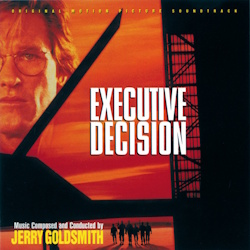
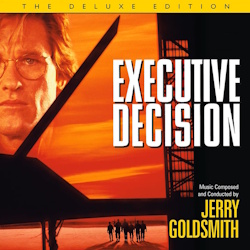 One of the longstanding issues with Executive Decision has been its presentation on album. The original 1996 release offered only a brief snapshot of the score, omitting large portions of the music due to industry constraints at the time. This led to years of frustration among fans, especially since much of the more nuanced or interesting material existed in shorter cues that were never officially released. Thankfully, in 2016, Varèse Sarabande and producer Robert Townson released an expanded edition album which remedied this to an extent, presenting a far more complete version of Goldsmith’s work. Action cues like “The Villa/Flying Lessons” and “Initiating Approach” are especially outstanding, the latter containing a particularly heroic version of the action fanfare that is deeply satisfying. While this longer format provides a clearer sense of the score’s dramatic structure, it also highlights its unevenness, with extended stretches of low-key suspense in the album’s mid-section that may test listeners’ patience. I am happy that the longer version of the score exists, but I still gravitate toward the original 30-minute program when I go to listen; make of that what you will.
At the time this score was released, people were very critical of Goldsmith in general, and of scores like Executive Decision in particular, saying that the music was significantly inferior to what he was writing in the 1970s, and especially criticizing his use of electronic percussion; and it is true that his music is inferior to the action music he was writing in the 1970s, and the electronic percussion is an acquired taste. If you hated it in Gremlins, or Legend, or King Solomon’s Mines, or Link, or The ‘Burbs, or a dozen others, it’s always going to be a sticking point. However, from my point of view, looking back on this now more than 20 years after the composer’s passing, there’s something wonderfully nostalgic about this style of music; nobody is writing this anymore, obviously, but the fact that Goldsmith had such an identifiable and highly personal action style is in my opinion something to be cherished.
Ultimately, Executive Decision is a solid but not exceptional entry in Goldsmith’s action catalogue. It showcases his technical skill and professionalism, elevating the film and providing moments of genuine excitement, but it rarely reaches the level of creativity or memorability found in his best work from the same era. For dedicated fans of the composer, it offers worthwhile material and insight into his process, especially in its expanded form. For more casual listeners, however, it remains a competent, occasionally engaging score with a few highlight moments, but ultimately is perhaps best appreciated within the context of the film rather than as a standalone listening experience.
Buy the Executive Decision soundtrack from the Movie Music UK Store
Track Listing:
- ORIGINAL 1996 RELEASE
- The Map (1:30)
- All Aboard (5:40)
- Drill Team (5:39)
- Do It (2:33)
- Pick It Up (3:31)
- Starting Over (2:55)
- The Sleeper (3:28)
- The Ramora (2:19)
- Hold It (1:58)
- EXPANDED 2016 RELEASE
- The Map (1:29)
- The Villa / Flying Lessons (2:45)
- The Abduction (3:00)
- The Bomber (0:58)
- Waiting/The Take Over (3:07)
- The List/No Choice (3:05)
- One Drop/The Passenger (2:50)
- The Remora (2:17)
- The Toy/No Choice (2:03)
- Initiating Approach (3:03)
- All Aboard (5:39)
- Close Inspection (2:35)
- Drill Team (5:39)
- The Cable/Not Here (2:08)
- The Wallet (2:42)
- In the Interest of Peace / Another Gun (3:03)
- The Bomb/Get to It (1:19)
- Do It (2:32)
- Stop Them/Come Home (1:25)
- Executive Decision (0:59)
- Our Destiny/Weak Link (2:16)
- Pick It Up (3:31)
- Starting Over (2:53)
- Open Your Eyes/Inside the Bomb (1:18)
- Don’t Do It/5 Minutes (2:57)
- The Sleeper (3:27)
- It’s Over/Line it Up (2:26)
- Happy Landing (1:15)
- Hold It (2:00)
Running Time: 29 minutes 33 seconds — Original
Running Time: 74 minutes 41 seconds — Expanded
Varese Sarabande VSD-5714 (1996) — Original
Varese Sarabande CD Club VCL-0216-1164 (1996/2016) — Expanded
Music composed and conducted by Jerry Goldsmith. Orchestrations by Alexander Courage. Recorded and mixed by Bruce Botnick. Edited by Kenny Hall. Album produced by Jerry Goldsmith. Expanded album produced by Robert Townson.

Shop at the Movie Music UK Store

Member of the


