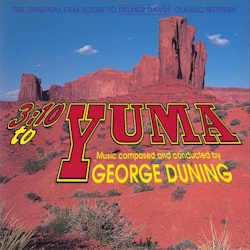
3:10 TO YUMA – George Duning
 GREATEST SCORES OF THE TWENTIETH CENTURY
Original Review by Craig Lysy
The original story for 3:10 to Yuma was the brainchild of writer-producer David Heilweil, who adapted the 1953 short story of the same name written by crime author Elmore Leonard. He offered it to producer Robert Aldrich and his production company, who liked it enough to commission a screenplay by Halsted Welles. Yet the company was in need of cash, and so Aldrich sold the screenplay and film rights to Columbia Pictures for $100,000. Heilweil was assigned as producer, and Delmer Daves was tasked with directing. A creative decision was made to shoot the film in black and white using red filters on the camera lens, which afforded the picture a more arid and parched appearance. A fine cast was recruited, including Glenn Ford as Ben Wade, Van Heflin as Dan Evans, Leora Dana as Alice Evans, Felicia Farr as Emmy, Robert Emhardt as Mr. Butterfield, Henry Jones as Alex Potter, and Richard Jaeckel as Charlie Prince.
The story is set in the Arizona Territory circa 1880. Struggling rancher Dan Evans and his two sons witness a stagecoach robbery committed by the notorious outlaw Ben Wade and his gang. Evans alerts the sheriff, and Ben is successfully arrested, although one of his gang members escapes. The sheriff offers Dan $200 to escort Ben to Contention City for trial, which he accepts, much to the displeasure of his wife Alice. Before leaving, the brother of the slain stagecoach driver arrives seeking vengeance, and Dan saves Ben’s life in the process. Later, as they prepare to depart on the train, Ben’s gang arrives, and Ben returns the favor by shielding Dan so they can safely board the train together. As they depart, Ben tells Dan that he owed him for saving his life and that he can now honestly collect the reward. He then remarks that he has escaped from the Yuma jail before and therefore can collect the $200 bounty honestly. The film was a commercial success and was praised by critics for its storytelling and outstanding ensemble cast. The film, however, failed to earn any Academy Award nominations.
George Duning had signed with Columbia Pictures in 1946 and served as one of the studio’s resident composers. Director Daves had developed a strong rapport with Duning and therefore brought him onto the project, providing specific instructions regarding the type of score he desired. Daves requested a low-key, film noir–influenced style rather than a traditional Hollywood epic Western score in order to better underscore the psychological tension between the characters. Duning later related that he and Daves would “spot” the scenes together, determining exactly where music was needed, after which Daves granted him complete creative freedom to compose the remainder of the score.
 In conceiving his noir soundscape, Duning sought to create music that was brooding, dark, intense, and filled with raw emotion. Additionally, he chose to utilize sparse instrumentation for psychological effect, such as a menacing duet between piano and guitar to emphasize the unresolved tension as the train’s departure deadline approaches. Duning also adopted the use of a titular song, which had become a Hollywood staple, both to promote the film and to serve as the essential thread unifying the tapestry of the score. To that end, he brought in the renowned, Academy Award-winning lyricist Ned Washington. The lyrics and music were crafted to reflect the film’s plot, centering on a desperate rancher escorting a dangerous outlaw to a prison train. Duning wanted the song to evoke themes of fate, loneliness, the “ghosts of outlaws,” and the “sad refrain” of the train whistle. From the outset, Duning stated that the song was specifically written for Frankie Laine, whose “husky, lonesome voice” was considered ideal for portraying the “strong, yet weary men” typical of 1950s Westerns.
For his soundscape, Duning underpins his musical storytelling with a Main Theme that serves as the essential thread binding the score together. The song’s melody functions as the film’s heartbeat, appearing in a variety of instrumental guises; it is even whistled by the outlaw Ben Wade. The theme speaks not only for protagonist Dan Evans, but also for his antagonist Ben, as their fates are intertwined. The melody is minor-modal, sad, wistful, yearning, and existential in character. Yet it is also highly malleable, allowing Duning to transform it into more aggressive, romantic, portentous, and travel-oriented variations. He further varies its expression through the use of different instrumental colors, including guitar, woodwinds, forceful horns, and sumptuous strings. For Ben Wade and, by extension, his gang, Duning adopts a largely non-melodic, textural approach, evoking menace through dark chords, timpani strikes, eerie stingers, and an array of sinister sonic effects. This music assumes an increasingly aggressive tone that mirrors the brutality and violence of the outlaws.
Two feminine identities contrast with the score’s overarching and dominant Main Theme. The first, Alice’s Theme, offers a calm, warm, and folksy identity borne by teneri woodwinds. It supports both her character and the domestic scenes at the Evans ranch, where it establishes a welcoming and hospitable ambiance. Later in the score, as she faces the very real prospect of losing Dan, the theme transforms into a string-borne romanza carried by sumptuous strings filled with longing. The second, Emmy’s Theme, is in reality the Main Theme rendered as a romanza for guitar, woodwinds, and, at its most expressive, sumptuous strings romantico. It speaks to Ben’s yearning for love, a wife, and the promise of a fulfilling family life with children. Yet it also expresses Emmy’s loneliness and longing for a man who might sweep her away and offer her a new beginning. Together, these two themes provide respite from the score’s otherwise strident, sinister, and violent musical identities. When all was said and done, the resulting score was so well received that the abrasive and notoriously difficult-to-please Columbia studio head Harry Cohn sent Duning a rare congratulatory note.
“Main Title” offers a score highlight where Duning sets a somber tone for the film, which offers an existentialist story of a desperate rancher facing formidable odds. We open with strident horns and foreboding drum strikes, which support the display of the Columbia Pictures logo. We shift to an instrumental prelude of the titular song melody, which usher in at 0:19 a vocal sung by baritone Frankie Lain, which is buttressed by a women’s choir, who shift between haunting wordless vocals and repeating Lain’s phrases. The song supports the flow of the opening credits, which display against a desert backdrop where a stagecoach transits. Duning and Washington wanted the song to evoke themes of fate, loneliness, the “ghosts of outlaws”, and the “sad refrain” of the train whistle. I discern from the song’s lyrics an allegory on several themes. First: fate – It speaks of the inevitability of fate, “a man may meet his fate” on this train ride, positing that fate is implacable and inescapable. Second: death and Legend – It describes the ever-rolling train’s wheels as a “mournful sigh”, referencing a legend where passengers can see the “ghosts of outlaws riding by”, while aloft in the sky circle buzzards. Third: sacrifice – It speaks to the burden, and emotional cost of duty, noting that when one takes this train and “leaves the things you love,” you do so with a “silent prayer”. And fourth: Yuma itself – a train ride symbolic of a “final journey”, and yet it also speaks of uncertainty as offered by; “But the rains of death never fall from the cloudless skies of Yuma”, with rain serving as a metaphor for death.
In (*) “The Hold-up” we enter the film proper atop the song’s somber melody as the stagecoach passes cowboys managing a cattle drive. The driver stops as a gang with pistols drawn block his path. Duning sows an ominous musical narrative with quotes of the Main Theme. The driver puts up his hands, and Ben Ben rides up to the coach, where Mr. Butterfield declares he is the owner, and threatens retribution if they are robbed. Ben says all he is interested in is what lies beneath the rooftop tarp. Rancher Dan Evans and his two sons ride up looking for his cattle and arrives at the hold-up. Ben’s gang removes bags of gold and he and his number two Charlie ride up to challenge Dan. Dan declares those are his cattle and he wants them back. Charlie relays Ben’s response that he may have them in five minutes when they are done. They ride back and Dan chooses discretion, as the safety of his boys, matters more than valor, and so holds his ground. The driver Bill Moons pulls out a gun and threatens a gang member next to him. Ben, without blinking, shoots his own man, and then the driver. He then returns to Dan and seizes his horses to prevent him from notifying the sheriff, with the caveat that he will release them outside of the town of Bisby. We close with Dan and his boys herding the cattle back to the ranch on foot.
“Our Home” offers a warm and homey score highlight. It opens with a folksy musical narrative expressing Alice’s Theme, led by warm woodwinds as we see Dan’s wife Alice looking out from the porch of their ranch home. It shifts to strings, and then begins to darken as she finds all three returning without their horses. At 0:24 the music become grim carried by the Main Theme when elder son Matthew informs her that the stage coach was held up and Marks adds that they killed the driver. As the boys saddle up some horses, Dan deals with Alices concern over what the boys saw today, and her anxiety of living out here alone with men like Ben and his gang roaming lawlessly. At 1:06 the Main Theme shifts to strummed guitar and flute, joined by plaintive strings when he says the boys learned a lesson today, that sometimes you cannot act, but instead need to watch. (*) “Where Do I Get $200?” offers a nuanced musical narrative as the scene shifts from worry and anxiety, to hope and aspiration that good days lay ahead. Duning opens with a beleaguered musical narrative borne by strings and woodwinds tristi as the conversation shifts as Alice voices her worries that after ten hard years that they may not make it because the long drought has caused too many cattle to die for lack of water. He counters buying water rights to the stream owned by his neighbor Al Parker’s would cost $200 a year, which they cannot afford. She asks that he consider a bank loan to save them, and he says he guesses that they can try. An ascent by spritely strings supports the return of the boys with two horses. Warm French horns support as Dan sets off to bring water to aid to the stranded stage coach, and then retrieve his stolen horses. He promises that after the rains come, they will have water, the land will green, and the cattle will fatten for market. As he departs, he assures her that good times are coming. Duning offers one of the score’s most heart-warming and aspirational passages borne eloquently by warm and hopeful strings as Alice and the kids watch Dan ride off.
(*) “Bisby” offers an ominous musical narrative opens with horns minacciose, and carries Ben and his gang’s ride into Bisby. We flow into “Lovely Emily”, which I believe is the score’s most beautiful track. Ben and his men enter and line up along the bar, and Emily, the bar tender, pours them all a shot of whiskey one by one. She ends with Ben and as she pours round two, he informs her to notify the Sheriff that the stage coach from Contention was held up, the driver was killed, and that they lack horses and need assistance. She runs and wakes the Marshall saying Bill Moons has been killed. The Marshall orders a posse be called up, and then probes Ben for information. But before he can glean any information, Ben pays the tab, tips Emily, and they depart. Outside, the Sheriff prepares to ride out with his posse, and Ben orders Charlie to take the men across the border into Nogales, and he will hook up with them there. Ben stays, as he is clearly attracted to Emily. She admits that there are no young men here, and that she is lonely. Alex arrives late and Ben directs him to where the posse headed, and he rides out. Emily returns to the saloon, and Ben follows. Up to this point Duning has supported with a tender romantic canzone rendering of the Main Theme with guitar, soft strings and woodwinds delicato. He joins her behind the bar, and at 3:24 we shift to sumptuous strings romantico as he takes her into his arms and they join in a kissing embrace.
“I’ve Got Something” sustains the romantic eloquence of the prior cue. It reveals the Marshall encountering Ben and Mr. Butterfield. To his dismay, he learns that the robbers were Ben’s gang, which alerted him. An angry strummed guitar marks his frustration, and a solo flute leads a reprise of Emily’s Theme. When Alex informs them that Ben remained and reentered the saloon, they debate whether to jeopardize the safety of the town if they return and arrest Ben. They resolve to arrest him, and transport him out immediately, and as they depart, Ben joins when asked by the Marshall. At 0:48 a rousing quote of the Main Theme empowers their departure. In town Emily and Ben emerge from the back suggesting love-making. Her theme reprises as she pours him another shot and he confirm her suspicions that he will not be returning. He says he never stays in one place too long, and that asks if she cares. She answers, that she does, but that is life – saying you are on the go, and I am stuck here. She then adds that she does have memories, to which he answers, so do I. Their cheeks caress, but at 2:13 the moment is lost and the music ends as Charlie rides up to warn that a man is riding in.
(*) “Ben Arrested” reveals Ben walking in past Charlie and telling Ben that he got his cattle back, but it costs half a day’s wages. Ben asks how much, and Dan says he pays $2 a day. Ben gives him $2 for half a day, and Dan agrees that it will be what he settles for, but Ben adds $2 for his two sons. Music enters with a guitar strum when Dan asks for $2 for tiring out his cattle, to which Ben agrees. Duning sows a subtle tension with ambient guitar and novachord as Ben asks if there anything else you wanna get paid for? Ben asks if he could give him an extra $2 for making him nervous. Timpani strike as we hear; “Don’t move!” Dan tells Ben it is the Marshall and he has a shot gun on you. A crescendo violento erupts as deputies shoot at Charlie and miss. He returns fire and flees on his horse propelled by a trumpet declared Main Theme. Ben says his boys will return, free him, and you Dan, will be killed. The Marshall sits him down, and says they are moving him out of town fast. The Marshall leaves with Mac holding the shotgun. Dan tries to negotiate getting water rights from Mac, but he refuses saying he needs all of it to save his herd from the damn drought. Outside the Marshall evaluates three plans; take Ben to Fort Huachuca, to Benson, or to Contention City to catch the 3:10 train to Yuma. Ben leaves, hears the Butterfield offer $200 for the mission, and he accepts. The Marshall gives him a shotgun and asks for a second volunteer. Everyone declines, and so he deputizes the hapless Alex.
“Goodbye Emily” offer a score highlight with a wonderful extended exposition of a buoyant Main Theme. It reveals Dan and Alex as Ben’s guards and a spirited, woodwind led Main Theme. Dan asks where they are going, and at 0:13 the music sours when the Marshall says we will transfer Ben at your house to throw off the gang. Trumpets declare the Main Theme as the stage coach arrives. Duning supports with a vibrant musical narrative as the dead Bill Moons is removed, the other passengers disembark, and a fresh set of horses are brought and hitched. At 0:26 a diminuendo with accordion supports the town kids watching through the saloon window. The music regains its vibrancy as the hand-cuffed Ben is escorted out at gunpoint. At 1:02 the Main Theme once more transforms into an achingly beautiful romanza as Emily joins, and opens the coach door. Ben promises to send her some pearls so she will not forget him, to which she replies, that she will not forget. He boards the coach and at 2:35 a bounding Main Theme is rendered as a ravel motif as Emily, with her eyes full of longing, watches the stage coach depart. The theme supports the stage coach and armed escort winding through the countryside. They arrive at Dan’s ranch and purposely drive the coach into a roadside crevasse. They call out to Dan to come and help, and he and Alex leave his porch and help them pull the coach out as Charlie and another outlaw observe from a hill top. The coach rides off as Dan, Ben and Alex return to his ranch, and hope their diversion scheme works. Film – Album synchrony ends at 3:59. On the album, at 0:400 wordless women’s chorus usher in Frankie Laine reprising the titular song, while in the movie, we end on a diminuendo of uncertainty as we see Alice is displeased that Dan has brough Ben into their house.
(*) “Dinner” reveals the Evans hosting a dinner for Ben and Alex. All is polite and cordial, with Dan agreeing to cut Ben’s meat as he is handcuffed. Dire Main Theme horns resound as gunshots elicit Dan to run outside. An edgy Alex, believes he saw something, and the theme descends into sadness as Alex realizes he is nervous and twitchy from lack of whiskey. Inside Ben engages Alice in conversation and we shift to a guitar rendering of the Love Theme as Ben has wistful thoughts of a woman, he loved, who like her was from San Francisco. The intimate moment is severed by foreboding horns and strings bearing the Main Theme as Dan calls Alice away from the table. Dan sends Alex in to guard Ben and the Main Theme joins on woodwinds as Alice asks about the shooting. Dan deflects and we detect jealousy as he says he disapproves of her listening to his tales. The Main Theme rejoins as he orders the boys to get the three saddled horses, and then informs Alice of his plan. The gang will pursue the stage coach and overtake it by noon tomorrow. They will not find Ben and it will be too late as we will have already taken him to Contention City. We shift back to the Alice’s Theme of warm strings as she relates that she and the boys are so proud of what he has done with Ben. As Ben is escorted out, he thanks Alice for her hospitality, and adds he hopes he can send Dan back to her alright. A sumptuous and warm rendering of the Alice’s Theme supports, their departure, joined by a pensive Main Theme as Alice and the boys watch. The theme carries their travel as Dan informs Ben that they are headed to Contention City as he has a ticket on the 3:10 train to Yuma.
“Contention City” reveals the three men riding into Contention City at dawn. Eerie strings and a pensive Main Theme support as Mr. Butterfield joins, and says he has rented a room at the hotel to hold Ben. Alex heads off to circle behind the hotel to make sure it is secure, and the pensive Main Theme carries his reconnoiter. All is clear, and Dan escorts Ben up to his room. Ben begins to bait Dan, and makes an unsuccessful bid to take his gun. Butterfield who is posted in the lobby is informed by Alex that all is well, however he seems uneasy as a suspicious man continues to sleep on the lobby sofa, his face covered by a newspaper. The camera zooms in on the lobby clock, which is chiming 11:00 am with dissonance. “And I’m Proud” reveals Ben getting Dan to disclose his bounty of $200, and then saying he will double it to $400 if he uncuffs him and lets him go free. Dan declines, and we shift to the street where a funeral procession proceeds down Main Street led by a small Indian boy striking a drum in a steady cadence. He asks Ben to take a look as he might recognize some people. He relates, that there is Mrs. Moons, escorted by their son Bob. She had another son, Bill Moons, the stage coach driver, adding, perhaps you remember him. The Main Theme joins as Dan relates that just before 3 pm they are going to walk out of here and that you are getting on that train. In the lobby, the man wakes up, removes the newspaper, and we see it is Ben’s number two, Charlie. Back in the room, Ben ups the ante to $7,000, saying such money would solve all his problems and ensure a good life for his family, but Dan is impervious. Outside a distant funeral drum beat and foreboding texturalism supports Charlie’s walk-through town.
(*) “Bob’s Fury” reveals Bob Moons and some friends walking into the hotel and taking some whiskey shots. Duning sows a palpable undercurrent of tension as Bob sees Butterfield and is enraged that he, as Bill’s employer did not have the decency to attend the funeral. Butterfield says he can explain, only to have his shot thrown in his face, which Duning punctuates. Back in the room, Ben sweetens the deal, now offering $10,000, and we see Dan’s resolve weakening. He also realizes it, and asks Ben to not speak to him for a while. (*) “Bob’s Revenge” reveals a knock on the door. Butterfield says he is bringing up some coffee. Dan unlocks the door and the door is kicked open, throwing him to the floor causing him to lose his shot gun. Before he can retrieve it, Bob orders him to stop at gunpoint. Butterfield apologizes as Bob put a gun to his head. Bob announces his intent to avenge his brother, and Dan says if you pull that trigger, he’ll hang for murder. Dan walks toward him undeterred, punches him, and the pistol goes off, alerting Charlie in the street below. Butterfield asks, what if someone heard that shot? When Dan looks out the window, his eyes and Charlie’s lock. Charlie smiles, and then gallops out of town. Ben then advises that he also planted men in Benson and Fort Huachuca, so they never had a chance. They decide to recruit the Sheriff and his deputies, but Bob advises they are in Tucson delivering a prisoner. Butterfield agrees to help and recruit as many men as possible, but Bob declines, saying he is now his mama’s only remaining son and he cannot risk it. Butterfield departs, says he hopes he can get at least five men so they have a fighting chance, and Ben, says, good luck. Duning punctuates this with a dire chord of Ben’s Theme, from which arises an eerie, and foreboding textural musical narrative.
“Anxious Wife” reveals Alice riding into town carried by her theme rendered as a travel motif. She inquires if there is any word, and is told there is none. She rides off, intending to join Dan in Contention city, once again carried by her theme rendered as a travel motif as we see her riding across the countryside. “Girl Singing” opens with guitar strums as Dan rolls a cigarette. A woman begins singing the titular song, with new lyrics. The woman is unseen, with her vocals wafting in through the window. We feel her yearning for her wayward lover, and these feeling are reflected on Ben’s face. She continues singing wordlessly as Ben remarks that he likes a girl singing. He then asks Dan for the time, and the wall clock reads 2:30 pm, and so he smiles and advises Dan that he has half an hour to decide. Butterfield returns and says he has recruited five men, which brings their number up to eight. Dan says we will hole up in the hotel and only engage if they try to break in. “I Was Thinking” reveals Butterfield reminding Dan that it is 2:30, eliciting him to angrily yell back, “I know!”, which Duning punctuates with a dire declaration. An eerie and foreboding textural passage using Ben’s Theme follows with drum strikes, which sow tension. At 0:29 a solo flute leads reprise of the Main Theme, which is both sad, and full of longing. Ben opens up that when he was having dinner with your family, it made him think that one day he would like to have a wife and family. He then tries to provoke him, saying that he would treat her better than you do, feed her better, buy her pretty dresses, and not have her work so hard. When he says I bet she was a real beautiful girl before you met her. This was the final straw, and in (*) “Dan’s Fury” he erupts in anger, points the shotgun at Ben’s face and yells; “I told you to shut up! And adds if you say one more word, I’ll kill you.” Duning punctuates this with an angry declaration. Ben remains calm, and asks that Dan look out the window, which he does. Ben continues his psychological warfare by to sowing doubt and anxiety
(*) “Charlie and the Gang’s Ride” reveals the camera panning the desert landscape supported by foreboding textural effects. Charlie and the gang ride furiously into the picture empowered by a stepped crescendo dramatico. We shit to the hotel bar where Butterfield and the five recruits wait pensively as we see a half empty bottle of whiskey with each holding a shot glass. They hear the approach of hoofbeats and Alex calls up to Dan and says they are coming. Dan orders Alex to join the other men in the lobby. Butterfield deploys his men in the lobby as the seven outlaws ride into town. Charlie calls up and asks if Ben is alright, and he says yes, and to go into the hotel and have some drinks. “Contention City” opens darkly with ominous and foreboding textural effects. A forlorn flute emotes the Main Theme as Ben reminds Dan that he has a wife and kids, who need him. In the lobby, the men lose their conviction when they see seven outlaws. They decide to walk out as Butterfield pleads, offering $50 each, but they all decline, saying they have families to care for. Ben tells Dan that your men have deserted, and soon Butterfield will also, leaving you alone against seven. Butterfield says for Alex to stand guard as he is going up to talk to Dan.
In “Make It Good”, Duning sow danger as Alex sees a man on a roof across from the hotel. He pulls out his pistol, but Charlie surprises him from behind and yells to drop your gun. He does so, sees a man taking aim with a rifle, and shouts; “Dan! The roof!” Sharp, stabbing orchestral thrusts support the outlaw firing and missing. Dan returns fire and kills him, with Charlie shooting Alex in the back. Duning escalates the tension and violence, as Butterfield joins Dan in the hotel room. Dan tells Ben that one more shot means he is dead, and to tell his men to back off. Ben yells out that they have one more shot, to which Charlie replies, tell’em we will use it at the train station. A foreboding Main Theme supports Dan sending Butterfield down to check on Alex. He reaches the stair balcony and at 1:30, a horrific stinger supports a silhouette of Alex hanging from the chandelier. An urgent crescendo brings him back and he informs Dan that he has had enough, that he is backing out, and that he is releasing him from his obligation as Alex is dead. A thunder clap usher in a grotesque musical narrative as Alice arrives in town. She is desperate to convince Dan that his life is worth more than the $200 reward, with the music evoking the tension between Dan’s commitment to justice and her fear for his survival. She discovers Alex hanging from the chandelier, and cries out for Dan as she ascends the stairs. At 1:52 we segue into “One More Shoot” atop her string borne theme as she reaches the upstairs. Dan gives Butterfield the shotgun, and goes out to greet Alice. He calls to her and she runs desperately into his welcoming arms. They talk past each other with him relating that thunder means the rains are coming, while she asks him to forgive her for the things she said yesterday. Her theme transforms into a stirring romanza for the theme’s most beautiful exposition in the score. Yet at 3:25, it sours as he remains steadfast in his commitment to duty, saying that he must ensure that Alex and Bill did not die in vain, and that justice is done. She tries to dissuade him one last time supported by a pleading Love Theme, yet he remains resolute. At 3:55 guitar strums of fate mark the clock chiming 3:00 pm. He says it is time to walk Ben to the station, and for her to wait downstairs in the lobby. He returns to the room, takes the shotgun, and tells Ben, it is time, which Duning supports with foreboding tension. At 4:43 a forlorn Main Theme joined with eerie string figures, which support the start of their trek. We close at 5:39 with a longing Love Theme as Dan tells Butterfield he will exit the back door, and that he is to take his wife and ride out of town as fast as they can. As he departs, he promises Alice he will return home and she replies, that she will be waiting.
(*) “Walk To The Train Station” reveals Dan moving Ben at gun point, exiting the rear of the hotel. Duning entwines the Tension Motif and Main Theme to express a suspenseful musical narrative. The camera shifts to Charlie on a roof top and his rifle shot misses Dan. They duck behind cover and Dan tells Ben to inform Charlie that one more shot and he will cut him down. Yet Ben shouts, Charlie, you have one last shot. They resume their trek and Dan finds he is trapped; Charlie on a roof with a rifle ahead of him, with another man with a pistol behind. The Main Theme reprises as Ben advises Dan that he is trapped. Two other men now join and Dan is surrounded as the train whistle blows. Yet fate intervenes as a cattle drive passes and Dan uses it as a diversion to safely cross the street. Tension escalates as Charlie cries out that they are headed for the train! The men mount their horse and are propelled on their ride by an urgent Main Theme. They ride ahead and dismount, converging at the train platform, blocking the way. Ben tells Dan to leave or be cut down, but he presses on. The train arrives, and Dan uses a horse as a shield to cross. He then tells Ben to order Charlie into the open. “End Title” opens with the train beginning to depart, and Dan pushes Ben out to board, using the steam as a cover. Yet they come face to face with the gang. They order Ben to drop so they have a clean shot to kill Dan. Instead, Ben says to Dan; “Let’s get out of here.” Dan replies; How do I know you’ll jump?” To which Ben replies, “You’ll just have to trust me.” They jump in a car together and the gang pursues propelled by tension motif strikes as Dan kills Charlie. Dan is shocked and a relieved a flute led Main Theme with guitar accompiament joins as he asks Ben why did he do it? He replies that he does not like owing people favors, reminding him that he saved his life at the hotel. He adds that he has escaped from the Yuma Territorial Prison before, so he can claim his reward in good conscience. At 0:47 we shift to sumptuous strings as Alice sees Dan pass by safely on the train as rain pours down on her, breaking the long drought. They wave to each other and we flow at 1:03 into a reprise of the titular song sung by Frankie Laine with wordless women’s choral support. We close joyfully with the blessing of rain as Laine concludes the song with a flourish as “The End” displays.
“3:10 to Yuma” is a quintessential example of a titular song melody serving as a main theme, which is so integral, so essential, so pervasive, and woven into the very soul of the film’s narrative, that the film could not exist without it. I, and I believe most film score critics consider this one of Duning’s finest achievements for his ingenious way of weaving the titular song melody, his central theme, into a multiplicity of iterations, through diverse scenes, constantly reminding the audience of the impending fateful 3:10 train to Yuma. I have long been a fan of Ned Washington, who I believe is one of the greatest Hollywood lyricists of all time. His lyrics reveal his genius at capturing the very heartbeat of a film’s narrative. He wrote more than 140 songs, 40 of which were titular, for some of the greatest Hollywood composers, including; Victor Young, Dimitri Tiomkin, Leigh Harline, and Max Steiner. He had twelve Academy Award nominations, winning two for “When You Wish Upon a Star” (1940), “Do Not Forsake Me, Oh My Darling” (1952).
The score is a dark, psychologically intense work that departs from the sweeping, grand orchestral style typical for many 1950s Hollywood Westerns, instead embracing Film Noir sensibilities. What also elevates this score is that Duning understood that for his musical storytelling to be effective, he needed to juxtapose the film’s pervasive darkness, with light. To that end, he utilized two feminine identities as contrasting musical narratives. Alice’s Theme speaks of her long-suffering love for Dan, her sons, and their beloved cattle ranch. It offers a warm, and homey identity, which later in the film transforms, and blossoms into a beautiful and sumptuous string borne romanza. The other feminine identity is associated with Emily, the love interest of Ben. There is a yearning, and sadness in the notes as Emily is lonely, and her love is unrequited. Rather than offering a new and original theme, Duning instead transforms the Main Theme into a second Love Theme, expressed as a tender, romantic, canzone rendering of the Main Theme using guitar, soft strings and woodwinds delicato. Folks, this score contends for Duning’s Magnum Opus, as he masterfully enhances, empowers and elevates the film from first to last reel. I sincerely hope that this long coveted Holy Grail obtains a Kickstarter re-recording. Until that time, do take in the film on one of the streaming services to bear witness to Duning’s genius.
Note: The score for 3:10 to Yuma was first released as an LP vinyl in 1979 by Citadel Records, and then as promotional CD by Prometheus Records in the year 2000, and then again by Canadian label Disques CinéMusique in 2015 (coupled with Duning’s score for the 1958 western Cowboy). All three releases feature the same program. The audio quality is clean but limited by its age, as it is mastered from the original 1957 monaural soundtrack masters, and exhibits the compression typical of 1950s recordings.
For those of you unfamiliar with the score, I have embedded a YouTube link to an excellent sixteen-minute suite: https://www.youtube.com/watch?v=mTi6HrB87PE&list=RDmTi6HrB87PE&start_radio=1
Buy the 3:10 to Yuma soundtrack from the Movie Music UK Store
Track Listing:
- Main Title (written by George Duning and Ned Washington, performed by Frankie Laine) (2:26)
- Our Home (1:53)
- Lovely Emily (4:08)
- I’ve Got Something (2:31)
- Goodbye Emily (6:25)
- Anxious Wife (1:08)
- A Girl Singing (1:09)
- I Was I’m Proud (1:28)
- Contention City (2:04)
- And I’m Proud (3:55)
- The Ballad of 3:10 To Yuma (2:25)
- Make It Good (1:36)
- One More Shot (4:22)
- End Title (written by George Duning and Ned Washington, performed by Frankie Laine) (1:52)
Citadel Records GD2 (1957/1979)
Prometheus (1957/2000)
Disques CinéMusique DCM147 (1957/2015)
Running Time: 37 minutes 22 seconds
Music composed and conducted by George Duning. Orchestrations by Arthur Morton. Recorded and mixed by XXXX. Edited by XXXX. Score produced by George Duning. Prometheus album produced by Luc Van de Ven. Disques CinéMusique album produced by Clément Fontaine.
Leave a comment

Shop at the Movie Music UK Store

Member of the


Wonderful, I have somehow not checked this one out! Bell, Book and Candle is another great score of his!