A GREAT AWAKENING – Chad Marriott
 Original Review by Jonathan Broxton
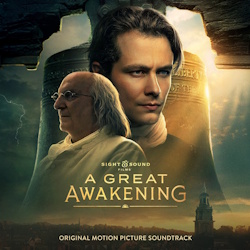
A Great Awakening is a historical drama film written and directed by Joshua Enck, which examines the friendship between George Whitefield and Benjamin Franklin. Franklin was, of course, one of the Founding Fathers of the United States, a pioneering writer, scientist, inventor, statesman, diplomat, and philosopher, as well as one of the most admired men in American history. Whitefield, meanwhile, was an English Anglican priest who was one of the founders of Methodism and the evangelical movement and who, after moving to the United States in the 1730s, played a key role in the subsequent Great Awakening religious movement that changed the American church forever. The film stars John Paul Sneed as Franklin and Jonathan Blair as Whitefield, and was a moderate success when it received a limited theatrical release in the United States in April 2026.
A Great Awakening was produced by Sight & Sound Films, the big-screen subsidiary of the entertainment company Sight & Sound Theatres, which produces adaptations of Bible stories for the live stage and is considered the largest faith-based theater company in the United States. 47-year-old composer Chad Marriott has been involved in the work of Sight & Sound for many years and has been its music director since 2025, which explains how he came to score this film. Originally from Horsham in West Sussex, England, Marriott is now based in Lancaster, Pennsylvania. His social media accounts describe him as a “multi-instrumentalist, songwriter, composer and producer” whose “major influences include the prog-rock bands Genesis, Yes, Pink Floyd, and Marillion,” and he is also very open about his deep personal religious convictions and his work as a pastor.
A Great Awakening is Marriott’s second feature film score; his only previous credit was for the 2022 drama I Hear the Bells, which was based on events from the life of American poet Henry Wadsworth Longfellow and how his poem “Christmas Bells” became the Christmas carol “I Heard the Bells on Christmas Day.” That film was also produced by Sight & Sound Films, but I have not see or heard it. However, based on the quality of this work, I have to say that Marriott is tremendously talented indeed.
 It’s interesting how many of these contemporary faith-based films feature the type of music that resonates with me the most. Scores like Mark McKenzie’s The Greatest Miracle and Max and Me, as well as more recent works such as Gene Back’s Cabrini, Antonio Pinto’s Bonhoeffer, and Tae-Seong Kim’s animated The King of Kings, all feature rich, lush, emotionally powerful orchestral music, and A Great Awakening is another worthy addition to that list. Of course, the biblical epic has always been one of my favorite film music styles—Miklós Rózsa’s Ben-Hur is arguably the greatest score ever written, after all—but the genre as a whole fell out of fashion for many years, and one could argue that deeply emotional, thematic film music is very much out of fashion within the Hollywood mainstream these days. That’s why scores like A Great Awakening deserve to be highlighted and recognized; whatever your feelings may be about faith-based films as a whole, their musical accomplishments are often outstanding.
The score was recorded with a full orchestra and choir in Nashville, Tennessee, and is a large-scale dramatic work that overflows with thematic content and old-fashioned cinematic emotion. Some online commentators have described it as feeling like “a lost masterpiece from the 1990s and early 2000s, filled with fantastic themes, long cues, and goosebump-inducing moments.” Stylistically, people have described it as “a little bit liturgical, a little bit Americana, and with a lot of Jerry Goldsmith/John Williams/James Horner vibes,” and I have to say I agree wholeheartedly with this assessment. Marriott’s work here feels like a throwback to a time when writing big, emotional orchestral film music was the rule rather than the exception, and anyone who grew up on that sound will find it hitting them right in the sweet spot.
The score is built around a recurring main theme, “Awaken Us Today,” which is actually an original hymn that Marriott wrote for a scene in which Whitefield spontaneously breaks into song while preaching to a gathered crowd on a Philadelphia street. Marriott originally researched colonial hymns of the period, intending to use an arrangement of a pre-existing hymn in the scene, but nothing quite seemed to work, so he simply sat down and wrote a new one, music and lyrics alike. The song is a stunning success: warm and folksy, with an immediately identifiable sense of classic Americana, an appropriate amount of religious reverence, and a memorable thematic hook that captures the listener immediately. When Marriott first played it for director Enck and screenwriter Jeff Bender, both men apparently burst into tears. The preaching scene in question appears on the album in the cue “Awaken Us Today (Market Street)” and is initially performed solo, in character, by actor Jonathan Blair before being taken up by the crowd and choir.
The rest of the score grows organically from this main theme, which remains prominent throughout the work. Large, powerful statements of it bookend the score in “Awaken Us Today (Theme)” and “Awaken Us Today (End Credits),” but Marriott also uses the theme liberally throughout the underscore. It first emerges in the gently melancholic “Remembering George Whitefield” and appears on tender flutes in multiple cues, including “Meant for Bigger Stages” and “The Holy Club.” Marriott surrounds the theme with subtle electronics and angelic choral textures, but gives it a more subdued character in cues such as “Prison Ministry” and “A Darker Valley,” adopting an appropriately somber tone considering Whitefield’s work at the time. The use of guitars to support the melody in “Whitefield’s Awakening” gives it an aspirational emotional outlook and makes it one of the score’s highlights. Later, the main theme underpins the entirety of the triumphant and uplifting “The Coal Fields” and receives a folksy fiddle-and-dulcimer makeover in “Deal in a Print Shop.”
Where the theme is absent, Marriott’s orchestral writing remains deeply impressive. There is a real sense of drama and intensity in the thrusting strings and commanding brass of “Constitutional Convention,” which occasionally reminds me of the classic power anthems Hans Zimmer was writing in the 1990s. There is also genuine warmth and sentimentality in the orchestral textures of cues such as “Franklin’s Childhood” and “Benny’s Print Shop,” especially in the way Marriott employs pastoral woodwinds, some of which occasionally recall John Williams’s more Americana-inspired scores.
A noble-sounding personal theme for Franklin seems to emerge during the beautiful “Don’t Let the Sun Set on Your Faith,” later reappearing in cues such as “Market Street.” To Marriott’s credit, however, he frequently alters the theme’s emotional intent, making it darker and more subdued through the use of choral textures and a prominent dulcimer. “The Stage” is gorgeous, introducing an honest and determined new theme carried mostly by rich low strings and underpinned by elements of English folk music. “Oxford University” is a fun, pompous little march that gently pokes musical fun at the conventions and traditions of that venerable institution.
“Do Not Be Deceived” is the closest thing the score has to an action cue, filled with bombastic, energetic strings, but it is also notable for containing the score’s first appearance of a two-note ascending brass motif that screams 1990s James Horner. It is a specific gesture Horner employed in numerous scores throughout his career, though it may be most familiar to fans of Titanic. This sound in general, and that motif in particular, return during the glorious “The Pulpit Will Be My Stage,” the celebratory and festive “Whitefield Arrives” (which is notable for its prominent use of fiddles and at times reminds me of 1990s Danny Elfman or James Newton Howard), and especially “Market Street Sermon Calculations,” which revisits some of the action-writing techniques heard earlier in the score and builds to a soaring conclusion.
One of the standout cues in the entire score is “Preaching and Printing,” which takes lithe pizzicato textures, prominent fiddles and dulcimers, and the two-note Horner-style brass motif and combines them with an epic brass statement of Franklin’s theme, underlining the two men’s developing personal and professional relationship. “Virtue Chart” is quirky and playful, while “The Kite Experiment” is lyrical and hopeful. Meanwhile, “Who Is the Source? (The Letter to Franklin)” is gravely serious and contains more than a hint of 1990s John Barry in its chord progressions.
The conclusion of the score, from “Franklin Awakens” through to the “Closing Titles,” sees Marriott raising the emotional stakes to their highest level, reprising the main theme in a variety of forms and bringing the work to a stirring conclusion. I love the fiddle-and-dulcimer reprise of the theme in “Franklin Awakens,” the way it is subsequently enhanced by a massed chorale, and the manner in which it reprises Franklin’s patriotic theme in its final moments. The snare drum tattoos beneath the orchestra in “Franklin’s Speech” reminded me at times of the score for Apollo 13, and they are excellent as well.
There are some easy criticisms one can make of a film like A Great Awakening, especially today. The film presents Whitefield and the revival movement through an overly reverential lens, creating what one reviewer called a “rosy sheen” and featuring what another described as “hagiographic dialogue.” There are also legitimate concerns regarding the apparent Christian nationalist viewpoint the film advances, with some reviewers questioning the timing and emphasis of a work that clearly supports the narrative that America is fundamentally a Christian nation whose political identity is inseparable from evangelical faith. This is especially noteworthy given that the nation is about to celebrate its 250th anniversary. Some commentators have also suggested that the film’s themes of national renewal, spiritual awakening, and liberty inevitably echo current American political debates, even though the filmmakers have explicitly stated that they were not trying to advance a political agenda.
Whatever the case may be, and whatever your feelings toward the film as a whole, the score for A Great Awakening is clearly a tremendous musical achievement, and it marks Chad Marriott as a composer worth watching. Although I Hear the Bells was technically his debut, A Great Awakening feels like his breakthrough. Whether he will capitalize on this success, score non-Christian films for other directors, or branch out to work with other production companies remains to be seen. I hope he does, because a composer capable of this much orchestral excellence, thematic depth, and emotional power deserves to be heard.
Buy the Great Awakening soundtrack from the Movie Music UK Store
Track Listing:
- Awaken Us Today (Theme) (1:01)
- Constitutional Convention (1:56)
- Franklin’s Childhood (1:34)
- Don’t Let the Sun Set on Your Faith (1:49)
- Market Street (2:19)
- Benny’s Print Shop (2:49)
- Remembering George Whitefield (1:42)
- The Stage (1:38)
- Meant for Bigger Stages (1:23)
- Oxford University (1:04)
- William Seward (1:33)
- The Holy Club (1:06)
- Prison Ministry (4:57)
- A Darker Valley (3:27)
- Whitefield’s Awakening (2:24)
- Do Not Be Deceived (1:40)
- The Pulpit Will Be My Stage (2:40)
- The Coal Fields (5:28)
- Whitefield Arrives (3:11)
- Market Street Sermon Calculations (5:12)
- Awaken Us Today (Market Street) (1:46)
- What Do You Make of Whitefield (1:36)
- Deal in a Print Shop (1:08)
- Preaching and Printing (3:16)
- Virtue Chart (2:11)
- The Kite Experiment (2:35)
- Who Is the Source? (The Letter to Franklin) (2:23)
- Franklin’s Retort (1:40)
- Awaken Us Today Theme (The London Play) (1:48)
- Franklin Awakens (6:16)
- Franklin’s Speech (4:28)
- The Sun Is Rising (2:03)
- Closing Titles (1:06)
- Awaken Us Today (End Credits) (5:18)
Sight & Sound Films (2026)
Running Time: 86 minutes 25 seconds
Music composed by Chad Marriott. Conducted by Aidan Davis. Orchestrations by Jordan Cox and James Regan. Recorded and mixed by Nick Spezia. Edited by XXXX. Album produced by Chad Marriott.

Shop at the Movie Music UK Store

Member of the


