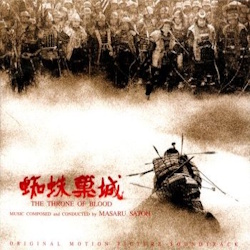
THRONE OF BLOOD – Masaru Sato
 GREATEST SCORES OF THE TWENTIETH CENTURY
Original Review by Craig Lysy
Upon finishing his last film, I Live in Fear in 1955, renowned director Akira Kurosawa began to conceive of his next project and decided that he would retell William Shakespeare’s famous 1606 play Macbeth from a Japanese cultural perspective. To that end, he sought to impart native Japanese cultural sensibilities by embracing Noh, a classical form of Japanese dance-drama performed since the 14th century. Noh utilizes masks, costumes, and stage props to support performances in which emotions are expressed through stylized gestures and masks that symbolize ghosts, women, deities, and demons. Noh also espouses the ancient Buddhist doctrine of impermanence and the concept of a soul denied salvation and condemned to wander the mortal world, a theme reflected in Washizu’s fate.
The screenplay, written by Kurosawa, Shinobu Hashimoto, Ryūzō Kikushima, and Hideo Oguni, was presented to Toho Studios, which agreed to finance the project. However, because of its grand scale and anticipated costs, the studio asked Kurosawa to both produce and direct the film. A legendary cast was assembled, including three of the greatest Shingeki actors of the day: Isao Kimura, Seiji Miyaguchi, and Nobuo Nakamura, who portrayed the three samurai ghosts in the second scene. Joining them were Toshiro Mifune as Washizu Taketoki (Macbeth), Isuzu Yamada as Washizu Asaji (Lady Macbeth), Takashi Shimura as Odakura Noriyasu (Macduff), Akira Kubo as Miki Yoshiteru (Fleance), Hiroshi Tachikawa as Tsuzuki Kunimaru (Malcolm), Minoru Chiaki as Miki Yoshiaki (Banquo), and Tamaru Sasaki as Lord Tsuzuki Kuniharu (King Duncan).
The story is set in Japan during the Sengoku (Warring States) Era, the 16th century in the Western calendar. It offers a retelling of Shakespeare’s renowned Macbeth, a tale of betrayal that ultimately brings ruin to all involved. Generals Miki and Washizu encounter a witch who foretells that Washizu will soon be named Lord of the Northern Garrison and that Miki’s son will one day become lord of the castle. The prophecy proves true for Washizu, but his wife covets even greater power. She gradually poisons his mind, and together they conspire to murder Tsuzuki, followed by Miki and his son.
Washizu’s ascent to lordship at Spider’s Web Castle sets in motion a chain of events that ultimately destroys his house. Asaji gives birth to a stillborn heir and descends into madness from guilt. On the battlefield, Washizu’s soldiers first desert him and then turn against him. The story ends with Washizu defiantly drawing his sword before being cut down in a hail of arrows. The film was a commercial success and earned the highest box-office receipts of any Japanese film that year. Although some criticism was directed at the abandonment of Shakespeare’s verse, the overwhelming consensus was that Kurosawa had created a masterpiece. Nevertheless, the film failed to earn any Academy Award nominations.
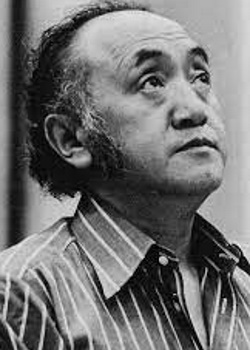 Composer Masaru Satō had stepped in to complete the score for Kurosawa’s previous film, I Live in Fear (1955), when his mentor, composer Fumio Hayasaka, died unexpectedly. Kurosawa was deeply grateful, and Satō’s efforts led to a fruitful collaboration spanning eight consecutive films, beginning with Kumonosu-jō (1957). Satō was pleased to collaborate once again; however, the project became extremely stressful when Kurosawa’s renowned meticulousness in post-production resulted in a very late delivery of the final cut. Matters were compounded by an inflexible release date imposed by Toho executives. As a result, Satō was given only one week to compose and record the score for the nearly three-hour film.
Satō decided that his music would reflect the psychological states of the characters as well as the devastating consequences of Washizu’s and Asaji’s actions, which brought desolation and ruin upon their house. He chose to eschew Western sensibilities, Hollywood-style romanticism, and traditional leitmotifs, instead fully embracing Japanese aesthetic traditions. To accomplish this, he employed a trio of musical approaches woven seamlessly into the fabric of his soundscape.
Foremost among these was his embrace of Noh theatrical sensibilities. Traditional Noh combines music with a chorus and a Hayashi ensemble, consisting of a shrill nōhkan (bamboo flute) and three percussion instruments: the high-pitched shime-daiko, the ōtsuzumi (hip drum), and the kotsuzumi (shoulder drum). He also employed minimalism, atmospheric textures, and interludes of silence to create a haunting, formless, and nebulous soundscape that was often eerie, elusive, and intangible. Finally, Satō incorporated ominous taiko drum percussion, dire horn chords, and unsettling vocalizations, including howling, to create a foreboding, shadowy, and intense atmosphere. Additionally, Satō heightened the drama by synergistically blending his music with diegetic sounds such as wind, rustling kimonos, and clattering horses, thereby creating a sensory experience of dread. He also spotted the score sparingly, rarely allowing it to accompany dialogue. Instead, the music punctuates the action, serving as a dramatic exclamation point during moments of violence, madness, and emotional turmoil.
“Titles” offers a score highlight in which Satō brilliantly sets the tone of the film, referencing the Prelude from Giuseppe Verdi’s opera “Macbeth” (1847), with a bleak, haunting, and minimalist composition. He evokes a sense of ghostly barrenness that eschews traditional Western cinematic grandeur, instead embracing the stark aesthetics of Noh theatre. We open ominously with a gong strike as the Toho Company Limited logo displays. Additional gong strikes accent a brooding marcia funebre empowered by bamboo percussion. At 0:15 a shrill bamboo nōhkan (flute) heralds the film title and the flow of the opening credits. It then joins the march meandering formlessly over funereal wailing, which portends the conflict, bloodshed and ruin that will come to pass. At 2:25 we enter the film proper which reveals a slow camera pan over a desolate fog draped landscape. Satō evokes an eerie, and ominous atmosphere that mirrors the film’s somber, fate-driven narrative. He creates an eerie synergy by joining the haunting winds sounds, Noh musical aesthetics borne by Nōhkan, bamboo percussion, and timpani. We see a Boseki (an upright stone, square column grave marker) with the inscription; “Here stood Spider’s Web Castle. A men’s chorus of baritones and bass vocals sing “Chant of the Spirit” in Japanese, a solemn threnody reminding the audience of Taketori Washizu, a proud warrior murdered by ambition, whose spirit is condemned to walk the earth and haunt this accursed site;
“Behold, within this place,
Now desolated, stood
Once a mighty fortress
Lived a proud warrior
Murdered by ambition
His spirit walking still
Vain pride, then as now will
Lead ambition to kill”.
The song in many ways embodies the role of the ancient Greek chorus common with plays from antiquity, who provided insight into what will take place. The scene functions as a prologue with the chorus portended the demise and ruin of those who abandon virtue, for pride, vanity and ambition.
In “War Drum”, the fog lifts to reveal the Spider’s Web Castle as we return from the past to the present. , and a lone samurai rides up the castle gate. He pounds and cries out that the north castle has revolted, and castles four and five are aflame. Later he debriefs Lord Tsuzuki, who realizes his dire position. The courier is taken away to be cared for and music enters as Lord Tsuzuki asks his generals do we attack or stand a siege? He receives counsel to hold the castle, but deploy troops to the forest for ambush. Another advises that they have only a three-month supply of food and water. A guard announces a courier from castle two, and he is admitted to court. He declares Captains Miki and Washiru have halted the enemy’s advance, and forced their retreat to the North castle. The North Castle’s commander Fujimaki offers to surrender and shave his head, but Tsuzuki refuses. He dispatches men to execute Fujimaki and orders Miki and Washiru to report to him at once. Satō supports with a stark, formless and minimalist rhythmic composition, using drums, bassoon, low horns, saxophone, and Nōhkan, which sow tension, and portend a dark fate for Lord Tsuzuki. “Light” reveals Miki and Washiru riding through the forest in a thunderstorm, which Satō supports with a shrill Nōhkan and pounding bamboo percussion. The ride headlong only to realize they have returned to the same spot. Suddenly a maniacal evil spirit laughs and startles them. “Rush” reveals Miki and Washiru declaring that they will not be stopped, and they again gallop off to reach the castle propelled by a dramatic horn empowered charging musical narrative. In the film, the maniacal laughing of the evil spirit buttresses the musical flight. “Old Woman of the Straw Hut” (unused) reveals Miki and Washiru discovering a latticed straw hut within which dwells an old ghost woman. They dismount, approach and listen to her singing a haunting song, as she tends to her spinning wheel, which in ancient lore symbolizes fate, life cycles, and destiny in the making;
“Men are vain and death is long
And pride dies first within the grave
For hair and nails are growing still
When face and fame are gone
Nothing in this world will save
Or summon up man’s actions here
Nor in the next, there is none
This life must end in fear,
Only evil may maintain,
An afterlife for those who will,
Who love this world – who have no son,
To whom ambition calls,
Even so – this false fame falls,
Death will reign – man dies in vain”.
The song is nihilistic, and posits that human ambition is futile, that glory is fleeting, and the impermanence of life, with death being the inevitable end of man’s pursuit. After she completes the song, they rush to the cage, open its gate, and ask if she is a human or ghost? She greets them by name and bestows a prophecy; Washizu will be named Lord of the Northern Castle and is destined to later become Lord of Spider’s Web Castle. Miki will become commander of the First Fortress this day. Satō’s supports with a ghostly, shadowy piece, an other-worldly misterioso borne by ever shifting, intangible strings and nebulous woodwinds. In “It Strangely Disappears” she closes telling Miki that his luck turns more slowly, but lasts much longer than that of Captain Washizu, saying that his son Yoshiteru will eventually become Lord of Forest Castle. With this she rises and music joins a frightening crescendo that crests in terror, as she vanishes into nothingness. “Ancient Battlefield” reveals Washiru and Miki entering the hut, pushing out the back wall, then turning to find the hut has completely vanished. Satō sow unease texturally with grave strings and woodwinds to create a ghostly, not of this world ambiance. They come upon fog-draped burial mounds, remnants of an ancient battle, strewn with skeletal remains of soldiers in their battle armor. At 0:50 a ghostly solo flute borne threnody for the fallen joins and as the fog becomes an impenetrable shroud, which dissipates into nothingness.
“Wandering in Fog” reveals Washiru and Miki lost and riding aimlessly in a dense enveloping forest fog. Satō juxtaposes foreboding bass, joined by meandering upper register strings. The two string lines are aimless, lack connection and serve to create a ghostly, and barren atmosphere. Accents by muted, non-rhythmic, distant drum strikes, sow unease and reinforce their feelings of being lost, trapped, and watched. They finally escape the forest fog, but they are weary and decide to camp and take off their heavy armor. In “Fireside” Washiru and Miki arrive at Spider Web Castle and are honored with walk past an honor guard of torch bearers for their audience with Lord Tsuzuki. A two-beat drum ostinato that slowly dissipates supports. “Disturbing Coincidence” reveals their arrival at court. While this is a moment of great honor, ennoblement and reward, Satō’s musical narrative speaks otherwise. They kneel and Lord Tsuzuki bestows a sword to Washiro promoting him to the post of Lord of North Castle. Portentous woodwinds grave support, offering a foreboding uncertainty. Lord Tsuzuki then promotes Miki to Commander of Fort One. Satō reprises musically with portentous woodwinds grave offering a foreboding uncertainty. They bow, and as they depart, the drum ostinato reprises.
“Northern Castle” reveals a camera shot of the North Castle surrounded by idyllic fields where farmers are busy tending to their crops. Satō supports with an idyllic woodwind borne musical narrative. The music is atmospheric, using repeating phrases, not melody in conveying the music’s emotions. In a pivotable unscored scene, Washizu is content ruling the North Castle, however his wife Asaji covets power and so commences to sow mistrust and discord, advocating that he should murder Lord Tsuzuki and become Lord. She then turns her attention to Miki, also urging Washiru to murder him as well, as he will betray you. This outrages him as he declares that Miki is his best friend. The conversation is ended when a herald arrives and announces that Lord Tsuzuki, who has been hunting, soon arrives. Washiru mobilizes his men and the castle shifts into frantic efforts of preparation. “Hunting Contest” reprises the idyllic musical narrative of the “Northern Castle” cue as we see Lord Tsuzuki and his entourage and personal guards approaching the castle. The farmers all kneel and bow as we see him bearing several slain stags, as they ride through the beautiful countryside.
“Provocation ~ Separation” reveals Lord Tsuzuki holding court. He advises that his hunting expedition is a rouse, designed to obscure his true intent – to attack and punish the rebellious and rival Lord Inui. He adds that this castle will serve as his headquarters, that Washizu will lead the attack, and Miki will command this castle. Later Washiru reproaches Asaji saying that Tsuzuki placing him in command of the army reveals his trust, but she counters that in battle you will face arrows not only from the enemy in front of you, but also from the enemy from behind within your ranks. Music enters from the abyssal depths of the orchestra with ominous minimalist atmospherics as she adds that you have already lost your castle to Miki, who remains behind its walls safe, as he is Tsuzuki’s favorite. At 0:50 an eerie undercurrent joins as Tsuzuki’s guards grant passage to two of Washiru’s servants who declare they must prepare alternate quarters for their master. They enter the quarters warily as this was where the traitor Fujimaki committed suicide. They are horrified that not only is the floor is blood stained, but also the walls. A sudden caw of a crow, considered an ill omen, startles them. We close with a foreboding and lurking misterioso born by a repeating two-note motif with a tenuto effect for the second note. “Prisoner of Delusion” reveals Asaji continuing to sow her malevolent conspiracy theory and poison Washiro’s mind. She says Tsuzuki’s guards are not his own, but Noriyasu’s, which is better when blame must be assigned. She will give them drugged wine and when they fall asleep, you will kill Tsuzuki and become Lord. Satō embraces Noh with shadowy woodwinds, which presage Washiro slowly succumbing to paranoia. “Promotion” opens with crow’s caw again, which she asserts is confirmation that the throne is his. She closes saying that without ambition, a man is not a man. Satō supports the scene with the shrill Nōhkan and bamboo percussion.
“Horrid Feeling” reveals guards arriving and advising that Lady Asaji’s quarters are ready. When she asks about Tsuzuki’s guards, they advise they are posted with spears. She informs them that she will bring them some wine, and departs. She brings them wine, and returns later to find them all passed out. Asaji savors her success, while in his quarters, Washiro wrestles with his conscience. Asaji joins and presents Washiru his spear, affirmed once again with a portentous crow caw, and visual of a wanning crescent moon – a metaphor for the ending of a life phase. As Wahiro departs, Asaji stares with a vacant affect. Satō supports with a shrill, yet formless solo Nōhkan atmospheric, which dissipates into nothingness as the dice are cast. “Crazed Dance” reveals Asaji getting up and circling the blood-stained wood where Fujimaki killed himself. Satō offers a Noh-inspired piece, which embraces atonal disharmony expressed in jo-ha-kyū structure, a traditional Japanese concept where a performance begins slowly (jo), breaks or accelerates (ha), and reaches a rapid, climactic conclusion (kyū). It is a jarring composition, which features the distinctive, sharp sounds of the three Noh drums, the small kotsuzumi, the large otsuzumi, and the stick drum taiko, paired with a shrill, high-pitched Nōhkan bamboo flute. The music is severed when Washiru returns with his blood-stained spear.
“Confused Position” offers perhaps the score’s most forceful and kinetic composition. Asaji pries the spear from the dazed Washiro’s blood-stained hands and places it in the hands of one of the passed-out guards, only to discover that her hands are now bloodied. She returns, washes her hands in a water basin as Washiro sits in a stupor. She runs out, opens the gates, and screams murder! Guards run into the courtyard as Washiro joins and yells that his Lordship has been murdered. One of the drugged guards wakes, and Washiro charges him, and thrusts his sword through his heart. Music enters into the chaotic aftermath atop two drum rolls when an enraged Kunimaru, (Tsuzuki’s son), and Noriyasu, one of Tsuzuki’s advisors who provided his personal guards to protect him, suspect Washizu’s treachery. At 0:25 tense strings join to empower a crescendo d’orrore as Washiru’s army attacks Noriyasu’s army, but find that he has fled to try and warn Miki. Washiru and his men pursue and at 0:46 an escalating and shifting string ostinato with shrill woodwinds empowered by dire horns with percussive crashes propel the flight and pursuit. At 1:02 a driving marcia orrore by strings and drums propel their ride through the dense forest joined at 1:39 by frenzy strings, which crest at 1:45. Kunimar and Noriyasu elude Washiru, reach First Fortress and plead with Miki to no avail as he answers with arrows, which wound them both. They ride away and Washiru again orders a pursuit.
“Line of Great Lords at the Funeral” reveals Washiro declaring to the Castle Spider’s Web guards that he brings them the body of Lord Tsuzuki. A solemn funeral procession is visualized and Satō eschews a tradition marcia funebre, instead draping the scene in somber and foreboding auras and empowering the procession with a bleak, repetitive drum beat cadence atop which meanders a ghostly Nōhkan. At 2:48 Washiru looks up and notices no guards are present and dire horns resound. The gates finally open, Miki rides out, and his and his friend Washiru’s eyes lock. Neither speaks, and they ride into the castle together. Rows of kneeling women weep, Wahsiro asks on the status of Lady Tsuzuki, and Miki informs him she committed suicide. Miki then states that the future foretold by the ghost was true, and that he will recommend to the council that Washiru succeed to the Lordship. “Entry of the War Castle” reveals the two dismounting and Miki advising Washiru that we shall speak of this later as Tsuzuki’s coffin joins. The funereal drum cadence resumes, joined elegiac horns and dark abyssal woodwinds. “Conception” (film version) reveals Washiro and Asaji arguing over his decision to declare Miki’s son Yoshiteru his heir as he has no son. He cites the Ghost’s prophecy, yet she says she defies it and declares she is with child. The film version of this cue offers a shrill Nōhkan shriek to punctuate the announcement, while the longer original version offered shrill strings buttressed by horns dramatico.
“To Its Strange Cause” (unused) was dialed out by Kurosawa during his post production editing of the film. It offers a jarring, sawing ostinato, which dissipates into a misterioso. “Phantom Warrior” reveals Washizu and Asaji host a banquet in which he is imbibing a large amount of sake as he nervously waits for news that his men have successfully assassinated Miki and his son Yoshiteru. An old man performs a song tale that speaks of violence, and decay, citing a man’s whose actions are vain and deceitful, which ensures his demise as an inescapable consequence of abandoning moral principles;
“All of you wicked listen while
I tell of a man, vain, guilful, vile,
Who through ambition, insolent,
Could not escape his punishment…”
This strikes a nerve in Washizu as the tale mirrors his own tormenting guilt and paranoia over the murder of his lord, and his ordered assassination of his best friend Miki and his son. Satō supports with chilling atmospheric dissonance using a repeated two-note motif by grim low register strings of dread with bamboo percussion. The music stops when Washizu orders the performance stopped. He then begins to hallucinate as we see a ghostly image of Miki now seated in the hall. This causes a psychic break as Washizu explodes in rage, draws his sword and says he will kill Miki a second time, slashing madly at his seat cushion. The guests are horrified, Asaji’s apology does not succeed, and the guests all flee. She rebukes Washizu who rules a kingdom and yet is frightened by a ghost. She turns and sees Washizu’s trusted captain kneeling. He presents himself and offers the severed head of Miki, but confesses that he only wounded this son who escaped. In blind fury Washizu slays the man with his sword with the scene fading to black.
This multi-scenic sequence is unscored. Castle guards comment on the harsh winds buffeting the castle and the relate that Yoshiteru, Kuniharu, Noriyasu and Inui have joined forces. They also fret that many soldiers are abandoning Washizu. Inside Washizu receives devastating news that Asaji has delivered a stillborn son and is near death. He tries to visit but is dissuaded by the midwife’s sobbing and pleading. Alone in his quarters, he repeated screams “Fool!” and laughs like a madman. A guard arrives and advises that a courier has arrived from Fort One. He is advised the Inui’s army has crossed the border under the command of Noriyasu. He has surrounded the fort and seeks to avenge Lord Tsuzuki. A second courier arrives and says Kuniharu has besieged Fort 2. A third courier arrives and relates that Forts 1 and 2 have turned against us and joined in the siege of Fort 3. In his hall he berates his generals for not presenting a workable plan. A raging wind burst into the hall, and Wahizu rushes out demanding his horse. He rides headlong into the forest like a madman screaming for the witch to show herself. He rides around aimlessly and with every yell he makes calling for her, lightning and thunder join with the witch’s mocking laughter. Washizu at last finds her and she calls him honorable master of the Forest Castle. He asks if Miki’s son will succeed to the castle. She answers; “So you have reached your goal. I congratulate you”. He demands she foretell his future. She laughs and the tells him that he will not be defeated in battle until “the trees of the Spider’s Web Forest rise against the castle”. Washizu is relieved as he believes that his victory is all but assured since trees cannot move. The witch transforms into a warrior brandishing a pike who declares;
“If you choose ambition, Lord…
Then choose it honestly, with cruelty.”
Washizu yells that he will kill Noriyasu, Kunimaru and Miki’s son!
The spirit warrior declares;
“If you make a mountain of the dead,
Pile it so it reaches the sky.
If you shed blood,
Then let it run as a river.”
Now emboldened, Washizu rides off raving like a maniac, convinced he is invincible. Sato supports the scene starkly with bamboo percussion, a forlorn drifting Nōhkan with ominous orchestral textures. “The Great Army Comes” reveals the approach of the massive Inui army under the command of Noriyasu, Kunimaru and Yoshiteru. Repeating, dissonant declarations by horns grave joined by howling winds empower their approach to the great Spider’s Web Forest. General Yoshiaki Miki orders his men to proceed directly through the forest, which is a labyrinth, avoiding all tangential paths. At 0:37 he orders a charge and a jagged string ostinato buttressed by war drums propels them into the forest. In “Great Army 1” Washizu rebukes his commanders for abandoning the forest to take refuge with him in the castle. He climbs to the castle’s observation deck and sees the great army emerging from the forest. He turns and begins laughing like a madman saying there is nothing to fear. His commanders however, are visibly disturbed. He faces his men and boastfully declares to have faith, that under his command they cannot lose the final battle. He then relates the two prophecies by the witch of the woods, which foretold his rise to power, and invincibility in battle against men, with only an army of forest trees being able to defeat him. He rallies his men who raise their spears in an act of fealty. Satō supports the extended scene with minimalism uses random Taiko drum strikes. “At War, Smiling” (unused) was intended to support the arrival of the allied army at Sper’s Web Castle, but was dialed out by Kurosawa during post-production editing. It featured dire horn declarations and drums of war.
“Great Army 2” reveals Washizu again looking out from the observation deck at the allied army, which is proceeding with deployment maneuvers, again supported with the minimalism of random Taiko drum strikes. Washizu meets with his commanders when the men sound the alarm as a flock of birds swarm the castle. Washizu laughs when his men assert it is an evil omen. “A Sign” reveals Washizu sitting as birds continue to flutter about him, and we see anxiety rising in his men. Satō creates an eerie, minimalist passage using bamboo percussion, Taiko strikes and a repeating two-note motif by a ghost-like Nōhkan. As Washizu and his commanders sleep, they are awakened by a woman screaming. Washizu is buffeted by all Asaji’s ladies in waiting fleeing her chambers. He enters her chamber, pulls back a curtain and beholds a manic, sobbing Asaji furiously rinsing her hands in a water basin. She cries out; “Will it never be gone!” as a wary Washizu approaches. She cries out that she washes and washes, and yet the blood remains! He kneels next to her and shouts Asaji!, yet she has descended into madness and keeps babbling that she cannot cleanse the blood from her hands. He hears men yelling in the courtyard, and rushes out to find out the reason.
“Spiderhand Forest Moves 1” reveals Washizu coming outside and seeing his army fleeing out the castle gate in a panic. Fog has washed in and he stops a soldier who says, look, look out to the forest! It has begun moving towards us! Washizu yells nonsense, saying trees cannot move! He runs up to the observation deck and too his horror, he sees trees, shrouded in fog, advancing towards the castle, which Sato punctuates with a massive gong strike with resonance, which slowly dissipates into nothingness. Washizu is visibly frightened and recoils. He returns to look again in “Spiderhand Forest Moves 2”, and beholds the trees are indeed advancing, which according to the witch’s prophecy, portends his doom. He is terrified and Sato’s stokes this with a truly dark, and ominous passage welling up from the abyssal depths of his orchestra using groaning bass, dissonant horns, and drum strikes of doom. He descends in terror, orders his troops to return to their posts, yet they do not move. He yells again, and this time the answer is an arrow shot, which barely misses him. He the rebukes those who would give his head to the enemy and then beg to surrender. Repeated volleys of arrows strike, wounding him twice. He yells; “Traitors! Dogs! This is high treason!” This trigger repeated volleys of arrows that he tries to evade in vain. Eventually his body is strewn with arrows, with a final mortal shot through his neck, and yet he descends to the courtyard with his soldiers retreating in terror.
“Great Army 3” reveals Washizu walking towards them, as a howling wind joins. He attempts to draw his sword in a final act of defiance, but collapses unto death consumed by ground fog. We shift with howling winds to the fog shrouded trees advancing empowered by random Taiko drum strikes of doom separated by intervals of blank spaces (ma). We see that soldiers have cut down tree branches, and walk holding them in front with the fog helping to obscure their appearance. Cavalry and horse draw carts carry larger ones and when viewed from afar, it does look like the actual forest in marching on the castle. “Ending” reveals the film concluding, as it began with a camera shot of fog shrouded terrain. From out its depths arise horns tristi, joined by woodwind and trumpet accents, which resound with foghorn-like declarations. At 0:11 we see a Boseki (an upright stone, square column grave marker) with the inscription; “Here stood Spider’s Web Castle. A men’s chorus of baritones and bass vocals sing a solemn threnody reminding the audience of Taketori Washizu, a proud warrior murdered by ambition, whose spirit is condemned to walk the earth and haunt this accursed site;
“Behold, within this now desolated place,
There once stood a mighty fortress,
There once lived a proud warrior,
Who was murdered by ambition,
Still his spirit walks, his fame is known,
For what once was, so now still is true,
Murderous ambition will pursue,
Beyond the grave to give its due.
Lead ambition to the kill”
I would like to thank Toho Company Ltd. for this release. The audio quality achieves a significant, high-fidelity restoration of Masaru Sato’s minimalist score, although it remains inherently limited by its 1957 recording technology. The original monaural audio has been remastered to reduce age-related defects and unwanted noise like pops and crackles, but some listeners will discern some minor audio imperfections, which I do not believe detract from the listening experience. Satō’s score supports Shakespeare’s “MacBeth” tale, retold from a Japanese cultural perspective, which eschews Western sensibilities as well as Hollywood style romanticism and leitmotifs. Indeed, the score is a quintessential example of a composer fully embracing minimalism and traditional Japanese Noh Theater sensibilities to create a foreboding, and desolate landscape that mirrors the moral decay and isolation of the protagonist Washizu (MacBeth). I believe Satō masterfully used Noh to evoke musically, Kurosawa’s over-arching themes of the corrosive nature of power, moral corruption, as well as the Buddhist doctrines of impermanence and karma. Washizu’s mind is manipulated, and ultimately poisoned by his wife Asaji, who serves as a pawn used by the forest witch to punish Washizu. Satō’s score offers a mirror to Washizu’s psyche, revealing a man consumed by ambition and lust for power, who abandons integrity, loyalty, honor, and duty. He is tormented by his betrayal and murder of Tsuzuki and Miki, which precipitates his descent into madness, and succumbing to karma’s implacable and inescapable justice. Folks, the film is a masterpiece, and I believe it remarkable that Satō, is less than a week, was able to conceive and execute a score, which I believe enhanced the film from opening to closing acts, thus ensuring Kurosawa achieved his vision. How he evoked the emotional dynamics and motivations of the characters, as well as the fog-shrouded landscape reveals genius. I advise that the score’s embrace of Noh Theater sensibilities renders it unpleasant and unlistenable on its own, as it is shrill, stark, dissonant, non-melodic, and apparently devoid of musical storytelling. Yet when experienced in film context, its brilliance is immediately revealed.
For those of you unfamiliar with the score, I have embedded a YouTube link to a suite; https://www.youtube.com/watch?v=XEmMoFmNtCc&list=RDXEmMoFmNtCc&start_radio=1
Buy the Throne of Blood soundtrack from the Movie Music UK Store
Track Listing:
- Titles (3:54)
- War Drum (3:59)
- Light (0:12)
- Rush (0:38)
- Old Woman of The Straw Hut (Unused) (5:14)
- It Strangely Disappears (0:14)
- Ancient Battlefield (1:29)
- Wandering In Fog (3:07)
- Fireside (0:26)
- Disturbing Coincidence (0:46)
- Northern Castle (0:32)
- Hunting Contest (0:44)
- Provocation – Separation (1:37)
- Prisoner of Delusion (0:50)
- Promotion (0:11)
- Horrid Feeling (0:42)
- Crazed Dance (0:28)
- Confused Position (2:02)
- Line of Great Lords At The Funeral (3:44)
- Entry of The War Castle (0:31)
- Conception (Original Version) (0:15)
- Conception (Film Version) (0:09)
- To Its Strange Cause (Unused) (0:31)
- Phantom Warrior (2:37)
- The Great Army Comes (1:03)
- Great Army 1 (Tympani) (3:09)
- At War, Smiling (Unused) (0:22)
- Great Army 2 (Tympani) (0:16)
- A Sign (0:26)
- Spiderhand Forest Moves 1 (0:17)
- Spiderhand Forest Moves 2 (1:08)
- Great Army 3 (Tympani) (0:43)
- Ending (1:36)
- Titles (Without Gong) (3:54) BONUS
- Titles (With Gong) (0:13) BONUS
- It Strangely Disappears (Copy Music 1) (0:09) BONUS
- It Strangely Disappears (Copy Music 2) (0:49) BONUS
- Wandering In Fog (Strings) (1:42) BONUS
- Wandering In Fog (Bass Strings) (1:41) BONUS
- Wandering In Fog (Rhythmic) (3:21) BONUS
- Line of Great Lords at the Funeral (No Drums dub) (3:31) BONUS
- Line of Great Lords at the Funeral (Rhythmic) (2:55) BONUS
- Spiderhand Forest Moves 1 (Turned Around) (0:14) BONUS
- Titles (Alternate Take) (3:48) BONUS
- Hard Ride (Alternate Take) (0:35) BONUS
Toho Music AK-0003 (1957/2002)
Running Time: 66 minutes 44 seconds
Music composed and conducted by Masaru Sato. Orchestrations by XXXX. Recorded and mixed by Yoshikazu Iwasaki. Score produced by Masaru Sato. Album produced by Masao Iwase.

Shop at the Movie Music UK Store

Member of the


