THE INVISIBLE RAY – Franz Waxman
 GREATEST SCORES OF THE TWENTIETH CENTURY
Original Review by Craig Lysy
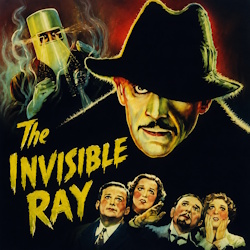
Bela Lugosi and Boris Karloff were coming off the success of their recent film, The Raven (1935), and Universal Pictures producer David Diamond wanted to cast them in a new film to be called Bluebeard. However, the script proved unsatisfactory, and the studio put the project on hold. A new film, The Invisible Ray, was chosen; however, it quickly went off track when director Stuart Walker left because he was dissatisfied with the script. Undeterred, Edmund Grainger was placed in charge of production with a large $168,875 budget, Lambert Hillyer was hired to direct, and Howard Higgin and Douglas Hodges were assigned to write the screenplay. For the cast, Boris Karloff played Dr. Janos Rukh, Bela Lugosi played Dr. Felix Benet, joined by Frances Drake as Diana Rukh, Frank Lawton as Ronald Drake, and Violet Kemble Cooper as Mother Rukh.
Dr. Janos Rukh has invented a telescope that can photograph light rays revealing the distant past. He, Dr. Benet, and Sir Francis Stevens witness images of an ancient meteor crashing to Earth a billion years ago and set off for Africa to confirm the discovery. Rukh discovers the meteorite but is exposed to a new form of radiation that he christens Radium X. This causes him to glow in the dark, makes his touch lethal to living things, and slowly drives him insane. Benet develops an antidote, but it offers only temporary relief rather than a cure. As Rukh succumbs to madness, he begins murdering the other members of the expedition one by one. His mother discovers his dark secret, destroys his bottles of antidote, and Rukh ultimately dies in a Radium X explosion that vaporizes his body. Although a change in directors and shooting delays caused the budget to balloon to $236,000, the film still made a profit for Universal. Critical reception was mixed, with some critics praising its entertainment value and technical ingenuity, while others found it lacking in genuine Gothic horror. The film received no Academy Award nominations.
In 1935, Universal Studio executives decided to promote Franz Waxman to director of music due to the tremendous success of his score for Bride of Frankenstein (1935). He was tasked with scoring The Invisible Ray, as the studio considered it a big-budget priority release that required his proven expertise. Upon viewing the film, I believe he understood that its narrative combined science fiction, Gothic horror, romance, and a collaboration between two of Hollywood’s most celebrated horror stars. He also recognized the value of using orchestral color to create the haunting and frightening atmosphere the story required.
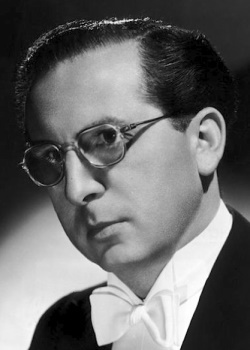 In conceiving his soundscape, Waxman’s guiding philosophy regarding the role of music in film was that it should not be relegated to mere decoration, but instead function as musical storytelling that illuminates the drama, guides the audience’s emotions, and reveals deeper truths. He had to be creative in maximizing the aural power of his twenty-two-piece orchestra through inventive orchestration, such as doubling violins with flutes and clarinets and using an organ to create a grand, dark, and Gothic atmosphere. Waxman was meticulous about synchronization, carefully controlling his dynamic range so that his orchestrations would not conflict with or drown out the film’s dialogue. His underscoring was highly discreet, designed to intensify emotion while allowing the spoken word to retain narrative priority.
Waxman decided to utilize the Wagnerian operatic tradition, building the score around a network of contrasting and recognizable leitmotifs. Foremost among these was the Radium X, or “Shining Face,” Theme. Waxman understood that he needed to evoke the unnatural and destructive power of the radiation. To accomplish this, he departed from conventional diatonic writing and turned to the whole-tone scale. Because the scale lacks a clear tonal center, it imparts a sense of restlessness, uncertainty, instability, and psychological dread. Closely related to it, and joined with it in horrific synergy, is the Madness Theme. Waxman combines the Radium X Theme with dissonant chromatic chords to represent the grotesque and isolating nature of the radiation, as well as Rukh’s tragic mental deterioration.
The Cosmic Theme speaks to the mysterious and unexplored depths of the universe. It opens with a sweeping, drum-empowered, upward-arpeggiated motif played by strings and harp, evoking the vastness of space. Waxman understood that an effective horror score requires contrast with the horror itself, and so he composed a highly melodic, sweeping romantic theme for the burgeoning relationship between Diana and Ronald Drake. This romantic subplot grounds the film in human emotion and serves as a counterpoint to Dr. Rukh’s descent into madness.
Dr. Benet’s Theme serves as the musical identity of Lugosi’s benevolent scientist and also provides a well-conceived counterpoint to Dr. Rukh. The theme offers a warm, structured, and tonal expression that acts as a melodic beacon of reason and authority, contrasting sharply with the harsh, unstable horn writing associated with Rukh’s radioactive powers. Finally, Waxman infuses his score with several classical pieces to provide the requisite cultural sensibilities, including the “Bridal Chorus” from Wagner’s Lohengrin, the “Wedding March” from Mendelssohn’s A Midsummer Night’s Dream, Op. 61, and Franz Liszt’s Hungarian Rhapsody No. 14 in F minor.
There is no commercial release of the score. As such I will use film time indices and scene descriptors to provide film narrative context to the music. The Universal Picture logo displays with a plane flying around a globe supported only by its engine sound. At 0:12 the “Main Titles” commence with white script displayed against a black background. We open dramatically with powerful declamatory horn fanfare, which dissipate into eerie, otherworldly harmonics. At 0:33 a descending harp arpeggios usher in a sweeping lyrical valzer elegante carried by the sumptuous strings. This introduces a lush, tragic romanticism, which supports the love triangle, and emotional alienation, between Janos, his wife Diana, and Ronald Drake. At 1:09 Waxman shifts dynamically to bring the Main Titles to closure by evoking the dark, supernatural, and awe-inspiring elements that draw inspiration from Edmund Burke’s “sublime of terror”, which was primarily used in operas to declare the presence of ghosts, oracles, demons, or furies. 1:15 “Foreword” opens with shimmering, and rapidly descending string tremolos, which introduce the supernatural feeling of “Radium-X”. We then flow into the narrative script;
“Every scientific fact accepted today was once burned as a fantastic fire in the mind of someone called mad. Who are we on this youngest and smallest of planets to say that the INVISIBLE RAY is impossible to science? That which of you to see a theory whispered in the cloisters of science. Tomorrow these theories may startle the universe as a fact.”
Waxman supports dramatically with a Romantic-Gothic idiom, which introduces his Cosmic Theme. It opens with a sweeping, drum empowered, upward-arpeggiated motif played by strings and harp, which evoke the vastness of the universe. As the text shifts to question whether the ray is impossible, the harmony slows, and shifts down into a foreboding minor modal expression. A syncopated horn rhythm joins, which presages the “fantastic fire” Dr. Ruhk will gain, as well as the inherent danger of wielding its awesome power. We close with a grand, resolving cadence as the narrator concludes that the theory is “whispered in the cloisters of science,” blending a sense of triumphant discovery with underlying terror. With these two opening cues, Waxman masterfully sets the tone of the film, and draws the audience into the story. The film proper opens in the Carpathian Mountains where we see the secluded laboratory of Dr. Janos Rukh. Inside Mother Ruhk, who suffered blindness from her son’s experiments, calls her daughter-in-law Diana to her. She helps mother up, and she worries that her son Janos will not learn until it is too late, that the universe is very large, and there are some secrets we are not meant to probe. Mother returns to her chair by the fire and Diana departs to inform Janos after seeing from a window, a car approach.
In 4:14 “The Laboratory”, we see Diana walking through the gothic castle to her husband’s laboratory. Waxman sets an ominous tone with a dramatic and atmospheric musical narrative within which is woven a musical adaptation of Franz Liszt’s Hungarian Rhapsody No. 14. Waxman uses sweeping turbulent, and thunderous orchestrations, which includes swirling strings, heavy, rumbling timpani to represent thunder, and shrieking woodwinds that echo lightning strikes. This brilliantly conceived sonic tempest underscores the cosmic danger and gothic settings of Ruhk’s Carpathian observatory. Lastly, subtly woven beneath the natural fury of the storm is the haunting, otherworldly Cosmic Theme. Waxman hints at the supernatural, using eerie, sustained chords to reflect Dr. Rukh’s obsession with capturing ancient light rays from the Andromeda galaxy. She finds him in the observatory peering through his telescope. The music dissipates when he looks up to answer her informing him that his guests soon arrive. In 5:04 “Tonight, They Will Believe” opens with a solitary flute delicato as Janos greets his wife with affection. An eerie violin tremolo supports as he declares with contempt that Dr. Francis Stevens and the great Dr. Felix Benet from the University of Paris, are coming. He adds, empowered by a grand declaration of the Cosmic Theme, “What do they know? What will they ever know? I will take them somewhere they have never been, back into time. They will never laugh at me again!” She calms him, and Waxman weaves in a gentle variation of the Love Theme played by the strings teneri. We shift into a lighter, rhythmic, and slightly accelerated tempo borne by flutes and oboes, which offer an elegant bridge that carries us from the cold and dark laboratory down to the more hospitable parlor below.
The guests arrive with Lady Arabella Stevens introducing herself, her husband, Sir Francis Stevens, Dr. Felix Benet, and her nephew Ronald Drake. Diana then introduces her mother-in-law, frau Ruhk. Janos joins and immediately joins Dr. Benet in pointed repartee, revealing clear personal animus. Janos is diverted by Lady Stevens and warms to her pleasant introduction to her nephew Ronald, whose maps he will find useful on the coming journey to Africa. In 8:01 “Janos’ Prepares His Experiment”, everyone assembles in the Observatory. Waxman creates a misterioso with high register woodwind figures to establish a sense of scientific mystery and the unknown vastness of outer space. The notes rapidly flutter, mimicking the twinkling or swirling nature of cosmic forces as Janos declares; “This is the Andromeda Galaxy”. He pulls out a receptacle, which will capture a light ray, which will be electronically transferred to a projector in his laboratory. There, he will recreate what is recorded on that beam of light. Beneath these light woodwind figures, is a slow, low-register undercurrent of horns and strings, which sow dramatic tension. Waxman with his music, informs the audience that beneath Janos’ brilliant scientific demonstration, lies a dangerous, nascent madness. At 9:23 the Love Theme joins on strings as Ronald asks if he can really do that? And Diana answers, he will not fail. An interlude without music supports Janos going to his laboratory to ensure the projector is ready to receive the captured light. Francis and Felix debate what the discovery would bring, while Diana and Ronald discuss her past. He is clearly enamored by her beauty and countenance. Janos returns wearing protective clothes and face shield. He starts his equipment, turns towards them, takes off his mask, and says, he is ready. He seats them behind Barium enriched glass barrier to protect them, dons his protective gear, and the prepares to begin the experiment. He says that to reproduce what is written upon the beam from Andromeda, we must travel out into space upon that ray of light, until we reach a point, turn, and look back upon our planet.
12:22 “Journey to Andromeda” offers a grandiose score highlight empowered by the Cosmic Theme. Janos proceeds on a monologue guided tour of the journey, with stunning visuals of outer space. Waxman deftly supports under the monologue with dynamic, shimmering string arrangements build in upward-sweeping arcs, evoking the feeling of leaving Earth’s atmosphere. In space, the Cosmic Theme, swirling with dramatic, and ethereal orchestration, beautifully captures the sense of cosmic wonder and scientific awe. Yet at 13:08 as we close upon Andromeda, and underlying sense of dread slowly builds. He pauses the journey, and informs that millions of years ago, a meteor bearing a powerful new element, Radium, struck in Africa. When the journey reaches its apogee, the music swells dramatically. It shifts from ambient cosmic tracking into an intense, rhythmically driven crescendo that punctuates the sudden time-travel reveal, tracking an ancient meteor as it violently hits Earth on the continent of Africa. Afterwards Drs. Benet and Stevens congratulate Janos on his momentous discovery, and the agree to Diana’s offer to take brandy in the parlor. In the parlor they all commend Janos, and toast to his success. Drs. Stevens and Benet then drop a bombshell – they intend to travel to Africa to locate the Andromeda meteorite and ask Janos to accompany them. He is pleasantly surprised and agrees. His mother however says, no. When Janos asks why, she presages misfortune, telling Janos that he is not used to people, and never will be. She closes with; “Your experiments are your friends. Leave people alone.”
17:34 “The Benet Expedition” opens with a scientific journal with an article title – “Radium “X” Goal of the Dr. Benet Expedition”. The camera zooms into the article, which indicates that Dr. Ruhk had separated from his colleagues to search for the coveted Radium “X” alone. Waxman composes an adventurous and optimistic springboard employing horn fanfares, and a driving, rhythmic tempo propelled by syncopated strings, and rapid woodwind runs. The music carries us out of the dark, isolated Carpathian laboratory, on to the global stage for Dr. Benet’s groundbreaking African expedition, a grand, celebrated, and heroic international scientific endeavor. We shift to Africa where natives bring supplies into camp. Drs. Benet and Stevens study an infant, who slightly glows, with Dr. Stevens declaring that human organisms are only part of astro-chemistry, controlled by radial forces from the sun. Later Arabella returns from a hunting expedition with fresh game, and sees that Diana is unhappy. In discussing this with Ronald, it strikes a raw nerve as she discovers that he has fallen in love with her. 21:37 “Ruhk Discovers Radium X” reveals that he has indeed gone rogue, abandoning Benet and Stevens, but also his wife. Waxman shifts the musical narrative from one of adventure, to one more dark and foreboding. Heavy, rhythmic horn motifs and low register, pulsing woodwinds express Rukh’s obsessive, unhinged drive for his coveted Radium “X”. At 21:51 the Geiger counter begins buzzing, frightening the native porter carrying it. Waxman aligns his orchestra with the visual and narrative trigger of the machine. As such, the music mimics the “alarm” state with shrill, piercing, high-register woodwinds buttressed by frantic, and agitated string tremolos. At 22:09 he runs and begin an ascent, which Waxman supports with an ascending, crescendo dramatico. We culminate at 22:30 with a grandiose declamation as he sees a rocky cauldron from which erupts gaseous plumes. A diminuendo carries him back to his native liter bearers and he unwraps and dons his protective gear. At 23:20 foreboding strings voice the Love Theme as Janos writes a letter to Diana, and then dispatches a courier to the base camp.
24:06 “Dinner” reveals the team dining at base camp supported by a steady nativist drum cadence, native chanting, and jungle sounds. Francis is in bad humor, and Diana and Ronald reserved due to their sexual tension. The courier arrives and Diana reads the letter, which informs that they are not to expect Janos back for some time. She tells the native master guide to bring the courier to her tent for questioning. Later, after the meeting, at 25:57 “I Am His Wife” reveals Diana instructing the master guide to prepare three men to accompany her to Janos’ camp. Ronald joins and asks why she is going, and she says because he is a great man, Waxman supports the scene with the Love Theme, borne by strings romantico tinged with sadness, which speak to Diana’s heavy heart and emotional sacrifice. Joining this narrative is subtle woodwind adornment, which infuses the music with bittersweet, and somber auras. At 26:36, when she further explains to Ronald that she is his wife, and that she has to support him, the score swells into a poignant resolution that captures the tragedy of her unrequited love for Ronald, and her entrapment to a husband consumed by a self-destructive obsession. Ronald replies, that she is not the type to let any man down, ever. The scene closes with Diana returning to her tent, but we see that the last word between them have not be spoken.
27:00 “Janos Retrieves Radium X” reveals Janos on a hoist, prepared to by lowered by rope down into the pit to retrieve a sample of Radium “X”. Waxman sow tension and an immediate sense of inescapable dread, with a heavy, repetitive and lower register, rhythmic, rumbling pattern. They lower him, and as he is hammering out a specimen, shimmering, dissonant and otherworldly orchestrations of the Radium X Theme evoke the strange, invisible, threat of radiation. The heavy, repetitive and lower register rhythmic rumbling pattern motif is sustained as Janos realizes the magnitude of his discovery, saying; “Power. More power than man has ever know.” The natives are agitated and the master guide says they want to go. Rather than be abandoned, Janos orders them to watch a massive perched boulder. As Janos prepares, loads, and activates the gun, the Radium X Theme erupts atop piercing woodwind and string trills, which creates an eerie, shimmering sonic texture meant to aurally represent the deadly, glowing “Radium X” radiation. The instant the gun blasts its invisible ray, the massive boulder disintegrates, and the orchestra explodes into a chaotic, descending multi-octave phrase. Waxman allows the music in the aftermath to dissipate into nothingness as we see a maniacal Janos’ mental health unravel before our eyes as he threatens to incinerate any native that opposes him.
29:47 “Janos Luminesces” offers a masterpiece composition in which Waxman uses his orchestra to evoke externally, Janos’ physical mutation, and internally, his descent into madness. The scene reveals Janos taking dinner outside his tent. He asks the server to take the lantern into the tent as it draws pests. He does so and once inside the tent we see Janos luminesce. The native returns, sees this, screams, and runs away terrified. Janos also notices and runs into the tent. The Radium X Theme expressed as a high register, shimmering, violin string tremolo supports the discovery. Janos turns the lamp off, begins to luminesce, and the music shifts from a glittering, awe-inspiring tone, into an ominous, heavy dissonance. Low register woodwinds and horns drop the register significantly to contrast with the high register violins, which punctuate his horrific realization. At 30:39 he grabs a mirror, Waxman distorts Janos’s primary intellectual theme by shifting it from a major key of scientific triumph, into a tragic, minor key. A crescendo di orrore surges in terror, and achieves a chaotic climax, mirroring Janos’s panic, and transformation, both physically by his luminescence, but also mentally, by his descent into madness. 31:19 Aftermath” reveals that he is stunned, and says it has poisoned me as otherworldly harp arpeggios cloak him. A string borne lament of despair joins as he sits on a cot, still unable to process what has happened. His loyal dog enters the tent and approaches him for comfort. He pets him, and the dog immediately collapses to the floor dead, carried by a life draining descent motif. Following this shock, the score collapses into a low-register, funeral-like dirge replete with somber woodwinds and muted horns, as Janos contemplates the horror and heart break of the realization that his mere touch is now a deadly weapon.
He hears noise, goes out and sees that Diana has arrived. He panics and closes himself off in his tent lest his touch kill her. She calls to him, and he tells her to go, that he does not want to see anyone while he works. 35:55 “I Understand” reveals that she is devastated by his callousness, but accedes to his wishes. She spends the night in another tent with the intention of departing in the morning. She goes to her tent and begins to weep supported by a heartbreaking, molto tragigo, down-sweeping wave of strings romantico, which speak to Diana’s isolation and despair. Janos grabs his Radium “X” garb, and weapon and decides to leave camp and seek the help of Dr. Benet. As he passes Diana’s tent, he hers her weeping supported by a minor modal variation of her melody. The strings mimic her crying, heightening the tragedy of a marriage callously severed by Janos’s cruel rejection. Janos arrives at the base camp and discloses to Felix his great discovery, and curse of being poisoned. Janos begs for Felix to create a cure, and he relates that there is one for radium that he could adapt for radium X if he knew the atomic structure. Janos gives him his notes that have the atomic structure, and Felix goes to work while Janos hides in the instrument tent. 37:39 “Diana Trek” reveals Diana traveling back at base camp, and clearly fatigued by the heat. Waxman supports with a beleaguered rendering of her theme. Back at base camp, Felix wakes Janos and gives him good and bad news; that the antidote works, ending his luminescence and the lethality of touching other. He adds however that it is not a cure, only an antidote that must be taken daily for the rest of his life. There is a caveat, there may be unknown effects on brain function from the daily interaction of poison and antidote. Janos is thankful, says he will complete his work at his camp, and then return. He also asks that his condition remain a secret between the two of them, to which Felix agrees.
40:07 “Ronald and Diana” reveals supported by animated nativist drums of base camp. A poor film edit shifts us jarringly at 40:12 to Ronald and Diana strolling together. He drops all pretenses and declares that he loves her. She is conflicted in her love, and they do not know what to do. As he moves in to kiss her, the dinner triangle sounds to break the moment. Waxman supports Ronald’s bittersweet earnestness with the Love Theme borne by violins romantico, buttressed by warm cellos. The theme has yet to blossom as Diana remains conflicted. 41:06 “Janos’ Revelation” reveals shifting drum rhythms and sounds as we see natives playing various drums. We settle into a four-beat drum ostinato as Felix arrives at Janos’ camp. He checks on Janos’ health, to which he replies is good. He is taken aback however by Janos’ declaration that he has harnessed Radium “X”’s power to destroy a nation, or all nations. Felix asks about harnessing its power to heal, and Janos replies, that will come later when I devise a filter to curb its power. He adds, until that time its power is mine, and mine alone. Felix discloses that they anticipated this, that something this powerful could not be left in the hands of one man, and so dispatched Dr. Stevens with the specimen you left me, to present this discovery to the International Scientific Congress in Paris. Janos becomes enraged yelling; Thieves! Thieves!” Felix calmly says you will be given full credit for the discovery, but we could not wait any longer for your results, especially since Diana has taken ill. He says he will depart and join them at Lake Nyanza. He then presents Janos with a letter from Diana. He is stunned and confides that she does not believe he loves her, and that she loves someone else. When he asks if it is Ronald Drake, Felix answers, yes. Janos erupts in fury, orders Felix out while grasping the Radium blaster. 44:29 “The Expedition Returns” opens with blaring fanfare dramatico as a newspaper headline informs that the Benet Expedition has left Africa, while Dr. Ruhk has returned to his Carpathian laboratory. The music slowly dissipates on a diminuendo of uncertainty.
In 44:49 “Janos Cures His Mother”, we shift to Janos’ laboratory where he aims his Radium X device at his mother’s eyes. Waxman supports with the Radium X Theme borne by trembling, dissonant string figures and mysterious tones to underline the dangerous, experimental nature of his power. As the procedure takes effect and the radium light beam touches her eyes, which become luminescent. The musical tension releases, replaced by ethereal, floating high strings and delicate harp glissandos to simulate a sense of wonder and the miraculous restoration of her sight. We close with the music blossoming into a lush, triumphant orchestral paean as the mother opens her eyes. The music then shifts to strings teneri for an intimate mother-son moment, which reflects her pride in the almost godlike grandeur of her son’s scientific achievement, while he relates; “I have harnessed it. Harnessed it. It’s mine at last”. He informs her that he leaves for Paris to present his findings, but mama cautions, saying that he will only find tragedy there. At 47:12, he says that in case he does find tragedy, he hands her an envelope that contains all his secrets. He confides that he has knowledge and more power than man has ever possessed – power to heal, or power to destroy. A somber, string-heavy variation of the Janos’s Theme, underscores the gravity and danger of the secrets inside the envelope. The music pivots to a gentle but deeply melancholy exposition by low register strings and woodwinds to represent Janos’s intuitive mother. It evokes an atmosphere of maternal tragedy, signaling her internal premonition that this element will destroy him. As the scene closes and Janos prepares to leave, the orchestrations swell into a sparkling and vibrant, cinematic crescendo draped with Parisian auras as the camera displays the Eiffel Tower and the bustling streets of Paris.
47:40 “Radium X” opens with horns dramatico as the screen displays; “The Medical Journal”. The journal opens and the article displays; “Doctor Benet’s Use of Radium X Startles Medical World”. Waxman offers Benet’s Theme infused with a sense of global prominence, excitement, and scientific triumph, expressed with sharp-edged horn accents and rising woodwind figures cut over the string rhythm. At 47:51 the camera zooms in and we read how Radium X has led to hundreds of maladies being cured. A diminuendo usher in a shift to Dr. Benet’s laboratory where he initiates a Radium X treatment on a young girl. On the street below, Dr. Ruhk arrives and enters the building. The girl is cured and her parents weeping and thankful. Benet calls for the next patient as Dr.Ruhk enters. We notice immediately dark, unsettling changes in Janos’ psyche. There is immediate tension, which Benet tries to diffuse, crediting him for his discovery, and commending him for receiving the Nobel Prize. Benet is happy that the antidote is still working, but Janos shifts the subject to Diana. Benet informs that she works as Lady Arabella’s secretary, that she remains in love with Ronald, but will do nothing until she speaks to you first. Janos says he will not stand in the way of their happiness, to which Benet commends. Benet then says that his discovery was too great for one man to control. Janos counters that someday he will realize that you have not yet even scratched the possibilities of Radium X, and, he is still the only man to control it fully.
51:47 “Janos’ Offer” reveal Janos walking along a Paris Street. Source music borne by spritely strings join a street organ grinder playing a lively, repetitive, and intentionally mundane carnival-like tune in the background. The music offers juxtaposition, belying Janos’ dark purpose. He selects a man of his height and stature, and offers him a ‘benefit’, from which he will profit. He agrees, and the scene ends with the two men walking away. We shift to Lady Arabella’s office where Diana types her dictation. The maid brings in a newspaper and the lead story read; “Radium X Discoverer Found Dead”. Diana is overcome, and the scene fades to black. 52:55 “Diana and Ronald Marry” opens with church bells and the “Bridal Chorus” by Wagner played on an organ, which support the wedding ceremony. As they exit the church, “The Wedding March by Mendelssohn supports. At 54:19 dire horns resound and support the sight of Janos lurking in the shadows. He glares as they depart supported by a dark, discordant, music with menacing undertones. He looks up and sees six statues and Waxman introduces a repeating Six Saints Theme borne by celli sinistri, a fluttering string tremolo, dire horns and an ominous heavy rhythm. Janos conceives a diabolical plot linking the six stone statues to the six members of the expedition. The theme will act as a musical harbinger for his countdown of revenge, where he systematically uses his lethal radium weapon to kill off his targets. He superimposes their image of the statutes; Diana, Ronald, Felix, Arabella, Francis and himself. We close on dire trumpets and a harp glissando misterioso. Janos visits an apartment building, and rents a unit facing the chapel for five francs/week. He looks out the window at statue one, and says; Sir Francis Stevens – thief.
Arabella and Felix are waiting for Francis in the parlor as they have a dinner date. She sends the butler to retrieve him and a maid screams. She is hysterical and runs past the butler who goes upstairs to investigate. The butler returns and says to come up immediately and they run up to investigate. They find him dead with a terrified facial expression. Benet asks Arabella to retrieve Francis’ ultraviolet camera from his laboratory so he can conduct an experiment before summoning the police. He takes the picture of Francis’ eyes and develops the plate in his lab. He places it in the viewer and we see an image of Janos on the pupil. Benet says, I knew it, however he accidently drops and shatters the plate evidence when removing it. We shift to Janos’ room where he glares with glee out the window. A crowd is held back by police as we see statue one has melted. He then looks at statue two, and says; Lady Stevens – match-maker. 1:01:18 “Rising Panic” reveals a newspaper boy shouting out the latest edition; “Radium X Claims Third Victim”. The city is gripped by panic as Dr. Benet assist police in tracking down the murderer. Waxman sow suspense and tension using staccato woodwinds and horns, which play over tense rumbling low register strings underneath. The camera focuses on; “Titled Woman Dies in ‘Curse’”. Dire horns and a harp glissando close the narrative as we shift to Lady Arabella’s bedroom, where Felix drapes Arabella’s body. Diana and Ronald arrive with the medical examiners, but Felix advises against Diana seeing the body. Diana and Ronald leave, and Dr. Benet turns off the lights and lifts the sheets. They all see a luminescent choke print of a hand over Arabella’s throat. Dr. Benet advises that only a person poisoned by Radium X could do this, and the one person he knows who was poisoned, Dr. Ruhk, died. Downstairs Diana frets over what has happened and asks how do we fight something we cannot see, cannot reach and cannot touch? Back upstairs, Dr. Benet convinces the medical examiners and police that Dr. Ruhk is not dead, only an imposter. They decide to commence a city-wide search to find him.
1:04:49 “Ruhk’s Terror” reveals new newspaper headlines; “Terror Grips Crowd as Statue Melts”, and “Sacred Image Mysteriously Disappears in Sight of Throng as Onlookers Faint and Pray”. Waxman sow a rising panic with frenetic, fast-paced strings, dramatic dissonant horn declarations, and percussion to amplify a growing sense of panic. A grim, dirge-like musical narrative then unfolds as we shift to a meeting of the police, medical examiners, Ronald and Dr. Benet. They plan to lure him here with an announcement that Dr. Benet and Ronald will be speaking about the Radium expedition to Congress scientists. If Ruhk manages to get past security, we will bolt all the doors closed, and at midnight, turn off the electrical power. His skin will luminesce, exposing him, and allowing his capture. Outside Janos approaches Dr. Meiklejohn and is able to lure him into an alley where he kills him, and takes his invitation card. Janos successfully makes it past the checkpoint, but circles the grounds to enter from the back. With all the guests admitted, the police synchronize their watches for 12:00 midnight. Janos watches from a window as Dr. Bent goes to his laboratory hoping to lure Janos in. 1:11:55 “Janos Kills Dr. Benet” reveals that it is just before midnight, and Dr. Benet opens the back door of the Laboratory and is confronted by Janos. The Radium X and Madness Themes evoke terror, and resound in an unholy synergy draped in shimmering string textures. Heavy, unsettling horns with frantic, disharmonious string phrasing express Janos’ psyche’s decay, and descent into madness. Benet retreats but is cornered with heavy ominous horns portending his doom. As they talk Dr. Benet turns the light switch off and Janos begins to glow. Dr. Benet’s Theme borne by low-register woodwinds and string tremolos build an underlying sense of panic and claustrophobia during their dialogue. Dr. Benet tries to reach out to Janos’ humanity to no avail. Janos says you are all thieves and must pay. He says it will be easiest if you just shake hands, however, Dr. Benet reaches to fire his pistol, but it is too late and at 1:12:52 a heavy musical death chord buttressed by loud percussion and shrieking horns of the Radium X Theme offer a lethal exclamation point to the murder, with a descent motif carrying Dr. Benet’s collapse unto death.
1:13:01 “Aftermath” returns us to the gathering where Ronald inquiries about his wife, while upstairs Diana frets to Mrs. Noyer. Waxman shifts to a low-register atmospheric underscore borne by trembling strings and subtle, dissonant brass undertones to mirror the characters’ growing unease and psychological dread. 1:13:37 “Madame Ruhk Arrives” reveals the arrival of Janos’s mother, Madame Rukh. Ronald greets her, thanks her, and she said it was her duty to be here. Waxman sets an ominous tone using deep, low register woodwinds and quiet foreboding strings to capture the underlying tension and the tragic weight of bearing Janos’s dark secret. She asks for Diana and Ronald escorts her up, as a policeman looks at his watch a few seconds from midnight. He shuts off the power breaker Waxman sow tension and a creeping dread using an eerie, sustained string tremolo combined with low register woodwinds. This creates an immediate sensation of pitch-black tension and creeping dread. As Janos sneaks up the back stairs, deep and ominous horn chords and low-register woodwinds mimic his slow, deliberate footsteps. Woven within the musical narrative are fragmented variations of Janos’s Madness Theme draped with dissonant, unsettling harmonies, which signal his monstrous, and completely unhinged psychological state.
1:14:49 “Diana Discovers Janos” reveals Diana entering the corridor with a candle holder and yelling Ronnie! Janos calls to her; “Diana”. She turns, is shocked, and drops the candle, which extinguishes. She beholds Janos glowing and flees terrified into the bedroom. He follows empowered by a monstrous Madness Theme. She is trapped, cowers, and he moves in to kill her empowered by a crescendo di terrore, which crests horrifically at 11:15:54 when he relents, unable to bring himself to kill her. We shift downstairs as several men find it strange that Dr. Benet has not returned, and they go to investigate. They find him dead with his right-hand glowing and deduce that Ruhk is in the house. They fan out to search, while upstairs Janos makes a second attempt to kill Diana empowered once again by his Madness Theme. Yet once again he relents, saying with a tortured voice; “No, I can’t kill you. I can’t.” But then he adds with eyes glaring with rage, that Ronald must die. As he departs, the music’s tempo slows to a heavy, and portentous funereal pace. Low register woodwinds and somber strings signal that Janos’s time is running out, as his body begins to succumb to the elemental radiation consuming him from within.
1:16:35 “Mother and Son” Janos comes face to face with his mother. Waxman’s musical conception for the finale is masterful, as he shifts the musical narrative from horror, to operatic, and finally, redemption. At 1:16:44 Janos calls out, mother supported by strings tragico, which evoke a sense of profound pity, and inevitability. He grabs his antidote case and says; “I must have time” I must reach one more – Drake. At 1:17:04 a crescendo dramatico swells as mother raises her cane and smashes his antidote vials, punctuated with shrieking violins, and a descent motif of despair. She says; “My son, you have broken the first law of science”. He looks at her pathetically, and says, perhaps it is better this way as smoke plumes begin to emerge from him. He says goodbye mother, and then a crescendo dramatico carries his run up the stairs, leap through a glass window, and fall to the ground with him flashing into all-consuming and vaporizing fireball. At 1:17:51 as Ronald comforts Diana, the Love Theme swells into a warm, sweeping orchestral movement featuring lush strings and woodwinds. 1:18:05 “Denouement” reveals a scientist gently taking her hand and asking Madame Ruhk, may I pay you homage? Tender strings bearing maternal love support as she says no. She says with maternal pride that “Janos Ruhk is dead, but part of him will go on eternally, working for humanity.” Waxman closes the film in classic Hollywood, Golden Age fashion atop a crescendo di speranza, which culminates in grand fashion atop a refulgent major chord with “The End”.
Franz Waxman received accolades when he transformed the Horror genre with his paradigmal score for “The Bride of Frankenstein” (1935). This latest effort served to reaffirm his mastery of the genre for what many describe as an underrated, and groundbreaking work. I believe Waxman crafted an exceptional, well-conceived and executed musical landscape enriched by masterful musical storytelling, which offered a thoughtful commentary on the destructive nature of man’s pursuit and misuse of power. Rather than merely providing background noise, stingers, eerie and haunting atmospherics for a standard “mad scientist” film, Waxman instead used sophisticated, operatic motifs to contrast the noble intent of discovering power, and the psychological corruption that comes from wielding it. The film offers a stark philosophical contrast between Dr. Rukh who hoards the power of Radium X and uses it destructively for vengeance, and Dr. Benet who seeks to use it altruistically to cure blindness. Waxman, highlights this moral divide through his underscoring; when Dr. Benet speaks of healing humanity, the music assumes warm, classical structures. However, when Dr. Rukh hoards his discovery, the score turns jagged and chaotic. The music explicitly judges how the two men choose to use power—framing Dr. Benet’s path as harmonious, and Dr. Rukh’s as violently unstable. Waxman also chose to focus on the inherent human tragedy of the main character who is consumed by ambition, and ultimately destroyed by obsession. His music masterfully expresses the heartbreak, and psychological unraveling of Dr. Janos Rukh as he slowly mutates into a toxic, glowing and malevolent monster. Indeed, by delivering a fully cohesive original symphonic composition, Waxman once again set a new qualitative standard for how Hollywood approached science-fiction filmmaking. Folks, if you like sophisticated musical storytelling, that illuminates, guides your emotions, and espouses deeper truths, which weaves together a haunting and tragic commentary that involves science fiction, mystery, romance, and a testament to the axiom that “Absolute power corrupts, absolutely”, then this is a score for you. Until such time we can get a re-recording, I highly recommend taking in the film on a streaming service.
For those of you unfamiliar with the score, I have embedded a YouTube link to a suite: https://www.youtube.com/watch?v=P3m-IV2-THI&list=RDP3m-IV2-THI&start_radio=1
Track Listing:
- NOT AVAILABLE
Music composed and conducted by Franz Waxman. Orchestrations by Clifford Vaughn. Recorded and mixed by XXXX. Score produced by Franz Waxman.

Shop at the Movie Music UK Store

Member of the


