THE FIRST WIVES CLUB – Marc Shaiman
 THROWBACK THIRTY
Original Review by Jonathan Broxton
The First Wives Club is a comedy-drama film directed by Hugh Wilson, adapted by Robert Harling from Olivia Goldsmith’s bestselling novel. It stars Bette Midler, Goldie Hawn, and Diane Keaton as Brenda, Elise, and Annie, three college friends reunited by the death of a fourth member of their old circle, Cynthia. Each has reached middle age only to discover that the husband she helped support has left her, betrayed her, or traded her in for someone younger. Their grief and anger become a plan: expose the men’s hypocrisies, hit them where it hurts, and reclaim the confidence they have lost. The film has an astonishing supporting cast, including Stockard Channing and Maggie Smith, Dan Hedaya, Victor Garber, and Stephen Collins as the philandering husbands, and Sarah Jessica Parker and Elizabeth Berkley as two of the younger women the husbands leave their wives for, plus Marcia Gay Harden, Rob Reiner, a young Timothy Olyphant, and various real-life New York feminist icons and socialites playing themselves.
The project had a long road to the screen. Goldsmith wrote the novel from her experiences and those of divorced friends, and the manuscript generated a Hollywood bidding war before it had found a publisher. Australian filmmaker P. J. Hogan, still riding high on the success of his film Muriel’s Wedding, was originally set to direct before Hugh Wilson, the director of the first Police Academy film, came on board. The casting attracted a number of heavyweight Hollywood comediennes for the lead roles – Jessica Lange and Sally Field were both considered before Keaton, Midler, and Hawn ultimately signed on – but the resulting film became one of the surprise box-office successes of 1996, with audiences responding positively to the chemistry between the three leads, while their grievances – being undervalued, growing older in a culture obsessed with youth, and losing financial or emotional security after years of marriage – hit home with a significant portion of the film’s target audience.
 The score for The First Wives Club was by composer Marc Shaiman, who of course began his career working as the music director for Bette Midler, and had worked with producer Scott Rudin on The Addams Family in 1991 and Sister Act in 1992. Shaiman was deep within his prime Hollywood A-List career in 1996 and was ideally suited to the material, as it required him to move quickly between theatricality, sophistication, and emotional directness, capturing both the inherent sadness and the urbane comedy without making either element feel insincere. To achieve this, Shaiman crafts a series of cues which are by turns playful, whimsical, and poignant, and often underpinned with a soupçon of New York jazz.
The score opens with a quick run through the four themes for the four women at the center of the story: Stockard Channing’s “Cynthia,” whose shocking death during the first few minutes of the film brings the women back together, and then the character themes for Keaton’s perkily optimistic “Annie,” Hawn’s cheerfully sexy “Elise,” and Midler’s outwardly sarcastic but inwardly wounded “Brenda,” each of which offers a compact portrait of a distinctly different personality. Shaiman uses these ideas as building blocks, allowing the women’s individual identities gradually to coalesce into the larger sound of the club, and often imparts specific instrumental colors to them: tender pianos for Cynthia, frisky strings for Annie, sultry saxophones for Elise, wistful woodwinds for Brenda, and so on.
It’s actually quite interesting how Shaiman structures the score because, although all four women’s themes feature prominently in the rest of the work, it is Cynthia’s theme that is the cornerstone: her sad demise is the wake-up call that the others need, her memory is the driving force for their actions, and in the finale it is their salute to her that provides the emotional catharsis. The reprise of Cynthia’s theme in “Bad News” is poignant, and then later in “Letter to Three Wives” it is downbeat and introspective, before Shaiman gives the melody an unexpectedly strident militaristic variation in “The First Wives Club” that feels like a piece of temp track love from Robert Folk’s Police Academy scores.
However, what makes The First Wives Club such a fun score is hearing Shaiman pull from all manner of styles and influences to create pastiches and homages encompassing numerous classic New York sounds. The opening part of “Gathering Information” is a fantastic riff on Nino Rota’s Godfather mafia sound for the Uncle Carmine character, a member of Brenda’s family who has mob connections. There is a bold, toe-tapping rock music vibe to “Setting Up Shop” that continues through several subsequent cues, and then “Tea Time With Gunilla” underscores Maggie Smith’s imperious society doyenne with a touch of harpsichord mischief combined with New York jazz, giving the cue exactly the elegant comic poise the character requires.
“Duarto Makes His Entrance” is an amusing burst of character writing for Bronson Pinchot’s cameo as Brenda’s boss, who is (according to Annie) “one of the ten worst interior decorators in New York City,” with music that combines sparkling George Gershwin inflections with echoes of Alfred Newman’s sweeping music for 1950s melodramas and comedies such as How to Marry a Millionaire.
“The Big Break In” is the score’s orchestral showpiece, a wonderfully intricate five-minute romp in which Shaiman accompanies the women’s clandestine activities in Brenda’s ex-husband Mort’s penthouse with breathless strings, chattering woodwinds, lively brass, and a succession of comic rhythmic feints. The music plays like a Looney Tunes cartoon with Carl Stalling channeling Gershwin’s sophisticated New York energy, while its combination of bustling action music and deadpan orchestral comedy recalls the lighter scores of Elmer Bernstein to excellent effect, perhaps blended with a little opera buffa and a dash of Mozart? It all comes at you so thick and fast that it’s hard to keep up.
Shaiman puts all the main women’s themes through the light action music wringer (including Gunilla’s), and at its most frenetic the cue has the feel of a Broadway overture running at breakneck speed, with the sort of kinetic orchestral dexterity one associates with An American in Paris or West Side Story, filtered entirely through Shaiman’s own melodic and theatrical personality. The same can be said of the conclusive “Operation Hell Hath No Fury,” which adds a reprise of the First Wives Club military march, and blends the women’s themes, Uncle Carmine’s theme, and the FWC rock motif into a piece that is full of action and terrifically complex both rhythmically and instrumentally – there is some astonishingly fluid and complicated writing for woodwinds layered against frenetic string lines and bursts of fanfare-like brass.
Everything ends with the rousing, triumphant reprise of Cynthia’s theme in “The Unveiling,” as the women use the money they liberated from their corrupt husbands to establish a crisis centre for women, named after Cynthia and located at the former headquarters of the First Wives Club.
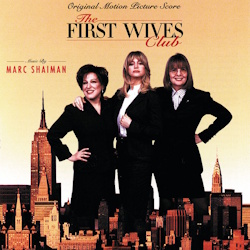
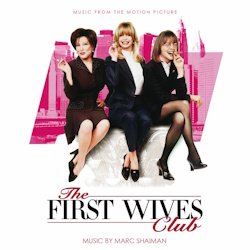 In addition to his scoring duties, Shaiman was also responsible for the film’s needle-drop song choices and musical numbers. It was he who suggested using Dionne Warwick’s version of Burt Bacharach and Hal David’s “Wives and Lovers” for the main title, and then, for the joyous closing scene, he created a new arrangement of Lesley Gore’s “You Don’t Own Me” for Midler, Hawn, and Keaton to sing on-screen, turning a 1960s pop anthem into a declaration of independence for the three characters. The accompanying song album features both songs prominently, alongside popular feminist anthems by Diana King, the Eurythmics, Aretha Franklin, and M People, among others. The original Varèse Sarabande score album presented just over half an hour of Shaiman’s music, while La-La Land’s 2022 expanded release allowed the score more room to breathe and offered some fun extended sequences, alternates, and pieces of source music.
At the 69th Academy Awards, Shaiman received the film’s sole Oscar nomination, in the then-separate category of Best Original Musical or Comedy Score, but eventually lost to Rachel Portman’s Emma. Despite that, I think it was deserved recognition; the score is witty, sentimental, and energetic in all the right ways, and perfectly showcases Shaiman’s innate skill at balancing all three elements without overwhelming the comedy. The First Wives Club may be remembered first for its stars, its one-liners, and that triumphant final song, but Shaiman’s contribution is central to its tone and emotional cohesion – stylish, melodic, funny, heartfelt, and enormously enjoyable.
Buy the First Wives Club soundtrack from the Movie Music UK Store
Track Listing:
- ORIGINAL 1996 RELEASE
- Cynthia (2:14)
- Annie (0:46)
- Elise (0:47)
- Brenda (0:45)
- Bad News (0:51)
- Wham, Bam, Divorce Me Ma’am (1:23)
- Letter to Three Wives (1:56)
- The First Wives Club (1:48)
- Gathering Information (1:55)
- Setting Up Shop (1:11)
- Tea Time With Gunilla (2:53)
- Duarto Makes His Entrance (0:41)
- The Big Break In (5:17)
- Phone Tag (0:59)
- The Auction (1:58)
- Operation Hell Hath No Fury (4:45)
- The Unveiling (0:56)
- 2022 EXPANDED RELEASE
- Cynthia (2:19)
- Annie (1:26)
- Elise (0:51)
- Brenda (0:50)
- Lithium?/Brenda Insulted (0:42)
- Bad News (0:53)
- He Has Reprioritized (0:43)
- Wham, Bam, Divorce Me Ma’am (1:26)
- Letter to Three Wives (1:56)
- The First Wives Club – Part 1 (1:07)
- Mole/The First Wives Club – Part 2 (1:42)
- Gathering Information (2:03)
- Setting Up Shop (1:17)
- Tea Time With Gunilla (2:57)
- Durato Makes His Entrance (0:43)
- Gunilla Arrives (0:17)
- The Big Break In (5:19)
- Phone Tag (1:02)
- The Auction (1:34)
- Unzip Me/Daddy’s Engaged (1:30)
- Operation Hell Hath No Fury (7:34)
- Whadda We Hafta Do? (0:28)
- The Unveiling (1:00)
- Letter to Three Wives (Alternate Take) (2:00) BONUS
- The First Wives Club – Part 1 (Alternate) (1:04) BONUS
- Setting Up Shop (Album Version) (1:18) BONUS
- Tea Time With Gunilla (Album Version) (2:58) BONUS
- Tea Time With Gunilla (Alternate) (1:21) BONUS
- The Auction (Album Version) (2:02) BONUS
- Elise Drinking Source (0:38) SOURCE
- Mo’s Toes (written by Brad Dechter) (0:43) SOURCE
- Tangerine (written by Johnny Mercer and Victor Schertzinger) (1:54) SOURCE
- You Brought a New Kind of Love to Me (written by Sammy Fain, Irwin Kahan, and Pierre Norman) (1:16) SOURCE
- In the Cool, Cool, Cool of the Evening (written by Johnny Mercer and Hoagy Carmichael) (1:31) SOURCE
- The End (contains “In the Cool, Cool, Cool of the Evening”) (Unused) (0:43) SOURCE
Running Time: 31 minutes 05 seconds — Original
Running Time: 57 minutes 07 seconds — Expanded
Varèse Sarabande VSD-5781 (1996) — Original
La-La Land Records LLLCD-1601 (1996/2022) — Expanded
Music composed by Marc Shaiman. Conducted by Artie Kane and Edward Karam. Orchestrations by Jeff Atmajian, Frank Bennett, Brad Dechter, Jon Kull, Patrick Russ, and Evan Vidar. Recorded and mixed by Dennis Sands. Edited by Nic Ratner and Nicholas Meyers. Album produced by Marc Shaiman. La-La Land expanded album produced by Dan Goldwasser.

Shop at the Movie Music UK Store

Member of the


