Under-the-Radar Round Up 2026, Part 3
 Original Reviews by Jonathan Broxton
I’m pleased to present the latest installment in my on-going series of articles looking at the best under-the-radar scores from around the world.
This article, the third of 2026, explores six more outstanding scores from recent months, including an Italian documentary celebrating 150 years of one of the country’s most important newspapers, a French comedic mystery inspired by the films of Alfred Hitchcock, a live-action western adventure based on the classic Lucky Luke comics, a gloriously retro French-Belgian parody of 1980s police thrillers, a Chinese historical documentary exploring a thousand years of Huizhou culture, and the latest entry in Spain’s outrageously irreverent Torrente comedy series.
150 ANNI DI CORRIERE DELLA SERA: IL RACCONTO DELL’ITALIA – Remo Anzovino
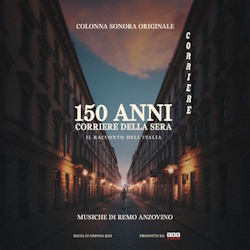 150 Anni di Corriere della Sera: Il Racconto dell’Italia is a documentary feature film directed by Simona Risi. The film uses archival footage, historical reporting, and testimony to trace the 150-year history of Corriere della Sera – Italy’s oldest and most-read newspaper – and, through it, all the political, social, and cultural shifts that have defined and shaped modern Italy. The film was released in Italian cinemas in March 2026 and features narration by popular actors and presenters such as Neri Marcorè, Cristiana Capotondi, and Serena Rossi.
The film’s score is by composer and pianist Remo Anzovino, who has gradually become one of the most distinctive voices in contemporary Italian screen music. He has recently developed a particularly fruitful niche in documentaries about art, culture, and history, with credits since 2019 including Hitler Versus Picasso, Van Gogh: Of Wheat Fields and Clouded Skies, Water Lilies of Monet, Gauguin in Tahiti, Frida: Viva la Vida, Borromini and Bernini, and The Immortals: Wonders of the Museo Egizio.
The score for 150 Anni di Corriere della Sera may be one of Anzovino’s most satisfying works in this vein. It is built around “Strillone,” a warm, lyrical theme for piano and orchestra inspired by the image of a young newspaper seller carrying the first Corriere through the streets of Milan in 1876. The melody has an immediate, gently nostalgic appeal, but Anzovino never allows the score to become a simple exercise in wistfulness. Instead, he uses the theme as a thread running through changing decades, reshaping it as the film’s historical perspective shifts.
“Via Solferino” has an elegant, almost lullaby-like lilt, whereas “Anatomia di una Nazione” expands the central idea into something broader and more ceremonial, giving the birth of the Italian Republic a real sense of optimism and consequence. “Albertini” returns the material to a more intimate piano setting, but from “Passaggi di Tempo” onward, the score increasingly embraces electronics. “Elzeviro” combines strings with an insistent modern pulse, and “Milano New York” places repeating piano figures against subtle synthetic textures, creating a persuasive sense of forward motion.
The darker historical episodes are handled with equal intelligence. “Io So” introduces a rougher, guitar-driven edge, whereas “Tobagi,” written for the murdered journalist Walter Tobagi, strips the emotion back to piano-led introspection. “Intervista a Khomeini” is tense and rhythmically charged, driven by pulsing electronics, and “P2” is one of the score’s most ominous pieces, using dense electronic sonorities to suggest institutional danger and moral unease.
Later, “Voce Libera” and “Transizione” offer lovely variations on the main theme, while “Ritagli” brings in Massimo Marches’s acoustic guitar for a distinctly Mediterranean color. “Cutuli,” for reporter Maria Grazia Cutuli, pushes the electronics toward abrasive, almost noise-like textures – a striking contrast to the score’s more lyrical material that perfectly captures the horror of her death while on assignment in Afghanistan in 2001. “Mani Pulite” drives forward on a dramatic ostinato of strings, synths, and metallic percussion, whereas “Rotativa” offers another reflective, guitar-led interlude.
The concluding “Strillone – Piano Solo” is the perfect ending: the central melody reduced to its essence, intimate and direct, as though 150 years of history have finally been distilled into one human voice. This is an excellent documentary score – melodic, thoughtful, varied, and emotionally sincere – and another reminder that Remo Anzovino deserves a much wider international audience.
Track Listing: 1. Strillone (2:28), 2. Via Solferino (2:55), 3. Anatomia di Una Nazione (2:37), 4. Albertini (0:45), 5. Passaggi di Tempo (1:39), 6. Elzeviro (2:59), 7. Milano New York (2:41), 8. Io So (2:05), 9. Forze Contrarie (0:57), 10. Tobagi (2:43), 11. Paese Che Cambia (1:03), 12. Angeli del Fango (1:29), 13. Intervista a Khomeini (2:04), 14. P2 (2:46), 15. Voce Libera (1:05), 16. Transizione (1:14), 17. Ritagli (1:30), 18. Riflusso (2:30), 19. Morire d’Amore (0:45), 20. Strillone (Reprise) (0:59), 21. Cutuli (2:19), 22. Fatti e Opinioni (2:04), 23. Il Sultano e San Francesco (2:32), 24. La Rabbia e l’Orgoglio (1:29), 25. Mani Pulite (1:28), 26. Equilibri (1:03), 27. Bollettino Meteorologico (1:33), 28. La Cucina del Giornale (0:59), 29. Rotativa (4:23), 30. Sanpietrini (1:10), 31. Strillone (Piano Solo) (2:29). Decca Italy, 58 minutes 54 seconds.
LE CRIME DU TROISIÈME ÉTAGE/MURDER IN THE BUILDING – Laurent Perez del Mar
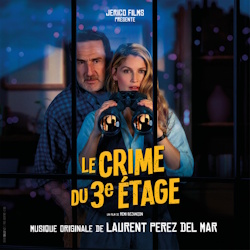 Le Crime du Troisième Étage, released internationally as Murder in the Building, is a French comic mystery-thriller written and directed by Rémi Bezançon. The story follows Colette Courreau (Laetitia Casta), a Sorbonne film professor and Alfred Hitchcock specialist, who becomes convinced that her new neighbor has murdered his wife after witnessing something suspicious through the windows across the courtyard. Her husband, François Tarnowski (Gilles Lellouche), a writer of old-fashioned historical crime novels, is initially skeptical but soon finds himself drawn into Colette’s increasingly elaborate amateur investigation. The film is conceived as a playful love letter to Hitchcock, especially Rear Window, while incorporating references to Vertigo, Psycho, Rebecca, and the famous “MacGuffin.”
The score is by French composer Laurent Perez del Mar, who has been one of the most consistently impressive voices in European film music over the last decade. Perez del Mar first gained significant international attention with The Red Turtle in 2016, a gorgeous orchestral score that earned Annie Award and Lumières nominations and won the International Film Music Critics Association Award for Best Original Score for an Animated Feature. Murder in the Building continues his fruitful relationship with Bezançon, following previous collaborations such as Zarafa, The Mystery of Henri Pick, and Paint It Gold.
Given the film’s subject, the obvious danger would have been to write a straightforward Bernard Herrmann pastiche, but Perez del Mar is too smart for that. The music unquestionably evokes Herrmann’s Hitchcock collaborations through nervous string writing, darkly romantic harmonies, bursts of orchestral violence, and a constant sense of something sinister beneath the surface, while retaining Perez del Mar’s melodic elegance and flair for emotional warmth. Contemporary reviews of the film specifically noted how the music resurrects the spirit of Herrmann without simply imitating him, and that is exactly right. The opening “Le Crime du Troisième Étage” establishes this approach immediately, balancing mystery, theatricality, and sly humor in an expansive introduction to the score’s central sound.
The main theme recurs in numerous guises, with especially effective reprises in cues such as the explosively dramatic “La Révélation,” the moodily mysterious “Fenêtre Sur Crime,” and the glassy, enticing “Les Enchaînés.” Several additional ideas emerge as the work progresses. The theme for “Colette” has a gorgeous, sensual quality. “Prélude du Crime” is wonderfully dramatic, functioning almost like a miniature Saul Bass title sequence in musical form, while “Vertigo” leans into spiraling, obsessive textures that conjure psychological unease without simply copying its inspiration.
The score’s centerpiece is arguably the nearly nine-minute “La Fouille de l’Appartement,” in which Perez del Mar sustains tension over an unusually long span, gradually tightening the musical screws with anxious strings and escalating orchestral urgency. The recurring integration of the main theme and Colette’s theme is handled skillfully, with the cue ultimately emerging as one of the best extended sequences of Perez del Mar’s recent career.
Elsewhere, “Le Lever de Rideau” is spiky and unnerving, “L’Homme De Ma Vie” is a thrilling action cue, “Le Spectre” moves into even darker melodramatic territory with church organ and religioso vocals, and “I Create Suspense” is especially clever, subverting the expectations created by its title through music that is actually calm, almost dreamlike. “La Fouille du Théâtre” develops the suspense writing on a larger scale and brings an overtly cinematic sense of old-school glamour and intrigue. “Le Duel à l’Épée” allows Perez del Mar a brief burst of flamboyant swashbuckling action, “Le MacGuffin” is a cheeky and self-aware dash of heroism, and “La Botte Secrète” dips its toes into Renaissance pastiche, somehow crossed with flamenco instrumentals. The concluding “Le Criminel est Parmi Nous” gathers the album’s mystery and theatricality into one final flourish.
Murder in the Building is an enormously entertaining score. Perez del Mar pays affectionate tribute to Herrmann and Hitchcock without surrendering his own musical identity, resulting in music that is elegant, suspenseful, witty, richly orchestral, and tremendously enjoyable. It is another outstanding entry in his increasingly impressive filmography and one of the year’s most delightful throwbacks to the grand tradition of sophisticated mystery scoring. The album runs for a generous 48 minutes and is available to stream and download from the usual retailers via the B Original Music label.
Track Listing: 1. Le Crime du Troisième Étage (4:44), 2. Colette (0:31), 3. Prélude du Crime (Générique de Début) (0:58), 4. La Révélation (2:12), 5. Vertigo (1:54), 6. Fenêtre Sur Crime (3:39), 7. La Fouille de l’Appartement (8:55), 8. Le Lever de Rideau (2:02), 9. Les Enchainés (2:42), 10. L’Homme De Ma Vie (1:28), 11. Le Spectre (3:22), 12. I Create Suspense (1:51), 13. La Fouille du Théâtre (4:34), 14. Le Duel à l’Épée (1:00), 15. Le Macguffin (0:39), 16. La Botte Secrète (0:54), 17. L’Émission de Radio – Générique (0:25), 18. Le Chat (0:30), 19. L’Étau Se Resserre (1:50), 20. Sueurs et Frissons (1:17), 21. L’Alliance (0:41), 22. Le Criminel Est Parmi Nous (1:52). B Original, 48 minutes 00 seconds.
LUCKY LUKE – Thomas Cappeau
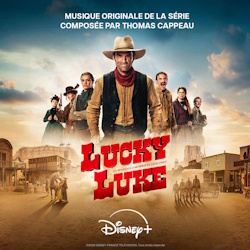 Lucky Luke is an eight-part French live-action western comedy-adventure developed by Mathieu Leblanc and Thomas Mansuy from the legendary comic created by Morris and René Goscinny, and directed by Benjamin Rocher. Alban Lenoir stars as the famous cowboy who shoots faster than his shadow, here drawn into an unexpectedly personal adventure when he agrees to help the headstrong 18-year-old Louise Willow find her missing mother. Billie Blain plays Louise, and Alice Taglioni plays her mother, Charlie; familiar characters from the comic include Jérôme Niel as Joe Dalton, Camille Chamoux as Calamity Jane, and Victor Le Blond as Billy the Kid. As Luke and Louise cross the West, their search becomes entangled with a conspiracy capable of altering American history, giving the series ample opportunity for gunfights, chases, comedy, and affectionate revisionism.
The music for Lucky Luke is by Thomas Cappeau, a French composer whose career in screen music began in 2008, when he joined the production company Empreinte Digitale and started writing for commercials, documentaries, and television. Since then, he has developed an interesting and impressively eclectic body of work. Je Sais Pas from last year is a personal favorite of mine, but Lucky Luke is comfortably his most expansive orchestral showcase to date.
Cappeau approaches the project in exactly the right spirit. This is recognizably western music, but it never feels like a warmed-over imitation of Ennio Morricone or Elmer Bernstein. Instead, Cappeau’s classical orchestral writing is combined with American folk colors – fiddles, guitars, banjo, and mandolin among them – to create something that acknowledges the musical vocabulary of the genre while retaining a lively, contemporary personality. The orchestral component was recorded with the FAME’S orchestra in Skopje, Macedonia, and the scale of the ensemble gives the score a richness that is increasingly rare in television.
The excellent title cue, “Lucky Luke,” immediately establishes the score’s swaggering central identity, which is based on Claude Bolling’s song “I’m a Poor Lonesome Cowboy” from the original 1970s Lucky Luke movies. It’s heroic without becoming pompous and broad enough to evoke open landscapes, yet it retains a playful edge appropriate to its comic-book origins and makes full and rich use of regional instrumental textures. When the Edda dell’Orso-style soprano vocalist enters during the second half of the cue, I am sold.
Cues such as “Le Crotale,” “Premier Duel,” “Discret et Chirurgical,” and the spikily aggressive “Le Gâteau” push the music into more dangerous territory, whereas “Un Héros” and the stirring “La Légende” emphasize Luke’s iconic stature. The lengthy “Poursuite” is one of the album’s early highlights, a spirited action piece that allows Cappeau to embrace the rhythmic excitement of the traditional western chase, but with a sense of playfulness in its arrangements.
There is plenty of colorful character writing too. “Les Daltons” has the sort of mischievous energy one would hope for whenever the perpetually incompetent brothers appear, and “Ma Dalton” and “La Mine” continue the comically villainous tone with jangly guitars, honkytonk pianos, and quirky twangs. “Le Vrai Joe” is a knee-slapping hoedown, “Queen Crow” is moody and sinister, “Don Herrero” is full of Spanish flair, and “Abraham Lincoln” broadens the score’s musical gallery with a smattering of fifes and drums. Collectively, these cues give the album a welcome sense of episodic variety. By contrast, selections such as “Souvenirs,” the more downbeat “Révélation,” the tender, guitar-led “Une Équipe,” “Conséquences,” “Regrets,” “Loin des Autres,” and “Louise & Joe” reveal a more reflective side to Cappeau’s writing, ensuring that the score’s emotional material carries as much weight as its action and humor.
The final stretch is especially enjoyable. Cues such as “Zee Attaque,” “Les Canons d’Herrero,” and “L’Esprit du Far-West” return to large-scale western adventure, whereas “Louise Vole le Contrat,” “Une Balle,” and “Lucky Louise” bring the season’s central relationship and action material together with real momentum.
For television soundtrack collectors, Lucky Luke is a particularly satisfying release. Cappeau’s score is melodic, energetic, colorful, genuinely orchestral, and full of affection for the traditions of the western without becoming trapped by them. It is exactly the sort of music a modern Lucky Luke adaptation needs and is easily one of the most enjoyable French television scores of 2026.
Track Listing: 1. Lucky Luke (2:49), 2. Le Crotale (1:31), 3. Premier Duel (2:12), 4. Un Héros (1:19), 5. Souvenirs (1:22), 6. Poursuite (3:21), 7. Révélation (0:57), 8. La Légende (1:18), 9. Discret et Chirurgical (1:08), 10. En Route Pour Mafia Town (1:06), 11. Les Daltons (1:25), 12. Luke Enquête (1:19), 13. Billy s’En Va (1:06), 14. Ma Dalton (0:59), 15. Le Gâteau (0:53), 16. Le Vrai Joe (1:08), 17. Une Équipe (1:32), 18. La Mine (1:39), 19. Fausse Pépite (1:22), 20. Le Trésor c’est l’Amour (1:44), 21. Conséquences (2:26), 22. Regrets (1:21), 23. Queen Crow (2:58), 24. A La Maison (1:35), 25. Toukom (0:49), 26. Loin Des Autres (2:52), 27. Le Plan (1:21), 28. Duel (0:52), 29. Louise & Joe (2:33), 30. Arrivée à l’Hacienda (1:10), 31. Don Herrero (1:35), 32. Zee Attaque (0:52), 33. Les Canons D’herrero (0:52), 34. L’Esprit Du Far-West (1:56), 35. La Foudre (0:52), 36. Abraham Lincoln (0:57), 37. Prisonniers (1:03), 38. Louise Vole Le Contrat (2:46), 39. Une Balle (2:46), 40. Lucky Louise (2:24), 41. I’m A Poor Lonesome Cowboy (1:05). B Original, 65 minutes 13 seconds.
POLICE FLASH 80 – Alexis Rault
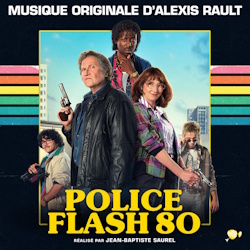 Police Flash 80 is a French-Belgian action-comedy directed by Jean-Baptiste Saurel, set in Paris in 1984 and conceived as an affectionate parody of the gloriously excessive police movies and television shows of the era. François Damiens stars as Yvon Kastendeuch, an unreconstructed old-school cop whose longtime partner is killed while investigating a heroin-trafficking operation. Yvon subsequently finds himself placed in charge of an experimental new squad, Police Flash 80, where he must work alongside younger officers whose methods and attitudes are very different from his own. The film was written by Thomas Ngijol, Giulio Callegari, and Yohan Zaoui, and was released in France in March.
The score for Police Flash 80 is by French composer Alexis Rault, whose previous significant credits include collaborations with acclaimed director André Téchiné on films such as Being 17, Golden Years, and Farewell to the Night. His most internationally prominent project may be the beautiful animated drama Les Hirondelles de Kaboul (The Swallows of Kabul), released in 2019, for which he won the Valois Award for Music at the Angoulême Francophone Film Festival.
Police Flash 80 could hardly be more different from the restrained dramatic writing of something like The Swallows of Kabul. Rault dives headfirst into the musical clichés of the 1980s police thriller, embracing synthesizers, drum machines, muscular electric bass lines, and gloriously over-the-top electric guitar. The obvious reference points are composers such as Harold Faltermeyer, Jan Hammer, Sylvester Levay, and Giorgio Moroder, but the score’s exaggerated swagger also evokes the countless American cop shows and direct-to-video action movies that copied their sound during the decade.
The opening “Police Flash” is an absolute blast, establishing everything so enjoyable about Rault’s approach: synth rhythms, bass, keyboards, and electric guitar combine to form a knowingly macho action theme that could accompany mirrored sunglasses, a speeding sports car, or an unnecessarily dramatic police briefing with equal ease. Rault performs most of the instruments, reinforcing the wonderfully handmade character of the music.
“Coupe Mulet” continues the tongue-in-cheek attitude – the title literally refers to the magnificently questionable mullet haircut sported by one of the supporting characters – whereas “Le Sac de la Kermesse” keeps the electronic pulse alive, albeit with a slightly darker edge. What is important is that Rault never treats the music itself as a joke. The sounds may be deliberately dated and the stylistic exaggeration knowingly absurd, but the score commits wholeheartedly to its tone, which is precisely why the comedy works.
“Luc le Timal” continues the synth-pop atmosphere, while “Yvon Kastendeuch” brings the protagonist into sharper musical focus. One of the most appealing elements of Rault’s score is the power-ballad-style electric guitar writing associated with Yvon, which gives the character an unexpectedly heroic and even slightly melancholy quality beneath all the macho posturing. The concluding “Merci Pour les Compliments” provides one final dose of glossy retro enthusiasm and sends the album out with a grin.
The only real disappointment is that there simply isn’t enough of it. Pathé’s soundtrack EP contains just six tracks and runs for approximately seven and a half minutes, despite Rault’s music being such an important part of the film’s period personality. What is included, however, is tremendously enjoyable. Police Flash 80 is catchy, funky, energetic, shamelessly nostalgic, and completely committed to the sound of its chosen decade. Anyone with a soft spot for Faltermeyer-style synth action, Moroder grooves, drum machines, screaming electric guitars, and the wonderfully excessive musical world of 1980s cop movies should have an enormous amount of fun with it.
Track Listing: 1. Police Flash (1:50), 2. Coupe Mulet (1:18), 3. Le Sac de la Kermesse (1:04), 4. Luc le Timal (0:54), 5. Yvon Kastendeuch (1:28), 6. Merci Pour Les Compliments (0:54). Pathé Films/Nolita Cinema, 7 minutes 28 seconds.
THOUSAND YEARS OF HUIZHOU – Li Xu, Simon Franglen
 Thousand Years of Huizhou is an eight-part historical and cultural documentary directed by Wang Zhentao. Broadcast on CCTV’s documentary channel beginning in February 2026, the series explores the thousand-year history of Huizhou, a large city of more than 6 million people in the Pearl River Delta region of southern China. The series uses eight different thematic perspectives to examine the region’s history, philosophy, commerce, architecture, education, art, and everyday life. Rather than using a conventional cast, the documentary combines present-day photography and historical reconstructions to bring figures such as scholar Wang Hua, philosopher Zhu Xi, and merchant Hu Xueyan to life. The result is intended to serve as both a cultural history of Huizhou and a broader portrait of Chinese civilization.
The music is principally by Chinese composer Xu Li, with the main theme written by British composer Simon Franglen. Xu has become something of a specialist in large-scale Chinese historical and cultural documentaries, and he has scored numerous projects featuring main themes by other composers, among them Yanni, Shigeru Umebayashi, and Stefano Lentini. Franglen is the latest to join this esteemed list. He spent decades as a producer, arranger, programmer, and musician, working with everyone from John Barry and James Horner to Celine Dion and Michael Jackson, before emerging as a major composer in his own right with James Cameron’s Avatar: The Way of Water and Avatar: Fire and Ash.
Franglen’s contribution here is the magnificent four-minute title piece, “Thousand Years of Huizhou,” and it is unquestionably one of the album’s highlights. Written on a grand scale for a majestic symphony orchestra and wondrous choir, it has the sweeping, sparkling, cinematic quality that has become a hallmark of Franglen’s recent music. There is nobility and wonder in the writing, but also an appealing sense of reverence, and it is a superb curtain-raiser. There is even the tiniest element of James Horner in some of its stylistic language, which is like catnip to me.
Xu then takes over for the remainder of the score, beginning with the compact “Opening Theme” and “Legend of a Thousand Years.” His approach is beautifully judged, blending a Western symphonic foundation with Chinese instruments and occasional broader Asian colors. A recurring wordless choir gives several passages a quality that ranges from dreamlike to spiritual, and the combination of voices, strings, delicate solo colors, and spacious orchestration creates an atmosphere that is simultaneously historical and timeless. Some cues incorporate elements from Franglen’s main theme, but Xu’s own voice regularly shines through.
“Morning Clearing” and “Leisure” represent the score at its most graceful and pastoral, painting an idyllic musical picture of the landscape and daily life through exquisite passages for erhu and dizi and playful percussion textures. “Pathos” introduces a darker and more introspective tone through impressive cello writing. The almost four-minute “Migration South” is one of Xu’s most substantial cues and, appropriately, carries a greater sense of movement and historical consequence. It is full of determined percussive rhythms and more forceful string textures. “Homeland” then provides additional dramatic and emotional counterweight. Its very concept is central to a documentary concerned with place and identity, and the cue features a notable, ancient-sounding choral element.
The second half continues to vary the emotional palette intelligently. “Endless Life” and “New Life” are rich and lyrical, with the former containing some distinctly John Williams-esque writing for violins. “Layered Clouds” is quiet, intimate, and led by piano and dizi, whereas “Magnificence” is slow, expansive, and features some of the score’s most prominent writing for brass. “Flames of War” inevitably brings more tension and weight, continuing the use of brass from the previous cue in a brighter, more heraldic fashion. “Atmosphere” and the concluding “Ancient and Modern” then bring the music full circle, connecting Huizhou’s distant past with its continuing cultural presence.
Although the soundtrack, at a little over 35 minutes, is not especially long, it is exceptionally cohesive, and there is something deeply satisfying about the way Franglen’s monumental opening statement leads into Xu’s more intimate exploration of a very specific part of Chinese culture. Thousand Years of Huizhou is beautifully crafted documentary music: elegant, melodic, richly orchestrated, culturally sensitive, and often genuinely moving. Admirers of expansive Chinese-flavored scores – especially anyone who enjoyed Franglen’s lyrical Avatar writing – should find a great deal to love here.
Track Listing: 1. 千年徽州/Thousand Years of Huizhou (4:16), 2. 片头曲/Opening Theme (1:03), 3. 千年的传说/Legend of a Thousand Years (1:43), 4. 晨霁/Morning Clearing (2:50), 5. 闲适/Leisure (1:57), 6. 悲情/Pathos (2:02), 7. 南迁/Migration South (3:55), 8. 家园/Homeland (2:43), 9. 生生不息/Endless Life (1:30), 10. 新生/New Life (2:11), 11. 云叠/Layered Clouds (2:22), 12. 壮美/Magnificence (1:57), 13. 战火/Flames of War (2:43), 14. 氛围/Atmosphere (1:48), 15. 古与今/Ancient and Modern (2:17). Zhihe Niannian Records, 35 minutes 25 seconds. Note: the track listings from this album have been translated from Chinese into English and may not be 100% accurate.
TORRENTE PRESIDENTE/TORRENTE FOR PRESIDENT – Roque Baños
 Torrente Presidente, released internationally as Torrente for President, is the sixth film in Santiago Segura’s enormously successful comedy series about José Luis Torrente, the spectacularly vulgar, corrupt, and incompetent former policeman who has been offending Spanish sensibilities since the first film in the series, Torrente: El Brazo Tonto de la Ley, was released in 1998. This latest film returns to the character after a twelve-year absence and pushes him into perhaps the one profession for which he seems uniquely qualified: politics. Torrente is recruited by the fictional populist party NOX and, through a mixture of demagoguery, shamelessness, and extraordinary good fortune, begins an improbable ascent toward the presidency.
The score is by Roque Baños, whose association with Torrente goes back to the original film. Baños has scored the entire series, making his music one of its few constants across almost three decades. The wonderful thing about Torrente Presidente – and, indeed, all the Torrente scores – is that Baños continues to score Torrente’s ridiculous exploits with almost complete dramatic seriousness. Rather than underlining every joke with musical slapstick, he treats Torrente’s political rise as though it were a genuine conspiracy thriller, creating an amusing gulf between the grandiose music and the ridiculous figure at its center. The music was recorded in Slovakia with the Bratislava Symphony Orchestra and has been described by Baños himself as having an “epic-grotesque” tone, an excellent encapsulation of its appeal.
“Fichado Por NOX” immediately establishes the tone with forceful orchestral colors and an undercurrent of mock importance that parodies the hyperpatriotic sound of Hollywood political thrillers. The cue includes a statement of a recurring theme heard throughout the score, which I assume is the series-spanning main theme for Torrente himself, although I have to admit I’m not familiar enough with the earlier scores to know for sure. It is great, though – a real earworm.
“Primer Meeting” and “Carrera Política En Ascenso” develop the idea into increasingly confident, almost triumphalist statements, combining the bright, peppy tone of a TV news theme with unexpected spaghetti western inflections, stirring brassy heroism, and a touch of broad comedy. “Debate Televisivo” captures the absurd theatricality of televised politics, after which “Campaña Electoral” offers a fantastic montage that underscores Torrente’s increasingly unstoppable campaign with a number of stylistic variations on the main theme. These range from 1970s Bill Conti disco beats to mariachi trumpets, Andean pan pipes, sultry saxophones, and honkytonk pianos, followed by an Argentine tango in “Peripecias En La Sede.”
The middle section becomes progressively more cinematic. “Crear Su Propio Partido” embraces the musical tropes of classic noir thrillers, while “Presencia de Trump” gives the main theme a regal, dignified flourish that stands at odds with the political figure it depicts. The outstanding pair of cues, “Hay Que Aniquilar a Ese Tío” and “Discurso en Moncloa,” shifts the score further into action-thriller territory with some killer contemporary chase music, before “Tiroteo” provides a moment of genuine emotional catharsis. This is precisely the sort of comedy scoring Baños does so well: music that is funny because it is magnificently overqualified for the idiot it accompanies, yet far more emotionally sincere than he is.
The action writing in the final third is even better. “Amparito al Volante” and “Huida de la Policía” are punchy orchestral set pieces, full of propulsive rhythms, urgent strings, 1970s percussion licks, wah-wah electric guitars, and brassy heroics. “A la Guarida de Spinelli” expands the suspense further, leading into the album’s major centerpiece, the five-minute “El Gran Jefe,” which gives Baños room to build a genuinely substantial dramatic arc. The concluding “Torrente Presidente” then summarizes the score’s mixture of swagger, pomp, danger, and comic self-importance in appropriately larger-than-life fashion, culminating in a final statement of the main Torrente theme.
The album for Torrente Presidente runs for approximately 35 minutes, long enough to showcase the score’s themes and action material but short enough to ensure that the joke never wears thin. Torrente Presidente is robust, colorful, richly orchestral comedy scoring from a composer who is not widely acknowledged for his success in the genre, but whose work here warrants exploration. After six films, Baños still finds ways to make Torrente sound like the hero he believes himself to be, and the result is tremendously entertaining.
Track Listing: 1. Fichado Por NOX (1:45), 2. Primer Meeting (1:11), 3. Carrera Política En Ascenso (1:33), 4. Debate Televisivo (2:26), 5. Campaña Electoral (1:17), 6. Peripecias En La Sede (1:40), 7. Crear Su Propio Partido (2:23), 8. Presencia De Trump (1:18), 9. Hay Que Aniquilar A Ese Tío (2:19), 10. Discurso En Moncloa (1:33), 11. Tiroteo (1:41), 12. Amparito Al Volante (2:18), 13. Huída De La Policía (2:42), 14. A La Guarida De Spinelli (3:36), 15. El Gran Jefe (5:16), 16. Torrente Presidente (2:35). Meliam Music, 35 minutes 38 seconds.

Shop at the Movie Music UK Store

Member of the


