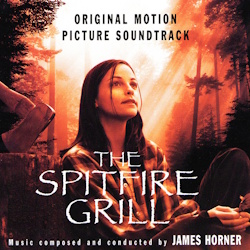
THE SPITFIRE GRILL – James Horner
 THROWBACK THIRTY
GREATEST SCORES OF THE TWENTIETH CENTURY
Original Review by Jonathan Broxton
The Spitfire Grill is a small-scale American drama film written and directed by Lee David Zlotoff, a television veteran best known as the creator of MacGyver and for his work on Remington Steele. The film marked Zlotoff’s feature directing debut and stars Alison Elliott as Percy Talbott, a young woman released from prison after serving time for manslaughter who decides to make a new start in the tiny town of Gilead, Maine. There she finds work at the Spitfire Grill, a weathered local diner owned by the formidable Hannah Ferguson, played by Ellen Burstyn. Percy gradually forms an especially important friendship with Hannah’s niece-by-marriage Shelby, played by Marcia Gay Harden, while Will Patton, Kieran Mulroney, and Gailard Sartain round out the principal cast. The story is essentially one of wounded people finding community and redemption: Percy’s arrival disturbs the town’s settled routines, but her energy eventually revives both the Grill and some of the people around it, even as secrets involving Hannah’s past and a mysterious figure living in the nearby woods begin to surface.
The film had an unusual path to the screen, originating with the Sacred Heart League, a Catholic nonprofit looking to produce a story that reflected broadly Judeo-Christian values without becoming overtly religious. Financed through its for-profit subsidiary Gregory Productions, the film was written by Zlotoff in 1994 and shot in Vermont the following spring. Then titled Care of the Spitfire Grill, it became an unexpected sensation at the 1996 Sundance Film Festival, winning the dramatic Audience Award and prompting a bidding war that ended with Castle Rock Entertainment paying $10 million for the distribution rights, at the time a record for a Sundance acquisition.
One of the less-discussed pieces of that history is James Horner’s involvement. An earlier score by jazz composer Bennie Wallace had already been written for the film, but prior to its Sundance breakthrough the producers decided the picture needed a new musical voice and brought Horner in to write a replacement score. At the time, this was an extraordinary coup for such a modest production. Horner was in the middle of one of the most astonishing creative runs of any composer in modern Hollywood, having recently written Legends of the Fall, Braveheart, and Apollo 13, but he reportedly responded strongly to the film and its values, accepted the assignment for a comparatively modest fee, and wrote and recorded the new music in late 1995. By the time Sundance audiences embraced The Spitfire Grill, Horner’s music had become an integral part of its emotional identity.
 What is immediately striking about The Spitfire Grill is how little it resembles the enormous, sweeping Horner scores that surrounded it, while still being unmistakably him. The instrumental palette is intimate – a modest orchestra augmented by solo piano, flute and other woodwinds, acoustic guitar, fiddles, subtle synthesizers, percussion, and occasional contemporary rhythmic elements – resulting in music that evokes sentimental Americana in all the best ways. A wonderful main theme emerges during the second half of the score and builds toward an outstanding finale, but perhaps best of all is Horner’s musical depiction of Gilead itself and the countryside around it – a sound that is rustic, fragile, slightly melancholy, and seems almost to embody nature itself.
I’ve talked about this sound before. Horner first started experimenting with it in scores as far back as The Journey of Natty Gann in 1985, continued to explore it in scores like Field of Dreams and Once Upon a Forest, and would develop it further in subsequent works like The New World, but The Spitfire Grill is where I believe he perfected it. It’s hard to describe in a way that makes sense, except to say that it has a certain poetry to it. Horner uses fluttering, expressive woodwinds alongside pretty, elegant strings and metallic chimes that shimmer and sparkle; it feels like the musical embodiment of sunshine casting beams of light through the branches of a tree, of a stream of water trickling over rocks, or of a soft breeze rustling through leaves. It feels alive and enchanted, but also somehow primeval and ancient, all at the same time. There might be something vaguely Stravinsky-esque about it, something avant-garde, but there’s something of Ralph Vaughan Williams, too, in the way the great English composer depicted the gentleness and comfort of a lush, verdant landscape. I love it, and The Spitfire Grill is full of moments like these, each adding a sense of magic to Percy’s life as she explores the woods near her new home.
The opening cue, “An Uncertain Future/Main Title,” establishes this sound beautifully. A delicate, twinkling piano theme for Percy opens the score with an appealing innocence which briefly evokes the transparent emotional world of classic Americana, after which Horner allows soft strings and woodwinds to develop the material into something more substantial, but still wonderfully evocative of a particular time and place. The orchestral colors, rather than the melodies, are what make this music so appealing; the combinations of instruments are so elegant, the textures so refined, whether it is the way the warm horns combine with the strings or the way the harp and piano dance around each other. It’s just magical, a true tone poem.
“Shelby & Percy” brings the guitars and fiddles into play for the first time, adopting a warm country-inflected vibe that beautifully charts the developing friendship between the two women. I love the instrumental combinations and textures here too; the use of shakers as a prominent percussion item gives it a distinctive character, and the return of Percy’s main piano theme allows her to remain at the center of the story, before it all becomes darker in the final part of the cue. The way Horner uses echoing woodwind figures in combination with undulating harps and pianos gives the cue a delicious air of mystery and spookiness that is not scary per se, but instead suggests a sense of curiosity about the unknown. It’s terrific. “Hannah’s Fall” offers a continuation of the score’s intimate dramatic voice, before “The Mystery of the Night” returns to the darker atmosphere of the previous cue, bringing restrained suspense to the film’s subplot involving rumors of a shadowy, furtive man who lives deep in the woods outside of town.
The first significant change of pace comes in the delightful “Open for Business,” where Horner brings back his folksier ensemble – fiddle, guitar, country-rock percussion – and gives the music a buoyant, handmade energy unlike anything else he was writing at the time; the only real precedent I can think of for this is some of the music he wrote for things like The Pursuit of D.B. Cooper and Rascals and Robbers: The Secret Adventures of Tom Sawyer and Huck Finn back in 1981 and 1982, or the country instrumentals he wrote for My Heroes Have Always Been Cowboys in 1991. This music represents the sense of optimism that accompanies the resurrection of the Spitfire Grill diner as the community heart of Gilead, and it’s enormously enjoyable.
“Remembering Eli” turns inward again, addressing the sadness buried beneath Hannah’s hard exterior and her tragic link to the mysterious man in the woods, with an emotional new theme for strings that combines beautifully with the piano theme for Percy. The subsequent pair, comprising “The Trees” and “A Gift From The Forest,” forms one of the score’s most magical sequences, a gorgeous exploration of the ‘nature sounds’ expanded to more than seven minutes that stands as some of the score’s most openly romantic writing.
The album’s emotional centerpiece arrives surprisingly late. “Reading the Letters” introduces the gorgeous theme that most fully represents the renewed life of Gilead and the Spitfire Grill itself, arising from Percy’s idea to hold a letter-writing contest in which entrants send $100 and a letter explaining why they want to own the Spitfire Grill, with the writer of the best essay winning the restaurant from Hannah. Conceptually, it’s something of a development of the theme for Hannah that was first heard in “Remembering Eli,” but Horner takes it to unexpected new heights – the lighter folk-rock colors eventually give way to the full orchestral ensemble with a spine-tingling crescendo – creating a graceful piece of Americana that overflows with optimism without ever becoming twee. I vividly remember hearing this cue for the very first time thirty years ago, with no idea what was coming, and having an extremely positive but highly emotional reaction to the moment the theme kicks in. I still love it today.
“A Healing Balm” gives the various emotional ideas room to breathe across six reflective minutes, including a lovely reprise of the full Spitfire Grill theme that moves beautifully between acoustic guitars and different sections of the orchestra, plus some more of those magical ‘nature’ sounds. The brief but lovely “A New Life for Gilead” revisits the title theme with an infectious burst of energy and renewal, but then the final stretch of the score becomes increasingly troubled. Nahum, Gilead’s sheriff, is still deeply suspicious of Percy because of her criminal past, and removes the money collected from the Spitfire Grill letter-writing contest and puts it into the bag Hannah leaves for the mysterious hermit in the woods. Percy unknowingly takes the bag to him, so when the money is discovered missing, some of the more prejudiced townsfolk assume she stole it. The hermit is then revealed to be Eli, Hannah’s long-lost son, who returned home from Vietnam psychologically damaged. When Hannah realizes what has happened, she fears that the sheriff and the men searching the woods may harm Eli, and so Percy goes after him to warn him – but while crossing the river, she is swept away by the current and drowns.
“Wrongful Blame” introduces a sense of anxiety to the ‘nature’ textures, while “A Desperate Decision” contains the darkest and most conventionally dramatic writing on the album. Here Horner combines his now-familiar textures with some of the more intense music from then-recent works such as Apollo 13 and the “Samuel’s Death” sequence from Legends of the Fall, allowing the music to build toward a sense of genuine panic that accompanies Percy’s desperate dash through the woods and, eventually, her tragic accident on the river. The poignant passage for prominent horns around the 2:00 mark is especially effective.
Everything comes together in the magnificent, nearly ten-minute finale, “Care of the Spitfire Grill,” which to this day remains one of my all-time favorite Horner cues. Like so many of Horner’s great extended finales, it functions as both summation and catharsis, revisiting the principal thematic ideas, passing them between individual soloists and sections of the orchestra, and gradually widening the emotional canvas. It begins with an appropriately emotional reprise of Percy’s theme, explores more of the forest nature textures, but then gradually shifts its weight to focus more on the main Spitfire Grill theme, initially arranged for a sensitive duet between an acoustic guitar and a piano, but eventually growing to encompass the full power of the orchestra. The gorgeous release of emotion at 5:27 – complete with a magical cymbal ring and a cascading wash of harps – coincides with the start of the end credits scroll, and after several magnificent statements Horner gradually lets his music fade to a whisper.
The Spitfire Grill is something of an obscure film and, as such, the score is not as famous as those James Horner wrote for Legends of the Fall, Braveheart, Apollo 13, or Titanic, but in my opinion it should be; it deserves to be mentioned alongside them when discussing Horner’s finest work of the 1990s, if not his entire career. It is a score of extraordinary sincerity, full of memorable themes, gorgeous pastoral textures, joyful moments of rich Americana, superb writing for solo instruments, and a sense of yearning and heartfelt compassion that leaves a lasting emotional impression. In a year overflowing with major orchestral achievements by numerous composers, this quiet little replacement score remains one of the most purely beautiful things James Horner ever wrote. It is an overlooked gem, a perfect marriage of composer and subject, easily one of the finest scores of 1996, and on the list among the greatest scores of the last century.
Buy the Spitfire Grill soundtrack from the Movie Music UK Store
Track Listing:
- An Uncertain Future/Main Title (3:38)
- Shelby & Percy (5:55)
- Hannah’s Fall (1:58)
- The Mystery of The Night (1:21)
- Open For Business (2:25)
- Remembering Eli (1:54)
- The Trees (1:39)
- A Gift From The Forest (4:43)
- Reading The Letters (2:02)
- A Healing Balm (5:59)
- A New Life For Gilead (1:25)
- Wrongful Blame (2:15)
- A Desperate Decision (5:07)
- Care Of The Spitfire Grill (9:53)
Running Time: 50 minutes 14 seconds
Sony Classical SK-62776 (1996)
Music composed and conducted by James Horner. Orchestrations by James Horner. Recorded and mixed by Shawn Murphy. Edited by Jim Henriksen. Album produced by James Horner.
Leave a comment

Shop at the Movie Music UK Store

Member of the


I would say “The Spitfire Grill” is Horner’s finest score. Understated, tuneful, melodic, and simply heartfelt without embracing Horner’s usual sentimentality. It may not have the sprightliness of “Krull” (another one of my favorites) or the childlike innocence of “Something Wicked This Way Comes”, but I can listen to this score multiple times and find something new to appreciate about it.