EMMA – Rachel Portman
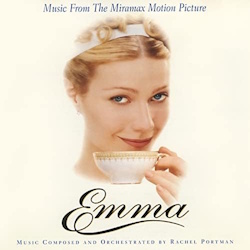 THROWBACK THIRTY
Original Review by Jonathan Broxton
The mid-1990s were an extraordinary time for Jane Austen on screen. Within a remarkably short period audiences were treated to Roger Michell’s Persuasion, Ang Lee’s Sense and Sensibility, Andrew Davies’s enormously popular BBC adaptation of Pride and Prejudice with Colin Firth, Amy Heckerling’s contemporary Emma reworking, Clueless, and finally this more traditional version of Emma, released theatrically in the summer of 1996. The film was written and directed by Douglas McGrath, who was making his feature directing debut after having earned an Academy Award nomination for co-writing Woody Allen’s Bullets Over Broadway in 1994. It stars Gwyneth Paltrow as Emma Woodhouse, a wealthy, intelligent, confident young woman living in the English village of Highbury who has convinced herself that she possesses an exceptional talent for matchmaking. Unfortunately, Emma understands almost everyone’s romantic feelings except her own.
Her principal project is Harriet Smith, played by Toni Collette, a sweet but socially uncertain young woman whom Emma attempts to match with the pompous Reverend Elton (Alan Cumming). From there, the romantic complications multiply, involving the handsome and apparently eligible Frank Churchill (Ewan McGregor), the accomplished Jane Fairfax (Polly Walker), the hilariously dreadful Mrs. Elton (Juliet Stevenson), and especially Emma’s long-time friend and occasional moral antagonist George Knightley, played with tremendous warmth and intelligence by Jeremy Northam.
McGrath had loved Austen’s novel since his undergraduate days at Princeton and had thought about adapting it for years. Interestingly, his original conception was apparently a contemporary version set on Manhattan’s Upper East Side, but those plans changed once it became apparent that Amy Heckerling’s Clueless was already exploring essentially the same idea. McGrath instead embraced the original Regency setting, and the result is a delightful comedy of manners, colorful and romantic but also gently satirical.
 One of the film’s most important assets is the music by Rachel Portman. Portman was just 35 when she wrote Emma, but by then she had already spent well over a decade building an impressive career, from her early work on prestige British TV projects through to her Hollywood breakthrough via scores like Benny & Joon, The Joy Luck Club, Sirens, Only You, and To Wong Foo, Thanks for Everything! Julie Newmar. By the time she came to Emma, Portman had developed a distinct musical personality: warm strings, expressive woodwind solos, uncomplicated but memorable melodies, delicate comedy, and a sense of romantic sincerity that never felt saccharine.
Emma is perhaps the purest expression of that sound. Portman bases much of the music on gently animated strings and prominently featured clarinets and oboes. There are two central thematic ideas running through the score: a lyrical principal theme associated with Emma herself and the title material, and a more energetic secondary idea that tends to accompany the film’s comedy. Portman also revealed that she used specific instruments to give a voice to the characters, with “a quivering violin” representing Harriet’s uneasy stomach, while “a bittersweet clarinet” accompanies Emma through her emotional journey.
The four-minute “Main Titles” introduce Portman’s main theme in wonderfully graceful fashion. There is a pastoral English elegance to it, but Portman wisely avoids trying to imitate authentic Regency music throughout the score. Instead, this is unmistakably modern romantic film music viewed through an Austen lens: flowing, beautifully shaped, full of delicate motion, and rich with tenderly expressive instrumental passages. The writing for solo violin in the second half of the cue is especially noteworthy – it sparkles with joy and whimsy – while the sense of constant activity underneath the melody also captures something important about Emma herself: she is outwardly composed but mentally always busy, arranging, interpreting, interfering, and planning.
Both “Harriet’s Portrait” and “Sewing and Archery” expand the score’s more mischievous side, as Portman’s lightly articulated strings and pretty, fluttering woodwinds create a constant sense of movement, with the latter dancing over the top and giving the music an almost conversational quality. “Frank Churchill Arrives” retains the attractive surface beauty of the main theme but introduces a slightly more anticipatory quality appropriate to the arrival of a man Emma believes might become romantically significant, emphasized by the prominence of delicate harp writing.
The delightful “Celery Root” is one of the score’s best comedy cues and gives Portman’s secondary theme a particularly lively workout, with the combined writing for clarinets and strings bouncing wonderfully without ever becoming broad slapstick. “Mr. Elton’s Rejection” and “Emma Tells Harriet About Mr. Elton” shift the emotional balance slightly to illustrate how Emma’s overconfidence in her own judgment has resulted in genuine hurt. Portman responds to this important tonal shift first with more dramatic textures and a more introspective use of her established sound, then with some delightfully Christmassy orchestration. The harpsichord quote of the traditional Christmas carol “Deck the Halls” and the prominent use of sleigh bells are especially agreeable.
The musical depiction of Emma’s social world returns in the playful “The Coles Party” and the wonderfully prim “Mrs. Elton’s Visit,” before the brief but beguiling “Emma Dreams of Frank Churchill” offers an amusing glimpse of Emma trying to persuade herself that she might be in love, expressed through an effervescent violin variation based on the main theme. The spirited “The Dance” brings overt period flavor into the score, standing somewhat apart from Portman’s principal thematic material but emerging as one of the score’s most traditionally inflected highlights, while the equally brief “Gypsies” explores some darker emotions.
The sequence beginning with “The Picnic” contains some of the score’s most dramatically satisfying writing. Portman initially evokes the pleasant pastoral atmosphere of the outing, but everything changes with “Emma Insults Miss Bates,” underscoring one of the story’s crucial moments, when Emma’s casually cruel remark to the kind-hearted Miss Bates and Knightley’s subsequent rebuke finally force her to confront the unpleasant consequences of her thoughtlessness. Portman’s music becomes correspondingly more intense, albeit in a manner consistent with the emotional restraint that women of the Georgian-Regency era were supposed to display.
“Emma Writes Her Diary” is similarly lovely, taking musical colors we have heard throughout the film and making them feel more reflective and mature; the poignant cello writing towards the end of the cue is especially noteworthy. That developing maturity carries through “Mr. Knightley Returns” before eventually blossoming in the superb “Proposal,” which is the cue that comes closest to the sort of full-bodied lyrical romanticism for which Portman is best known – intimate, elegant, and beautifully sincere. The excellent “End Titles” then provide a four-minute summation of the score’s principal ideas, opening with some of Portman’s liveliest comedy writing before returning to the warmth and lyricism of Emma’s theme, while also incorporating some especially notable brass countermelodies.
Of course, Emma subsequently became historically important for reasons extending far beyond the film itself. At the Academy Awards in March 1997, Portman won the Oscar for Best Original Musical or Comedy Score, and in doing so became the first woman ever to win an Academy Award for an original film score, a genuinely groundbreaking moment in film music history. Portman has subsequently recalled the win as both extraordinary and shocking, noting that the recognition immediately opened professional doors for her. She would later receive additional Oscar nominations for The Cider House Rules and Chocolat, but Emma was the score that first put her name in the Academy record books.
Thirty years later, Emma remains an absolute charmer. It is not a score built around enormous orchestral gestures or grand dramatic tragedy. Its pleasures are smaller and more precise: the lift of a woodwind phrase, the rhythmic flicker of the strings, the warmth of an emerging melody, and Portman’s ability to make comedy sound elegant without making it frivolous. It is also one of the defining scores of the 1990s Austen boom, standing alongside Patrick Doyle’s Sense and Sensibility and Carl Davis’s Pride and Prejudice as a beautiful musical representation of the period’s renewed fascination with Austen. The result is graceful, witty, affectionate, melodically appealing, and irresistibly engaging. Like Emma Woodhouse herself, the score initially seems to exist in a world of light social pleasures, but beneath that elegant surface there is real emotional intelligence. The heart of Emma is not whether the heroine finds a husband – it is whether she becomes perceptive enough to recognize her own flaws, understand the feelings of others, and finally realize whom she has loved all along.
For me, Emma remains one of Rachel Portman’s loveliest scores and a quintessential example of her romantic comedy writing. Although subsequent years would see Portman return to this style over and over again – perhaps, some might say, too often – at the time it was written, it felt new and fresh, and thirty years later I still find myself captivated by its charms. Although I would personally have chosen Alan Menken’s The Hunchback of Notre Dame as the Oscar winner that year, Portman’s Emma is still a deserving landmark in the history of film music.
Buy the Emma soundtrack from the Movie Music UK Store
Track Listing:
- Main Titles (4:26)
- Harriet’s Portrait (1:10)
- Sewing and Archery (3:07)
- Frank Churchill Arrives (2:29)
- Celery Root (2:55)
- Mr. Elton’s Rejection (1:58)
- Emma Tells Harriet About Mr. Elton (1:05)
- The Coles Party (3:10)
- Mrs. Elton’s Visit (1:32)
- Emma Dreams of Frank Churchill (0:49)
- The Dance (1:17)
- Gypsies (0:46)
- The Picnic (2:29)
- Emma Insults Miss Bates (1:59)
- Emma Writes Her Diary (2:53)
- Mr. Knightley Returns (1:57)
- Proposal (4:22)
- End Titles (4:21)
Running Time: 42 minutes 53 seconds
Hollywood Records MH-62069-2 (1996)
Music composed by Rachel Portman. Conducted by David Snell. Orchestrations by Rachel Portman. Recorded and mixed by Keith Grant. Edited by XXXX. Album produced by Rachel Portman.

Shop at the Movie Music UK Store

Member of the


