FLY AWAY HOME – Mark Isham
 THROWBACK THIRTY
Original Review by Jonathan Broxton
Fly Away Home is a family adventure-drama directed by Carroll Ballard, the filmmaker behind The Black Stallion and Never Cry Wolf, and photographed by his longtime collaborator Caleb Deschanel. The film stars Anna Paquin as Amy Alden, a thirteen-year-old girl who is sent to live with her estranged father Thomas, played by Jeff Daniels, in rural Ontario after her mother is killed in a car accident in New Zealand. Amy is withdrawn, angry, and emotionally stranded, but begins to heal when she rescues a clutch of goose eggs from land being cleared by developers. When the goslings hatch they imprint on her, and Amy becomes their surrogate mother. The problem is that, when autumn arrives, the birds have no adult geese to teach them their migration route, prompting Amy and Thomas to devise an extraordinary solution: they will lead the flock south in ultralight aircraft. Dana Delany co-stars as Thomas’s partner Susan, with Terry Kinney, Holter Graham, and Jeremy Ratchford in supporting roles.
The film was inspired by the real experiences of Canadian artist and inventor Bill Lishman, who successfully led a flock of Canada geese on migration using ultralights in 1993. Its production was almost as remarkable as the story. Ballard arrived in Ontario with the cast, the rights to the underlying story, and goose eggs about to hatch, but without a finished script; because the birds would grow too quickly to wait, he began filming immediately. Recordings of Paquin’s voice were played to the eggs before hatching so the goslings would imprint on her, while the screenplay was still being refined. Ballard and Deschanel turned the practical difficulties into one of the film’s great strengths, creating images of fields, lakes, barns, clouds, and airborne geese that feel tenderly lyrical and picturesque.
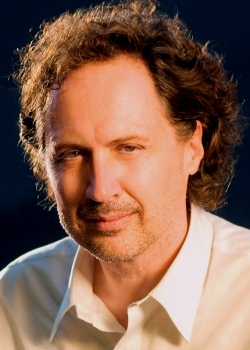 Mark Isham’s score is central to that lyricism. It was Ballard who gave Isham his first film-scoring assignment with Never Cry Wolf in 1982, and so by the time they reunited on Fly Away Home, Isham had been working in film for more than a decade, and his stature had increased significantly. His gorgeous Americana score for Robert Redford’s A River Runs Through It earned him an Academy Award nomination, while subsequent projects demonstrated his exceptional ability to adapt his musical personality to very different dramatic settings. Fly Away Home therefore represented both a reunion with Ballard and something of a return to the kind of naturalistic, environmentally conscious storytelling that had launched Isham’s film career.
It was clear that the music needed to mirror Amy’s emotional trajectory: beginning small and private, then gradually opening outward as she reconnects with her father and with the world around her. In interviews Isham has said that the solo violin was chosen specifically for its intimacy, and that instrument becomes the score’s defining musical voice. Around it he builds a warm orchestral palette of strings, flutes and other woodwinds, light percussion, harmonica, and rustic colors including guitars and accordion, allowing the music to suggest both the beauty of the natural world and the slightly eccentric human one surrounding it. The score’s melodic core is its greatest strength, especially its pastoral main theme and its unusually consistent sense of warmth, tenderness, and grace. Tonally it has a lot in common with his other Americana scores of the period, including the aforementioned A River Runs Through It, as well as Of Mice and Men and Nell, while also foreshadowing, to a lesser extent, later works such as The Education of Little Tree, October Sky, and The Majestic.
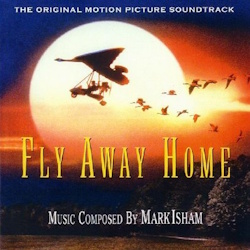
One of the most frustrating things about this score is that it has still never received a proper commercial album; this is a review of the 1997 awards promo album, which contained just over half an hour of music and subsequently became extremely difficult to obtain, although longer unofficial and bootleg editions circulated among collectors. That neglect is baffling. Fly Away Home is one of Mark Isham’s most beautiful scores, a superb example of how melody, orchestral color, and emotional content can transform a family film into something lovely.
The promotional album opens with “First Flight,” which immediately establishes the score’s emotional vocabulary and presents its wonderful main theme: a haunting flute texture, a spirited pennywhistle, and a beautifully singing violin line, all gently buoyed by the orchestra, capturing the wonder of leaving the ground and the exhilaration that accompanies it. The subsequent concert arrangement of the “Fly Away Home” theme is superb, big-hearted and expansive, with an especially satisfying lushness to the orchestral performance.
“Igor’s Big Adventure” is one of the score’s most delightful cues, a lively rhythmic piece built around the country textures and imbued with a gentle sense of humor, but which then erupts into sweeping, stirring statements of the main theme as the titular injured gosling becomes a miniature emblem of perseverance. “16 Eggs” is more introspective, a low-key exploration of the score’s key sounds in a tender, intimate way, reflecting how Amy’s fascination with the goslings helps initiate her healing process. The duet writing for solo violin and solo voice in this cue is especially beautiful.
“If at First You Don’t Succeed” has an almost lullaby-like quality to it, but quickly develops into a sound that is both playful and determined, using rhythmic woodwinds, lyrical violins, accordions, and a piano-driven momentum to underline the trial-and-error process of teaching the birds to fly. “The Great Escape” starts out darker and slightly uneasy, driven by moody piano clusters beneath the orchestra, but as it develops it becomes more energetic, with tapping percussion and increasingly animated orchestral writing giving the music real momentum and exhilaration. Hints of the main theme peek through, and it all builds to an exciting and powerful climax that remains one of Isham’s most impressive action sequences of the 1990s.
“Halls of Glass” brings back the main theme to spectacular effect, while “Remembrance of Things Past” is the emotional counterweight to all the airborne exhilaration, using a mournful solo voice and restrained orchestral writing to acknowledge Amy’s grief for her mother. Then, in the excellent concluding cue, “Homecoming,” Isham revisits the sparkling and upbeat country textures for accordion and fiddle, celebrating Amy’s achievement with the geese and her success in overcoming her grief with positivity and genuine sentiment.
An important note for collectors is that the song “10,000 Miles,” performed by folk singer Mary Chapin Carpenter, does not appear on the promotional album, despite being an important component of the film’s musical identity. Not only is it initially heard during the film’s devastating opening sequence, but Isham further integrates the song into the fabric of his underscore, allowing its melancholy character to inform the music associated with Amy’s mother and her grief, although none of these melodic references appears on the promo album. The song is based on a traditional folk ballad also known as “Fare Thee Well,” and is really quite lovely. Carpenter later released her recording commercially on her 1999 compilation, Party Doll and Other Favorites.
Ultimately, Fly Away Home is one of those scores that demonstrates just how gifted Mark Isham could be when working in a lyrical, intimate register. Its combination of graceful thematic writing, warm orchestral textures, rustic instrumental colors, and understated emotional sensitivity perfectly complements Carroll Ballard’s beautiful imagery and Amy’s journey from grief toward healing. The main theme is among Isham’s loveliest of the 1990s, while the score as a whole balances tenderness, humor, melancholy, and exhilaration with remarkable consistency. The fact that such an accomplished work has never received a proper commercial release remains enormously frustrating, especially considering how much excellent music is missing from the promotional album. Nevertheless, even in its abbreviated form, Fly Away Home stands as one of Isham’s most rewarding dramatic scores, and one that deserves to be much better known. For admirers of melodic Americana, emotionally direct orchestral writing, and Isham’s more lyrical side, this is an easy and enthusiastic recommendation.
Buy the Fly Away Home soundtrack from the Movie Music UK Store
Track Listing:
- First Flight (3:15)
- Fly Away Home (4:00)
- Igor’s Big Adventure (5:48)
- 16 Eggs (3:42)
- If At First You Don’t Succeed (3:37)
- The Great Escape (6:37)
- Halls of Glass (2:48)
- Remembrance of Things Past (2:13)
- Homecoming (3:46)
Running Time: 35 minutes 46 seconds
Promo (1996)
Music composed by Mark Isham. Conducted by Ken Kugler. Orchestrations by Ken Kugler.. Recorded and mixed by XXXX. Edited by Joe E. Rand and Craig Pettigrew. Album produced by Mark Isham.

Shop at the Movie Music UK Store

Member of the


