BOUND – Don Davis
 THROWBACK THIRTY
Original Review by Jonathan Broxton
Bound is a neo-noir crime thriller written and directed by Lana and Lilly Wachowski in what was their feature directing debut and, in retrospect, the first clear sign of the visual confidence and formal playfulness that would explode three years later in The Matrix. Gina Gershon stars as Corky, an ex-con renovating an apartment next door to Violet (Jennifer Tilly), the glamorous girlfriend of volatile mob money-launderer Caesar (Joe Pantoliano). Corky and Violet begin an intense affair and devise a plan to steal $2 million in Mafia cash and run away together, framing Caesar in the process; naturally, almost nothing proceeds as intended, and the film turns confined spaces, shifting loyalties, sexuality, and escalating panic into a wonderfully controlled pressure cooker of a movie.
The Wachowskis had already seen their screenplay Assassins filmed as a Sylvester Stallone/Antonio Banderas vehicle in 1995, and had also already written The Matrix, but Hollywood was not yet ready to hand them a major science-fiction production, and so Bound became their opportunity to demonstrate that they could direct. Dino De Laurentiis, who had worked with them on Assassins, backed the project after responding enthusiastically to the script, while other potential financiers had reportedly suggested changing Corky into a man. The directors refused. They hired cinematographer Bill Pope, whose sinuous camera work became central to the film’s identity, while sex educator and writer Susie Bright consulted on the intimate scenes between Gershon and Tilly. The result was a stylish, provocative, blackly funny thriller that announced two unusually assured new filmmakers. The film was a reasonable success, commercially and critically, with some commentators at the time comparing the Wachowskis favorably with the Coen Brothers, and it paved the way for what would eventually be their blockbuster success with The Matrix in 1999.
 The music for Bound was written by composer Don Davis, who at that point in his career was better known for television scoring and orchestration than for scoring theatrical features. He began his career in the late 1970s as an assistant to composer Joe Harnell, and by 1996 he had written extensively for several popular TV shows, including Beauty and the Beast, Star Trek: The Next Generation, and seaQuest DSV, and had been nominated for Emmys for his work on TV movies of the week such as Lies Before Kisses in 1991 and A Little Piece of Heaven in 1992. He was also an in-demand orchestrator who had contributed to scores by James Horner, Michael Kamen, David Newman, and Randy Newman. Bound was, for all intents and purposes, the first opportunity Davis had to bring his formidable compositional technique to a big-screen project, and he grasped it with both hands.
What Davis created is a superbly nervy suspense score, less interested in a conventional singable theme than in rhythm, color, and psychological pressure. There is a lot of Bernard Herrmann in the score, especially in the way Davis uses his strings, but there is also a great deal of Davis’s own personality here – something that would become clearer and more recognizable through his Matrix scores and other subsequent works. Each cue has a distinct personality, with different stylistic approaches employed for the film’s various thematic elements: the music for the developing romance between Violet and Corky is different from that accompanying the scenes involving Caesar and his Mafia goons, and at times the score explodes into tense, tightly wound, but impressively staged action.
“Closet Diving” sets the mood perfectly, establishing the tone with elegantly threatening strings, dark brass, glassy electronic tones, and an embryonic version of a musical gesture Davis would later sharpen in The Matrix. “Fix My Pipe” slips into a cooler, jazz-inflected mood with prominent plucked bass, brushed snares and, eventually, jittery pianos, helping to define the sizzling sexual tension between Corky and Violet, while the subsequent “Rug Rangers Qu’est-ce Que C’est” continues in a similar vein, slyly seductive but also watchful and nervous, like an easily spooked cat.
There is a wonderful sense of Gothic melodrama in “Hand It to Shelley,” while “Ravine Cuisine” initially gives Corky and Violet a warmer, piano-led glow that reminds me of Christopher Young’s Jennifer 8, before gradually curdling into more dangerous territory. “Yodeling in the Canyon,” “Girls Having Fun,” and “Ceasar Gets Corked” continue the blend of seduction and unease, mixing the jazzier tones associated with their relationship with increasingly suspenseful writing for the Mafia goons who threaten their future, including prominent use of varied percussion; I especially love the icy writing for strings and piano in the middle of “Girls Having Fun,” which feels like a romance theme that isn’t being allowed to be romantic.
From there, Davis tightens the screws beautifully. “Thelma and Louise from Hell” erupts into an abrasive orchestral crescendo full of screaming strings, while “Tang Bangers” sustains tension through more than five minutes of processed percussion, electronics, and restless orchestral figures, including a reprise of the threatening motif heard in the opening cue. After the tiny sting “Dying for His Money,” which is also built around that same motif, “I Am Gino Marzzoni, Capice?” expands into urgent, sometimes harshly dissonant orchestral writing, with jagged strings and James Horner-style crashing pianos driving the action. “Chicago’s Finest” is one of the score’s highlights: deep, muscular brass rises over rolling strings until the cue practically swaggers with malice. “Jail Bait,” “Curiosity Cops,” and “Corky’s Peephole” are compact suspense miniatures, each tightening the noose.
“Ceasar Bizarro” is distinctly and pleasingly Herrmannesque, employing extended techniques for both strings and piano to ratchet up the pressure, while the aggressively discordant “Holy Mackerel” even incorporates percussive gunshot effects into Davis’s sound design. The brutally percussive “In Utero Morituri Te Salutamus,” “Girl Talk,” and “Bang the Bangers” keep the tension coiled before the score reaches its dramatic peak in the extended set piece “Out of the Closet and Down the Stairs.” Here, crashing low pianos, hammering percussion, brass, and elegantly surging strings gradually rise to a grand guignol crescendo built around the threatening motif heard in the opening cue; there are even more echoes of 1990s-era James Horner here, as one might expect, but there are also elements that now sound unmistakably like stepping stones toward what we would eventually hear in The Matrix. Finally, “Mambo Mamacita” releases the accumulated pressure with a witty, sexy Latin flourish as Violet and Corky drive off into the sunset hand in hand.
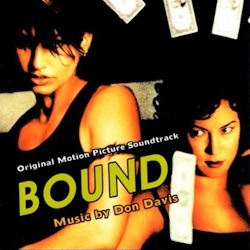
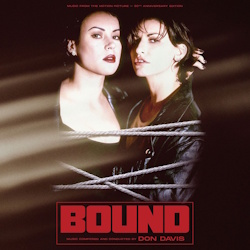 The score for Bound was initially released only as a composer promo through the California-based independent label SuperTracks, and for many years it was an expensive collectible available only on the secondary market. In early 2026, Davis and soundtrack producer Dan Goldwasser teamed up with La-La Land Records to release a proper soundtrack album, a 1,000-unit limited edition that features in-depth liner notes by writer Daniel Schweiger. The core album program is identical to the original promo, right down to the suggestively kinky cue titles, but the new release also includes a recording of Davis’s concert piece inspired by the film score, “Illicit Felicity,” performed by pianist Jenny Lin as a bonus track. The film also features songs such as “I Never Loved a Man the Way I Love You” by Aretha Franklin, “Hallelujah I Love Her So” by Ray Charles, “She’s a Lady” by Tom Jones, and “Hopeless Faith” by the riot grrl band The Hail Marys, but none of them appear on either album.
Ultimately, Bound is an excellent early showcase for Don Davis, a score that already contains many of the rhythmic, harmonic, and textural ideas that would later become central to his most celebrated work, while still possessing a distinctive sound of its own. It is taut, intelligent, stylishly abrasive when required, and often unexpectedly sensual, perfectly matching the film’s mixture of eroticism, danger, black humor, and mounting paranoia. The score may not have the immediately recognizable thematic profile of The Matrix, but its inventive orchestration and steadily escalating dramatic tension make it a fascinating and rewarding listen in its own right. Thirty years on, Bound plays as far more than a pre-Matrix curiosity: it is a smart, stylish, tremendously entertaining thriller score in its own right, and one of the most distinctive works of Davis’s early film career.
Buy the Bound soundtrack from the Movie Music UK Store
Track Listing:
- Closet Diving (2:49)
- Fix My Pipe (5:43)
- Rug Rangers Qu’est-ce Que C’est (2:23)
- Hand It To Shelley (2:02)
- Ravine Cuisine (4:37)
- Yodelling In The Canyon (2:38)
- Girls Having Fun (2:39)
- Caesar Gets Corked (1:42)
- Thelma And Louise From Hell (1:26)
- Tang Bangers (5:21)
- Dying For His Money (0:21)
- I Am Gino Marzzoni, Capice? (2:00)
- Chicago’s Finest (2:10)
- Jail Bait (0:53)
- Curiosity Cops (1:16)
- Corky’s Peephole (1:07)
- Caesar Bizarro (3:02)
- Holy Mackeral (1:39)
- In Utero Morituri Te Salutamus (1:21)
- Girl Talk (0:52)
- Bang The Rangers (2:03)
- Out Of The Closet and Down The Stairs (6:41)
- Mambo Mamasita (3:03)
- Illicit Felicity (performed by Jenny Lin) (3:58) – LLLCD Bonus Track
Running Time: 57 minutes 48 seconds — Original
Running Time: 61 minutes 00 seconds — Expanded
Super Tracks DDCD 069 (1996) — Original
La-La Land Records LLLCD1669 (1996/2026) — Expanded
Music composed and conducted by Don Davis. Orchestrations by Don Davis. Recorded and mixed by Armin Steiner. Edited by Stan Jones. Original album produced by Don Davis. La-La Land expanded album produced by Don Davis and Dan Goldwasser.

Shop at the Movie Music UK Store

Member of the


