HER PRIVATE HELL – Pino Donaggio
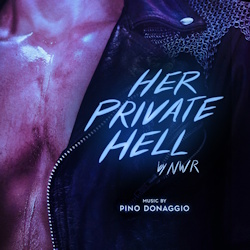 Original Review by Jonathan Broxton
Her Private Hell is the latest film from the acclaimed cult Danish film director and screenwriter Nicolas Winding Refn, and it is his first theatrically released film since The Neon Demon in 2016. The film is a surreal, dystopian psychological thriller that combines elements of sci-fi, film noir, fairy tale, slasher horror, and melodrama into a deliberately dreamlike narrative. It takes place in a futuristic metropolis where a mysterious, unnatural mist spreads across the city; the fog seems to unleash (or perhaps reveal) a deadly supernatural presence while reality itself becomes increasingly unstable. The story primarily follows Elle (Sophie Thatcher), a troubled young woman searching for her estranged father, who crosses paths with Private K (Charles Melton), an American GI convinced that his young daughter has been abducted. Their journeys slowly converge around the legend of the “Leather Man,” an elusive, almost mythical killer or monster whose identity could prove the key to the mystery.
Nicolas Winding Refn is something of a polarizing director, and critics are similarly divided over Her Private Hell. While the film has been rightly praised for its stylish visual aesthetic – its prominent use of neon within a cyberpunk setting and its intentional tonal references to Italian giallo cinema, especially the work of Dario Argento – others have criticized it for its inaccessibility, confusing narrative, and dream logic, although the latter part actually makes sense as Refn’s subsequently revealed that the film grew out of a dream he had during a near-death experience – he described being clinically dead for roughly half an hour following a medical emergency, saying the experience fundamentally changed his outlook and inspired the film’s vision of death, limbo, and rebirth.
The film’s intentional references to Italian giallo cinema are also important when it comes to the music, as the score for Her Private Hell was written by the great Italian composer Pino Donaggio. Donaggio is 84 years old now, but he has clearly lost none of the skills that first launched him to fame in 1973 following his work on the classic thriller Don’t Look Now, and which sustained him through numerous classic scores written for directors like Dario Argento, Lucio Fulci, and especially Brian De Palma on titles including Carrie, Home Movies, Dressed to Kill, Blow Out, and Body Double. Donaggio’s scores for these films had their fair share of thrills, horror, and suspense, but most importantly they were lush, operatic, and darkly romantic, seeking to push horror towards something sexy and erotic. Her Private Hell is an intentional homage to that sound.
 The score is terrific. Refn’s cinema has always been intensely musical, but Donaggio brings something different from the cool electronic minimalism Cliff Martinez brought to films like Drive, Only God Forgives, and The Neon Demon: a grand, old-fashioned orchestral romanticism capable of making violence feel tragic, seductive, and mythic all at once. The score is built around its recurring main theme, which is presented fully for the first time in the second track, “Touch of Beauty,” and it’s an absolute knockout – a long-lined, elegant, deliciously dark piece for shimmering romantic strings, harp glissandi, and misleadingly innocent woodwind textures that paint a beguiling portrait of feminine innocence. Despite having had a career overflowing with themes of this type, this is easily among my all-time favorite Donaggio melodies.
Later cues like “Daddy’s Back,” “Dreaming of Daddy,” “The Falling,” and “Ecstasy on the Terrace” feature the theme prominently. The searing cello writing in “Dreaming of Daddy” is especially praiseworthy, although even in these cues there are darker forces at work in the background, giving the performances a slightly off-kilter emotional tone that juxtaposes beauty with malevolence.
Donaggio builds on the sound and style of this theme as the score progresses, employing lovely choral textures in “Evil Has Two Eyes” (a nice verbal homage to his score for the 1990 Italian horror film Due Occhi Diabolici), dreamlike cascades of violins and harps in the stunning “Beautiful People,” a wordless female vocalist to enhance the sense of eroticism in “Ecstasy,” and an almost subliminal subtext of jazz in the phrasing of the first half of “Private Kay.” “Retro Beauty (Jukebox)” is a score highlight, and sees Donaggio returning to a sound drawn from the earliest part of his career as a songwriter and arranger for Italian pop music, adding a layer of 1960s-coded electric guitars, drums, vocals, and even a saxophone to his melody. Nostalgia overload.
Elsewhere, Donaggio employs unnerving, traditional horror-thriller sounds to represent the legend of the Leather Man in cues like “Revenge Wears Leather,” “Leatherman and the Lady Foxes,” and “The Leatherman and the Axe.” In these cues, Donaggio often layers the darker parts of his orchestra against creepy electronic organ sounds, nervously tinkling metallic percussion, a recurring three-note brass motif, and occasional moments of piercing dissonance to capture the elusive, looming presence of the leather-clad killer stalking Elle’s waking nightmares. Even here, though, the music is still defiantly musical – for the most part, Donaggio eschews the banging, clanging, and droning sounds favored by many modern horror scores in favor of significantly more sophisticated symphonic writing.
There’s a terrific, undulating piano action motif running through “Candyfloss” that I loved, and which returns reorchestrated for throbbing cellos in the second half of the aforementioned “Private Kay,” before reappearing in the thrilling “Fists of Fury,” where it is enhanced further by a bank of raucous, roaring brass.
The eight-minute “House of Horror” is one of the few cues where Donaggio abandons melodic lyricism almost entirely, engaging in an extended piece of unnerving sound design underpinned by eerie string textures and music-box sounds that combine to create a stark contrast with the rest of the score, making it an exercise in patient tension-building. After the unexpectedly playful, waltz-like whimsy of “Taste of Soap,” the nearly ten-minute finale, “Don’t Bring a Knife to an Axe Fight,” initially returns to the eerie, atmospheric sound-design style for an even longer journey into the musical underworld, but then gradually adds layers of thrusting brass, swirling strings, menacing choral textures, and powerful statements of the main theme at its most dramatic as it builds to a grand Grand Guignol climax. The conclusive pair, “Sad Elle” and “Elle,” are tender, slightly bittersweet reprises of the main theme, often featuring a child-like choir, but they again build toward ending the album on a powerful note.
Also included on the soundtrack are five tracks of additional music written by the director’s nephew, composer Julian Winding. These cues are more aggressive and focused on a rock and electronic palette, and are significantly different from anything in Donaggio’s score, but still offer something of note. I actually really like the vibe of “Leathergirl Lives,” which feels like a retro 1980s John Carpenter-adjacent American horror anthem, and makes excellent use of electric guitars and hypnotic female vocals. “Safe Words on Dead Ears” has a euphoric techno beat that feels like an instrumental take on Depeche Mode or Nine Inch Nails at their hard-hitting best. “Sunsets on Wallpaper” is more dream-like and introspective, “Let It End the Sweetness of Nothing” has an unexpected solemnity to it, and then “Dolce Mio” feels like Winding’s attempt to channel another aspect of 1970s Italian giallo music with an homage to synth specialists like Goblin and Fabio Frizzi. It works really, really well.
In many ways, Her Private Hell feels like a celebration of everything that has made Pino Donaggio one of the great film composers of the last half-century. Rather than simply revisiting the sound of his classic collaborations with Brian De Palma, he refines it with the confidence and restraint of a composer who knows exactly how to balance romance, beauty, terror, and tragedy. The result is a score that is both nostalgically familiar and creatively invigorated, filled with exquisite melodies, sumptuous orchestral writing, and just enough darkness to remind you why Donaggio remains such a master of the psychological thriller. Whether or not Refn’s film proves as divisive as many of his previous works, there should be little debate that Her Private Hell contains one of the year’s finest film scores. For admirers of Donaggio’s golden-era work – or indeed anyone who still appreciates the power of a richly thematic orchestral score in modern cinema – this album comes with my highest recommendation.
Buy the Her Private Hell soundtrack from the Movie Music UK Store
Track Listing:
- The Arrival (1:43)
- Touch of Beauty (2:29)
- Evil Has Two Eyes (1:12)
- Beautiful People (2:05)
- Revenge Wears Leather (4:48)
- Ecstasy (1:05)
- Leatherman and the Lady Foxes (2:46)
- Candyfloss (2:13)
- The Leatherman and the Axe (4:10)
- Daddy’s Back (3:05)
- Man in the Mirror (1:52)
- Private Kay (3:10)
- Retro Beauty (Jukebox) (3:19)
- Dreaming of Daddy (3:40)
- The Little Matchgirl (2:00)
- Leathergirl Lives (written by Julian Winding) (3:49)
- Kingdom in the Mist (1:13)
- Fists of Fury (2:15)
- The Falling (2:13)
- Ecstasy on the Terrace (2:41)
- Safe Words on Dead Ears (written by Julian Winding) (5:28)
- House of Horror (8:15)
- Sunsets on Wallpaper (written by Julian Winding) (2:53)
- Transforming (1:24)
- Taste of Soap (1:20)
- Don’t Bring a Knife to an Axe Fight (9:54)
- Sad Elle (2:41)
- Let It End the Sweetness of Nothing (written by Julian Winding) (3:05)
- Elle (3:03)
- Dolce Mio (written by Julian Winding) (4:04)
Milan (2026)
Running Time: 93 minutes 57 seconds
Music composed by Pino Donaggio. Conducted by Maurizio Abeni. Performed by the Bulgarian National Radio Symphony Orchestra. Orchestrations by Pino Donaggio and Maurizio Abeni. Recorded and mixed by Marco Streccioni. Edited by XXXX. Album produced by Pino Donaggio.
Leave a comment

Shop at the Movie Music UK Store

Member of the


What a fabulous review, it will make me investigate Pino Donnaggio’s works. Thank you!
Thank you. Happy investigating!