THE ODYSSEY – Ludwig Göransson
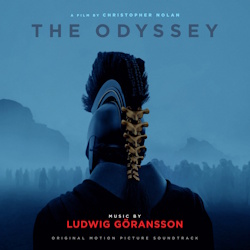 Original Review by Jonathan Broxton
The Odyssey, written approximately 2,700 years ago by the ancient Greek poet Homer, is one of the foundational works of Western literature. It follows the story of Odysseus, king of Ithaca, as he struggles for 10 years to return home after the Trojan War. Along the way, he encounters gods, monsters, and supernatural dangers – including the Cyclops Polyphemus, the enchantress Circe, the Sirens, and the sea god Poseidon, who repeatedly prevents him from reaching home. Meanwhile, back in Ithaca, his wife Penelope and their son Telemachus are surrounded by men trying to take Odysseus’s place and marry Penelope. The story ultimately becomes not just about surviving the voyage, but about returning home, reclaiming one’s identity, and restoring order.
The influence of The Odyssey is enormous and cannot be understated: the basic idea of a hero undergoing a long, difficult journey home has shaped storytelling for millennia. It explores themes that remain recognizable today: home and belonging, loyalty, temptation, revenge, hospitality, fate, and the tension between human choice and forces beyond our control, and it has inspired countless cinematic adaptations over the years. The two most obvious ones are Ulysses from 1954, which had Kirk Douglas in the title role and was a traditional 1950s swords-and-sandals production, and the 1997 two-part TV miniseries starring Armand Assante. Others are more abstract; O Brother Where Art Thou from the year 2000 is essentially an Odyssey remix set in 1930s Mississippi with George Clooney as the title character. In 2001: A Space Odyssey, director Stanley Kubrick and writer Arthur C. Clarke take the idea of the epic voyage and expand it into a journey across human evolution, technology, space, and ultimately the unknown, with the whole eventually becoming a metaphor for humanity’s voyage rather than one man’s return home. You can even recognize Odyssean DNA in movies as disparate as Cold Mountain and The Warriors, Finding Nemo and Cast Away, stories which all ask a surprisingly sophisticated question: after you’ve been away and changed by your experiences, can you actually return to your old life?
Christopher Nolan’s new film is perhaps the most lavish and ambitious version yet, and employs an impressive cast including Matt Damon as Odysseus, Anne Hathaway as Penelope, Tom Holland as Telemachus, Robert Pattinson as Penelope’s Machiavellian suitor Antinous, Lupita Nyong’o as Helen of Troy, Samantha Morton as Circe, Zendaya as the goddess Athena, and Charlize Theron as Calypso, a sea nymph who holds Odysseus captive for several years. John Leguizamo, Jon Bernthal, Himesh Patel, and Elliot Page also appear in smaller supporting roles. The scale of the film is gigantic – it cost roughly $200–250 million to make, making it Nolan’s most expensive film, and it was shot entirely on IMAX cameras, an undertaking so difficult that Nolan and cinematographer Hoyte van Hoytema had to invent entirely new camera systems to do it. They shot in five countries, in real ancient castles and remote locations, and built real boats which they then sailed on real oceans.
But here’s the thing: while I can absolutely appreciate the effort and time and craftsmanship that Nolan and his crew put into making the most authentic film possible, and while it is undoubtedly staggering from a visual perspective, I found the film to be curiously un-involving from an emotional perspective. The central conflicts and themes of the film are universal, but the delivery of them by the cast was ineffective to me. Anne Hathaway felt cold and distant. Tom Holland was, for large parts of the film, a whiny kid. Robert Pattinson was a cartoon villain rather than a formidable foe. Lupita Nyong’o is barely in it. John Leguizamo and Jon Bernthal’s undisguised New York accents made it difficult for me to take them seriously. And in the end, when Matt Damon finally returns home and is reunited with his wife, his emotional monologue didn’t land the way the filmmakers obviously intended.
 Some of this emotional distance is, for me, directly linked to its score, which was written by the multi-Oscar-winning composer Ludwig Göransson. This is now the third score Göransson has written for Nolan, after Tenet in 2020 and Oppenheimer in 2023, and he is now firmly Nolan’s composer of choice. As part of the drive for authenticity and realism, Nolan instructed Göransson to avoid writing the romantic western orchestral music commonly associated with the genre, and instead “evoke the materiality” of the Bronze Age and write music for as many period-appropriate instruments as possible. As such, Göransson sourced a number of highly specific musical sounds, including gongs, lyres, an aulos Greek double-reeded flute, a fyell Albanian end-blown flute, and various other metallic percussion items, alongside Albanian polyphonic vocal textures performed by the folk choir Të Rinjtë e Delvinës. He worked with archaeo-musicologists and ethnomusicologists who had an idea of how these instruments could be used and played, and the instruments were then layered with and manipulated by synthesizers to give Göransson more control over the final sound.
As I said, one cannot fault Göransson for his dedication to authenticity and intellectual application. This is something that has followed him throughout his career, through scores like Black Panther, Oppenheimer, and Sinners, and even his production work for rap and hip-hop artists like Childish Gambino and Kendrick Lamar. What this authenticity and intellectualism don’t always do, however, is produce a compelling film score, and that is the problem with The Odyssey. In context, it has little to no impact on the film itself, and as a standalone listening experience it is much too long, and is often downright dull.
On the one hand, of course, I understand why it sounds the way it sounds. To paraphrase the excellent thoughts of my friend and colleague Craig Lysy, Nolan clearly intended for his film to be an exploration of Odysseus’ tortured psyche, and the torment he feels for being the catalyst of the horrific genocide of Troy, and the subsequent death of his entire crew due to his pride and arrogance in the face of the gods – albeit one dressed up with numerous massive battles and action sequences. Ultimately there is very little traditional heroism, and only a small amount of redemption in the finale, and even this only comes following years of suffering by Odysseus and his comrades. Göransson’s score speaks to this internal tension and conflict more than it does the external action and spectacle, which results in a score which is quieter and more intimate than one would usually expect from a film of this scale. Emotionally, it is dark, tormented, and at times quite bleak. One could argue that Göransson’s music captures the essence of Nolan’s aesthetic, and as such is a complete success in that regard – but I ask for more than that basic requirement from my film scores, and for me it is here that it disappoints.
As I said, in film context, the score had little to no impact, and for me that came down to emotion. I’m not saying that I needed the film to have a lavish Miklos Rozsa-style orchestral epic score like Ben-Hur or El Cid (although, you know, I would have loved that…), but it needed something for me to latch on to, and warbling Albanian woodwinds, the occasional twang of a lyre, and rumbling gongs don’t cut it when it comes to conveying the deep emotional content inherent in the story. Ironically, in the few places where the score does call attention to itself, it did so in a way which felt distractingly obvious – I’m thinking especially of the ‘Trojan Horse/Sacking of Troy’ sequence, the scene with the giant Laestrygonians, and the final fight between Odysseus, Telemachus, and Antinous, all of which at different times descend into little more than a rowdy and annoying cacophony of endless drums, electronic pulses, and shouting. Recurring thematic material is present, but rare, mostly limited just to a few basic character motifs for Odysseus, Penelope, and Telemachus, plus an overarching theme for Ithaca and the concept of home. As I said, very few of these ideas left much of a lasting impression on me as the film ended.
The music as heard on the album does go some way towards presenting these ideas in a clearer and more apparent way, but the insane run time of the piece – almost two hours – hurts it tremendously, as there are numerous lengthy passages of music in between the thematic statements lasting ten minutes or more, which results in the music becoming stupefyingly passive to the point of boredom. Perhaps Göransson structured the album this way to make some kind of subtle point, referencing the endless nature of the journey at the center of the story, because listening to it sometimes feels like you are undertaking an odyssey of your own.
Some moments do stand out, although not always for the right reasons. The opening cue, “Zeus’s Law,” introduces the ancient-sounding gongs and softly plucked lyres that run throughout the entire score, and also features dramatic narration by rapper/actor Travis Scott performing in-character as a bard who tells poetic stories to entertain the throngs of people camped inside Penelope’s chambers – an idea that is repeated later in “Welcome Home Stranger”. The undulating, ancient-sounding woodwind theme for “Ithaca” is introduced in the cue of the same name, and is one of the score’s few clearly enunciated musical ideas, ultimately playing several times as a warm memory of home for Odysseus on his journey – you can hear it prominently in later cues such as “Hades” (where it is performed amid a cache of wailing, lamenting voices), “Sirens,” and parts of “Apollo’s Island”. The continued use of lyres and soft tapped percussion items here continues to establish the historic sound of the location, but the encroachment of grating bassy synth tones at the same time undermines its authenticity.
“Penelope” introduces the theme for that character, noble and regal and again carried mostly by the aulos and the fyell playing in tandem, which makes it a companion to the theme for Ithaca, albeit with a different central melody; in Odysseus’s mind, Ithaca and Penelope are one and the same, and represent home. More aggressive percussive ideas and the polyphonic vocals combine with the instruments in “Telemachus,” introducing a theme for the character which feels a little more youthfully enthusiastic and idealistic. The vocals in the Calypso part of “Calypso/Agamemnon” are more unnerving, shrill and discordant, speaking to the disorientation and confusion Odysseus feels while in the beautiful nymph’s gentle captivity. In the second half of the cue, the Agamemnon material uses guttural electronically-manipulated war horn sounds to accompany the brutal presence of the king of Mycenae who commanded Odysseus during the Trojan War.
There is some Zimmer-esque material in “Let’s Go Home,” dramatic pounding drums in combination with subtly optimistic synth tonalities that briefly allow Odysseus to believe his war is ended and he will soon be returning to Ithaca, but that is quickly drowned out by a bed of groaning electronic sludge that suggests the Gods have other ideas. This guttural electronic dissonance continues through the entire subsequent “Cyclops,” which is appropriately disturbing when it comes to conveying the horror Odysseus and his men feel upon encountering Polyphemus, the fearsome one-eyed man-eating son of Poseidon, but is difficult to connect with musically.
There is an engaging rhythmic element underneath the gong-led metallic instrumentation of “Menelaus, Husband of Helen,” as well as some soulful vocals that help to link his character to Telemachus; Menelaus and Odysseus were comrades in the Greek expedition against Troy, and are brothers in all ways except by blood; by visiting him, Telemachus is effectively making Menelaus represent what he hopes will eventually happen to his own missing father. These reprise with heroic intent towards the end of the otherwise interminable “Laestrygonians” track, making those couple of minutes an unexpected score highlight that reminded me at times of the score for Gladiator.
The “Circe” sequence features wordless in-character vocal stylings performed by actress Samantha Morton as the titular goddess/enchantress who lives on a remote island and uses magic to transform Odysseus’s men into pigs – a representation of the aggressive, animalistic nature they present following their attack on Troy. The music here is dreamy, a little mystical, but also at times violently horrific. The “Hades” sequence is even more unnerving, an uncomfortable cacophony of pulsating electronic noises and low bass booms that make Odysseus’s trip to the underworld nightmarishly inhuman.
The aforementioned “Sirens” underscores the famous scene where Odysseus and his crew must navigate their ship past rocks adorned with sirens – mythical creatures whose beautiful songs unwittingly lure sailors to their deaths. Göransson scores the scene with soft, beguiling voices, and an attractive setting of the Ithaca/Home theme that stands out as a melodic score highlight.
There is a sense of relief and destiny in “Another Name,” which underscores the moment where Odysseus finally returns home and is first reunited with his son; Göransson scores the scene with dramatic drums, soaring voices, and references to the Ithaca/Home theme, Penelope’s theme, and Telemachus’s theme, all of which play with the most emotional phrasing and intent I have heard in the score thus far. There is a sense of ominous darkness underpinning the incessant heartbeat-like percussive rhythms and low-end vocal sounds in “Bringing It All,” and in the eerie Vangelis-like textures of the latter half of “Welcome Home Stranger,” but the thematic presence returns to the forefront in “Odysseus,” which is by some margin the score’s standout cue, and features some notably excellent performances from the ancient woodwinds, the voices, and prominent driving percussion, which become joyous and near-celebratory during the second half of the cue.
The final confrontation between Odysseus and Antinous in “The Trial of the Bow/Vengeance” descends into that rowdy and annoying cacophony of endless drums and electronic pulses I mentioned before, and is a poor musical accompaniment to the film’s finale where the villain is satisfyingly dispatched, but “Chasing the Escaping Sun” ends the score with a sense of warmth and gentle optimism as Odysseus and Penelope literally sail off into the sunset together. The final song, “When I’m Home,” was co-written by Göransson and Nolan with English singer-songwriter and electronic musician James Blake and rapper Travis Scott, and is performed by Scott. It is about as polar opposite from my musical taste as it is possible to be, and that’s all I’m going to say about that.
The score for The Odyssey is likely to be a major player at next year’s Academy Awards, and mainstream film critics are already falling over themselves, clamoring to herald it as the next great film score. Don’t bet against Göransson picking up dozens of gongs for his work here. But, from my point of view, a lot of The Odyssey falls flat. While the album listening experience of the score is better than the in-context application – you can clearly hear the development of numerous themes, and several set pieces are quite impressive – it is the lack of in-context impact that is entirely the problem. Yes, it is meticulously researched. Yes, it uses period-appropriate instruments in authentic ways. Yes, it fits with the dark, introverted, intellectual aesthetic that Christopher Nolan has presented as his exploration of Odysseus’s psyche. But it’s the lack of emotional connection between score and audience that ultimately lets down the entire project and – for me – contributed significantly to my disappointed reaction to the film overall. As I said at the beginning of this review, The Odyssey is one of the foundational works of Western literature, tackling some of the most important issues and emotions inherent in humanity. If the score for a film like that actively hinders my connection with those emotions in context – as this score did for me, here – then I can only conclude that something has gone fundamentally wrong somewhere.
Buy the Odyssey soundtrack from the Movie Music UK Store
Track Listing:
- Zeus’s Law (3:36)
- Ithaca (5:41)
- Penelope (4:17)
- Telemachus (4:00)
- Calypso/Agamemnon (3:59)
- Let’s Go Home (3:12)
- Cyclops (6:01)
- Menelaus, Husband of Helen (3:49)
- Troy (6:14)
- Laestrygonians (5:02)
- Circe (7:36)
- Hades (10:33)
- Loyal to the Future (5:21)
- Sirens (2:39)
- Apollo’s Island (4:32)
- 7 Years (2:16)
- Another Name (1:51)
- Bringing It All (8:01)
- Welcome Home Stranger (5:51)
- Odysseus (8:42)
- The Trial of the Bow/Vengeance (6:14)
- Chasing the Escaping Sun (3:21)
- When I’m Home (written by Ludwig Göransson, James Blake, Travis Scott, and Christopher Nolan, performed by Travis Scott) (5:27)
Back Lot Music (2026)
Running Time: 118 minutes 15 seconds
Music composed by Ludwig Göransson. Orchestrations and arrangements by Ludwig Göransson and Noah Gorelick. Featured musical soloists Callum Armstrong, Rosa Fragorapti and Vendim Kapaj. Recorded and mixed by Riley Mackin. Edited by Alex Gibson and Felipe Pacheco. Album produced by Ludwig Göransson and Serena Göransson.
Leave a Reply

Shop at the Movie Music UK Store

Member of the


“But it’s the lack of emotional connection between score and audience that ultimately lets down the entire project”
If there was no emotional connection with the audience, there wouldn’t be posts of moviegoers who went to see the film and bought the score afterwards to hear it over and over again. It connected with audiences, but it didn’t with you.
I haven’t seen the movie but I listened the score, it is fucking terrible in its own right
That is correct. In this instance, the audience is me, and therefore this is clearly my personal point of view. That’s how reviews work.
Though grandiose and loud, The Odyssey fell short for me. I’m not saying it’s a bad movie, it’s actually great, but it’s not as great as the studio wants us to believe.
I agree with your point about the score’s lack of emotional connection with the audience. I’ve seen countless memes using the music from the Sirens scene, but that doesn’t necessarily mean people genuinely care about or enjoy the score. The music is mostly being used for the joke.
As for the score itself, I really like Ludwig Göransson and admire how creative he is, but hey, no one is perfect. He was bound to make a disappointing score at some point, haha. The score for The Odyssey feels bland and has very little personality. Aside from its use in memes, it can hardly stand on its own outside the film.
The use of electronic elements was also awful, in my opinion, and ruined several moments that came very close to being memorable.