MASTERS OF THE UNIVERSE – Daniel Pemberton
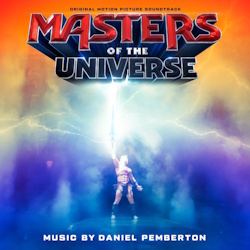 Original Review by Jonathan Broxton
As I have mentioned in other reviews, as a child growing up in the 1980s, few television shows captured my imagination quite like He-Man and the Masters of the Universe. At the time, He-Man was a cultural phenomenon and a fixture of playground conversations across the United Kingdom. The franchise had begun life as a line of Mattel action figures launched in 1981, each packaged with a mini-comic that expanded the mythology, before being transformed into a hugely successful animated TV series by American studio Filmation, that first aired in 1983. Although the cartoon was clearly designed to promote the toys – and rarely missed an opportunity to deliver a heavy-handed moral lesson at the end of each episode – that hardly mattered to my younger self. I was completely engrossed by the adventures of Prince Adam, who became the mighty He-Man whenever he raised his enchanted sword and proclaimed, “By the power of Grayskull!”, and by his ongoing struggle to protect Eternia from the schemes of the villainous Skeletor. The show’s colorful cast of allies, including Duncan (Man-at-Arms), Teela, Orko, and Cringer – who transformed into the fearsome Battle Cat – only added to its appeal. Viewed through adult eyes today, the series is undeniably dated, with repetitive storylines, limited animation, and often simplistic writing, yet its charm endures. More than anything, it remains a source of warm nostalgia and a vivid reminder of a much-loved part of my childhood.
Although it is not a good film by any metric, I have fond memories of the cheesy 1987 big-screen version of Masters of the Universe starring Dolph Lundgren. I also watched the 2021 animated series Masters of the Universe: Revelation, which was developed by filmmaker Kevin Smith for Netflix, but that was a sequel to the original 1981 series, and was sort of its own thing; as such I never felt that the franchise had received a proper big-screen adaptation – until now. This new version of Masters of the Universe is the He-Man film that 12-year-old me has always wanted. It’s big, it’s action-packed, it’s silly, it has its tongue firmly planted deep in its cheek, but it’s also a great big nostalgia bomb that immediately transported me back to Saturday mornings in the 1980s with its familiar characters and un-pretentious charm.
The film is directed by Travis Knight, whose previous films include the animated adventure Kubo and the Two Strings and the Transformers spin-off Bumblebee, and stars Nicholas Galitzine, Camilla Mendes, Jared Leto, Alison Brie, and Idris Elba. Adam is a pre-teen prince on the distant planet of Eternia, growing up with his parents, the King and Queen, his best friend Teela, and Teela’s father Duncan, the King’s man-at-arms. When Eternia is attacked by the evil Skeletor and his minions, Adam is entrusted with a magical sword that harnesses the power of Castle Grayskull, and sent through a portal to Earth, his mother’s home planet; however, Adam loses the sword during his journey, and because of that remains there as an orphan with no way to return home. Fifteen years later Adam works a dead-end job in human resources, and spends his personal time searching for the sword and unsuccessfully convincing his friends that he is really a prince from a distant planet. However, things change for Adam when someone finds his sword in a comic book store, and he is able to finally return home to reunite with his friends, reclaim his birthright, and protect his kingdom.
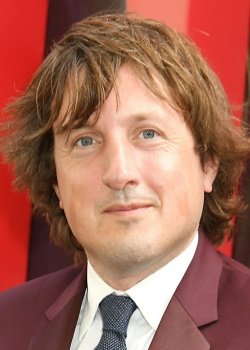 The score for Masters of the Universe is by composer Daniel Pemberton, who has already written music for two of 2026’s most acclaimed films, Project Hail Mary and The Drama, and is no stranger to 1980s fantasy nostalgia, having scored the TV prequel to The Dark Crystal, Age of Resistance in 2019. In an interview with Matt Minton for Variety, Pemberton explains that he intentionally wrote a ‘maximalist’ score for Masters of the Universe, saying that he wrote it with a more rock and pop sensibility. He explains: “The big thing about this film is even though at its core it’s kind of ridiculous, it’s incredibly sincere, and so we’re writing this music that’s very flamboyant, theatrical, over the top and quite fun … It really means everything it says. It’s not ironic.” He goes on to say that, with this music, “I wanted a grown man to feel like a small boy again, and I wanted a small boy to feel like a grown man … I wanted something that had the weight and seriousness of a hard-rock track mixed with the color, campiness and slight cheese of a poppy Euro song. The influences around the ‘80s were very pop-driven. I wanted it to have that sensibility that as soon as you start the movie, it tells you you’re in for something fun. That’s the most important thing about this film – it’s unashamedly fun.”
To that end, Pemberton’s score comprises an 80-piece orchestra, a 100-piece choir, a rock band, and plenty of synthesizers; this approach is similar to the one that Bear McCreary took with his score for Masters of the Universe: Revelation, which he described as sounding “like Basil Poledouris collaborated with early Metallica to score Conan the Barbarian”. However, rather than bringing Kirk Hammett out to play, Pemberton arguably went one better and collaborated with Brian May, lead guitarist of the legendary rock band Queen; May, of course, was himself involved in his own 1980s superhero movie when he and his band-mates collaborated with composer Howard Blake to score Flash Gordon in 1980, and as such it should come as no surprise to learn that Masters of the Universe often resembles that score.
The score’s recurring main theme is introduced in the opening theme, “Eternia,” a galloping, soaring festival of thunderous orchestrations, chanting choirs, roaring electric guitars, rock drums, and synth embellishments. It’s insanely brilliant – a heroic, catchy earworm that is cheesy in all the best ways, a perfect musical representation of the project as a whole. At the 2:11 mark, one of the score’s secondary ideas is introduced, a cascading 5-note motif that appears to be inspired by the central bridge from the cartoon theme and which, as the music develops, establishes itself as the recurring motif for the Sword of Power. May performed his solos for this cue on his famous Red Special guitar, which he built out of repurposed household materials as a teenager and which has been used numerous times in Queen’s live performances.
These two ideas – the Eternia theme and the Sword of Power motif – dominate most of the score, recurring in a variety of ways in multiple cues. I love the lullaby-esque, faintly medieval-sounding version of the Eternia theme that opens in “Young Adam,” which underscores the little prince’s idyllic life in the royal palace, and even includes a sneaky reference to Brian May’s famous percussive riff from the Queen song “We Will Rock You” during a combat training sequence. I love the use of the Sword of Power motif in “Portal to Earth,” especially its choral variation, which accompanies young Adam as he escapes from Skeletor’s clutches thanks to an inter-dimensional wormhole conjured up by Castle Grayskull’s radiant Sorceress – eventually landing him in suburban Oklahoma City.
The blues-rock-jazz versions of the Sword of Power motif in the “Comic Store Heist” and the “Freeway Escape” are terrific. The triumphant statement of the main theme in “Folding Space” is sensational, capturing the overwhelming sense of joy and wonderment Adam feels when Teela appears in her spaceship, rescues him from Earth, and finally brings him home; however, this is quickly overtaken by the somber, haunted statement of the theme that appears in “Eternos in Ruins,” as Adam realizes how much damage Skeletor has wrought during his years away.
“The Power of Grayskull” underscores the moment where Adam finally harnesses the Sword of Power and transforms into He-Man for the first time – a massive, epic statement of both the Eternia theme and the Sword of Power motif backed with May’s roaring guitars and soaring choirs. From this point on, when Adam is in his He-Man persona, Pemberton often switches to a massive, brassy He-Man action variation on the Eternia theme that sits perfectly within the established Eternia/Sword sound, but adds a new heroic dimension to that specific character – cues such as “He-Man vs. Trap-Jaw,” “Sky Fight,” and “Battle Cat and He-Man” feature the He-Man theme prominently. One of the things I like about the He-Man action theme is how Pemberton again seems to be alluding to a specific rhythmic excerpt from the original cartoon theme, this time obliquely referencing the two-note ‘He Man’ exclamation that underpins the melody.
However, as he always does, Pemberton takes things further, introducing several additional themes for villains, minor heroes, and more. The most prominent villain theme is, of course, the theme for Skeletor, an inhumanly guttural howl combining guitars, keyboards, and heavy percussion, which first appears in “The Battle for Eternos,” and then infects its way through “Skeletor and King Randor” amid a host of keening, croaking string textures and epic choral outbursts. There is nothing subtle about Pemberton’s Skeletor music; it’s just the personification of evil, the musical equivalent of a maniacal laugh. Once the action shifts back to Eternia from Earth, and He-Man and Skeletor face off, the Skeletor motif appears frequently: you can hear it in “Get the Sword,” the wicked-sounding “Mulched,” and then all throughout the film’s action-packed conclusion.
The theme for Adam’s parents, King Randor and Queen Marlena, is introduced in the final moments of “Young Adam” and is a similarly medieval-sounding madrigal of regal bearing. Later, “You Failed” introduces the brief heroic motif for Idris Elba’s Duncan, and the harsh metallic motif for his nemesis Trap-Jaw. However, perhaps the biggest drawback of the score is the lack of clear signature identities for both Teela and Evil-Lyn; they do appear to have music motifs – you can hear them both prominently in “The Witch and the Warrior Goddess,” which underscores their primary fight sequence – but their themes, and the themes for Duncan and Trap-Jaw, do tend to get lost somewhat amid the prominent themes for Eternia, the Sword, and He-Man, and this is a little disappointing.
Thankfully, Pemberton more than makes up for this with his action music, which is generally outstanding, ranging from the epic scope of “The Battle for Eternos” to the jazzy caper vibe of the “Comic Store Heist” and the effortless swaggering cool of “Prison Break”. Perhaps my favorite of the middle-album action sequences is “Sky Fight,” a thunderous, fast-paced explosion of energy which underscores a chase sequence where He-Man flees on his signature Sky-Sled, pursued by a platoon of Skeletor’s minions on dragonfly-like Fright Fighters and razor-tipped Roton vehicles. Stylistically, these cues feel like variations on the action sound from his Spider-Man scores, blended with some of the symphonic textures of The Dark Crystal: Age of Resistance, the dexterity of Enola Holmes, the eclectic rhythmic experimentation of King Arthur: Legend of the Sword, and even a little bit of 1990s Trevor Jones in the underlying ostinatos. It’s all superb.
The finale of the film – and score – begins with the massive, driving “Journey to Snake Mountain” and eventually encompasses a series of individual conflicts between He-Man and Skeletor, Teela and Evil-Lyn, Duncan and Trap-Jaw, as well as the more wide-ranging battle that sees He-Man’s allies and Skeletor’s minions fighting for control of Snake Mountain, Castle Grayskull, and Eternia as a whole. During this 25-minute sequence Pemberton brings out every theme in the score, in multiple guises, and plays them with the volume turned to eleven. The muscular drive of “Journey to Snake Mountain” is superb. “Fight for Snake Mountain” seethes with barely-controlled orchestral fury and roaring electric guitar goodness. There is a tender reprise of the theme for Adam’s parents in “I Wanted to Protect You,” underscoring one of the film’s most emotional moments.
As I mentioned, “The Witch and the Warrior Goddess” contains the score’s clearest statements of the themes for Teela and Evil-Lyn, the former being an energetic syncopated rhythm, the latter being a sort of banshee howl similar to, but distinct from, Skeletor’s theme. “The Sword of Power” attains some massive heights, and then the conclusive “Skeletor vs. He-Man” pits both characters’ themes against each other in a rowdy, bombastic battle for supremacy. The stirring statement of the Sword of Power motif during the track’s conclusion is especially satisfying, and then the final statement of the main Eternia theme in “Return to Eternia” ends the main part of the score on a massive, triumphant high.
One final thing to mention, of course, is the classic and massively popular theme from the original TV show, written by Haim Saban and Shuki Levy with ‘Erika Lane’ (the pseudonym of Filmation co-founder Lou Scheimer). Bill Conti famously ignored the theme entirely in his score for the 1987 Masters of the Universe, and while Bear McCreary considered using it in his score for the animated TV sequel, contractual shenanigans eventually prevented him from doing so. Fans of the show will therefore be delighted that it does appear here; as I mentioned earlier, there are subtle allusions to the underlying rhythms from the theme in both the Sword of Power motif and the He-Man action theme, but it explodes fully in the epilogue cue “A Job for He-Man”. In the aforementioned Variety interview Pemberton explains that, while he would have liked to use it more frequently, it didn’t work out, saying that while “the theme song is phenomenally catchy and such an iconic part of people’s childhoods,” he tried it elsewhere in the film and it was very difficult to make it work within the action beats of the movie, noting that “at its core, that theme is played for 10 seconds at the beginning of every cartoon, and it doesn’t sustain in the same way for longer.” As such, “A Job for He-Man” will have to suffice for fans of the show – I’m just pleased he was able to use it at all, and I admit I found myself having a slightly misty-eyed nostalgic glow when it appeared.
The album ends with a fantastic original glam rock song, “Masters of the Universe,” written by Pemberton with Justin Hawkins and Dan Hawkins, and performed by Hawkins’ band The Darkness, who you might remember from their 2003 smash hit “I Believe In a Thing Called Love”. It’s a terrific homage to the genre as a whole, carried by May’s guitars and Hawkins’s towering falsetto. Other source music songs that feature in the film but are not on the soundtrack album include an unexpectedly tender instrumental version of the classic Cure song “Boys Don’t Cry,” “What’s Up?” by 4 Non Blondes, “The Man” by The Killers, “The Power” by Snap!, and “Princes of the Universe” by Queen, a sly in-joke for fans of Flash Gordon and Highlander. I also noticed one cue from Pemberton’s score from The Man from UNCLE used as a piece of source music early in the film.
Masters of the Universe is exactly the sort of score that modern blockbuster filmmaking rarely attempts anymore: unabashedly melodic, gloriously excessive, and utterly committed to entertaining its audience. Daniel Pemberton embraces every colorful, larger-than-life aspect of the He-Man franchise and channels it into two hours of soaring themes, thunderous action music, and rock-infused bravado. Whether you’re a lifelong fan who grew up with Prince Adam and Skeletor or simply someone who enjoys bold, old-fashioned adventure scoring, there is an enormous amount to enjoy here, although a tolerance for very prominent electric guitars and a love of classic Queen-style rock is highly necessary in order to fully embrace its vibe. For me, the music succeeds for the same reason the film does: it understands that Masters of the Universe was never meant to be subtle. It was meant to make you feel like a kid again, and from my point of view it succeeded on both counts. By the time the final notes fade away, it’s clear that Pemberton has well and truly claimed the power of Grayskull.
Buy the Masters of the Universe soundtrack from the Movie Music UK Store
Track Listing:
- Eternia (3:19)
- Young Adam (3:46)
- The Battle for Eternos (4:07)
- You Failed (0:50)
- Skeletor and King Randor (2:19)
- Portal to Earth (2:22)
- Boys Don’t Cry (written by Robert Smith, Lol Tolhurst, and Michael Dempsey) (1:28)
- Comic Store Heist (2:41)
- Freeway Escape (1:18)
- Folding Space (Eternia) (1:36)
- Eternos in Ruins (1:28)
- What’s Left of Us (1:06)
- Prison Break (3:46)
- Conflict Territory (2:27)
- The Power of Grayskull (1:54)
- He-Man vs. Trap-Jaw (1:49)
- Get the Sword (1:21)
- Sky Fight (5:47)
- Mulched (2:06)
- You Are He (1:14)
- See Another Morning (1:54)
- Such Good Friends (1:35)
- Journey to Snake Mountain (1:34)
- Enter Snake Mountain (1:43)
- Fight for Snake Mountain (3:55)
- I Wanted to Protect You (2:33)
- The Universe Shall Quake in My Shadow (1:30)
- Battle Cat and He-Man (2:23)
- The Witch and the Warrior Goddess (1:27)
- Let’s Have a Look (1:15)
- The Sword of Power (3:34)
- Skeletor vs. He-Man (3:32)
- Return to Eternia (3:12)
- A Job for He-Man (written by Shuki Levy, Haim Saban, and Erika Lane) (1:51)
- Masters of the Universe (written by Justin Hawkins, Dan Hawkins, and Daniel Pemberton, performed by The Darkness) (3:20)
Lakeshore Records (2026)
Running Time: 72 minutes 12 seconds
Music composed by Daniel Pemberton. Conducted by Andrew Skeet and Edward Farmer. Orchestrations by Edward Farmer, Cameron Smith, Andy Kyte and Danny Ryan. Additional music and featured guitar solos by Brian May. Recorded and mixed by Sam Okell. Edited by Ben Smithers. Album produced by Daniel Pemberton.
Leave a Reply

Shop at the Movie Music UK Store

Member of the


such a fun score! Thanks for sharing!
I discovered Pemberton’s music recently when I listened to the Steve Jobs OST for the first time. I’ve listened to his other albums since, and each one sounds both distinctly unique and like nothing you would have imagined any other composer would have composed. He’s impressively imaginative and definitely the most singular voice among current composers.
Great review! I have this score on a constant repeat, it’s absolutely wonderful. And so is the movie. I never watched the cartoons as a kid (I only played with the toys and read the comics), but I think the tone of the movie (and score) fits perfectly what I imagined back then. Only sad part of it all is, that I’m now 50 years old and can’t pull out my MOTU toys and play with them 🙂 BTW, I don’t think Brian May plays on the song by The Darkness? He’s not credited on Spotify at least.
This is one of my favorite recent scores. Terrific themes and the Queen inspired vibe was perfect for the movie. Pemberton nailed this one. He understood the assignment. It was supposed to be over the top and it succeeds on every level. I’m amazed the film didn’t do well at the box office. It was great and one of the best times I’ve had at the movies in recent years. Hopefully we’ll still get a sequel.