DISCLOSURE DAY – John Williams
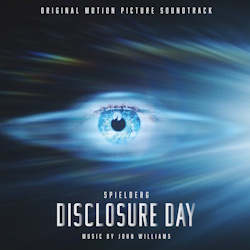 Original Review by Jonathan Broxton
WARNING: THIS REVIEW CONTAINS PLOT SPOILERS. IF YOU HAVE NOT YET SEEN THE FILM, YOU MIGHT WANT TO CONSIDER WAITING UNTIL AFTER YOU HAVE DONE SO TO READ IT.
Steven Spielberg has been obsessed with aliens since he was a small child. His first short film, shot on a Super 8 camera in and around his hometown of Phoenix, Arizona, was a story about a mysterious alien encounter and invasion called Firelight; he was 17 in 1964 when he made it. Close Encounters of the Third Kind (1977) was a groundbreaking masterpiece. E.T. the Extra-Terrestrial (1982) remains, for me, one of the greatest films ever made. War of the Worlds (2005) and Indiana Jones and the Kingdom of the Crystal Skull (2008) also featured aliens in different capacities. Now, with his new film, Disclosure Day, Spielberg has returned to the genre that has arguably defined his career.
The story initially follows two strands. First, a cybersecurity specialist named Daniel Kellner steals a cache of highly classified files from a company called Wardex and goes on the run with his girlfriend, Jane, intending to bring the files to a former Wardex employee named Hugo, who in turn plans to disclose the information to the entire world. Meanwhile, Kansas City TV weather forecaster Margaret Fairchild begins to develop bizarre psychic abilities, including speaking languages she does not know and intuitively understanding the thoughts and emotions of others. Both Daniel and Margaret find themselves being hunted by Wardex CEO Scanlon, who is desperate to protect the information Daniel has stolen because, as we eventually discover, it contains proof that there have been dozens of instances of human-alien contact dating back to the Roswell incident in 1947, and the U.S. government is trying to cover it up. The film stars Emily Blunt as Margaret, Josh O’Connor as Daniel, Colin Firth as Scanlon, Eve Hewson as Jane, and Colman Domingo as Hugo, and is based on a screenplay by David Koepp.
There are a lot of different, interesting ideas floating around in Disclosure Day. In many ways, the film can be seen as a companion piece to both Close Encounters and E.T., notably in the way all three films deal with different aspects of the real-world implications of an actual encounter with extraterrestrial life. Spielberg’s core philosophical claim seems to be that the greatest challenge posed by alien contact is not scientific, but moral, and whether humanity can respond to a larger reality with empathy rather than fear. It asks whether humanity has a right to know the truth about life as we know it, even if that truth is potentially destabilizing from a religious and existential point of view. It also explores AI, misinformation, and technological manipulation, and posits that many of the world’s problems could be solved if we simply listened to and understood one another. The fact that there are also exciting car chases and action scenes is secondary to the screenplay’s underlying philosophical concerns.
Unfortunately, the film has been the recipient of some criticism, with commentators pointing out that Spielberg presents a simplistic, old-fashioned, perhaps even naïve view of the post-COVID world, especially in the final third and in the way the revelations are presented to the public. I personally found a couple of things frustrating, from Emily Blunt’s central performance and some of the character motivations to the abruptness of the ending and even the quality of some of the special effects, the latter of which is especially surprising considering the type of filmmaker Steven Spielberg is. However, one thing I did not find frustrating was the score, which is by the legendary John Williams.
 John Williams and Steven Spielberg first met in 1973 and first worked together in 1974 on The Sugarland Express. Their collaborations since then comprise some of the greatest film music in cinematic history – no one needs me to list those masterpieces – and Disclosure Day marks their 30th film together. John Williams is 94 years old now and has not been in the best of health lately; recent appearances at events with the Boston Symphony Orchestra and at his old high school in North Hollywood have shown him looking frail and using a wheelchair, so the fact that he is writing music for films at all is astonishing. Williams suggested three years ago that his score for The Fabelmans would likely be his last, but Spielberg talked him into returning for Disclosure Day, and the fact that the resulting music is still as good as it is is nothing short of a miracle.
Williams actually began writing the score in the summer of 2025 and started recording in mid-September, almost a full year before the film’s release. It’s mostly a traditional symphonic score, bolstered by unusual orchestrations here and there, primarily involving electronic and choral embellishments and specialty instruments such as a celeste and a larger-than-usual bassoon section. Williams conducted and orchestrated most of it himself, assisted by longtime collaborators William Ross and Randy Kerber, and the resulting score is quintessential Williams: contemplative, warmly emotional, often subdued and thoughtful, yet imbued with moments of suspense, heightened drama, light horror, and driving action, as dictated by the story.
Truthfully, there isn’t much innovation here in terms of Williams trying out new sounds and techniques, but at his age and with his stature, there doesn’t need to be. There are hints and allusions to dozens of previous Williams scores: Close Encounters of the Third Kind and E.T. the Extra-Terrestrial, naturally, but also some unexpected ones. Some of the string phrasing, especially those big, rich clusters, reminded me of Born on the Fourth of July. The melody and chord progressions of the main themes have something of Angela’s Ashes about them, perhaps crossed with elements of A.I. Artificial Intelligence. Some of the action and suspense music reminded me of Minority Report and War of the Worlds, perhaps crossed with some of his more recent Star Wars work.
Thematically, there appear to be at least four main themes running throughout the score, but rather than relating strictly to specific individuals or places, they seem more conceptual, dealing with the film’s big ideas and overarching emotions. The first theme, which appears in the opening cue “Listen,” is loosely associated with Daniel and his ability to hear and understand language and mathematics, but more broadly relates to Spielberg’s assertion that humanity needs to listen to one another. The theme is gorgeous: soulful, bittersweet, slightly sad, yet also hopeful and optimistic. Williams initially carries the melody with solo horns before shifting it to a bank of tender strings, which dominate the remainder of the cue. The whole thing is steeped in classic Williams-isms, the melodic idea surrounded by many of the warm, inviting textures he has used throughout his career to illustrate similarly profound concepts.
There is a lovely reprise of the Listen theme in the middle of “In Vivo,” a cue that elsewhere consists of impressionistic textures for strings and soft choir, as well as a prominent solo vocal performance by Holly Sedillos. In context, this theme also appears in several scenes where the three animals – the cardinal, the deer, and the fox – are prominent. We don’t know it at the time, but these animals are actually extraterrestrials assuming harmless forms to better observe humans; unfortunately, these cues do not appear on the album.
The second theme, which appears in the cue “Memory,” is associated with both Daniel and Margaret, but more generally relates to their shared childhood encounters with the aliens and the latent powers those encounters awakened. This theme is carried by piano, backed by harp glissandi and string textures, and feels magical, almost like a fairy tale, while also being underpinned by trepidation, as heard in the minor-key chords Williams often uses to conclude his thematic statements.
There’s an excellent, extended exploration of this theme in the captivating “Celestial,” a tone poem full of endless wonder that underscores the flashback sequence of young Margaret’s abduction by the cardinal alien, the deer alien, and the fox alien. Williams plays with variations of the theme for almost seven minutes, employing gorgeous choral textures, effervescent woodwind colors, breathless string tremolos, delicate harps, wholesome horns, and warm chords that seem to melt into your soul. The music moves into slightly shadier and more dissonant territory when the aliens reveal themselves, before finally presenting several full thematic reprises after the four-minute mark that feel like a lullaby.
The third theme, which appears in “Believe,” is loosely associated with Jane, but primarily addresses the concept of a crisis of faith, specifically her concerns about how the revelation of alien life would affect religion and belief. Williams uses solo piano backed by subtle harps, an almost subliminal celesta, and wholesome strings to address the issue in a sensitive, almost childlike way. The Believe theme reminded me somewhat of a slower, more relaxed version of the piano end credits from E.T., which I love. The statement of the theme in the final moments of “Home” is simply gorgeous.
The fourth and final theme, which appears in “Empathy,” is loosely associated with Margaret and her ability to seemingly read minds and understand people’s emotions simply by looking into their eyes, but it is more broadly tied to Spielberg’s secondary thematic concern: that not only listening to one another, but understanding one another, is how humanity will save itself. Again, Williams uses gentle piano textures as the foundation of the theme, but as the cue progresses he expands both its instrumental scope and emotional intensity until it reaches exceptional heights. There is a distinct, almost Delerue-like lyricism to the theme that is heartbreakingly beautiful, and which I adore.
The rhythmic militarism at the end of “Believe” functions as a motif for Scanlon and Wardex, recalling the music for Keys and the medical scientists in E.T.. This idea reprises with satisfying, timpani-led intensity throughout the churning “Unseen,” the intense “KCXE,” and later in the middle of “Caught.” Suspense cues such as “Dive,” “Negotiation,” the aforementioned “KCXE,” and the ominous “Signs” are darker, more abstract, and occasionally dissonant, employing lower tones, rumbling string passages, bleating bassoons, and electronic textures to create an uneasy atmosphere. Several action moments stand out as well, especially the kinetic and chaotic “Chase,” with its frantic string runs, shrill woodwinds, and imposing bursts of percussive energy, including notable passages for xylophone and cymbals. I also love the explosion of low, growling Nixon-style horns that appears about a minute into “Home,” accompanying the arrival of Hugo’s fleet of fake fire trucks at the warehouse hangar where an exact replica of Margaret’s childhood home has been constructed.
There is an increasing sense of urgency, wonder, and revelation throughout “Disclosure,” which underscores the scene in which Daniel’s stolen footage is finally broadcast to an incredulous world. A fascinating duet between oboes and harps runs through the cue, creating a hypnotic effect. Then the final cue, “Reprise,” functions as a concert suite offering extended statements of the Listen, Memory, Believe, and Empathy themes. The cue frequently features a more prominent vocal and choral presence, a frantic underpinning ostinato for undulating strings and dramatic horns, and sweeping thematic flourishes. It’s superb from beginning to end.
What I like about Disclosure Day is not that it is especially original or groundbreaking, because it is neither of those things. Williams remains firmly within his comfort zone throughout the score, but that’s not the point. What I like is that Williams is still very much a thinking composer. His themes weave in and out of one another in a way that helps clarify and illuminate many of the philosophical and intellectual underpinnings of Spielberg’s screenplay in a manner few other composers could achieve. Williams understands that he is often the direct conduit between filmmaker and audience, and that it is his job to bring those nuanced emotions and connections to the surface through music. I write that as though it were easy, but it is not, and that is part of why Williams is so revered.
Furthermore, Williams has clearly lost none of his technique. There isn’t a dull moment in the entire score; even when he is not referencing one of his themes – especially when he is not referencing one of his themes – Williams constantly finds interesting things to say through a particular instrumental color, a phrase, or a small flourish, making full use of everything an orchestra can offer. Williams still does not receive enough credit for his gorgeous musicianship and textural sophistication – he is not all marches and love themes – and cues such as “Celestial” showcase that beautifully.
I wrote on Facebook the other day: “It’s June 11th, 2026, and I’m listening to a brand new score by John Williams for a brand new film by Steven Spielberg. What a gift. What a joy.” And I truly mean that. John Williams and Steven Spielberg have been a gift to cinema and film music since 1974, and they continue to be one more than 50 years later. Disclosure Day is not one of John Williams’s very best scores, and it is certainly not one of Steven Spielberg’s best films, but the fact that Williams can still write music with this much beauty, this much craft, this much intensity, and this much emotion at 94 years old is something no one should take for granted.
Buy the Disclosure Day soundtrack from the Movie Music UK Store
Track Listing:
- Listen… (4:08)
- Memory… (4:07)
- Dive… (4:37)
- Chase… (2:14)
- Believe… (3:35)
- In Vivo… (2:49)
- Negotiation… (3:25)
- Empathy… (2:24)
- Celestial… (6:50)
- Unseen… (3:09)
- KCXE… (5:56)
- Signs… (2:37)
- Home… (3:37)
- Caught… (5:56)
- Disclosure… (4:22)
- Reprise… (4:54)
Back Lot Music (2026)
Running Time: 64 minutes 40 seconds
Music composed by John Williams. Conducted by John Williams, William Ross and Randy Kerber. Orchestrations by John Williams, William Ross and Randy Kerber. Recorded and mixed by Shawn Murphy. Edited by Ramiro Belgardt. Album produced by John Williams.

Shop at the Movie Music UK Store

Member of the


