Archive
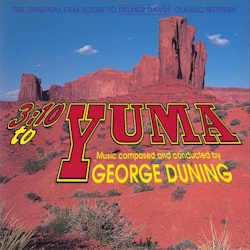
3:10 TO YUMA – George Duning
 GREATEST SCORES OF THE TWENTIETH CENTURY
Original Review by Craig Lysy
The original story for 3:10 to Yuma was the brainchild of writer-producer David Heilweil, who adapted the 1953 short story of the same name written by crime author Elmore Leonard. He offered it to producer Robert Aldrich and his production company, who liked it enough to commission a screenplay by Halsted Welles. Yet the company was in need of cash, and so Aldrich sold the screenplay and film rights to Columbia Pictures for $100,000. Heilweil was assigned as producer, and Delmer Daves was tasked with directing. A creative decision was made to shoot the film in black and white using red filters on the camera lens, which afforded the picture a more arid and parched appearance. A fine cast was recruited, including Glenn Ford as Ben Wade, Van Heflin as Dan Evans, Leora Dana as Alice Evans, Felicia Farr as Emmy, Robert Emhardt as Mr. Butterfield, Henry Jones as Alex Potter, and Richard Jaeckel as Charlie Prince. Read more…
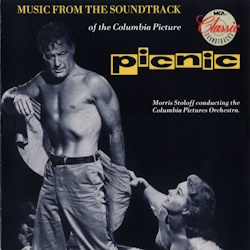
PICNIC – George Duning
 GREATEST SCORES OF THE TWENTIETH CENTURY
Original Review by Craig Lysy
Columbia Pictures took notice of the enormous success of the Broadway play “Picnic” by William Inge, which opened on February 19, 1953 at the Music Box Theater, ran for 477 performances, and won the Pulitzer Prize in Drama in 1953. The studio purchased the film rights in 1953 for $350,000, Fred Kohlmar was placed in charge of production with a budget of $3 million, Joshua Logan, the director of the Broadway stage production was tasked with directing, and Daniel Taradash joined William Inge in writing the screenplay. For the cast, the studio made the controversial decision to cast 37 year old William Holden, their marquee star, as 21 year old Hal Carter, joining him would be Kim Novak as Madge Owens, Rosalind Russel as Rosemary Sydney, Betty Field as Flo Owens, Cliff Robertson as Alan Benson, Nick Adams as Bomber, and Susan Strasberg as Millie Owens. Read more…
NO SAD SONGS FOR ME – George Duning
 GREATEST SCORES OF THE TWENTIETH CENTURY
Original Review by Craig Lysy
Columbia Pictures came across the 1944 novel “No Sad Songs For Me” by Ruth Southard and believed its sentimental tale would translate well to the big screen. They purchased the film rights, assigned production to Buddy Adler, tasked Rudolph Maté with directing, and hired Howard Koch to write the screenplay. Casting was problematic. Originally Irene Dunne was envisioned for the lead role of Mary Scott, but this did not pan out, nor did Olivia de Haviland. In the end, they secured Margaret Sullavan for what would be her final film. Joining Sullavan would be Wendell Corey as Brad Scott, Viveca Lindfors as Chris Radna, and Natalie Wood as Polly Scott. Read more…
FROM HERE TO ETERNITY – George Duning, Morris Stoloff
 GREATEST SCORES OF THE TWENTIETH CENTURY
Original Review by Craig Lysy
In 1952 Columbia Pictures was intent on producing a war romance as a vehicle for stars Burt Lancaster and Montgomery Clift. They found their story with the 1951 novel From Here to Eternity by James Jones. They purchased the film rights, assigned production to Buddy Adler and allocated a $2.5 million budget. Fred Zinnemann was given the reigns to direct with Daniel Taradash writing the screenplay. A stellar cast was assembled, including Lancaster as First Sergeant Milton Warden, Clift as Private Robert E. Lee “Prew” Pruwitt, Deborah Kerr as Karen Holmes, Donna Reed as Alma Burke, Frank Sinatra as Private Angelo Maggio, Philip Ober as Captain Dana “Dynamite” Holmes, and Ernest Borgnine as Staff Sergeant James R. “Fatso” Judson. Read more…
George Duning, 1908-2000
 Composer, arranger and conductor George Duning died in San Diego, California, on February 27, 2000, just two days after his 92nd birthday.
One of the most prolific composers of Hollywood’s studio era, Duning spent 15 years at Columbia Pictures and wrote music for more than 100 films, receiving five Academy Award nominations during a career that later extended successfully into television.
Duning was born in Richmond, Indiana, on February 25, 1908, into a musical family; his father was a singer and conductor and his mother taught piano and organ. He studied theory at the Cincinnati Conservatory of Music and composition with Mario Castelnuovo-Tedesco, while also developing a strong background in jazz. After college he worked as a trumpeter and arranger with dance bands before becoming musical director of Kay Kyser’s enormously popular radio program Kollege of Musical Knowledge. During World War II he served in the US Navy as a conductor and arranger for the Armed Forces Radio Service.
After the war Duning joined Columbia Pictures as an arranger and orchestrator. His first substantial original film score was Robert Rossen’s noir Johnny O’Clock (1947), and he quickly became one of the studio’s principal composers. His first Oscar nomination came for Jolson Sings Again (1949), followed by another for the intimate drama No Sad Songs for Me (1950).
Duning’s reputation grew considerably during the 1950s. Among his major scores were Salome (1953), Miss Sadie Thompson (1953), From Here to Eternity (1953), My Sister Eileen (1955), Picnic (1955), The Eddy Duchin Story (1956), 3:10 to Yuma (1957), Cowboy (1958), Bell, Book and Candle (1958) and Houseboat (1958). From Here to Eternity brought him his third Academy Award nomination, while The Eddy Duchin Story earned his fifth.

Shop at the Movie Music UK Store

Member of the


