Angela Morley, 1924-2009
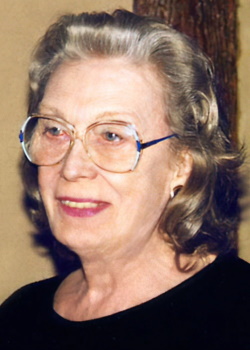 Composer, arranger, orchestrator and conductor Angela Morley died in Scottsdale, Arizona, on January 14, 2009, at the age of 84. She had suffered a heart attack while undergoing surgery following a broken hip.
One of Britain’s most accomplished arrangers, Morley’s remarkable career encompassed big bands, radio, records, film and American television. She received two Academy Award nominations, won three Emmy Awards, and contributed behind the scenes to some of the most famous film scores of the late twentieth century.
Morley was born Walter Morley Stott in Leeds, Yorkshire, on March 10, 1924, and developed an early fascination with big-band music. Largely self-taught at first, she became a professional saxophonist at 15 and by 17 was playing lead alto with Oscar Rabin’s orchestra. She joined Geraldo’s celebrated band in 1944, increasingly concentrating on arranging, and later studied composition with Mátyás Seiber and conducting with Walter Goehr. By the early 1950s she had abandoned performing to concentrate entirely on writing.
Under her former professional name, Wally Stott, Morley became enormously familiar to British radio audiences. She was musical director for Philips Records, arranged for singers including Rosemary Clooney and Mel Tormé, and provided music for The Goon Show. Most famously, she wrote the theme and incidental music for Hancock’s Half Hour, including its memorably lugubrious opening tuba motif. She also produced a series of light-orchestral compositions and arrangements that established her as one of Britain’s leading practitioners in the field.
Morley’s early film work included The Heart of a Man (1959), Captain Nemo and the Underwater City (1969), The Looking Glass War (1970) and When Eight Bells Toll (1971). She had actually begun turning down feature-film assignments around 1960, frustrated by the poor quality of film sound reproduction, but returned to cinema toward the end of the decade.
In 1972 Morley underwent gender transition and thereafter lived and worked publicly as Angela Morley. Her career soon entered one of its most successful periods, beginning with her work on The Little Prince (1974). Collaborating with songwriters Alan Jay Lerner and Frederick Loewe, she adapted and orchestrated their songs into the dramatic score, sharing an Academy Award nomination with Lerner, Loewe and Douglas Gamley.
A second Oscar nomination followed for The Slipper and the Rose (1976), an elaborate musical retelling of Cinderella. Richard and Robert Sherman wrote the songs, while Morley arranged them and developed their melodies throughout the underscore, in addition to conducting the film’s music. The result demonstrated the quality for which colleagues particularly admired her: an exceptional ability to move naturally between popular song, jazz and full-scale symphonic writing.
Her most important original film score was Martin Rosen’s Watership Down (1978). Morley took over the project after original composer Malcolm Williamson became unavailable, with Williamson having completed only the opening portion of the score. Morley wrote almost all the remaining music, creating lyrical pastoral passages, darker material for the rabbits’ dangerous journey and powerful orchestral writing for the film’s more violent episodes. The BFI continues to single out Morley’s score as one of the defining elements of the film.
Morley was also one of Hollywood’s finest orchestrators. She developed a particularly important relationship with John Williams, contributing orchestrations to Star Wars, Superman and The Empire Strikes Back, and later assisting him on E.T. the Extra-Terrestrial, Home Alone, Home Alone 2, Hook and Schindler’s List. She also wrote numerous arrangements for Williams during his years conducting the Boston Pops Orchestra and worked for composers including Miklós Rózsa, Alex North, David Raksin, Johnny Mandel, Ernest Gold and Bill Conti. Williams later praised her musicianship and technical command of orchestration in the strongest terms.
After moving to California in 1979, Morley concentrated increasingly on American television. She scored episodes of Dallas, Dynasty, Cagney & Lacey, Falcon Crest, Hotel, Wonder Woman, Emerald Point N.A.S. and other series. She also continued arranging and conducting for major television specials, winning three Emmy Awards for music direction and receiving numerous further nominations for dramatic scoring and arrangement.

Shop at the Movie Music UK Store

Member of the


