Alexander Courage, 1919-2008
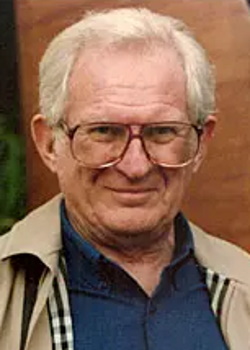 Composer, arranger and orchestrator Alexander “Sandy” Courage died in Pacific Palisades, California, on May 15, 2008, at the age of 88, following several years of declining health.
During a career spanning more than half a century he worked on hundreds of film and television productions, but remains immortal for one of the most recognizable pieces of music in television history: the soaring theme for the original Star Trek.
Courage was born in Philadelphia on December 10, 1919, and grew up in New Jersey. He studied composition at the Eastman School of Music, graduating in 1941, before serving during World War II as a bandleader in the United States Army Air Forces. After settling in Los Angeles he began arranging and composing for CBS radio and in 1948 joined MGM as an orchestrator.
At MGM, Courage became one of the craftsmen responsible for the celebrated sound of the studio’s golden-age musicals. His credits included Show Boat (1951), The Band Wagon (1953), Seven Brides for Seven Brothers (1954), Kismet (1955) and Gigi (1958), while he also worked on Guys and Dolls and Funny Face. His sophisticated command of the orchestra later made him a valued collaborator of composers including John Williams and Jerry Goldsmith.
Courage also composed original film scores, most notably for Arthur Penn’s western The Left Handed Gun (1958), starring Paul Newman, and André de Toth’s stark Day of the Outlaw (1959). Although original film composition never became the principal focus of his career, these scores demonstrated a muscular dramatic style quite distinct from the elaborate musical arrangements for which he was already renowned.
His defining assignment arrived when Gene Roddenberry asked him to score the pilot for Star Trek. Courage devised an eight-note brass fanfare to announce the USS Enterprise and a sweeping main melody beginning with an exposed flute, creating music that immediately conveyed exploration, optimism and adventure. The theme accompanied the original series from 1966 and subsequently became embedded throughout the wider Star Trek franchise. Courage also scored several individual episodes and even created the famous rushing sound heard as the Enterprise passes the camera in the opening titles.
Courage’s relationship with Roddenberry later became strained after the producer wrote previously unused lyrics to the theme, thereby entitling himself to a share of its royalties. Courage consequently did comparatively little additional scoring for the series, although his fanfare survived and was later incorporated into numerous Star Trek films and television productions.
Away from Star Trek, Courage composed extensively for television, including Daniel Boone, Voyage to the Bottom of the Sea, Judd for the Defense, Lost in Space, The Waltons, Eight Is Enough and Falcon Crest. He wrote music for more than 100 episodes of The Waltons alone. His arranging work also brought two Academy Award nominations, shared with Lionel Newman for The Pleasure Seekers and Doctor Dolittle.
In later decades Courage became particularly important as an orchestrator for Jerry Goldsmith and John Williams, contributing to films including The Poseidon Adventure, Fiddler on the Roof, Jurassic Park, Basic Instinct, Hook and The Mummy. He won an Emmy in 1988 as principal arranger for the television special Julie Andrews: The Sound of Christmas.

Shop at the Movie Music UK Store

Member of the


