Vic Mizzy, 1916-2009
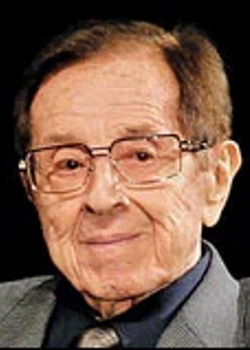 Composer and songwriter Vic Mizzy died at his home in Bel-Air, California, on October 17, 2009, at the age of 93, from heart failure.
A prolific writer for popular music, film and television, Mizzy created two of the most instantly recognizable television themes of the 1960s, The Addams Family and Green Acres. His film career was dominated by comedy and light fantasy, including a celebrated series of scores for Don Knotts, but his wonderfully eccentric musical personality could also be heard in horror films such as The Night Walker and The Spirit Is Willing.
Victor Mizzy was born in Brooklyn, New York, on January 9, 1916, the son of immigrant parents. He began playing accordion and piano as a child and, while attending New York University, formed a songwriting partnership with Irving Taylor. The pair wrote sketches and songs for variety shows and appeared on radio programs including Major Bowes’ Original Amateur Hour. Mizzy subsequently became a successful Tin Pan Alley songwriter, producing hits such as “Three Little Sisters,” “There’s a Faraway Look in Your Eye” and “Take It Easy.”
During World War II Mizzy served for four years in the United States Navy while continuing to write songs. He later collaborated with lyricist Mann Curtis on hits including “My Dreams Are Getting Better All the Time,” “Pretty Kitty Blue Eyes,” “The Whole World Is Singing My Song” and “The Jones Boy.” His songs were recorded by performers including Doris Day, Perry Como, Dean Martin and Billie Holiday, establishing him as a successful popular songwriter long before Hollywood became his principal occupation.
Mizzy moved increasingly into television during the early 1960s, scoring programs including Shirley Temple’s Storybook and The Richard Boone Show. His career changed permanently with The Addams Family in 1964. Mizzy wrote the catchy harpsichord-led theme, its macabre melody offset by comic lyrics and the famous rhythmic finger snaps. When the producers declined to pay for a vocal group, Mizzy simply overdubbed his own voice several times. The result became one of the most famous television themes ever written.
He achieved almost the same level of immortality the following year with Green Acres. Sung by stars Eddie Albert and Eva Gabor, the theme introduced the show’s central conflict between city sophistication and rural life directly within the opening titles. Mizzy also devised much of the series’ underscore, using instruments such as bass harmonica and fuzz guitar to enhance its cheerfully surreal humor. Other television work included Kentucky Jones, The Double Life of Henry Phyfe, The Pruitts of Southampton and The Don Rickles Show.
Mizzy’s feature-film career began in earnest with William Castle’s The Night Walker (1964), starring Barbara Stanwyck and Robert Taylor. Its eerie, unusually serious score demonstrated that he was capable of considerably more than comedy and led to extensive work at Universal. He became particularly associated with Don Knotts, scoring The Ghost and Mr. Chicken (1966), The Reluctant Astronaut (1967), The Shakiest Gun in the West (1968), The Love God? (1969) and How to Frame a Figg (1971). His playful orchestration and instinct for musical timing were ideally suited to Knotts’s nervous screen persona.
Other films included A Very Special Favor, Don’t Make Waves, The Caper of the Golden Bulls, The Perils of Pauline, The Busy Body and Castle’s supernatural comedy The Spirit Is Willing. Mizzy later concentrated largely on television movies and episodic work, including contributions to Quincy, M.E., but enjoyed renewed attention late in life as his soundtracks were released on album and his television themes became enduring pieces of American popular culture.
Mizzy was married to singer Mary Small, with whom he had two daughters, Patty and Lynn; Patty predeceased him. He is survived by Lynn, his brother Sol and two grandchildren.

Shop at the Movie Music UK Store

Member of the


