EVOLUTION – John Powell
 Original Review by Jonathan Broxton
Having never been particularly enamored with either of their individual works, I have often wondered just what kind of chemistry develops when Harry Gregson-Williams and John Powell work together to enable them to write such charming and ebullient scores as Antz, Chicken Run and Shrek. I have also often wondered whose musical personality is the more dominant when it comes to these magnificent animation works – and now I think I know. Evolution, John Powell’s first major solo score since Face/Off and Forces of Nature, is a definite kissing cousin to the Dreamworks hits in terms of tone and style, and has more than changed my attitude of the Englishman as a composer in his own right. Read more…
PEARL HARBOR – Hans Zimmer
 Original Review by Jonathan Broxton
Director Michael Bay so much wanted for Pearl Harbor to be his Titanic – an epic love story that takes place within one of the most tragic, violent, and talked-about events of the 20th Century. But, with Michael Bay being the director he is, it had to not just equal, but eclipse James Cameron’s Oscar-winning watery thriller. Instead of sinking one boat, Bay sinks a couple of dozen. Not content with presenting a simple boy-meets-girl story, Bay turns Pearl Harbor’s romance into a love triangle. And, in an effort to outdo James Horner’s work on the earlier film, Bay hired Hans Zimmer to wring every last emotional drop from his audience and his listeners. And he succeeds – almost. Read more…
Remembering Carmine Coppola, 1910-1991
 Composer, conductor and flautist Carmine Coppola died ten years ago today in Los Angeles on April 26, 1991, at the age of 80, after suffering a stroke.
Although much of his film career was closely connected with his son, director Francis Ford Coppola, he created memorable music for some of the defining American films of the 1970s and 1980s, including The Godfather Part II, Apocalypse Now, The Black Stallion and The Godfather Part III. His work brought him an Academy Award and a Golden Globe.
Carmine Valentino Coppola was born in New York City on June 11, 1910, into an Italian-American family. He studied flute and composition at the Juilliard School and Manhattan School of Music and became an accomplished professional flautist. He performed under Arturo Toscanini with the NBC Symphony Orchestra before increasingly turning to composition, arranging and conducting.
Coppola’s connection with cinema became significant when Francis asked him to contribute music to The Godfather (1972). Nino Rota wrote the principal score, but Carmine supplied additional music, including material heard during the Corleone wedding festivities. The collaboration continued more substantially on The Godfather Part II (1974), where Coppola contributed original material alongside Rota’s themes, including music associated with the film’s early twentieth-century American sequences. Rota and Coppola shared the Academy Award for Best Original Dramatic Score, giving Carmine his greatest professional honor. Read more…
THE LUZHIN DEFENCE – Alexandre Desplat
 Original Review by Jonathan Broxton
What’s the sound of a French composer falling off a tall building? Desplat. I’m opening this review with a joke because I’ll wager that most of you have never heard of Alexandre Desplat, the French-born composer of The Luzhin Defence. Before I saw this film and heard this album, I knew his name, and could I list a few of his previous films (Innocent Lies, A Self Made Hero, Love Etc.), but nothing beyond that. Even now, biographical details about Desplat’s life are sketchy – I don’t even know how old he is – but I do know this: he is a composer of considerable talent. Read more…
CROCODILE DUNDEE IN LOS ANGELES – Basil Poledouris
 Original Review by Jonathan Broxton
Paul Hogan must have had an especially large electric bill last year – otherwise why on Earth would he resurrect his now rather dated character Crocodile Dundee for a third outing, 13 years after the first sequel. Hogan said, in defense of his movie, that he thought people might be interested in where “Mick had been for the last decade; what had happened to him and his life”. Well, flogging a dead horse is one thing, if it makes a buck or two for the people involved, I have nothing against shameless capitalism. But Crocodile Dundee has no redeeming features – its not funny, its not very interesting and, worst of all, its not even particularly well made. Read more…
SPY KIDS – Robert Rodriguez
 Original Review by Jonathan Broxton
There’s a saying in Britain – I don’t know how widespread it is in the rest of the English-speaking world – which states that “too many cooks spoil the broth”. What this means, basically, is that if too many people try to take part in one thing at once, the end result can be diminished by the contributions of its many creators. This old adage can be applied to Spy Kids, an enjoyable children’s action score which is rendered just a little overly-schizophrenic through the use of eight – count ’em – eight different composers. Basically, Spy Kids is a James Bond adventure story with a difference – the protagonists are pre-teens. What some people may find surprising is the fact that it was written and directed by Robert Rodriguez, the man who previously brought the world such dark, violent movies as El Mariachi, Desperado, From Dusk Till Dawn and The Faculty. The plot is simple: Gregorio and Ingrid Cortez (Antonio Banderas and Carla Gugino) are semi-retired spies with two precocious children, Carmen (Alexa Vega) and Juni (Daryl Sabara). Gregorio and Ingrid still occasionally blast off on an adventure when duty calls but unfortunately, their sabbatical has made them a little rusty – so much so that they end up being captured by the diabolical Fegan Floop (Alan Cumming), a children’s TV show host who is planning to use an army of robot children to take over the world. The only solution? The kids to rescue, armed with a load of cool gadgets and the espionage know-how inherited from mom and dad. Read more…
Academy Award Winners 2000
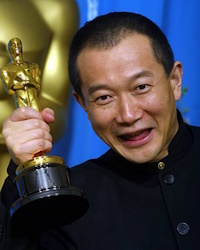 The Academy of Motion Picture Arts and Sciences (AMPAS) have announced the winners of the 73rd Academy Awards, honoring the best in film in 2000.
In the Best Original Score category, Chinese composer Tan Dun won the Academy Award for his score for Ang Lee’s Crouching Tiger, Hidden Dragon. In his acceptance speech Tan said:
I prepared something exactly forty-five seconds. My music is to dream without boundaries. Tonight, with you, I see boundaries being crossed. As a classical music composer I’m thrilled to be honored here. “Crouching Tiger” bridged East and West, romance and action, high and low cultures. Thank you, Ang Lee, Yo-Yo Ma, Peter Gelb, Michael Gorfaine, James Schamus, Bill Kong. Thank you, Sony Classical, CAMI and G. Schirmer for their long support. Last, this is for two tigers in my family: my wife Jane, Ian, [my] son, both born in the year of tigers. Thank you, Academy.
The other nominees for Best Original Score were Rachel Portman for Chocolat, Hans Zimmer for Gladiator, Ennio Morricone for Malèna, and John Williams for The Patriot.
In the Best Original Song category, legendary singer-songwriter Bob Dylan won the Academy Award for “Things Have Changed” from Curtis Hanson’s Wonder Boys. Dylan was touring Australia at the time of the ceremony and appeared from Sydney by satellite.
The other nominees for Best Original Song were Randy Newman for “A Fool in Love” from Meet the Parents; Björk, Lars von Trier and Sjón Sigurðsson for “I’ve Seen It All” from Dancer in the Dark; Jorge Calandrelli, Tan Dun and James Schamus for “A Love Before Time” from Crouching Tiger, Hidden Dragon; and Sting and David Hartley for “My Funny Friend and Me” from The Emperor’s New Groove.
THE DISH – Edmund Choi
 Original Review by Jonathan Broxton
Composer Edmund Choi has had an unusual career to date. After graduating, he wrote music for Praying With Anger and Wide Awake, Sixth Sense director M. Night Shyamalan’s first two films, and the romantic comedy Down To You in early 2000. However, it was his re-scoring of the Australian comedy The Castle in 1999 (Miramax asked him to replace Craig Harnath’s original music for the American market) that landed him this assignment writing the score for Rob Sitch’s follow-up. Unfortunately, despite his undoubted talent, Choi has fallen into the trap many fledgling composers find themselves facing, and succumbed to a bad case of temp-track fever. Set in 1969, The Dish is a warm and appealing comedy starring Sam Neill as Cliff Buxton, an amateur astronomer from rural Parkes, NSW, Australia, who is the man in charge of the large satellite transmitter which sits proudly in the community’s main sheep paddock. Then, suddenly, Parkes is put on the map when NASA contacts Buxton to ask him to provide backup technology for Neil Armstrong’s historic walk on the face of the moon. With the help of his good natured but slightly inept assistants (Kevin Harrington, Patrick Warburton), Buxton is only too pleased to be of service to the Americans – but gets more than he bargained for when a technical glitch back home in Houston leaves the Parkes Dish solely responsible for sending out the lunar TV pictures to a world holding its collective breath. Sitch’s endearing film was one of 2001’s sleeper successes, at least critically – it did very little at any box-office, despite receiving glowing reviews – and boasts a charming lead performance from Neill, a world away from the histrionics of Jurassic Park and its sequels. Read more…
Remembering Howard Ashman, 1950-1991
 Lyricist, playwright, director and producer Howard Ashman died in New York City ten years ago today, on March 14, 1991, at the age of 40, from complications related to AIDS.
Although his career was tragically brief, Ashman played a crucial role in revitalizing both the American musical theatre and Disney animation. With composer Alan Menken he wrote the songs for Little Shop of Horrors, The Little Mermaid and Beauty and the Beast, while his final work on Aladdin was completed shortly before his death. He won two Academy Awards for Best Original Song, the second posthumously.
Howard Elliott Ashman was born in Baltimore, Maryland, on May 17, 1950, and developed an early interest in theatre. He studied at Boston University and Goddard College before earning a master’s degree from Indiana University. Moving to New York in 1974, he worked briefly in publishing while writing plays and became involved with the small WPA Theatre, eventually serving as its artistic director.
Ashman’s first collaboration with Alan Menken was the 1979 musical God Bless You, Mr. Rosewater, adapted from Kurt Vonnegut’s novel. Their breakthrough came three years later with Little Shop of Horrors, based on Roger Corman’s low-budget 1960 comedy about a man-eating plant. Ashman wrote the book and lyrics and directed the original production, while Menken composed the music. Its mixture of 1960s pop, Motown, comedy and horror became an enormous Off-Broadway success. Read more…
Piero Umiliani, 1926-2001
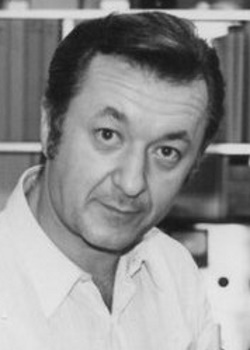 Composer, pianist and conductor Piero Umiliani died in Rome on February 14, 2001, at the age of 74.
One of the most distinctive figures in post-war Italian film music, Umiliani wrote more than 150 scores during a career encompassing comedy, thrillers, westerns, gialli, documentaries and exploitation cinema. A gifted jazz musician and enthusiastic electronic experimenter, he is also remembered internationally for the irresistible “Mah Nà Mah Nà,” one of the most unlikely soundtrack themes ever to become a worldwide popular standard.
Umiliani was born in Florence on July 17, 1926. Fascinated by jazz at a time when the music was discouraged by Italy’s Fascist regime, he listened avidly to Duke Ellington and other American musicians on foreign radio during World War II. He subsequently became an accomplished jazz pianist, performed and recorded with leading Italian musicians, and studied counterpoint and fugue at Florence’s Luigi Cherubini Conservatory. After moving to Rome he worked as an arranger for Armando Trovajoli before establishing himself in cinema.
His breakthrough came with Mario Monicelli’s classic comedy I Soliti Ignoti (Big Deal on Madonna Street, 1958). Monicelli specifically wanted a jazz score, and Umiliani responded with music that brought a strikingly contemporary sound to Italian cinema, including the memorable “Blues for Gassman.” The score was among the earliest Italian films to use jazz so extensively as dramatic accompaniment and immediately established Umiliani as a composer with a musical personality very different from the traditional symphonic school. Read more…
Academy Award Nominations 2000
 The Academy of Motion Picture Arts and Sciences (AMPAS) have announced the nominations for the 73rd Academy Awards, honoring the best in film in 2000.
In the Best Original Score category, the nominees are:
- TAN DUN for Crouching Tiger Hidden Dragon
- ENNIO MORRICONE for Malèna
- RACHEL PORTMAN for Chocolat
- JOHN WILLAMS for The Patriot
- HANS ZIMMER for Gladiator
This is the first Oscar nomination for Tan, the 5th nomination for Morricone, the 3rd nomination for Portman, the 34th nomination for Williams, and the 6th nomination for Zimmer. Portman previously won for Emma in 1996. Williams previously won for Fiddler on the Roof in 1971, Jaws in 1975, Star Wars in 1977, E.T. the Extra Terrestrial in 1982, and Schindler’s List in 1993. Zimmer previously won for The Lion King in 1994.
In the Best Original Song category, the nominees are:
- TAN DUN, JORGE CALANDRELLI, and JAMES SCHAMUS for “A Love Before Time” from Crouching Tiger Hidden Dragon
- BOB DYLAN for “Things Have Changed” from Wonder Boys
- BJÖRK GUÐMUNDSDÓTTIR, LARS VON TRIER, and SJÓN SIGURÐSSON for “I’ve Seen It All” from Dancer in the Dark
- RANDY NEWMAN for “A Fool In Love” from Meet the Parents
- GORDON SUMNER (STING) and DAVID HARTLEY for “My Funny Friend and Me” from The Emperor’s New Groove
The winners of the 73rd Academy Awards will be announced on March 25, 2001.
AFRICA – Alex North
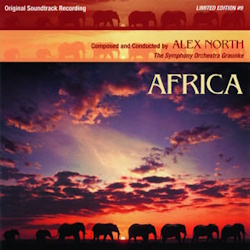 MOVIE MUSIC UK CLASSICS
Original Review by Jonathan Broxton
I so much want to like Alex North’s music. Every bone in my body tells me that, technically, he was one of the most gifted and creative composers every to work in Hollywood. Modern luminaries laud his work as being some of the most groundbreaking ever written for the Silver Screen. Jerry Goldsmith was a close friend and ardent admirer. As a 14 time Oscar nominee, the esteem in which he is held speaks for itself. But, with a few notable exceptions, I never have been able to actually sit and “enjoy” an Alex North score. He didn’t write that kind of music. Read more…
BAFTA Nominations 2000
 The British Academy of Film and Television Arts (BAFTA) has announced the nominations for the 54th British Academy Film Awards, honoring the best in film in 2000.
In the Best Original Music category, which is named in memory of the film director Anthony Asquith, the nominees are:
- T-BONE BURNETT and CARTER BURWELL for O Brother, Where Art Thou?
- TAN DUN for Crouching Tiger Hidden Dragon
- STEPHEN WARBECK for Billy Elliot
- NANCY WILSON for Almost Famous
- HANS ZIMMER and LISA GERRARD for Gladiator
These are the first nominations for Burnett, Burwell, Dun, Gerrard and Wilson. It is the second nomination for Warbeck, and the third nomination for Zimmer.
The winners of the 54th BAFTA Awards will be announced on February 25, 2001.
ROBOCOP: PRIME DIRECTIVES – Norman Orenstein
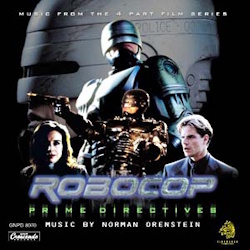 Original Review by Jonathan Broxton
Preconceptions are funny things, especially in film music. When Robocop: Prime Directives dropped through my door, with the name Norman Orenstein adorning the package, my first instinct was to dismiss it as cheesy TV music. Without wanting to sound unkind, Canadian composer Norman Orenstein’s career to date has hardly been stellar. A series of cut-price straight-to-video classics such as Ski School II, Mask of Death and The First 91/2 Weeks have been the highlights of his film music career so far – until Robocop Prime Directives came along. Working with a comparatively small budget, and out of his personal studio in Toronto, Orenstein emerged with a surprisingly vibrant, large-scale, enjoyable series of cues which mix electronics with sampled acoustics and a smattering of live instruments. It’s a world away from the classic march Basil Poledouris wrote for the film series, but as TV music goes this is as solid a score as you would expect. Read more…
THE CLAIM – Michael Nyman
 Original Review by Jonathan Broxton
I’m not really given to making lofty proclamations here, but this is one guaranteed to ruffle a few feathers: The Claim is Michael Nyman’s best score to date. I’m not talking best as in the complexity of the music, or the craftsmanship: rather, The Claim is Nyman’s first film score in the sense that it overflows with emotion. It’s lush, it sweeps, and it features one of the most attractive central themes the enigmatic Englishman has ever written. Michael Nyman writing for a big-screen adaptation of Thomas Hardy’s The Mayor of Casterbridge; that I can believe. Michael Nyman writing for an epic Western set at the height of the gold rush; well, that’s another proposition entirely. Read more…

Shop at the Movie Music UK Store

Member of the


