ALL THE PRETTY HORSES – Marty Stuart, Kristin Wilkinson, Larry Paxton
 Original Review by Jonathan Broxton
I’ve spoken about preconceptions many times before on Movie Music UK; pre-judging a score based on what you know about the movie, and the composer, before you hear the music. Once again, I have been found guilty of negatively pre-judging a particular score, only to hear the thing and be totally blown away. The score in question this time is All the Pretty Horses, written by Marty Stuart, with additional music by Larry Paxton, Kristin Wilkinson and Daniel Lanois. All the Pretty Horses is director Billy Bob Thornton’s sophomore effort, following his critically acclaimed, Oscar-winning debut Sling Blade. It’s a rites-of-passage Western, adapted from the popular novel by Cormac McCarthy and starring Matt Damon as John Grady Cole, a young man in rural 1940s Texas who, after being made homeless following his grandmother’s death, heads off to Mexico with his best buddy Lacey Rawlins (Henry Thomas) to seek his fortune. Unfortunately, fortune is not what Cole and Rawlins find south of the Rio Grande, instead becoming involved in the affairs of a teenage gunslinger Blevins (Lucas Black), a Mexican rancher’s daughter (Penelope Cruz), with whom Cole falls in love, and the local police, who take exception to the blossoming romance between the handsome American and the beautiful señorita. Read more…
THE GIFT – Christopher Young
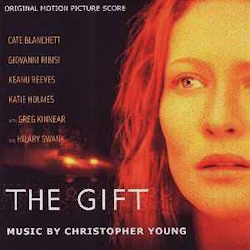 Original Review by Jonathan Broxton
It may be my imagination, or my personal tastes, but during the last year or so Christopher Young finally seems have found himself a series of good movies to score. From The Hurricane last year, though Wonder Boys and The Big Kahuna this year, the quality and profile of each consecutive assignment seems to have been greater than the previous, almost to the stage where Young can genuinely class himself as an A-list composer. This latest effort is The Gift, a dark thriller starring Cate Blanchett and Keanu Reeves, and directed by directed by Sam Raimi, in what was his big Oscar push for the year 2000. Read more…
MALÉNA – Ennio Morricone
 Original Review by Jonathan Broxton
Ennio Morricone’s fifth and final score of 2000 is for the Italian romantic-comedy-drama Maléna, directed by Giuseppe Tornatore, for whom Morricone has written several classic scores, not least the incredible Cinema Paradiso. What’s interesting about Maléna is the fact that, unlike 99% of Morricone’s output of late, it has been the recipient of quite a bit of publicity, mainly through its association with the Miramax marketing machine. A second Golden Globe Best Score nomination in a row has been secured for the Italian maestro – following his success with The Legend of 1900 last year – and is backed up by a high profile soundtrack release. The only difference between this and 1900, though, is that Maléna is worthy of the praise. Read more…
Golden Globe Nominations 2000
 The Hollywood Foreign Press Association (HFPA) has announced the nominations for the 58th Golden Globe Awards, honoring the best in film and American television of 2000.
In the Best Original Score category, the nominees are:
- TAN DUN for Crouching Tiger Hidden Dragon
- MAURICE JARRE for Sunshine
- ENNIO MORRICONE for Malèna
- RACHEL PORTMAN for Chocolat
- MARTY STUART, LARRY PAXTON, and KRISTIN WILKINSON for All the Pretty Horses
- HANS ZIMMER and LISA GERRARD for Gladiator
These are first nominations for Dun, Stuart, Paxton, Portman, and Wilkinson. It is the second nomination for Gerrard, the third nomination for Zimmer, the seventh nomination for Morricone, and the tenth nomination for Jarre. Zimmer previously won for The Lion King in 1994. Morricone previously won for The Mission in 1986 and The Legend of 1900 in 1999. Jarre previously won for Doctor Zhivago in 1965, A Passage to India in 1984, Gorillas in the Mist in 1988, and A Walk in the Clouds in 1995.
In the Best Original Song category, the nominees are:
- GARTH BROOKS and JENNY YATES for “When You Come Back to Me Again” from Frequency
- BOB DYLAN for “Things Have Changed” from Wonder Boys
- BJÖRK GUÐMUNDSDÓTTIR, LARS VON TRIER, and SIGURJÓN SIGURÐSSON for “I’ve Seen It All” from Dancer in the Dark
- STAFFAN OLSSON (BOSSON) for “One in a Million” from Miss Congeniality
- GORDON SUMNER (STING) and DAVID HARTLEY for “My Funny Friend and Me” from The Emperor’s New Groove
The winners of the 58th Golden Globe Awards will be announced on January 21, 2001.
CROUCHING TIGER, HIDDEN DRAGON – Tan Dun
 Original Review by Jonathan Broxton
After spending much of its history consigned to art-houses, lauded by critics but unseen by the masses, Chinese cinema is suddenly big business. The emigration west of some of its biggest names, notably action stars such as Jackie Chan and Chow Yun Fat, has undoubtedly paved the way for Chinese-language movies to reach a wider audience, and now the first true crossover hit seems to have come: Ang Lee’s Crouching Tiger Hidden Dragon. Director Lee has, of course, been making critically popular films in English for a number of years, from the Oscar winning costume drama Sense & Sensibility to the drama The Ice Storm and the civil war epic Ride With The Devil. Throughout his career, though, Lee has harbored a desire to make a wuxia pian, a Chinese costume drama combining traditional drama with martial arts. Lee has described Crouching Tiger Hidden Dragon as “Jane Austen meets Bruce Lee”. Read more…
PROOF OF LIFE – Danny Elfman
 Original Review by Jonathan Broxton
Proof of Life: The Movie has been overtaken in the world’s press by Proof of Life: The On-Set Romance to such an extent that director Taylor Hackford’s espionage thriller has almost become an unimportant by-product of the Meg and Russell Show. Meg divorced Dennis Quaid to be with Crowe, who then left Meg to be with his cattle in Australia… it’s certainly one of Tinseltown’s more unusual love triangles. But Movie Music UK is not concerned with tabloid tittle-tattle, instead preferring to judge things on their artistic merits. Unfortunately, as far as the music is concerned at least, Proof of Life doesn’t have many. The film Russell Crowe stars as Terry Thorne, a private investigator and hostage negotiation specialist who is hired by Alice Bowman (Meg Ryan) to find her engineer husband Peter (David Morse), who has been kidnapped by guerrillas in South America. Terry and Alice head deeper into danger, locking horns with Ecuadorian freedom fighters and corrupt government officials as they try to obtain some kind of reassurance that Peter is alive, and worth searching for. However, as the two of them endure life-threatening situation after life-threatening situation, a tentative romantic relationship develops, jeopardizing both the mission and Terry’s professional integrity. Read more…
VERTICAL LIMIT – James Newton Howard
 Original Review by Jonathan Broxton
By popular consensus, James Newton Howard has finished the year 2000 as one of the strongest and most consistent composers in Hollywood. The 49-year old Californian wrote three stellar scores in 2000 – Dinosaur (my personal favorite of the entire year), Unbreakable, and Vertical Limit, the latter being an epic mountaineering score for the film directed by Martin Campbell. The undoubted high quality of his work, the critical acclaim it has received amongst score fans, and the old-fashioned enjoyment derived from his work of late has thrust him into the limelight; Vertical Limit is just the latest in a long line of excellent works from the man with three names. Read more…
Remembering Aaron Copland, 1900-1990
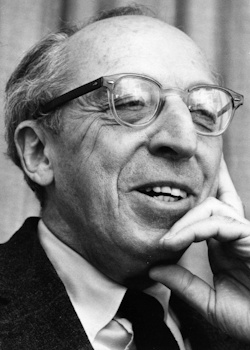 Composer, conductor and teacher Aaron Copland died ten years ago today in North Tarrytown, New York, on December 2, 1990, at the age of 90, following years of declining health.
Widely regarded as one of the defining voices of American concert music, Copland also enjoyed a brief but highly influential career in Hollywood, bringing to films the spacious harmonies, direct melodies and unmistakably American character that had already distinguished works such as Billy the Kid, Rodeo and Appalachian Spring.
Copland was born in Brooklyn on November 14, 1900, the youngest of five children in a Russian-Jewish immigrant family. After studying in New York he travelled to Paris, where he became one of the first American pupils of the influential teacher Nadia Boulanger. Returning home in the 1920s, Copland gradually developed a musical language that combined European modernism with jazz, folk material and an increasingly accessible style intended to speak directly to American audiences.
His first film assignment was Ralph Steiner and Willard Van Dyke’s documentary The City (1939), produced for the New York World’s Fair. That same year Copland entered Hollywood with Lewis Milestone’s adaptation of John Steinbeck’s Of Mice and Men. Rather than imitate the lush late-Romantic style then dominant in studio scoring, Copland used clear textures, folk-like melodies and restrained orchestration, allowing the rural setting and loneliness of the characters to emerge without excessive sentimentality. The score received Academy Award nominations for both original score and scoring. Read more…
THE LOST CHILD – Mark McKenzie
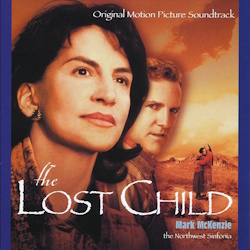 Original Review by Jonathan Broxton
It’s quite an amazing career that Mark McKenzie is building for himself, especially considering the fact that it has only been around six years since he stopped being a full-time session orchestrator and started writing for himself. Now, it seems, with every score e writes, he just gets better and better. Durango was lovely. Dragonheart II was lovelier still. His score for the new Hallmark TV movie The Lost Child could well be his best yet. A dreamy, unashamedly romantic, heartbreaking string and piano score that swells, swoops and swoons with every lick of the orchestra, it’s a score which transports you into another world. Fans of lush orchestral romance will be jumping up and down with delight at the sounds on offer here. Read more…
BOUNCE – Mychael Danna
 Original Review by Jonathan Broxton
The more of Mychael Danna’s music I hear, the more I am of the opinion that he is one of the most talented – and versatile – practitioners of film music working today. Having become noted for composing minimalist, ethnically-inflected scores for films such as Exotica, Kama Sutra and The Ice Storm, Danna bucked his own trend by writing two of the most interesting and challenging scores of 1999: the vivid, confrontational 8MM, and the sweeping, epic Ride with the Devil. The musical development of Danna continues with his lovely score for Bounce, the Canadian’s first mainstream romance. Bounce is directed by Don Roos (previously responsible for The Opposite of Sex) and stars Ben Affleck as businessman Buddy Amaral, who finds himself delayed at an airport while waiting for an overbooked flight to Los Angeles. Striking up a conversation with fellow passenger Greg Janello (Tony Goldwyn), Buddy thinks he is doing a good turn when he offers Greg his seat so he can get back in time to see his young son. In a tragic twist of fate, the plane Buddy should have been on then crashes, killing all on board. Racked with guilt and remorse, descending into alcoholism and quitting his job, Buddy seeks out Greg’s widow Abby (Gwyneth Paltrow) looking for some kind of redemption and forgiveness… and certainly not expecting to end up falling in love. Read more…
HOW THE GRINCH STOLE CHRISTMAS – James Horner
 Original Review by Jonathan Broxton
The problem with reviewing this kind of album is whether to review the score, or the package as presented to us by the record label. Interscope Records’ release is a curious hybrid of pop, dialogue and score that never quite gels together as a product – although the three elements, in themselves, are good, the end result of an album that falls short on virtually all levels, each part never quite complementing each other, and leaving score fans with a definite sense of being short-changed. How the Grinch Stole Christmas, shortened to simply “The Grinch” over here, is the first live-adaptation of the classic children’s story by Theodor S. Geisel, aka Dr Seuss. The story was famously rendered in cartoon form by the legendary Chuck Jones in 1966, and went on to become a perennial Yuletide favorite in the United States, but has never captured the imagination of children in the UK in quite the same way. We know who Dr Seuss was, and all about The Cat in the Hat and so forth… it just never really caught on. Besides, we’ve got Raymond Briggs and The Snowman to keep up happy over the festive period. It’s actually rather surprising, therefore, that the movie has gone on to become a massive smash in this country, sitting at the number one slot for several weeks and taking in millions of pounds at the box office. Read more…
RED PLANET – Graeme Revell
 Original Review by Jonathan Broxton
Of late, there seems to be an increasing amount of pressure on film music composers to score science fiction films in daring new ways. While this kind of innovation in film music is, and always should be, welcomed, it has to be said that these experiments are not always entirely successful. The critical backlash against Ennio Morricone’s Mission to Mars was palpable; similarly, Graeme Revell’s techno score for the animated summer movie Titan A.E. did little to stir the minds and hearts of soundtrack fans. Revell continues to break down barriers with his score for Red Planet, the latest in a line of Martian movies to hit screens in the wake of NASA’s Pathfinder exploration of our closest celestial neighbor. Unfortunately, and while credit is certainly due to the New Zealander for his efforts, the score for Red Planet is likely to be as equally derided as its predecessors. Read more…
THE LEGEND OF BAGGER VANCE – Rachel Portman
 Original Review by Jonathan Broxton
With increasing frequency, British composer Rachel Portman is finding herself being asked to score films with “Academy potential”. After her award-winning turn on Emma in 1995, which secured her status in history as the first woman to win a composing Oscar, the undisputed queen of film music has scored such acclaimed movies as Marvin’s Room, Beloved, and last year’s successful drama The Cider House Rules, cementing her status as a member of Hollywood’s A-list. Her latest assignment is The Legend of Bagger Vance, a tale of life, love, and the open fairway which seeks to do for golf what Field of Dreams did for baseball, directed by Robert Redford from the novel by Steven Pressfield. It stars Matt Damon, Will Smith and Charlize Theron, and tells the story of Adele Invergordon (Theron), who inherits her late father’s golf resort in late 1920s Savannah, Georgia. In order to get rid of some of the debts, she decides stages a celebrity golf tournament at the course, and invites three of the state’s top players, one of whom is Rannulph Junuh (Damon), her one-time beau and a former top pro who retuned from the war a drunken, shell-shocked, broken man. Initially reluctant to start swinging the clubs again, Junuh unexpectedly finds himself receiving encouragement from the mysterious Bagger Vance (Smith), who offers to be his caddy in exchange for a mere $5, and begins to impart to Junuh all the wisdom he possesses about life, love and golf. Read more…
PAY IT FORWARD – Thomas Newman
 Original Review by Jonathan Broxton
There’s a worrying trend developing in the career of Thomas Newman – peculiarity. Now, I’m all for innovation in film scoring. When a composer does something unexpected to enhance the mood or feel of a film, it is a refreshing and invigorating experience. When Thomas Newman did it on American Beauty, I was pleased. Newman has always been one of Hollywood’s most unconventional mainstream composers, equally at ease with lush symphonic writing (a la The Shawshank Redemption or Meet Joe Black) and experimental sound design (as in Flesh & Blood or Red Corner). Of late, though, Newman seems to have been stuck in this percussive rut, with seemingly no way out. In effect, he has written the same score for his last three movies: American Beauty, Erin Brockovich, and now Pay It Forward. Read more…
Remembering Leonard Bernstein, 1918-1990
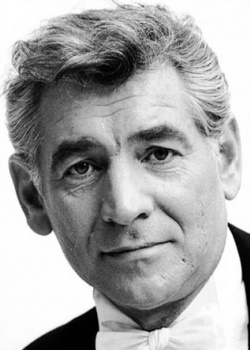 Composer, conductor, pianist and educator Leonard Bernstein died at his Manhattan, New York, home ten years ago today, on October 14, 1990, at the age of 72, from complications of progressive lung failure.
One of the towering figures of twentieth-century American music, Bernstein achieved international fame in the concert hall and on Broadway, but his relationship with cinema was surprisingly brief. He wrote only one original score specifically for a motion picture, yet that score—Elia Kazan’s On the Waterfront—became one of the landmarks of American film music.
Bernstein was born Louis Bernstein in Lawrence, Massachusetts, on August 25, 1918, the son of Ukrainian Jewish immigrants. He studied at Harvard University and the Curtis Institute of Music and achieved national prominence in 1943 when he famously substituted at short notice for Bruno Walter with the New York Philharmonic. He subsequently became one of America’s most celebrated conductors, eventually serving as music director of the Philharmonic while simultaneously pursuing careers as a composer, pianist, broadcaster and teacher.
Cinema first encountered Bernstein’s music through On the Town. The 1944 Broadway musical, written with Betty Comden and Adolph Green and developed from Bernstein’s ballet Fancy Free, was purchased by MGM and filmed in 1949 with Gene Kelly and Frank Sinatra. However, studio chief Louis B. Mayer replaced almost all of Bernstein’s original score, an early indication of the difficulties the fiercely independent composer would have with Hollywood filmmaking. Read more…

Shop at the Movie Music UK Store

Member of the


