Remembering Aaron Copland, 1900-1990
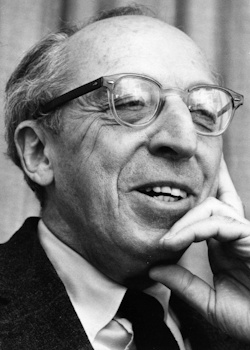 Composer, conductor and teacher Aaron Copland died ten years ago today in North Tarrytown, New York, on December 2, 1990, at the age of 90, following years of declining health.
Widely regarded as one of the defining voices of American concert music, Copland also enjoyed a brief but highly influential career in Hollywood, bringing to films the spacious harmonies, direct melodies and unmistakably American character that had already distinguished works such as Billy the Kid, Rodeo and Appalachian Spring.
Copland was born in Brooklyn on November 14, 1900, the youngest of five children in a Russian-Jewish immigrant family. After studying in New York he travelled to Paris, where he became one of the first American pupils of the influential teacher Nadia Boulanger. Returning home in the 1920s, Copland gradually developed a musical language that combined European modernism with jazz, folk material and an increasingly accessible style intended to speak directly to American audiences.
His first film assignment was Ralph Steiner and Willard Van Dyke’s documentary The City (1939), produced for the New York World’s Fair. That same year Copland entered Hollywood with Lewis Milestone’s adaptation of John Steinbeck’s Of Mice and Men. Rather than imitate the lush late-Romantic style then dominant in studio scoring, Copland used clear textures, folk-like melodies and restrained orchestration, allowing the rural setting and loneliness of the characters to emerge without excessive sentimentality. The score received Academy Award nominations for both original score and scoring.
He followed it with Sam Wood’s Our Town (1940), based on Thornton Wilder’s play. Copland’s warm, deceptively simple music for the fictional New England community of Grover’s Corners became one of his most characteristic film works, balancing nostalgia with an underlying sense of mortality. It brought him another Oscar nomination, and he later incorporated music from Our Town, Of Mice and Men and The City into his concert suite Music for Movies.
During World War II Copland scored Lewis Milestone’s The North Star (1943), written by Lillian Hellman and depicting Ukrainian villagers resisting the Nazi invasion. Its mixture of folk-inspired material, patriotic drama and darker wartime writing earned Copland another Academy Award nomination. He also wrote music for the government documentary The Cummington Story before returning to Hollywood for Lewis Milestone’s The Red Pony (1949), another Steinbeck adaptation.
Copland’s greatest film success came with William Wyler’s The Heiress (1949), starring Olivia de Havilland, Montgomery Clift and Ralph Richardson. Set in nineteenth-century New York, the film required a more intimate and psychologically restrained approach than his rural Americana scores. Copland responded with elegant orchestral writing built around recurring themes for the characters, although Wyler controversially altered parts of the finished score. Despite Copland’s dissatisfaction with some of those changes, The Heiress won him the Academy Award for Best Music Score of a Dramatic or Comedy Picture.
After The Heiress, Copland largely withdrew from Hollywood. He returned only once, for Jack Garfein’s independent drama Something Wild (1961), whose bleak New York setting inspired a tougher, more urban score. Copland subsequently fashioned portions of the music into the orchestral work Music for a Great City.
Away from cinema, Copland’s concert music established him as perhaps the most influential American classical composer of his generation. Works including the ballets Billy the Kid (1938), Rodeo (1942) and Appalachian Spring (1944), the orchestral El Salón México (1936), the Lincoln Portrait (1942), and his Third Symphony (1946) helped create a musical language that came to symbolize the American landscape and character. His combination of open harmonies, folk-inspired melodies and rhythmic vitality proved enormously influential, while Appalachian Spring earned him the Pulitzer Prize for Music in 1945. Copland was also an important teacher, writer and advocate for contemporary American composers, ensuring that his influence extended well beyond his own compositions.
Copland’s filmography was tiny compared with those of full-time Hollywood composers, but its influence was substantial. His preference for clarity, restraint and open harmonies offered an alternative to the dense symphonic traditions of the studio era, and his conception of an authentically American film sound echoed through later generations of composers. Of Mice and Men, Our Town, The Red Pony and The Heiress demonstrate that Copland never regarded cinema as lesser work: he brought to it the same melodic economy and distinctive musical personality that made him one of the central figures in American music.

Shop at the Movie Music UK Store

Member of the


