Remembering Leonard Bernstein, 1918-1990
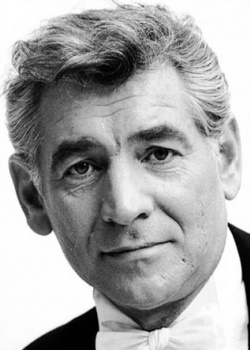 Composer, conductor, pianist and educator Leonard Bernstein died at his Manhattan, New York, home ten years ago today, on October 14, 1990, at the age of 72, from complications of progressive lung failure.
One of the towering figures of twentieth-century American music, Bernstein achieved international fame in the concert hall and on Broadway, but his relationship with cinema was surprisingly brief. He wrote only one original score specifically for a motion picture, yet that score—Elia Kazan’s On the Waterfront—became one of the landmarks of American film music.
Bernstein was born Louis Bernstein in Lawrence, Massachusetts, on August 25, 1918, the son of Ukrainian Jewish immigrants. He studied at Harvard University and the Curtis Institute of Music and achieved national prominence in 1943 when he famously substituted at short notice for Bruno Walter with the New York Philharmonic. He subsequently became one of America’s most celebrated conductors, eventually serving as music director of the Philharmonic while simultaneously pursuing careers as a composer, pianist, broadcaster and teacher.
Cinema first encountered Bernstein’s music through On the Town. The 1944 Broadway musical, written with Betty Comden and Adolph Green and developed from Bernstein’s ballet Fancy Free, was purchased by MGM and filmed in 1949 with Gene Kelly and Frank Sinatra. However, studio chief Louis B. Mayer replaced almost all of Bernstein’s original score, an early indication of the difficulties the fiercely independent composer would have with Hollywood filmmaking.
His sole venture into original film scoring came five years later with On the Waterfront (1954), Kazan’s celebrated drama starring Marlon Brando as former boxer Terry Malloy, a dockworker struggling with corruption and violence on the New Jersey waterfront. Bernstein responded with a powerful, unusually concentrated score that fused symphonic writing, jazz, harsh brass, percussion and moments of aching lyricism. The music’s aggressive rhythms vividly evoked the brutality of the docks, while a more introspective theme reflected Terry’s vulnerability and growing conscience.
Bernstein’s music was strikingly modern for a major Hollywood production, at times pushing forcefully against the images rather than merely accompanying them. The score begins with a lonely horn statement before erupting into muscular orchestral violence, establishing both the film’s bleak environment and its underlying emotional conflict. Bernstein later extracted approximately 22 minutes of the music into the Symphonic Suite from On the Waterfront, which received its concert premiere at Tanglewood in 1955 and became an enduring part of his orchestral repertoire.
On the Waterfront received twelve Academy Award nominations and won eight, including Best Picture, Best Actor for Brando and Best Director for Kazan. Bernstein received his only Oscar nomination, for Best Music, Scoring of a Dramatic or Comedy Picture, but lost to Dimitri Tiomkin for The High and the Mighty.
Bernstein never again composed an original film score. His music nevertheless returned spectacularly to cinema through West Side Story. The 1957 stage musical, with lyrics by Stephen Sondheim, was adapted for the screen by Robert Wise and Jerome Robbins in 1961. Unlike On the Town, the film retained the essential character of Bernstein’s music, including “Maria,” “Tonight,” “America,” “Somewhere” and the ferocious dance music surrounding the Jets and Sharks. The film won ten Academy Awards, including Best Picture; the Oscar for musical scoring went to Saul Chaplin, Johnny Green, Sid Ramin and Irwin Kostal for adapting Bernstein’s material for the screen.
Bernstein’s film-music catalogue may therefore be among the smallest ever produced by a composer of his stature, but its impact is disproportionately large. West Side Story became one of cinema’s defining musicals, while On the Waterfront demonstrated how the rhythmic energy, harmonic tension and emotional immediacy of his concert and theatre music could transform a dramatic film. Had Bernstein chosen to pursue Hollywood more extensively, he might have become one of its great screen composers; instead, with essentially a single original film score, he left behind a cinematic legacy that most composers would have been proud to achieve over an entire career.

Shop at the Movie Music UK Store

Member of the


