THE GIFT – Christopher Young
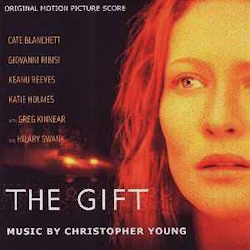 Original Review by Jonathan Broxton
It may be my imagination, or my personal tastes, but during the last year or so Christopher Young finally seems have found himself a series of good movies to score. From The Hurricane last year, though Wonder Boys and The Big Kahuna this year, the quality and profile of each consecutive assignment seems to have been greater than the previous, almost to the stage where Young can genuinely class himself as an A-list composer. This latest effort is The Gift, a dark thriller starring Cate Blanchett and Keanu Reeves, and directed by directed by Sam Raimi, in what was his big Oscar push for the year 2000.
Derived from a screenplay by Billy Bob Thornton, The Gift stars Blanchett as Annie Wilson, a single mother raising two children in the south of America, who just happens to be able to tell fortunes and see into the future. She is very matter of fact about this, and dispenses sensible advice to all those who seek her council. However, things change for the worse for Annie when the local police ask her to help them piece together the mystery surrounding the disappearance of a local girl. Suddenly, Annie’s gift becomes a curse, as she focuses her attentions on an abusive husband (Reeves) and his wife (Hilary Swank), and a young man haunted by recurring nightmares (Giovanni Ribisi), all of whom may or may not hold the key to mysterious girl’s fate. The film is also notable for a cameo appearance by composer Danny Elfman, as a fiddle player in a dream sequence. Elfman was originally slated to score the movie, and dropped out due to a scheduling clash, but agreed to act as a favour for his old friend Raimi.
 The Gift is a delicately balanced score. Parts of it rank among the most beautiful single moments of Young’s career, while others plumb the depths of ragged dissonance and creative abstraction.There are moments in this music which recall Hush, others which recall Murder in the First, and even parts of Rounders, but mostly The Gift remind me of Young’s little known bluegrass masterpiece Bright Angel, albeit less abstract and with more natural beauty and charm. Bright Angel was a musical recollection of small-town America which, when subjected to Young’s twisted musical sensibilities, emerged as something of a forlorn homage to the white picket fence sensibilities. Sprung from traditional values, but somehow dirtied by the cynicism and sour taste of modern life. I find that The Gift has the same kind of feeling running through it. Moreso than Bright Angel, The Gift is Young’s tribute to down-home Americana, and it noticeable for his excellent work using fiddles, an instrument he is not commonly associated with. In this context, The Gift has more in common with, say, John Williams’ The Patriot, or James Horner’s Legends of the Fall than anything in his own recent past. You can almost visualise the forests of Appalachia as you listen to parts of this score.
The cornerstone of the score is the recurring central theme, performed mainly by the fiddles, which appears for the first time in ‘The Gift’, is recapitulated in the superb ‘Friend to Me’ and others, and rounds the score off in grand style during ‘Empathy’. Beauty is not a Chris Young watchword. Terror, yes. Tragedy, yes. Despair, yes. But parts of The Gift are beautiful in a way that rarely shows in Young’s work, and it only makes me wonder why we don’t hear this side of his nature more often. When going for emotional broke, as he did in Murder in the First, and recently The Hurricane, the New Yorker is more than capable of breaking hearts. Gentleness and subtlety are also words not commonly associated with Chris Young’s work, but the lovely ‘Without Words’ offers a simple duet between solo piano and fiddle that allows this normally untapped well of calm and peace to flow.
At the other extreme, ‘Use Your Instincts’ cleverly pits a series of eerie textures against a hesitant recapitulation of the fiddle theme to create a nervous, disquieting effect of alienation, before erupting into a chaotic collision of voices – a cross between a feline wail and someone screaming in pain. Vocal ingenuity has always been one of Young’s strong points, as scores such as Hellraiser and the recent Bless the Child attest, and The Gift carries on this tradition. ‘Psychic Attack’ is similarly violent, and features some brilliant Penderecki-style skittering percussion effects that flit from side to side on your stereo, while ‘Predictions’ and ‘Cryptomnesia’ continue the trend.
The album being reviewed here is the promotional CD released by Young’s publicists at Costa Communications to snag him an Oscar nomination (it didn’t work). A slightly longer album on the Will Records label, with different cover art and slightly different cue titles, is also available. It features two additional tracks of score, and the fiddle solo performed by Elfman in the film. Picking up either version is highly recommended.
Track Listing:
- The Gift (2:43)
- Friend to Me (3:45)
- Use Your Instincts (4:47)
- Without Words (2:09)
- Psychic Attack (5:37)
- Predictions (6:05)
- Blue Diamond (2:31)
- Cryptomnesia (4:39)
- Clear Sensing (5:09)
- Empathy (7:15)
Running Time: 44 minutes 40 seconds
Paramount Classics Promo (2000)
Music composed by Christopher Young. Conducted by Adam Stern. Performed by The Northwest Sinfonia. Recorded and mixed by Robert Fernandez. Edited by Tanya Noel Hill. Album produced by Flavio Motalla and Christopher Young.

Shop at the Movie Music UK Store

Member of the


