THE ADJUSTMENT BUREAU – Thomas Newman
 Original Review by Jonathan Broxton
Looking back over Thomas Newman’s career to date, it’s interesting to note how much his musical style has altered over the years. During the late 1980s and 1990s he was very much his father’s son; scores such as The Shawshank Redemption, Little Women, Oscar and Lucinda, Meet Joe Black and The Horse Whisperer showcased his lush, theme-driven, string-heavy music, and made him a popular favorite within the film music world. Then, in 1999, he wrote American Beauty, and from then on began his gradual transformation into a composer whose music relies on sound design, instrumental texture and unusual instrumental combinations than the straightforward orchestral through-composing that made many – including me – such an admirer. Since the turn of the millennium, for every Cinderella Man or Angels in America, there have been a half-dozen other “quirky” scores dominating his filmography: Erin Brockovich, White Oleander, In the Bedroom, Jarhead, Little Children, Revolutionary Road. These scores show flashes of the orchestral brilliance of which he is capable, but more often than not eschew the lyricism in favor of rhythm and texture, with very little thematic content to grab hold of. Unfortunately, The Adjustment Bureau is more of the same. Read more…
SCL Oscar Nominees Reception
 On Saturday, February 26th I had the honor of attending a champagne reception to recognize the achievements of the music nominees for the 83rd Academy Awards. The event was organized by the Society of Composers and Lyricists (SCL) and held at the home of the Emmy-nominated composer John Cacavas in Beverly Hills.
The six nominees for Best Original Score – Alexandre Desplat (The King’s Speech), John Powell (How to Train Your Dragon), A.R. Rahman (127 Hours), Trent Reznor and Atticus Ross (The Social Network) and Hans Zimmer (Inception) – were all in attendance, as were Best Original Song nominees Alan Menken and Glenn Slater (Tangled), and Tom Douglas, Troy Verges and Hillary Lindsey (Country Strong).
In a brief presentation, SCL President Dan Foliart, SCL First Vice President Arthur Hamilton and SCL Director Charles Bernstein congratulated each nominee on their Oscar nomination, and paid tribute to their work in furthering the art of film music during 2010. During the tribute, respects were also paid to the late John Barry, and long-time film music publicist Ronni Chasen, who was tragically murdered in November 2010. Read more…
Academy Award Winners 2010
 The Academy of Motion Picture Arts and Sciences (AMPAS) have announced the winners of the 83rd Academy Awards, honoring the best in film in 2010.
In the Best Original Score category Trent Reznor, front man of the rock group Nine Inch Nails, and composer Atticus Ross, won the award for their score for the Facebook-themed drama The Social Network. In his acceptance speech, Reznor said:
“Wow. Is this really happening? When we finished work on The Social Network we were very proud of our work and happy to just be involved in this film, and to be standing up here in this company is humbling and flattering beyond words. I’d like to especially thank the Academy for recognizing our work here, and David Fincher… David Fincher, yeah. Thank you so much for the opportunity. I’d also like to thank my wonderful wife Mariqueen, I love you so much”.
Ross continued:
“Time’s nearly out, so I’ve got to improvise a little. David, everyone who brought the film to life, thank you so much. Trent, I think you’re a genius. A great friend, and a genius. My wonderful wife Claudia, and our three children, I love you. Thank you.”
The other nominees were Alexandre Desplat for The King’s Speech, John Powell for How to Train Your Dragon, A.R. Rahman for 127 Hours, and Hans Zimmer for Inception.
In the Best Original Song category, composer/songwriter Randy Newman won his second Oscar for We Belong Together” from Toy Story 3.
The other nominees were Tom Douglas, Troy Verges and Hillary Lindsey for “Coming Home” from Country Strong; Alan Menken and Glenn Slater for “I See The Light” from Tangled; and A.R. Rahman, Dido Armstrong and Rollo Armstrong for “If I Rise” from 127 Hours.
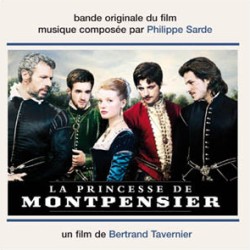
LA PRINCESSE DE MONTPENSIER/THE PRINCESS OF MONTPENSIER – Philippe Sarde
 Original Review by Jonathan Broxton
La Princesse de Montpensier – The Princess of Montpensier – is a French period drama based on a classic novel by Madame de Lafayette and directed by Bertrand Tavernier. Set during a period of religious turmoil in 16th century France, the film stars Mélanie Thierry as Marie, a young noblewoman who falls in love with the dashing Henri de Guise (Gaspard Ulliel). However, in order to further her father’s political ambitions, she is forced to marry instead the well-connected Philippe de Montpensier (Grégoire Leprince-Ringuet), a career soldier who quickly leaves for war. Left alone in the care of an aging nobleman, Marie soon finds her life becoming more complicated as she begins to encounter the different political – and sexual – manipulations of her new world. Read more…
IFMCA Award Winners 2010
 JOHN POWELL’S HOW TO TRAIN YOUR DRAGON IS NAMED INTERNATIONAL FILM MUSIC CRITICS’ 2010 FILM SCORE OF THE YEAR
The International Film Music Critics Association announces the winners of its seventh annual awards for excellence in musical scoring in 2010 with John Powell’s score for the animated film HOW TO TRAIN YOUR DRAGON topping the list, winning both Film Score of the Year and Best Score for an Animated Film. Alexandre Desplat receives three awards: Best Score for a Drama Film (THE KING’S SPEECH), Best Score for an Action/Adventure/Thriller Film (THE GHOST WRITER) and Composer of the Year.
Continuing their tradition to highlight lesser known but vital world talents, the Association awards the Breakout Composer of the Year to Portuguese composer Nuno Malo for AMÁLIA. Turkish composer Pinar Toprak wins Best Score for a Comedy Film for her score to the THE LIGHTKEEPERS. Rounding out the film categories are Best Score to a Fantasy/Science Fiction/Horror Film which goes to TRON: LEGACY by the French duo Daft Punk, Best Score for a Documentary Film winner is French composer Bruno Coulais for OCÉANS and American Danny Elfman’s “Alice Theme” from ALICE IN WONDERLAND wins Best Individual Composition.
In the non-film category, Bear McCreary wins his second award in a row in the Best Score for a Television Series, this year for Fox’s drama HUMAN TARGET (McCreary won last year for BATTLESTAR: GALACTICA). Kojima Productions’ CASTLEVANIA: LORDS OF SHADOW, with music by Óscar Araujo, wins Best Score for a Video Game or Interactive Media.
The Best Archival Release goes to the six-disc box set release of Alex North’s score to Stanley Kubrick’s SPARTACUS, which was Varèse Sarabande’s executive producer Robert Townson’s 1000th release for the label. Best Record Label of the Year goes to La-La Land Records, their first win in this category, for such notable 2010 expanded release soundtracks as BATMAN RETURNS, DRAGONSLAYER, PANIC IN THE YEAR ZERO and HOME ALONE. Read more…
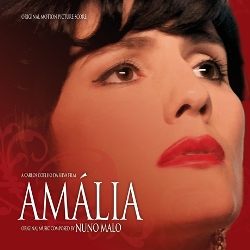
AMÁLIA – Nuno Malo
 Original Review by Jonathan Broxton
Amália da Piedade Rodrigues was a Portuguese singer and actress whose life and work helped popularize fado – a specific genre of Portuguese folk music – on a worldwide scale. From the 1940s until her death in 1999 Amália was known as Rainha do Fado (the Queen of Fado) and was immensely popular in her native country, selling hundreds of thousands of records. Carlos Coelho da Silva’s film Amália, which stars Sandra Barata Belo in the lead role, is the story of her life. Although the film played in theaters in Portugal in 2008, it is only just now beginning to surface in other countries; to coincide with this wider exposure, Moviescore Media has released the film’s score, by US-based Portuguese composer Nuno Malo. It’s absolutely wonderful. Read more…
LA HERENCIA VALDEMAR/THE VALDEMAR LEGACY – Arnau Bataller
 Original Review by Jonathan Broxton
La Herencia Valdemar is the first film of a two-part Spanish mystery-horror-thriller series written and directed by José Luis Alemán. Steeped in Lovecraftian imagery and themes, it stars Silvia Abascal as Luisa Lorente, an expert on inheritance tax relating to old buildings, who visits an enormous Gothic mansion called Valdemar to conduct an audit following the death of the owner. When she disappears in mysterious circumstances, her boss hires a private detective named Nicolás Tremel (Oscar Jaenada) to find out what happened to her. However, upon his arrival at Valdemar, Nicolás discovers much more than he bargained for – an-age old horror beyond imagination. The film, which also stars Daniele Liotti, Laia Marull and Rodolfo Sancho, was a popular success in it’s native Spain when it opened there in January 2010, but by far the most impressive aspect of the entire production is the score by 33-year old composer Arnau Bataller. Read more…
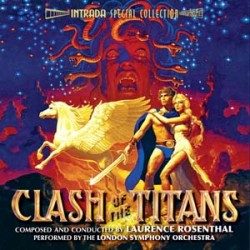
CLASH OF THE TITANS – Laurence Rosenthal
 MOVIE MUSIC UK CLASSICS
Original Review by Craig Lysy
This film presents a classic Greek myth that tells the tale of the demi-god Perseus (son of Zeus) who secures the mandate of Heaven as he takes on an epic quest to slay the forces of darkness and rescue his love. The renowned master of stop motion animation Ray Harryhausen who was enamored with Greek and Arabic mythology conceived the film. MGM agreed to the project and provided a generous budget based on his previous successes with his three Sinbad films as well as Jason and the Argonauts. The film featured an all-star cast that included Laurence Olivier (Zeus), Maggie Smith (Thetis), Ursula Andress (Aphrodite), Burgess Meredith (Ammon), and the handsome newcomer Harry Hamlin as Perseus. The storytelling was first rate and the stop motion animation superb. While not a critical success, the film was a commercial success, more than covering its production costs of $15 million to make $41 million. Read more…
BAFTA Winners 2010
 The British Academy of Film and Television Arts (BAFTA) have announced the winners of the 64th British Academy Film Awards, honoring the best in film in 2010.
In the Best Original Score category composer Alexandre Desplat won the award for his score for the critically acclaimed drama The King’s Speech.
The other nominees were Danny Elfman for Alice in Wonderland, John Powell for How to Train Your Dragon, A.R. Rahman for 127 Hours, and Hans Zimmer for Inception.
IFMCA Award Nominations 2010
 ALEXANDRE DESPLAT RECEIVES 7 INTERNATIONAL FILM MUSIC CRITICS AWARD NOMINATIONS, INCLUDING TWO FOR FILM SCORE OF THE YEAR
The International Film Music Critics Association has announced its list of nominations for excellence in musical scoring in 2010, with French composer Alexandre Desplat leading the field with 7 nods including THE KING’S SPEECH (3 nominations) and THE GHOST WRITER (3 nominations) for Film Score of the Year. Also nominated in this category are John Powell’s HOW TO TRAIN YOUR DRAGON (5 nominations), Daft Punk’s score to TRON: LEGACY (3 nominations) and Hans Zimmer’s INCEPTION (3 nominations).
Desplat, who also wrote the nominated score to HARRY POTTER AND THE DEATHLY HALLOWS PART 1, is short-listed for Composer of the Year along with John Powell (HOW TO TRAIN YOUR DRAGON); James Newton Howard (SALT, THE LAST AIRBENDER, NANNY MCPHEE RETURNS); Danny Elfman (ALICE IN WONDERLAND); and Hans Zimmer (INCEPTION).
Breakout Composer of the Year nominees include Guy-Manuel de Homem-Christo and Thomas Bangalter, better known as the French electronic/dance duo Daft Punk, for TRON: LEGACY; Spanish composer Oscar Araujo for the video game CASTLEVANIA: LORDS OF SHADOW; Spanish composer Arnau Bataller for the mystery film LA HERENCIA VALDEMAR; German composer Herbert Grönemeyer for the George Clooney drama THE AMERICAN; and Portuguese composer Nuno Malo for AMÁLIA, the film about the life of Portuguese fado singer Amália Rodrigues. Read more…
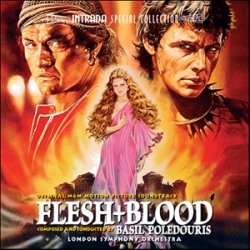
FLESH + BLOOD – Basil Poledouris
 MOVIE MUSIC UK CLASSICS
Original Review by Craig Lysy
Flesh + Blood was director’s Paul Verhoeven’s first American film as well as his first collaboration with Basil Poledouris. The tale is set in the darkness that was 16th century Europe during the era of the great plague. It stars Rutger Hauer, Jennifer Jason Leigh and Tom Burlinson. Our ‘hero’ Martin (Rutger Hauer), who was commissioned by the King, leads a band of brutal mercenaries. When the King reneges on his deal, Martin and his band of men strike back by kidnapping Agnes (Jennifer Jason Leigh), who is betrothed to Prince Steven (Tom Burlinson). They take control of a castle and prepare for the attack by royal forces under the command of the aggrieved Prince Steven. Fate would have it that Agnes begins to fall in love with Martin which brings her into conflict with Celine (Susan Tyrell) who also loves him. To say that this film excelled in graphic, gratuitous, brutal violence and carnal imagery is an understatement! Verhoven shows everything without restraint or shame, and the film is not for the squeamish. Commercially the film was a bust, with a production cost of $6,500,000 it grossed only $100,000. Read more…
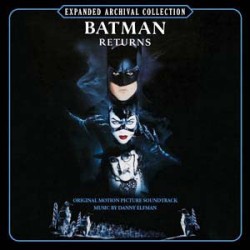
BATMAN RETURNS – Danny Elfman
 MOVIE MUSIC UK CLASSICS
Original Review by Craig Lysy
Studios execs used a significant salary increase and offer of creative control to induce resistant Tim Burton to reprise his role and direct the next installment in the Batman franchise. Burton rejected a sequel, stating “I wanted to treat this like it was another Batman movie altogether.” So, a new Batman, new villains and a grim and darker Gotham City were introduced. The plot pits Batman against an evil tycoon Max Shreck (Christopher Walken), who seeks to enrich himself by monopolizing the city’s power supply, the pathetic deformed and inwardly mutated Penguin who harbors unresolved anger for being abandoned by his parents, and lastly the schizophrenic and mercurial Catwoman played by Michelle Pfeiffer. The film was not a critical success, however it was a commercial success and so spawned a third installment in the franchise. Read more…
John Barry, 1933-2011
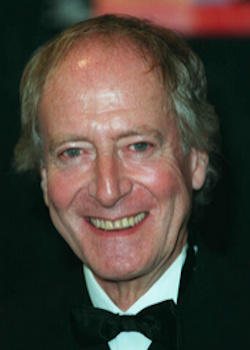 Composer John Barry died on January 30, 2011, at his home in Oyster Bay, New York, after suffering a heart attack. He was 77.
John Barry Prendergast was born in York, England in November 1933, where his father owned a chain of cinemas. He played the organ at York Minster and, after spending some time as a classical pianist, formed a jazz band, The John Barry Seven in 1957. The Seven had a number of popular instrumental hits in the UK, including a cover of “Walk Don’t Run” and the theme from the TV show Juke Box Jury, “Hit and Miss”, before moving into cinema.
Barry made his film music composing debut in 1960 writing music for the Adam Faith film Beat Girl at the age of 27, before establishing himself as a major force in the British film industry when he was brought in to arrange the theme for Dr. No, the first Bond film, in 1962. Though the “James Bond Theme” is credited to Monty Norman, Barry’s unmistakable arrangement—brassy, rhythmic, and insouciantly cool—established the sound of the series. He wrote the entire score for the second James Bond film, From Russia With Love, in 1963, and went on to score ten more, including Thunderball, Goldfinger, You Only Live Twice, On Her Majesty’s Secret Service, Diamonds Are Forever, Octopussy, and The Living Daylights. Read more…
Academy Award Nominations 2010
 The Academy of Motion Picture Arts and Sciences (AMPAS) have announced the nominations for the 83rd Academy Awards, honoring the best in film in 2010.
In the Best Original Score category, the nominees are:
- ALEXANDRE DESPLAT for The King’s Speech
- JOHN POWELL for How to Train Your Dragon
- A. R. RAHMAN for 127 Hours
- TRENT REZNOR and ATTICUS ROSS for The Social Network
- HANS ZIMMER for Inception
These are the first Oscar nominations Powell, Reznor, and Ross, although Reznor and Ross picked up a Golden Globe nomination for The Social Network earlier in the season. This is the 4th Oscar nomination for Desplat, the 2nd Oscar nomination for Rahman, who won the Award in 2009 for Slumdog Millionaire, and the 9th Oscar nomination for Zimmer, who previously won in 1994 for The Lion King.
In the Best Original Song category, the nominees are:
- TOM DOUGLAS, TROY VERGES and HILLARY LINDSEY for “Coming Home” from Country Strong
- ALAN MENKEN and GLENN SLATER for “I See The Light” from Tangled
- RANDY NEWMAN for “We Belong Together” from Toy Story 3
- A.R. RAHMAN, DIDO ARMSTRONG and ROLLO ARMSTRONG for “If I Rise” from 127 Hours
The winners of the 83rd Academy Awards will be announced on February 27, 2011.
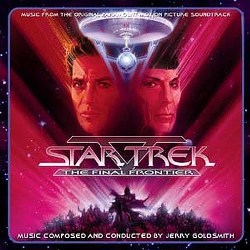
STAR TREK V: THE FINAL FRONTIER – Jerry Goldsmith
 MOVIE MUSIC UK CLASSICS
Original Review by Craig Lysy
Star Trek V is at its heart a mystical quest film concerned with a question that has aroused humanity’s curiosity for millennia. It explores our search for that sacred omphalos from whence we arose – the Garden of Eden. In metaphysics Eden symbolizes primordial perfection, the source of all life and the state of perfect communion between humanity and God. It is from this inner longing, this yearning that the saga which is Star Trek V unfolds. William Shatner lobbied very hard to direct the film and although he managed to win the directorship, he regretfully would not enjoy critical success. Production and financing problems forced a dramatic scaling back of the movie’s climactic scene where he had planned a dramatic display of immense stone gollums and the earth opening up to reveal scenes of Dante’s ten levels of Hell. It suffices to say that the lack of resources served to mortally wound the story’s narrative and resulted in what many believe to be the weakest film in the Star Trek franchise. Read more…

Shop at the Movie Music UK Store

Member of the

 MOVIE MUSIC UK