Archive
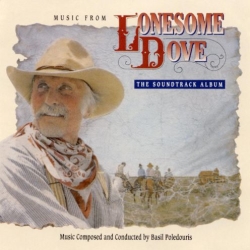
LONESOME DOVE – Basil Poledouris
 THROWBACK THIRTY
Original Review by Jonathan Broxton
Lonesome Dove, an epic western mini-series based on the Pulitzer Prize-winning novel by Larry McMurtry, was one of the television successes of the year after it premiered on CBS in the spring of 1989. Directed by Simon Wincer and starring Robert Duvall and Tommy Lee Jones, and set in the closing years of the Old West, the story focused on the relationship between Gus (Duvall) and Call (Jones), two retired Texas Rangers who decide to leave their quiet town on the Mexican border and drive a herd of cattle north to Montana. McMurtry’s original novel – which explores themes of old age, death, unrequited love, and friendship – was based on a screenplay that he had co-written with Peter Bogdanovich for a movie that was intended to star John Wayne, James Stewart, and Henry Fonda, but the project collapsed when John Ford advised Wayne to reject the script. Prior to its airing, the ‘classic western’ was considered to be a virtually dead genre, but Lonesome Dove almost singlehandedly re-vitalized it. The series drew staggering viewership numbers of more than 20 million homes, went on to win 7 Emmys from 18 nominations (including Best Director and a slew of technical awards), and paved the way for the cinematic resurrection of the genre with Kevin Costner’s Dances With Wolves in 1990 and Clint Eastwood’s Unforgiven in 1992. Read more…
Under-the-Radar Round Up 2018, Part 2
 Original Reviews by Jonathan Broxton
This is the second installment in my annual series of articles looking at the best “under the radar” scores from around the world. Rather than grouping the scores on a geographical basis, this year I decided to simply present the scores in a random order, and so this first batch includes five scores from several disparate locations – a stunning romantic TV drama from China, a political drama score for a TV series from Egypt, a drama score from India by one of the world’s most successful composers, and two standout works from Spain – a historical TV drama series, and a stunning documentary work about mysteries of science, nature, and space.
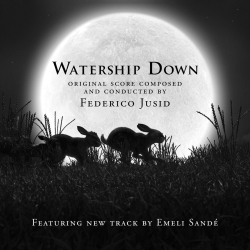
WATERSHIP DOWN – Federico Jusid
 Original Review by Jonathan Broxton
The 1972 novel Watership Down by Richard Adams is a classic of British literature. Note that I said literature and not children’s literature, because although the story is about a group of anthropomorphized rabbits, the story is very much an adult one. Following the destruction of their warren, a group of rabbits led by the brave Hazel, the sensitive Fiver, and the strong Bigwig make their way across the English countryside in search of a new home, and must fight against all manner of dangers – both natural and man-made – as they do so. What’s so brilliant about Adams’s novel is the way in which it creates an entire culture for the rabbits, with a creation myth, gods and spirits, a unique language with specialized vocabulary, and even a hierarchical society – the latter of which comes into play when Hazel and his friends encounter rabbits from an authoritarian rival warren overseen by the tyrannical General Woundwort. When you combine this with themes that mirror classical epics about life and death, environmentalism, and politics, the result is one of the great English books of the last fifty years. The story was made into a much-loved animated film in 1978 – again, not for kids – and is now a three-part mini-series jointly produced by the BBC and Netflix, directed by Noam Murro, which features an astonishing voice cast including James McAvoy, Nicholas Hoult, John Boyega, Ben Kingsley, Tom Wilkinson, Gemma Arterton, Olivia Colman, Daniel Kaluuya, Taron Egerton, and many many others. Read more…
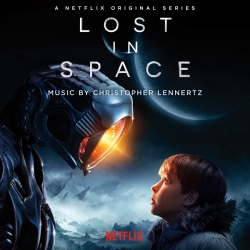
LOST IN SPACE – Christopher Lennertz
 Original Review by Jonathan Broxton
Considering that American TV appears to be obsessed with nostalgic reboots, it was perhaps only a matter of time before producers began to look back even further than the 1980s for inspiration. Lost in Space was one of several TV series produced by the legendary Irwin Allen which, along with Land of the Giants, The Time Tunnel, and of course Star Trek (which was not produced by Allen), eventually came to be regarded as game-changers for science fiction television storytelling. Unlike anthology series like The Twilight Zone, Lost in Space was a sequential drama that followed the adventures of the Robinson family, who are chosen to lead an exploration to find a new planet for humans to colonize, but who become hopelessly lost in the depths of space when their mission is sabotaged by a sinister stowaway. Originally broadcast in 1965, it started out quite seriously, but gradually became sillier as it went on, concentrating much more on the antics of the stowaway Dr Zachary Smith, played by Jonathan Harris, and his relationship with the family’s youngest child Will Robinson, than the existential drama at the heart of the show. It was cancelled in 1968 after three seasons, and despite an initial attempt to re-boot it in 1998 as a movie starring William Hurt, Gary Oldman, and Matt LeBlanc, it has nevertheless remained something of a quaint relic of the 1960s – until now. Read more…
Under-the-Radar Round Up 2017, Part 8
Original Reviews by Jonathan Broxton
The penultimate installment in my annual series of articles looking at the best “under the radar” scores from around the world sees us back on Europe mainland for a final dash around the continent. This is where we get really obscure: we’ve got a total of eight scores here, including a TV series from Poland, a historical action movie from Russia written by a rock musician, a Norwegian supernatural thriller, children’s adventure films from both Germany and Norway – one of which is animated – and a comedy road movie about racism from Finland! It just goes to show that good film music being written everywhere, in the most unexpected places, if only you have the patience to seek it out.
Under-the-Radar Round Up 2017, Part 5
Original Reviews by Jonathan Broxton
The fifth installment in my annual series of articles looking at the best “under the radar” scores from around the world sees us in one of my favorite film music countries, Spain. I have long been a vocal promoter Spanish film music which, over last ten years or so, has become a soundtrack powerhouse filled with composers who – in terms of the number of excellent scores per film – are probably writing the highest quality film music in the world. 2017 was no exception, with dozens of excellent scores emerging from the country during the calendar year. This article contains the scores which, in my opinion, are the eight best, which encompass both film and television, span multiple genres, and are written both by familiar favorites and exciting newcomers.
WOJCIECH KILAR REVIEWS – 1964-2007
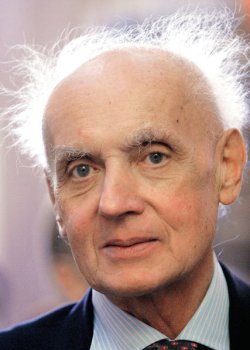 In this latest installment of the new irregular series looking at the career of some film music’s most iconic composers, we travel to Poland to look at the work of one of film music’s most unsung geniuses, Wojciech Kilar.
Wojciech Kilar was born in Lvov, Ukraine, when it was still part of Poland, in July 1932, but moved to Katowice in Silesia in 1948 with his father, a gynecologist, and his mother, an actress. Kilar studied at the State Higher School of Music in Katowice under composer and pianist Władysława Markiewiczówna, at the State Higher School of Music in Kraków under composer and pianist Bolesław Woytowicz, and then in Paris with the legendary Nadia Boulanger in the late 1950s. Upon his return to Poland, Kilar and fellow composers Henryk Górecki and Krzysztof Penderecki led an avant-garde music movement in the 1960s, during which time he wrote several acclaimed classical works.
Kilar scored his first film in 1959, and went on to write music from some of Poland’s most acclaimed directors, including Krzysztof Kieślowski, Krzysztof Zanussi, Kazimierz Kutz, and Andrzej Wajda. He worked on over 100 titles in his home country, but he did not score an major English-language film until Francis Ford Coppola’s adaptation of Bram Stoker’s Dracula in 1992.
In addition to his film work, Kilar’s classical output includes such masterworks as Krzesany (1974), a symphonic poem for orchestra, inspired by the “highlander” music of the Tatra mountains region of southern Poland; Exodus (1979), a religious choral piece used in the trailers for Schindler’s List, and others such as Prelude and Christmas Carol (1972), Mount Kościelec 1909 (1976), Angelus (1984), Orawa (1986), and Choralvorspiel (1988). His third, fourth and fifth symphonies – the September Symphony (2003), the Symphony of Motion (2005) and the Advent Symphony (2007) – were among his last major completed works. Kilar died on December 29, 2013, at his home in Katowice, after a battle with cancer, aged 81.
JOHN WILLIAMS REVIEWS – 1960-1969
 In this latest installment of the new irregular series looking at the early career of some iconic composers, we switch to Hollywood to look at the work of John Williams.
Williams attended the University of California, Los Angeles, and studied privately with the Italian composer Mario Castelnuovo-Tedesco, before being drafted into the U.S. Air Force, where he conducted and arranged music for Air Force bands as part of his assignments. After his service, Williams moved back to New York, and studied both at the Juilliard School, and at the Eastman School of Music, while moonlighting as a jazz pianist.
After completing his studies, Williams worked in Hollywood, orchestrating and performing piano on film scores for composers such as Alfred Newman, Bernard Herrmann, Elmer Bernstein and Jerry Goldsmith. Williams made his film music composing debut in 1959 on the film Daddy-O at the age of 27 – credited as Johnny Williams – and these first reviews look at sixteen subsequent film scores Williams that wrote between 1960 and 1969.
Not included here are the multitude of episodic TV scores he wrote during the period for shows and anthology series like Alcoa Premier, Playhouse 90, M-Squad, Wagon Train, Impact, The Virginian, Lost in Space, The Time Tunnel, and Land of the Giants, and others. Nor am I including the two scores where Williams adapted music by other people: Valley of the Dolls (1967), where Williams worked with music by André Previn and Dory Previn and for which he received his first Oscar nomination for Best Adaptation Score of a Musical Picture, and Goodbye, Mr. Chips (1969), where Williams adapted music by Leslie Bricusse, and for which he earned his second nomination in the same category. Read more…
FEUD: BETTE AND JOAN – Mac Quayle
 Original Review by Jonathan Broxton
Building on the success of their hit TV anthology series American Horror Story, TV network FX and writer/director/producer Ryan Murphy have expanded into different areas with two additional shows. The first, American Crime Story, began in 2016 with The People vs. O. J. Simpson, an in-depth look at the celebrity murder trial which gripped the United States in the mid 1990s. The second, Feud, is intended to take a closer look at numerous different true-life inter-personal rivalries, and began by exposing the decades-long grudge between Hollywood actresses Joan Crawford and Bette Davis, which came to a head during the filming of the movie Whatever Happened to Baby Jane in 1962. The 8-episode series, which starred Jessica Lange and Susan Sarandon in the title roles and debuted in March 2017, reveled both in its Old Hollywood sheen and in the fading glamour of the two former starlets, while unearthing juicy details on a number of studio power players, ranging from Warner Brothers exec Jack Warner to director Robert Aldrich, and gossip columnist Hedda Hopper. The show was an enormous success, and went on to pick up 19 Emmy Award nominations. Read more…
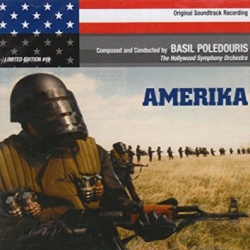
AMERIKA – Basil Poledouris
 THROWBACK THIRTY
Original Review by Jonathan Broxton
In the spring of 1987 viewers of the network TV channel ABC were treated to a 6-part mini-series imagining a horrific alternate reality for the United States where the country has been insidiously, but bloodlessly, overtaken by the Soviet Union. Amerika posits the country as being essentially a puppet state of Moscow, with the President and Congress mere figureheads for the Soviet regime; the population is kept under control by a UN peacekeeping force called the UNSSU, which is supposed to be multi-national but is in reality a Russian Communist military arm, which uses fear and intimidation tactics to suppress opposition. From out of this nightmare three heroes emerge: former politician Devin Mitford (Kris Kristofferson), who is released back into society after spending years in a labor camp for treason; administrator Peter Bradford (Robert Urich), who pretends to collaborate with the Soviets while working to bring down the regime from within; and Colonel Andrei Denisov (Sam Neill), a KGB agent becoming more and more disillusioned with his country’s politics. The series, which was written and directed by Donald Wrye, has been in the news of late after more than 20 years of relative obscurity, mainly due to the accusations of Russian influence in Donald Trump’s successful run for US President in 2016… this fiction couldn’t be happening in reality, could it? Read more…
Under-the-Radar Round Up 2016, Part 7
Original Reviews by Jonathan Broxton
The seventh and final installment in my annual series of articles looking at the best “under the radar” scores from around the world returns to the Asian continent, and highlights a half dozen more outstanding scores from Japan and China. This set of reviews features everything from epic action fantasy films, sweet animated adventures, horror films, and historical dramas, and concentrates strongly on music by one particular composer who is writing some of the best film music anywhere in the world today, and who should be most more respected and acclaimed in the west: Naoki Sato.
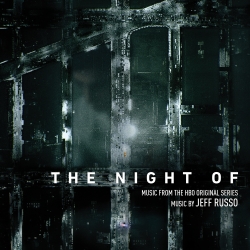
THE NIGHT OF – Jeff Russo
 Original Review by Jonathan Broxton
The Night Of is one of the more critically acclaimed TV dramas of 2016. It’s an American remake of the 2008 British drama series Criminal Justice, and was adapted for broadcast on HBO by Richard Price and Steven Zaillian, the director/screenwriter behind such excellent films as Schindler’s List, Searching for Bobby Fischer, Moneyball, and many others. Essentially, the show is an unflinchingly realistic look at the American justice system as seen through the eyes of Nasir Khan (Riz Ahmed), a Pakistani-American college student accused of murdering a girl in New York City. As Naz makes his way through the system he encounters numerous individuals who have control over his destiny: the lead detective on his case (Bill Camp), a scrappy ambulance-chasing lawyer (John Turturro), the dogged district attorney seeking a conviction (Jeannie Berlin), a hardened prisoner who takes Naz under his wing and teaches him how to survive in jail (Michael Kenneth Williams), and an idealistic young defense attorney (Amara Karan) who shares Naz’s ethnic heritage. But the show is more than simply a murder-of-the-month whodunit; Zaillian and Price use Naz’s story to spotlight the unfairness, harshness, and occasional corruption of the justice system, as well as the cultural and political overtones of being a Muslim man accused of murder in contemporary America. Read more…
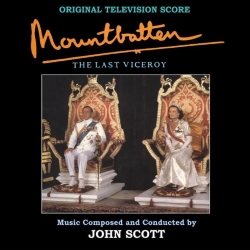
MOUNTBATTEN: THE LAST VICEROY – John Scott
 THROWBACK THIRTY
Original Review by Jonathan Broxton
Mountbatten: The Last Viceroy was a critically acclaimed 6-part British television series, telling the astonishing life story of Louis Mountbatten, a member of the British aristocracy, and a cousin to Queen Elizabeth II. The series chronicles his life as a British statesman and naval officer; he served as the Supreme Commander of the Allied forces in South-East Asia during World War II, and afterwards was appointed Viceroy of British colonial India, where he successfully negotiated with both Mahatma Gandhi and Muhammad Ali Jinnah, and oversaw the transition of power from the British Empire to the independent nations of India, Pakistan, and Bangladesh in 1947. Following his work in India, Mountbatten returned to Britain, and subsequently served in the government as a senior member of the military, until he was assassinated by the Irish Republican Army in 1979. The series was directed by Tom Clegg, starred Nicol Williamson, Janet Suzman, and Ian Richardson, and had a score by the great English film composer John Scott. Read more…
STRANGER THINGS – Kyle Dixon, Michael Stein
 Original Review by Jonathan Broxton
Nostalgia for the 1980s appears to have peaked during the summer of 2016. Mainstream films, TV shows, and their musical accompaniments are all relishing their trips down amnesia lane, digging up thirty years worth of long-forgotten pop culture references, busting out with outdated lingo, and embracing the questionable fashion choices that defined the decade. Children’s adventure movies were especially popular in the 1980s, and it is that sub-genre that the Netflix original series Stranger Things lovingly emulates. Set in suburban Indiana in 1983, the show begins with the disappearance of a 12-year-old boy named Will Byers (Noah Schnapp); as his mother Joyce (Winona Ryder) panics, the local police department led by Sheriff Jim Hopper (David Harbour) begins a formal investigation. Meanwhile, Will’s nerdy Dungeons-and-Dragons-playing friends (Finn Wolfhard, Gaten Matarazzo, Caleb McLaughlin) begin their own investigation – and before long the boys are knee-deep in an extraordinary mystery involving top-secret government experiments, terrifying supernatural forces, and a strange little girl named Eleven (Millie Bobby Brown) who appears to display psychokinetic abilities. Read more…
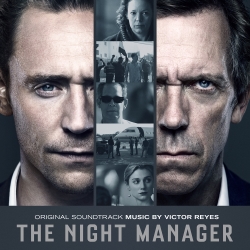
THE NIGHT MANAGER – Víctor Reyes
 Original Review by Jonathan Broxton
The Night Manager is a six-part TV drama mini-series based on John le Carré’s 1993 novel of the same name. Directed by Susanne Bier and co-produced by the BBC and American cable channel AMC, it stars Tom Hiddleston as Jonathan Pine, a former British soldier now working as the head concierge at a luxury hotel in Cairo at the height of the Arab Spring popular uprisings. Pine witnesses the brutal murder of an arms dealer’s mistress, and is advised by a friend working for MI6 in Egypt to flee; six months later, Pine is in Switzerland, again working as the head concierge at a luxury hotel in the shadow of the Matterhorn. It is here that Pine encounters Richard Roper (Hugh Laurie), a British philanthropist, and his entourage, including his wife Jed (Elizabeth Debicki) and majordomo Corkoran (Tom Hollander). After realizing that Roper has significant ties to the arms dealer back in Egypt, Pine is approached by another MI6 agent, Angela Burr (Olivia Colman), who has been investigating Roper for years. Angela offers Pine a proposition: to infiltrate the inner circle of Roper’s clandestine organization in order to bring him down from the inside, and avenge the Cairo murders. Read more…

Shop at the Movie Music UK Store

Member of the


