Archive
Under-the-Radar Round Up 2025, Part 9
 Original Reviews by Jonathan Broxton
I’m pleased to present the latest installment in my on-going series of articles looking at the best under-the-radar scores from around the world.
This article, the ninth and last of 2025, is a bumper crop, and covers another nine scores released last year from a wide array of genres and countries, including a short film from the Netherlands about magical paintings, a short film from Canada that makes the directorial debut of an Emmy-winning composer, a comedy-drama film from Denmark about a bank robber with dissociative identity disorder, a supernatural murder mystery from Vietnam about a 19th-century detective, and a short film from Mexico about a little girl and a heroic horsewoman who wields a magical lasso.
Then there’s an Australian sci-fi action horror film about a group of American soldiers encountering dinosaurs during the Vietnam war, an animated sex comedy from Norway about two sperms on an epic adventure trying to find their way to an un-fertilized egg, a Spanish TV series about a detective investigating a series of murders in a rural community, and an action horror film from Norway about a pair of gargantuan trolls terrorizing the fjords!
Under-the-Radar Round Up 2025, Part 1
Original Reviews by Jonathan Broxton
I’m pleased to present the latest installment in my on-going series of articles looking at the best under-the-radar scores from around the world.
This article, the first of 2025, covers seven scores released in the first quarter of the year from a wide array of genres and countries, including tender romance score from Japan, a fantastic historical animated action-adventure TV score from France, a jazzy Swiss period drama, a Japanese animated short film, a Norwegian nature documentary TV series, a French period TV series, and a French action-adventure score with a gender-swapped twist! Read more…
Under-the-Radar Round Up 2024, Part 6
Original Reviews by Jonathan Broxton
I’m pleased to present the latest installment in my on-going series of articles looking at the best under-the-radar scores from around the world.
This article, the sixth of 2024, covers another five scores from a wide array of genres and countries, including a spectacular documentary score about dinosaurs, a Japanese action thriller based on a popular TV series, and three scores for a trio of acclaimed short films: one from France, one from the Netherlands, and one from the United States, several of which are on the shortlists to receive Short Film Academy Award nominations.
THE SNOWMAN – Howard Blake
 Original Review by Jonathan Broxton
We’re walking in the air…
The Snowman is a magical adaptation of Raymond Briggs’ well-loved 1978 storybook of the same name. Directed by Dianne Jackson, it tells the tale of a young boy named James who builds a snowman one Christmas Eve, which comes to life that night and takes James on an unforgettable trip to the North Pole to meet Father Christmas. It’s a simple story of childhood wish fulfillment, told with loving attention to detail and superbly stylized renderings, but also with a sense of bittersweet poignancy and emotion that often underpins Briggs’s work. In the years since its initial release in 1982, the film has gone on to be heralded as one of the best animated short films ever made; every year over the Christmas period the British TV network Channel 4 screens the film, allowing families both young and old to enjoy this wonderful piece of seasonal tradition time and again. It is now considered undisputed animated classic, and a touchstone of British Christmas culture. Read more…
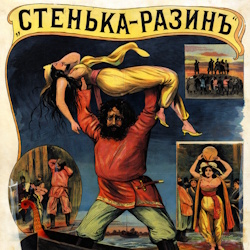
STENKA RAZIN – Mikhail Ippolitov-Ivanov
 GREATEST SCORES OF THE TWENTIETH CENTURY
Original Review by Craig Lysy
The short silent film’s genesis arose from a collaboration between two pioneers of the emerging 20th century Russian cinema; producer/cinematographer/correspondent Alexander Drankov, and director Vladimir Fedorovich Romashkov. Following the 1905 Russian revolution the country was simmering with worker and peasant discontent against the autocracy of Tsar Nicholas II and the aristocracy. In an effort to tap into public discontent, they conceived of a fictionalized account from the life of Stenka Razin, a heroic 19th century Cossack chieftain who led a peasant revolt against the oppression of the Tsar and landed nobility. The 10-minute short film would be financed by Drankov’s own production company, which he formed the year before in 1907. The screenplay was written by Vasily Goncharov, and is an adaptation from the play Ponizovaya Volnitsa. A single actor is credited, Yevgeni Petrov-Krayevsky who would play Stenka Razin. Read more…
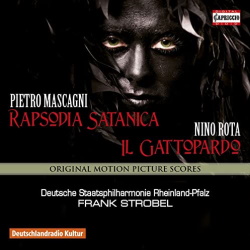
RAPSODIA SATANICA – Pietro Mascagni
 GREATEST SCORES OF THE TWENTIETH CENTURY
Original Review by Craig Lysy
Italian playwright, screenwriter and film director Nino Oxilia found inspiration for his next film in legendary character Faust, for which he would provide a twist – retelling the story with Faust cast as a woman. He chose to utilize poems by Fausto Maria Martini who was a member of ‘Crepusscolari”, the ‘Poets of Twilight’. The works of these artists were tragedies, which spoke of the decline of the shallow bourgeois culture. Oxilia purchased the film rights, and Società Italiana Cines agreed to produce and fund the film with a budget that allowed Oxilia to realize his vision. Oxilia spared no expense for his passion project, hiring the leading actress of her generation, prima diva Lyda Borelli who was beloved by Italians, to star in the film. He tasked poet Fausto Maria Martini to provide the film’s closed captions, used elaborate costumes and jewelry, and lastly, added color, both tinted and toned, as well as stenciling to create film imagery that expanded beyond the limited confines of black and white. Read more…
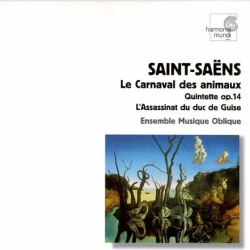
L’ASSASSINAT DU DUC DE GUISE/THE ASSASSINATION OF THE DUKE OF GUISE – Camille Saint-Saëns
 GREATEST SCORES OF THE TWENTIETH CENTURY
Original Review by Craig Lysy
During the 1880s a technological revolution occurred with the invention of celluloid photographic film and motion picture cameras. The first public screening of a motion picture in which an admission fee was charged occurred in New York City 1895 by the Lambda Company, founded by Woodville Latham. The idiom quickly gained popularity, and in 1907 Paul Lafitte, a wealthy novelist, publisher and financier founded the French production company Le Film d’Art to produce French films, which he hoped would gain the admiration of the cultural elite as well as the patronage of the common people. Throughout his life Lafitte had been tireless in fostering literature and the theatre. He saw motion pictures as a new way to bring education and entertainment to the masses. He recruited talented stage actors from the Comédie-Française theatre group, and in 1908 decided to produce his first film, the French historical drama L’Assassinat du Duc de Guise originally titled La Mort du Duc de Guise. The Pathé Frères company would distribute the film, and he tasked French actors Charles le Bargy and André Calmettes to direct. French dramatist Henri Lavedan was hired to write an original screenplay, and a fine cast was assembled, which included Charles le Bargy as King Henry III, Albert Lambert as Le Duc de Guise, Gabrielle Robinne as Marquise de Noirmoutier and Berthe Bovy as Le Page. The final product was a short film of 18 minutes. Read more…
L’ASSASSINAT DU DUC DE GUISE/THE ASSASSINATION OF THE DUKE OF GUISE – Camille Saint-Saëns
Original Review by Ben Erickson
In 1907 financier Paul Laffitte founded a revolutionary production company by the name of Le Film d’Art. Its purpose was to guide the education of the French masses with reenactments of renowned historical and mythological accounts, featuring the talented actors of the Comédie-Française and marking a turning point in the history of cinema. The company attained early success with the 1908 French historical drama L’Assassinat du Duc de Guise (originally La Mort du Duc de Guise) which faithfully depicts King Henry III and his brutal murder of the rival, the Duke. Directed by Charles le Bargy and André Calmettes. the film lasts approximately eighteen minutes (longer than the average fifteen minute film during this time), and is notable for both its use of a screenplay by eminent writer Henri Lavedan and for being the earliest documented film for which an original score was written. Calmettes had the idea to score the film with original music, and so it was only logical that the producers turned to one of France’s most celebrated composers of the day, Camille Saint-Saëns. Read more…
WOJCIECH KILAR REVIEWS – 1964-2007
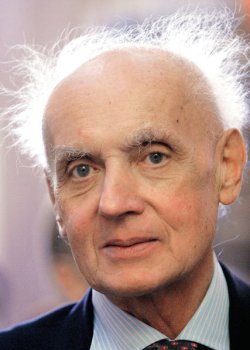 In this latest installment of the new irregular series looking at the career of some film music’s most iconic composers, we travel to Poland to look at the work of one of film music’s most unsung geniuses, Wojciech Kilar.
Wojciech Kilar was born in Lvov, Ukraine, when it was still part of Poland, in July 1932, but moved to Katowice in Silesia in 1948 with his father, a gynecologist, and his mother, an actress. Kilar studied at the State Higher School of Music in Katowice under composer and pianist Władysława Markiewiczówna, at the State Higher School of Music in Kraków under composer and pianist Bolesław Woytowicz, and then in Paris with the legendary Nadia Boulanger in the late 1950s. Upon his return to Poland, Kilar and fellow composers Henryk Górecki and Krzysztof Penderecki led an avant-garde music movement in the 1960s, during which time he wrote several acclaimed classical works.
Kilar scored his first film in 1959, and went on to write music from some of Poland’s most acclaimed directors, including Krzysztof Kieślowski, Krzysztof Zanussi, Kazimierz Kutz, and Andrzej Wajda. He worked on over 100 titles in his home country, but he did not score an major English-language film until Francis Ford Coppola’s adaptation of Bram Stoker’s Dracula in 1992.
In addition to his film work, Kilar’s classical output includes such masterworks as Krzesany (1974), a symphonic poem for orchestra, inspired by the “highlander” music of the Tatra mountains region of southern Poland; Exodus (1979), a religious choral piece used in the trailers for Schindler’s List, and others such as Prelude and Christmas Carol (1972), Mount Kościelec 1909 (1976), Angelus (1984), Orawa (1986), and Choralvorspiel (1988). His third, fourth and fifth symphonies – the September Symphony (2003), the Symphony of Motion (2005) and the Advent Symphony (2007) – were among his last major completed works. Kilar died on December 29, 2013, at his home in Katowice, after a battle with cancer, aged 81.
VAN HELSING: THE LONDON ASSIGNMENT – John van Tongeren
 Original Review by Jonathan Broxton
One of the recent phenomenons in the world of motion pictures are straight-to-video animated spin-offs based on major feature films. Virtually every Disney animated classic has its own straight-to-video sequel, the recent Chronicles of Riddick has been given Dark Fury as a bridge-gap between it and the original Pitch Black, and the 2004 summer blockbuster Van Helsing has Van Helsing: The London Assignment. Essentially a prequel telling of Gabriel Van Helsing’s first encounter with the Dr. Jekyll and Mr. Hyde character who appears at the beginning of the cinematic film, it is directed by Sharon Bridgeman and features the voices of many of the same actors who played in the live-action movie, including Hugh Jackman, Robbie Coltrane and David Wenham. Read more…
A LETTER FROM THE WESTERN FRONT – Ryan Shore
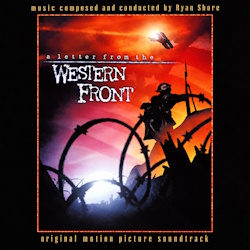 Original Review by Jonathan Broxton
A short review for a short score, but one which marks the emergence of a composer who could one day be very popular. Ryan Shore is Howard Shore’s nephew, and has already undertaken orchestrating duties for his uncle on a number of scores, notably the recent Dogma and Existenz. His debut score as a solo composer is for the highly regarded World War I animated drama A Letter from the Western Front, directed by NYU student filmmaker Daniel M. Kanemoto and which won several respected student film and animation awards in 1998, including the coveted Gold Medal at the Student Academy Awards. Read more…

Shop at the Movie Music UK Store

Member of the


