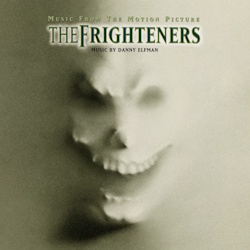
THE FRIGHTENERS – Danny Elfman
 THROWBACK THIRTY
Original Review by Jonathan Broxton
The Frighteners is a supernatural horror-comedy film directed by Peter Jackson, made at the fascinating midpoint between the gleefully disreputable splatter films that established Jackson’s reputation and the enormous fantasy epics that would soon make him one of the most famous filmmakers in the world. Michael J. Fox stars as Frank Bannister, a widowed former architect who, following the traumatic death of his wife, discovers that he can see and communicate with ghosts. Frank turns this ability into a scam: his spectral friends haunt local houses, and he then arrives as a self-proclaimed psychic investigator to “exorcise” them for a fee. Things become considerably less amusing when an apparently supernatural serial killer begins murdering people around town, forcing Frank to confront both the mystery of the killings and the unresolved tragedy in his own past.
The supporting cast includes Trini Alvarado as a kind doctor, and Jeffrey Combs giving an astonishingly twitchy performance as a deranged FBI agent, plus Dee Wallace, Jake Busey, John Astin as one of Frank’s ghostly companions, and R. Lee Ermey in a wonderfully self-aware cameo as a drill instructor from beyond the grave. The film was Jackson’s first substantial Hollywood-backed production after the Oscar-nominated success of Heavenly Creatures in 1994, although he and his writing partner Fran Walsh had actually developed the idea more than five years earlier. Robert Zemeckis was involved when the project was being considered as an episode of Tales from the Crypt, and it was he who ultimately encouraged Jackson to turn it into a feature and direct it himself. Jackson shot the film in New Zealand, making its towns pass for small-town America, and the production became an important proving ground for the young Weta effects operation, which expanded dramatically to handle the hundreds of visual-effects shots necessary for the film.
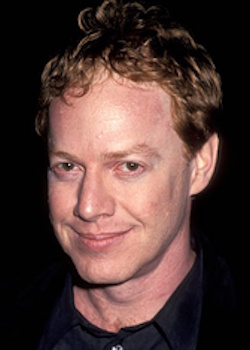
The score for The Frighteners was composed by Danny Elfman, who by 1996 was already one of the most distinctive composers in Hollywood and was no stranger to spookiness – scores such as Beetlejuice, Batman, Edward Scissorhands, Batman Returns, Darkman, Nightbreed, and The Nightmare Before Christmas all contained his unmistakable blend of gothic romanticism, black comedy, choral writing, feverish orchestration, and eccentric instrumental color. The Frighteners appeared just as Elfman was retiring from his band Oingo Boingo after its final Halloween concerts in 1995, allowing him to focus fully on film.
 In my original review of The Frighteners from 1998, which I wrote during the earliest days of Movie Music UK, I stated that I was “beginning to get a little tired of Elfman’s music,” and compared it unfavorably with then-recent scores like Sommersby. I noted that The Frighteners “has all the elements that Elfman fans know and love – the racing violins, chanting female choir, high-note fanfare brasses and eccentric orchestrations,” but concluded that “the problem really lies in the complete lack of coherence throughout the album.” I also wrote that there was “no main theme to speak of,” and complained that the music “just meanders along honking and tooting and reaching occasional crescendos” and “more often than not ends up being a rather cacophonous mess”. Naturally, I have since revised that opinion significantly, and now have a much more positive view of the project as a whole.
“Intro/Titles” opens the score with a creeping harpsichord and malevolent-sounding vocal ideas that eventually coalesce into a dark motif for racing strings and snarling brass, before finally arriving at a lullaby-like central theme that makes its presence known properly around the 2:44 mark on lilting bassoons and bass flutes. It’s a clever theme, able to sound creepy, comic, or dangerous depending on orchestration and volume, and Elfman threads it throughout much of the score to accompany Frank’s increasingly spectral adventures. It’s got a lot of classic Elfman in it – especially The Nightmare Before Christmas – as well as some foreshadowings of things that would later be prominent in scores like Sleepy Hollow, so fans of his sound will immediately be drawn to it, but it doesn’t have the same strength of personality as some of his most famous works, and as a result occasionally gets a bit lost in the cacophony.
“The Lads” gives Frank’s ghostly accomplices a jaunty personality through more harpsichord textures, xylophone-like percussion, skittering figures, and comic brass, while “Poltergeists” expands the same vocabulary into busy supernatural slapstick, full of bold, exaggerated orchestral gestures. The mood changes sharply in “Victim #38” and “Who’s Next?” as the real threat emerges – a cloaked Grim Reaper–like entity that only Frank can see, which crushes the hearts of its victims and leaves them with glowing numbers carved into their foreheads. Here the choir becomes less whimsical and more spectral, while the orchestra often acquires a genuine sense of darkness and menace.
Both “The Garden” and the brief “Chilly” reveal a softer side to the score, bringing a welcome hint of tenderness to the developing relationship between Frank and Lucy, although this is often interrupted by the reaper’s dissonant harpsichords. “Time” is one of the album’s great action showpieces, a nearly five-minute explosion of bulbous brass, percussion, darting strings, choral interjections, and manic momentum. The weird ‘cackling/laughing’ vocal idea from the opening title returns here to disturbing effect, and Elfman regularly reaches into the bag of tricks that served him so well during the more frenzied moments of scores like Beetlejuice and Darkman, channeling the same kind of anarchic energy.
“Patty’s Place” brings back the creepy lullaby-like main material in an especially eerie guise, with the female choir giving the cue a ghostly, almost childlike quality. “Patty Attack” pushes the score back into violent orchestral action, combining the la-la-la vocals and the main melodic theme with increasingly ferocious orchestral lines. “Frank’s Wife” briefly reconnects the horror with the emotional wound at the center of Frank’s character, and then “Doom” delivers the album’s finest piece of full-blooded gothic writing, in which brass pulses, feverish strings, choir, and tolling bells surround increasingly shrill statements of the main theme to create a grand supernatural climax. The concluding “Heaven,” by contrast, is calm and luminous in a way that reminds me a little of the finale of Batman Returns, allowing the score to exhale after more than half an hour of musical mayhem, as the Grim Reaper-like demon is vanquished and Frank is reconciled with his wife from beyond the grave. The album ends with New Zealand band The Mutton Birds performing a cover of the Blue Öyster Cult classic “Don’t Fear the Reaper,” an amusingly obvious but irresistible choice for the end credits.
What makes The Frighteners so enjoyable, for me, is the fact that Jackson gave Elfman permission to indulge all his most macabre instincts without restraint, and while some critics have criticized the score for recycling too many familiar Elfman devices, I think that misses the point. The film itself is a collision of horror archetypes, cartoon ghoulishness, broad comedy, grief, and frantic action, and Elfman responds with a deliberately heightened version of his established supernatural sound. This score sees Elfman writing a gleefully nasty ghostly rollercoaster for a director whose sensibilities matched his own remarkably well.
While The Frighteners may not have the sweeping emotional grandeur or the iconic thematic profile of some of his most popular scores, there is still enough quality here to impress. His familiar fingerprints are everywhere, but so are the things that made those fingerprints distinctive in the first place: wicked humor, orchestral virtuosity, gothic atmosphere, rhythmic imagination, and a clear understanding of how to make horror sound fun. For anyone who loves Elfman’s darker 1980s and early-1990s mode, The Frighteners is not an exhausted retread. Instead, it is, to quote Oingo Boingo, a wonderfully unruly dead man’s party.
Buy the Frighteners soundtrack from the Movie Music UK Store
Track Listing:
- Intro/Titles (5:43)
- The Lads (2:00)
- Poltergeists (2:05)
- Victim #38 (1:52)
- Who’s Next? (1:39)
- The Garden (3:08)
- Chilly (1:29)
- Time (4:41)
- Patty’s Place (2:12)
- Flashbacks (1:07)
- Patty Attack (3:04)
- Frank’s Wife (0:50)
- Doom (3:08)
- Heaven (1:46)
- Don’t Fear the Reaper (written by Donald Roeser, performed by The Mutton Birds) (5:46)
Running Time: 41 minutes 14 seconds
MCA Records MCAD-11469 (1996)
Music composed by Danny Elfman. Conducted by Artie Kane. Orchestrations by Steve Bartek, Mark McKenzie and Edgardo Simone. Recorded and mixed by Shawn Murphy. Edited by Ellen Segal. Album produced by Danny Elfman.

Shop at the Movie Music UK Store

Member of the


