COYOTE VS. ACME – Steven Price
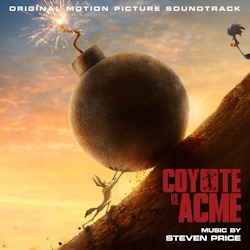 Original Review by Jonathan Broxton
Coyote vs. Acme is a live-action/animated comedy based on the classic Looney Tunes characters created by Chuck Jones and Michael Maltese, and more specifically on the 1990 New Yorker humor piece “Coyote v. Acme” by writer Ian Frazier. It is directed by Dave Green and stars Will Forte, Lana Condor, and John Cena, alongside numerous animated Looney Tunes characters. The story takes place in a world in which cartoon characters and human beings live side-by-side, and focuses on Wile E. Coyote, who has spent decades attempting to catch and eat the apparently uncatchable Road Runner. Unfortunately, virtually every rocket, catapult, explosive, giant magnet, pair of rocket-powered roller skates, or other ridiculous contraption he has purchased from the Acme Corporation has malfunctioned spectacularly, usually causing significant physical injury to himself. Eventually Wile E. decides that enough is enough and hires unsuccessful Albuquerque personal injury lawyer Kevin Avery (Forte) to sue Acme for selling him defective and dangerous products. Avery, assisted by his idealistic niece Paige (Condor), takes the case, only to find himself facing the vast resources of the Acme Corporation and its slick, arrogant attorney Buddy Crane (Cena), while gradually discovering evidence of a much larger corporate conspiracy.
Wile E. Coyote and the Road Runner are, of course, among the most iconic characters in the history of American animation. They first appeared together in director Chuck Jones’s 1949 short Fast and Furry-ous, and subsequently became fixtures of the Warner Bros. Looney Tunes and Merrie Melodies universe. The cartoons developed an almost ritualistic structure: Wile E. devises an absurdly elaborate scheme to catch the Road Runner, purchases some implausible piece of equipment from Acme, confidently puts his plan into motion, and then watches as the laws of physics apparently conspire to destroy him. The Road Runner, meanwhile, barely acknowledges his adversary beyond an occasional “meep-meep” before disappearing over the horizon.
One of the essential elements of the Coyote/Road Runner cartoons is that neither character requires conventional dialogue. Wile E. occasionally spoke when appearing opposite Bugs Bunny – usually introducing himself with supreme confidence as “Wile E. Coyote, Super Genius” – but in the Road Runner cartoons he communicated almost entirely through facial expressions, body language, and hand-held signs. Coyote vs. Acme wisely preserves this tradition, meaning that Forte’s Kevin Avery must literally become Wile E.’s voice in the courtroom. The concept also creates an unexpectedly emotional dimension to a character who, for more than seventy years, has essentially been defined by hunger, obsession, ingenuity, catastrophic failure, and an apparently limitless capacity to get back up and try again.
The Acme Corporation itself has been part of the joke almost from the beginning. Acme is Wile E.’s seemingly inexhaustible mail-order supplier, sending him everything from rockets and explosives to enormous springs and scientifically dubious animal traps. Frazier’s original New Yorker piece took this running gag to its logical conclusion by presenting Wile E.’s predicament in the language of an actual product-liability lawsuit, and the movie expands that brilliant central joke into a feature-length courtroom comedy and corporate satire.
 The extraordinary circumstances surrounding the release of Coyote vs. Acme became almost as famous as the film itself. Completed in 2022 at a reported cost of around $70 million, the movie was shelved by Warner Bros. Discovery in November 2023 despite reportedly strong test screenings, with the studio initially planning to take a tax write-off of roughly $30 million. The decision prompted an immediate backlash from filmmakers, animators, journalists, and fans, and just four days later Warner Bros. agreed to let the filmmakers shop the finished movie elsewhere. Various studios reportedly expressed interest, but Warner Bros. was said to be seeking between $75 million and $80 million and rejected the offers it received. Subsequent reporting also indicated that the senior executives behind the decision, including Warner Bros. Discovery CEO David Zaslav, had not seen the final version of the film, with Zaslav reportedly never having watched it at all. The irony was impossible to miss: a movie about a battered underdog taking on a huge corporation had itself been deemed disposable by one.
The filmmakers and fans nevertheless refused to let the movie disappear. Voice actor Eric Bauza became one of the most visible supporters of the #ReleaseCoyoteVsACME campaign, Will Forte publicly criticized the decision, and clips and images from the production spread widely online. Composer Steven Price also became an unexpected part of the campaign when he shared footage of a professional choir solemnly singing the Road Runner’s “meep-meep” sounds during the score sessions, believing audiences might never otherwise hear the music; the clip quickly went viral. Eventually, in 2025, independent distributor Ketchup Entertainment acquired the film from Warner Bros. for a reported $50 million and scheduled it for theatrical release in August 2026. When it finally opened in the United States on August 28, it exceeded expectations with approximately $15.5 million on its opening weekend. I personally thought the film was great – all the jokes landed, the clever references to numerous classic Road Runner cartoons created a terrific sense of nostalgia for viewers like me who grew up with them (I loved the fact that the law firm defending Wile E. was Avery, Jones & Maltese), and it had a surprisingly emotional kick during its finale.
As I noted above, the score for Coyote vs. Acme is by British composer Steven Price, whose increasingly eclectic career has encompassed such films as Attack the Block, The World’s End, Fury, Baby Driver, Last Night in Soho, Over the Moon, The Aeronauts, and The Running Man, as well as his outstanding work in documentary television on projects such as Our Planet and David Attenborough’s A Life on Our Planet. Price won the Academy Award for Best Original Score for Alfonso Cuarón’s Gravity in 2013, and has subsequently demonstrated an impressive ability to move between large-scale orchestral writing, electronics, sound design, comedy, drama, action, and intimate emotional material. Coyote vs. Acme required Price to do virtually all of those things at once.
Price recalled director Green pitching the movie to him as “a children’s legal thriller,” a description that immediately illustrates the peculiar tonal problem he faced: musically, he had to reconcile two fundamentally different worlds. The first is the traditional Looney Tunes approach associated with composers such as Carl Stalling and Milt Franklyn, in which almost every physical movement on screen can be reflected directly in the music. The classic Warner Bros. cartoon scores were extraordinarily sophisticated pieces of synchronization, moving rapidly between original orchestral writing, popular-song quotations, classical music, jazz, and exaggerated musical sound effects. When a character falls, the music falls with him; when something shoots into the air, the orchestra shoots upward too; every impact, raised eyebrow, tiptoe, explosion, and collapsing cliff can have its own musical response. Price explicitly embraced this technique, explaining that the Looney Tunes side of the score was designed to “hit every single detail” of the action, with the music tightly synchronized to what the audience sees.
The second musical world is more sincere and emotionally grounded, dealing with Kevin Avery’s personal journey, the courtroom drama, and especially the idea that audiences are finally being encouraged to feel real sympathy for Wile E. Coyote rather than simply laughing when an anvil lands on his head. Price went back to the original cartoons for inspiration, especially what he described as “all those guitars and hints at Americana,” but deliberately introduced a greater sense of fragility into the sound. The crucial difference is that Coyote vs. Acme treats Wile E. as an actual protagonist. After seventy years of watching him repeatedly obliterate himself in pursuit of the Road Runner, the movie asks us to consider the psychological consequences of all that failure. Price specifically identified an early scene in which Wile E. sits alone in his cave contemplating his countless disasters as one of his favorites because it reveals a side of the character that audiences have never really been allowed to see before.
This combination of manic cartoon synchronization and sincere feeling is the central idea behind the score. Price could not allow the courtroom material to become so dramatically serious that it killed the comedy, nor could he make everything relentlessly wacky without undermining the film’s heart. If the score became too serious, it diminished the humor; if it became too bouncy, it diminished the drama.
The most inspired element of the entire score, however, is undoubtedly Price’s use of the choir to represent the Road Runner’s seemingly permanent presence inside Wile E. Coyote’s increasingly tortured mind. Price recorded the London Voices choir at Abbey Road’s legendary Studio One and had them perform the Road Runner’s familiar “meep-meep” with the utmost musical seriousness. His idea was that Wile E. has spent so many years obsessively pursuing the Road Runner that the sound has essentially become psychological torture – as Price later called it, “this sound of insanity in Wile E.’s head.”
It is an absolutely perfect conceptual joke because Price refuses to treat it as a throwaway gag. The choir is not there simply because forty professional singers making Road Runner noises is inherently funny, although obviously it is; it represents Wile E.’s obsession, thereby becoming a legitimate thematic device. Price said that he became fascinated with the idea of a classical choir taking the whole thing completely seriously, eventually applying the concept to one of the most bombastic pieces in the classical repertoire: Tchaikovsky’s 1812 Overture.
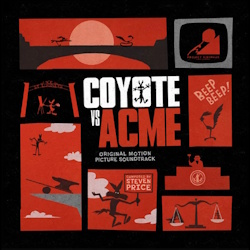 The album opens with “I Know Too Much,” which accompanies the film’s prologue involving an Acme scientist modeled after actor Peter Lorre, and immediately establishes the conspiracy element underpinning the story, while also embracing a colorful Carl Stalling everything-but-the-kitchen-sink approach to scoring. Some of the trilling snare-drum riffs remind me of classic 1990s James Horner scores such as Sneakers and The Pelican Brief, and there are also brief hints of what will eventually become the score’s rousing, undulating main theme.
“Acme” introduces the corporate side of the narrative with a sinister take on the score’s main theme, while the raucous orchestral action of “Fastas Hellus vs. Hungrious Carnivorus” – its title itself a wonderful reference to the mock-Latin species descriptions which accompanied the characters in several classic cartoons – brings the Coyote/Road Runner relationship directly into the foreground, using acoustic guitars and mariachi-adjacent textures to evoke the American Southwest, alongside the main theme, the meep-meep choir, and some interesting colors including a theremin. Subsequent cues such as “Thwarted Plans” and “The Sky Is Not the Limit” use similar orchestrations to further explore Wile E.’s familiar cycle of confidence, invention, disaster, and recovery, while also beginning to establish the more sympathetic side of the character. Parts of “Thwarted Plans” are quite moving, and the cue becomes very rich and grandiose by its conclusion.
The ‘courtroom drama’ portion of the score emerges through cues such as “We Wrote the Law,” “We Will Be Polite,” “You May Be Seated,” and “My Client Is Innocent,” and here Price leans more heavily into the second half of his musical concept. There is still a fundamental whimsicality to the score – this is, after all, a legal drama in which one of the litigants is a coyote who communicates with wooden signs – but Price treats the emotional stakes seriously, and offers more dramatic takes on the main theme, while also returning to the ‘conspiracy’ sound from the opening cue and its intricate rhythmic patterns, alongside moments of warmth. Acoustic guitars and the meep-meep choir continue to play an important role in the overall texture of these cues, but in a very different way. It’s clever how Price can take these absurd ideas and make them work.
There is a wonderfully sinister quality to the music in “What’s Up Doc?” that accompanies the protagonists’ shadowy encounter with a mysterious, white-gloved rabbit late at night at the Albuquerque Carrot Festival, and that leads into the terrific action cue “That Looks Unspeakably Dangerous,” which builds up a superb head of steam as it progresses. “We Were Having a Heart to Heart” continues the outstanding action writing, with Price making excellent use of the main theme, the meep-meep choir, and some Carl Stalling slapstick in the mix. The subsequent “Roadrunner Stew” then hammers home the extent of Wile E.’s obsession with a quite frantic appearance from the meep-meep choir.
“I Tawt I Taw,” which underscores a dramatic desert encounter between Tweety Bird and Buddy Crane, is strikingly intense, with the ‘conspiracy motif’ getting an especially vigorous workout, and the subsequent “This Calls for a Flashback” continues in a similar vein; the darting string writing, percussive drive, and intricate orchestrations are very impressive. “Bombs, Boulders and Pianos” is another bold action cue, again blending several of the different thematic ideas and motifs into something surprisingly powerful – the use of a harpsichord/cimbalom as part of the instrumental palette is a fun touch. The magnificently titled “Stop Stop Stop Stop Stop Stop Stop” is perhaps the best example of this side of the score. The way Price shifts between energetic cartoon writing, moments of stealth and intrigue, and more conventionally dramatic orchestral scoring without making the movie feel as though it is jumping between completely unrelated musical styles is very impressive; best of all, the meep-meep choir reaches its dramatic zenith here, sounding both deadly serious and unbelievably ridiculous at the same time.
The dramatic courtroom finale begins with “He Wakes Up With Purpose,” which offers a series of earnest variations on the main theme and the ‘conspiracy’ theme – including some augmented by a cool electric guitar tone – and continues through the tightly wound “Business Is Complex.” Foghorn Leghorn’s rousing speech in “A Little Pain for the Greater Good” blends the ‘conspiracy’ theme with some brass-heavy Americana and warm choral accents. The meep-meep choir sounds genuinely majestic in “Are You Coming Back” when Road Runner himself appears to testify in front of a congressional panel chaired by Senator Elmer Fudd – yes, you read that right – and then turns tender as Wile E.’s nemesis clearly demonstrates his warm feelings for his friend. The concluding pair, “They Trust You” and “The Sky’s the Limit,” are affectionately endearing, and present the main theme with a sense of warmth that fully conveys the idea that, as long as a coyote is chasing a roadrunner somewhere in the world, everything will be OK.
The album concludes with the minute-long burst of the “1812 Overture,” in which the grandiose seriousness associated with Tchaikovsky is deliberately undermined by the Road Runner choir. In a strange way, it also brings the musical history of Looney Tunes full circle. Carl Stalling routinely appropriated classical music, opera, popular songs, and the Warner Bros. song catalogue and transformed them into musical punchlines; Price is essentially doing the same thing eight decades later, except now he has the resources of Abbey Road and one of the world’s great choral ensembles at his disposal.
There is also something rather touching about the fact that this particular piece of music became part of the film’s real-life survival story. As noted earlier, when Warner Bros. announced that Coyote vs. Acme would be buried, Price shared footage of the choir online on the assumption that this might be the only opportunity anyone would ever have to hear it. Instead, the video became part of the material around which the film’s supporters rallied. A musical joke about Wile E. Coyote being psychologically incapable of giving up his pursuit of the Road Runner became associated with a campaign whose entire philosophy was, essentially, to refuse to give up.
That ultimately makes Coyote vs. Acme one of the more unusual projects of Steven Price’s career. The musical challenge of combining old-fashioned Stalling-style cartoon synchronization, southwestern Americana, legal-thriller seriousness, broad orchestral comedy, character emotion, and a choir singing “meep-meep” could easily have resulted in something incoherent, but the whole concept is rooted in a thoughtful understanding of Wile E. Coyote himself. The key to making the score work was not simply to write funny music for a Looney Tunes movie, but to take one of animation’s great comic losers seriously for perhaps the first time in his life.
Whether accompanying another complicated Acme disaster, lending real dramatic weight to Wile E.’s day in court, or allowing the London Voices to meep their way through Tchaikovsky, Price’s score clearly understands the central appeal of the character: no matter how many rockets explode beneath him, how many cliffs collapse, how many anvils land on his skull, or how many multinational corporations try to erase him from existence, Wile E. Coyote always gets back up to chase another day.
Buy the Coyote vs Acme soundtrack from the Movie Music UK Store
Track Listing:
- I Know Too Much (2:38)
- Acme (1:13)
- Fastas Hellus vs. Hungrious Carnivorus (3:15)
- Thwarted Plans (2:44)
- The Sky Is Not the Limit (3:13)
- We Wrote the Law (0:55)
- We Will Be Polite (2:42)
- You May Be Seated (1:15)
- My Client Is Innocent (2:52)
- What’s Up Doc? (2:16)
- That Looks Unspeakably Dangerous (3:32)
- It Is Really Super Easy to Lose (2:22)
- We Were Having a Heart to Heart (1:24)
- Roadrunner Stew (1:10)
- I Tawt I Taw (2:14)
- This Calls for a Flashback (3:17)
- Bombs, Boulders and Pianos (1:44)
- The Whole World Will Be Watching (1:48)
- You Wanted a Drumstick (2:36)
- Stop Stop Stop Stop Stop Stop Stop (3:16)
- He Wakes Up with Purpose (3:23)
- Business Is Complex (1:42)
- A Little Pain for the Greater Good (2:29)
- Are You Coming Back (2:34)
- They Trust You (1:58)
- The Sky’s the Limit (1:24)
- 1812 Overture (written by Pyotr Ilyich Tchaikovsky) (0:58)
WaterTower Music (2026)
Running Time: 60 minutes 54 seconds
Music composed by Steven Price. Conducted by Geoff Alexander. Orchestrations by David Butterworth. Recorded and mixed by John Barrett and Gareth Cousins. Edited by Connor Hughes and Bradley Farmer. Album produced by Steven Price.

Shop at the Movie Music UK Store

Member of the


