THE FALL OF A NATION – Victor Herbert
 GREATEST SCORES OF THE TWENTIETH CENTURY
Original Review by Craig Lysy
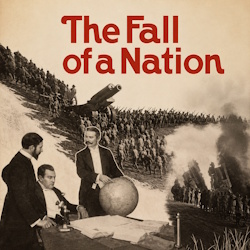
The 1916 film The Fall of a Nation was created for two primary reasons. Author Thomas Dixon wanted to capitalize on the popularity of his 1915 novel “The Birth of a Nation” with a sequel novel. Second, he wanted to urge Americans to prepare for World War I and warn against the dangers of pacifism. Dixon would manage production of the sequel using his own production company Dixon Studios with a budget of $31,000. He would also direct, and write the screenplay. For his cast, Lorraine Huling as Virginia Holland, Percy Standing as Charles Waldron/Prince Karl von Waldron, Arthur Shirley as John Vassar. Flora MacDonald as Angela Benda, Paul Willis as Billy, Phil Gastrock as Thomas and Clarence Geldart as General Arnold.
Dixon predicated “The Fall of a Nation” as a concerted attack on the pacifism of William Jennings Bryan, Henry Ford and the growing “America First” isolationist movement that germinated prior to of WWI. The film was his personal plea for American preparedness for war. In the film, America is unprepared for an attack by the “European Confederated Army” headed by Germany. This foreign army invades America and executes children and war veterans. Charles Waldron a tycoon, decides to collaborate with the invaders to preserve his fortune and so accepts a title as prince of a puppet government. However, America is saved by pro-war Congressman John Vassar and allies who raise a grass roots army to defeat the invaders. Suffragette Virginia Holland. Holland assists by forming the “Daughters of Jael,” who seduce and then kill the soldiers of the occupation force. Eventually the forces of American Liberty prevail and drives out the Europeans. The movie failed to resonate with audiences and was a huge commercial failure. Critical Reception was overwhelmingly negative with many criticizing it as boring and preachy compared to the first film.
Victor Herbert was a well-known Irish-American cellist, conductor, and prodigious composer of operettas, opera, incidental music for plays, and many concert pieces. Director Thomas Dixon wanted a prestigious, “household name” composer with star power attached to the project to give his movie, artistic credibility, and serious media attention. Herbert was a very traditional, proud, and patriotic American who was an ardent supporter of the preparedness movement – a political campaign demanding the U.S. build up its military to prepare for the growing threat of World War I. When Dixon offered the scoring assignment for his “anti-pacifism” tale about a fictional invasion of the United States, Herbert accepted as he saw both a professional opportunity of writing music for a full-length feature film, but also a project, which aligned with his own strong beliefs.
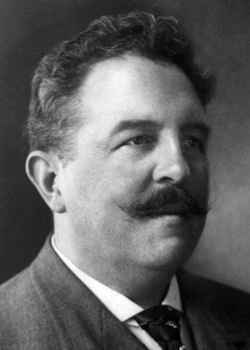 Herbert decided to approach the movie operatically, viewing it as a massive, through-composed musical narrative rather than a standard patchwork movie score. He composed his music to be played continuously, matching the tone, action, and emotion on screen from the opening title to the end credits. Musically, Herbert approach involved several techniques and methods. He decided to utilize Wagnerian leitmotifs (specific musical themes) to represent main characters, settings, and ideas. This he reasoned, would allow the audience to connect the music to what they were seeing. Herbert was well-known for his Broadway operettas, and true to form he relied on a lush, Romantic-era orchestral sound, which was highly melodic and emotional. Herbert also decided to compose contrastive music, because the film was a World War I era propaganda piece about a foreign invasion of the United States To that end, he embraced Americana and paired the American homeland scenes with proud, patriotic music, while the evil, invading European adversaries were imbued with a darker, malevolent, and militaristic theme. Lastly, as the film narrative shifted, so too did the musical narrative, with Herbert shifting his themes to express the changing emotional dynamics.
For his soundscape, Herbert recognized that the conflict was the nexus of the film’s narrative, and so grouped themes into two buckets; American vs European. Herbert represented the U.S. with earnest, noble, and confident melodies. He used traditional patriotic tunes and marches to reflect freedom and liberty. I discerned five themes. Foremost is the that of our hero, John Vasser, which I find unusual, and unexpected. Its construct is ABA, with the A Phrase presenting with regality borne by strings maestoso, with a countenance I would normally associate with European royalty. At 0:56 the B Phrase emerges and the royal bearing is shed, replaced by a more lyrical, graceful, and noble sensibility. We close at 1:32 with a reprise of the regal and maestoso A Phrase. For our heroine Virginia Holland, her theme offers the only feminine identity in the film and so I believe that to temporize his score and provide emotional counterpoint, Herbert composed an archetypal feminine theme, imbued with the societal mores of gender identity of the time. The music is sweet, graceful, elegant, and refined, borne by woodwinds teneri and strings delicato it imbues both her vulnerability, and her nobility.
The Love Theme supports the romance of our two hero’s, John and Virginia who make plans to marry after the war is won. Herbert graces us with a gorgeous, old world romanza borne warmly by sumptuous strings romantico interwoven with soft flute, oboe delicato, and harp adornment, which deepens the emotional weight, and adds warmth, and a tender intimacy underneath the main melody. True to form, Herbert concludes the piece in a stirring romantic flourish. The Daughters of Jael Theme support a female freedom fighter group who purposely flirt with the soldiers of the conquering army to get them to drop their guard, before assassinating them. Herbert ingeniously blends the romantic tension of the rebel women charming the invaders, expressed by violins seducenti, which dance perilously over the constant, underlying threat of discovery, expressed by foreboding, pulsing bass minacciosi. Violas and celli fill in and intensify the unsettling musical narrative. Uprising Theme serves as a collective identity for the freedom fighters. Its narrative is urgent, tense, sharp-edged and militant, propelled aggressively by rugged staccato rhythms, heavy horns and martial percussion. Lastly, the national anthem, The Star-Spangled Banner” offers a paean of victory.
The European Themes are for the most part highly militaristic. Herbert wrote a heavy, rumbling “Invaders’ March”, their anthem, in which he eschews the sensibilities of traditional military and patriotic marches, and instead propels the invasion with a diabolical marcia dall’inferno. He empowers the march with jagged strings, heavy, low register trombones and tubas, paired with sharp, aggressive staccato notes and heavy rhythmic snare and bass drum cadences. This cadence sonically mimics the rigid, mechanical, and unstoppable footfalls of an occupying military force. Lastly, Herbert crowned the march with operatic grandiosity, infusing it with dramatic orchestral swells and sweeping string lines that add a theatrical, larger-than-life scale to the onscreen invasion. Most interesting is that Herbert utilizes an interlude of benign woodwinds at 1:20, a technique later made famous by John Williams with his piccolo interlude during his immortal Imperial March. The Battle Theme is unleashed as a dissonant, syncopated, martial maelstrom; a chaotic and cacophonous agitato onslaught, which utilizes intense militare fanfare, rapid bugle calls, rolling snare drum percussion, replete with trilling woodwinds. We bear witness to a driving, unstoppable, symphonic tour de force crushing without mercy, out-manned and out-gunned Americans fighting for survival. As American resistance collapses, an ascendant European marcia della morte dominates, crushing all in its path. Lastly, there is the Occupier Waltz. The waltz makes only one appearance and Herbert fashions it as an emblem of European arrogance, and countenance of cultural superiority. It flows as a classic valzer elegante, but over time Herbert rewrites its very DNA as the competing Uprising Theme slowly twists, distorts, and ultimately subsumes it all together as the surprise attack erupts. The rest of the score offer discreet set-pieces, masterfully supportive of their secenes.
Because the film was a commercial disaster, it was largely disowned by Dixon, studios and preservationists. So, we have the unusual situation where the movie is considered a lost film, with no known complete prints of the footage surviving. As such, I cannot perform my usual practice of reviewing the score in film scene context, however, an alternative means presented itself. Also, although no script or screenplay exist, a narrative plot from the book, which is divided into three acts does. I accessed this to gain insight into the film’s narrative for each track, which gave me insight into what Herbert was supporting musically. So, I will instead review the score as a stand-alone listen, with the track titles and plot descriptors offering some insight to guide my assessment.
“Main Title” offers a powerful score highlight where Herbert masterfully sets the tone of the film. It opens ominously with repeating frightful and powerful declarations of the adversarial European Fanfare. The fanfare emotes with a grim, and oppressive descending contour, with lashing string and trilling woodwinds accents, which portends despair, doom and defeat. Herbert propels the dramatic call to arms with heavy and dour orchestral percussion, which offers a wake-up call to the audience, establishing a tone of immediate crisis and imminent wartime peril. At 1:16 the oppressive musical narrative yields to a crescendo dramatico, as the music surges ever upwards impassioned with emotional intensity, which closes, molto dramtico at 1:34, the opening credits. My research alludes to narrative script being part of the film, which informs the audience of the current political setting, and I surmise that begins at 1:37 after a 3 second interlude of silence. Dark, and foreboding low register woodwinds led by bassoon, and draped with string tresses of gloom, would seem to establish the dire circumstances an isolationist, and unprepared America now faces. At 2:33 a counter narrative of aggrieved strings joins, which intensifies the pathos of despair. At 3:11 the music supporting the narrative script surges with a reprise of the ominous, and repeating frightful and powerful declarations of the European Fanfare, which culminates grandissimo.
“The Heroine” I believe offers a theme for the heroine Virginia Holland, a suffragette recruited by the traitorous Prince Karl von Waldron to spearhead his new organization called “The Woman’s Imperial Legion of Honor”. She is duplicitous from the start, betrays him, and assumes the guise of a modern Joan of Arc who inspires a massive underground of rebellion. I believe Herbert composed an archetypal feminine theme, imbued with the societal mores of feminine gender identity of the time. The music is sweet, graceful, elegant, and refined, borne by woodwinds teneri and strings delicato it imbues both her vulnerability, and her nobility. It closes by transforming into a gorgeous and delightful danza felice. “The Hero” I believe offers a theme for Congressman John Vassar, the story’s hero, who was in many ways an American version of Winston Churchill. Like Churchill’s warnings about the Nazis, John repeatedly warns the country to arm itself against the militaristic European Confederacy. He tries unsuccessfully to pass a National Defense Bill to get the United States ready for war, but pacifists defeat his plan. Collaboration by tycoon Charles Waldron and the Germans leads to an invasion, which defeats and subjugates America. John leads the resistance and mobilizes in secret a hidden army. He then jointly leads the rebellion, alongside a group of brave women led by Virginia, and succeed in ousting the invaders and restoring American sovereignty. His theme emotes with strength, fortitude and regality borne nobly by strings maestoso, with a countenance I would normally associate with European royalty.
In “The Immigrants”, immigrants are depicted as an internal threat and a “fifth column” secretly armed by the corrupt Tycoon Waldron. Waldron, secretly collaborates with a German-led European Confederated Army using his vast wealth to covertly arm and organize America’s immigrant population, turning them into a hidden internal army. These immigrant sleeper agents capture National Guard armories and turn heavy artillery pieces directly onto unarmed American citizens. Their internal insurrection completely destabilizes domestic defense, allowing the invading European fleet to easily land, crush the remaining American forces, and conquer the country. I believe Herbert scored this track is scored with an old world, European sensibility, structured in ABA form. The A Phrase emotes with as a classic valzer gentile, which carries us like a leaf on a morning breeze. At 0:57 we shift to the B Phrase carried by carefree, bubbling woodwinds of delight, expressed as a danza felice. We conclude at 1:30 with a return to the A Phrase waltz. My impression is that Herbert offers a benign, and disarming musical narrative, which obfuscates their malignant secret mission. “The Hand Organ” reveals that the hand organ is a farewell gift given to the immigrant Tomasso Benda by his friend Pasquale. Tomasso gifts it to his wife Angela, who uses the hand organ and a performing monkey to entertain neighborhood children in the street. This street-level performance distracts onlookers, allowing Tomasso to secretly meet Waldron’s personal assistant Meyer, who attempts to recruit Tomasso into Waldron’s subversive, anti-American political plot. The music is again expressed in an ABA construct. For me, this composition is just delightful, with the A Phrase flowing with playful, carefree, joie de vivre. At 0:44 we shift into the lyrical B Phrase carried by bubbling gossamer woodwinds and buoyant strings felice. At 1:18 we resume the A Phrase, which brings us to a most satisfying conclusion.
“Rag” accompanies scenes of everyday American life and the grand “peace jubilee”, which is celebrated by clueless, foolish citizens. Herbert offers a festive, lighthearted piece animated by a Ragtime syncopated rhythm. For Ragtime, the melody is played off-beat and paired with a highly syncopated march-like baseline. There is a Berlinesque quality to the piece, which I greatly enjoyed. Again, I believe Herbert speaks to the clueless citizens, tone-deaf to the sinister changes occurring around them. “Invader’s March” offers a powerful score highlight, where Herbert unleashes his orchestra with ferocious militarism. I believe the scene provides a striking, frightening visual of the European Confederated Army taking control of American streets, underscoring the brutality of the occupation forces and the loss of American sovereignty. This invasion serves to catalyze the Vasser and Holland resistance movements. Herbert eschews the sensibilities of traditional military and patriotic marches, and instead propels the invasion with a diabolical marcia dall’inferno. Following victory, Herbert crowns the march with operatic grandiosity, infusing it with dramatic orchestral swells and sweeping string lines that add a theatrical, larger-than-life scale to the onscreen invasion.
“Battle Music” supports the actual invasion and battle between the European invasion army and their immigrant allies, and American forces. Herbert unleashes a dissonant, syncopated, martial maelstrom, a chaotic and cacophonous agitato onslaught, which utilizes intense horns militare fanfare, rapid bugle calls, rolling snare drum percussion, replete with trilling woodwinds. We bear witness to a driving, unstoppable, symphonic tour de force crushing without mercy, out-manned and out-gunned Americans fighting for survival. At 1:48 American resistance collapses and an ascendant European marcia della morte dominates, crushing all in its path. “After The Battle” offers a poignant score highlight. It speaks to the aftermath of America’s defeat. A tiny Italian American boy searches among the carnage for his father, while a young girl hides under a dining table in terror. Herbert offers a slow-moving, mournful, solemn, and deeply melancholic piece with funereal auras, which offers a lament, that captures the tragic landscape of a battlefield littered with casualties. The musical narrative is borne by strings affanato, abyssal woodwinds and horns, pizzicato strings, and ethereal harp adornment. At 1:24 Taps joins to offer a reverential lament for the fallen. At 2:14 a glimmer of hope arises like a sunbeam piercing a cloud, yet at 2:47 a powerful declamation of the European Fanfare thunders, affirming the descent of the world into shadow.
“Domestic Scene” supports the humiliation of pacifist politician Plato Barker, who meets the brutal foreign invaders, and greets them with; “pink tea words of love and peace”. The invaders mock his naivety and force him to peel potatoes. This scene contributes to the film’s narrative by mocking pacifism, and offering a direct, satirical attack on real-life peace advocates of the era like William Jennings Bryan. Lastly, the film’s narrative here highlights the total loss of American dignity, showing that without military preparation, even national leaders are reduced to doing manual labor for the enemy. Once again, Herbert offers musical counterpoint gracing us with a gorgeous valzer elegante. The musical eloquence, gentility, and free-flowing rhythms would see to bely the humiliation and degradation occurring onscreen. “Entracte – Love Theme” offers a molto romantico score highlight, and the audience a rest break. Herbert offers a very dramatic, passionate piece in the finest traditions of the Late-Romantic Era. The theme supports the romance of our two hero’s John and Virginia who make plans to marry after the war is won. We open with a dramatic declaration, from which arises an ascending accelerando appassionato, that crests with a woodwind delicato interlude. This pattern is repeated with the woodwinds, draped with harp glissandi, ushering in at 0:41, The Love Theme. Herbert graces us with a gorgeous, old world romanza borne warmly by sumptuous strings romantico interwoven with soft flute and oboe delicato, and harp adornment, which deepens the emotional weight, and adds warmth, and a tender intimacy underneath the main melody. True to form, Herbert concludes the piece in a stirring romantic flourish.
“Death of the Kid” offers a score highlight full of melodramatic grief. It supports a young boy who is shot and killed by foreign invading soldiers. The killing is a catalyst, which elicits the mourning townspeople to transform their grief into fiery anger, leading them into an armed uprising against the occupying forces. Herbert once again embraces the emotional sensibilities of late-Romantic symphonic school with somber and evocative writing, which tugs at the audience’s heartstrings. He offers a tragic, yet beautiful, lamento del canone by mournful violins and bass, which tie the child’s tragic death into the broader story of the nation’s suffering. “Love and Danger” reveals that America is occupied and underground rebel forces are planning a military overthrow. Female resistance fighters known as the “Daughters of Jael”, are actively flirting with the soldiers of the conquering army to get them to drop their guard, before assassinating them. Herbert ingeniously blends the romantic tension of the rebel women charming the invaders, expressed by violins seducenti, which dance perilously over the constant, underlying threat of discovery, expressed by foreboding, pulsing bass minacciosi. Violas and celli fill in and intensify the unsettling musical narrative.
“The Uprising” offers a masterpiece composition, which is perfect in its conception, and execution. Herbert creates two identities, which contest musically. The occupiers and their collaborators are supported by a valzer elegante, which animates their lavish ball. Herbert infuses this waltz with decadence, a carefree detachment, and an aristocratic countenance. Juxtaposed, is the musical identity of the freedom fighters, which is urgent, tense, sharp-edged and militant, propelled aggressively by rugged staccato rhythms, heavy horns and martial percussion. We open with a bravado Freedom Fighter Theme, which yields at 1:17 to the Valzer elegante of the occupiers. At 1:46 we shift back to the aggressive and strengthening Freedom Fighter Theme. When we return to the Occupier waltz at 2:47 we discern that Herbert is rewriting its musical DNA with that of the Freedom Fighters, which results in it becoming twisted, and distorted. When we shift back to the Freedom Fighters at 3:42, we find that it has co-opted the Waltz, and subsumed it into a new aggressive identity, which will propel the defeat and expulsion of the occupiers. “Victory Parade” accompanies the immediate aftermath of this successful uprising as American freedom fighters celebrate victory. Herbert empowers the celebration with proud fanfare, which usher in a solemn, slow-paced, and patriotic, marcia eroico rendering of John’s Theme. At 0:55 we conclude the triumph of American democracy with a reverential exposition of the Star-Spangled Banner.
 Victor Herbert’s score for the film The Fall of a Nation is a major milestone in the history of American cinema. Before Herbert’s 1916 score, it was standard practice for theaters to use a “compilation score”, comprised of a mix of popular songs and classical music chosen by local pianists to fit a scene. Unlike Joseph Carl Briel’s score to “The Birth of a Nation” a year earlier, which was a compilation of original, classical and folk music, Herbert did not rely on pre-existing classical music or public-domain standards. As such, he created a new paradigm by writing over two hours of original, cohesive, leitmotif music meant for a specific movie. This audacious act was a seminal event of American cinema, setting a precedent of composing a custom and original symphonic score with musical storytelling to support, and enhance a film.
Folks, Herbert intuitively understood the film was a propaganda film intended to rouse American patriotism against the pacifist, isolationist “America First” movement of the time. The good guys, bad guys, and battlelines were clearly demarcated and he delivered the goods with an exceptionally conceived and executed score empowered by a multiplicity of themes, which clearly defined good and evil, offered emotional storytelling, and enhanced the film in every way. I highly recommend the purchase of the album as it is one of film score art’s Holy Grails.
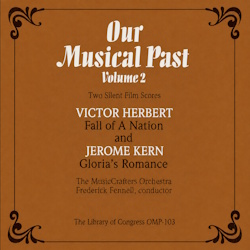
Editor’s note: This review is of the Library of Congress recording of the score for The Fall of a Nation. Released in 1986, this compact disc is a modern, high-fidelity digital recording that captures the music with crisp, clear, and professional stereo sound quality. The album sees Herbert’s score paired with Jerome Kern’s score for another lost silent film from the same period, Gloria’s Romance.
For those of you unfamiliar with the score, I have embedded a YouTube link to the Entr’acte – Love Theme: https://www.youtube.com/watch?v=j-SCG0pINW0&list=RDj-SCG0pINW0&start_radio=1
Track Listing:
- Main Title (3:50)
- The Heroine (2:00)
- The Hero (2:10)
- The Immigrants (2:00)
- The Hand Organ (1:50)
- Domestic Scene (1:25)
- Rag (1:05)
- Invaders March (2:25)
- Battle Music (2:23)
- After The Battle (3:05)
- Entracte – The Love Theme (2:35)
- Death Of The Kid (2:50)
- Love And Danger (1:25)
- The Uprising (5:13)
- Victory Parade (2:10)
Running time: 36 minutes 26 seconds
The Library of Congress OMP-103 (1916/1986)
Music composed by Victor Herbert. Conducted by Frederick Fennell. Performed by The MusicCrafters Orchestra. Orchestrations by Victor Herbert. Score produced by Victor Herbert. Album produced by XXXX.

Shop at the Movie Music UK Store

Member of the

 MOVIE MUSIC UK