Archive
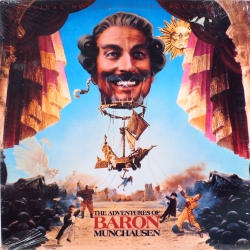
THE ADVENTURES OF BARON MUNCHAUSEN – Michael Kamen
 THROWBACK THIRTY
Original Review by Jonathan Broxton
The fictional German aristocrat Baron Hieronymus Karl Friedrich Freiherr von Munchausen was created in 1785 as a conduit for author Rudolf-Erich Raspe’s fanciful tales of absurdity and social and political satire. Munchausen had been a familiar name in literary circles for more than 200 years before writer-director and former Monty Python member Terry Gilliam embarked on making a film based on the ‘life’ of the Baron. A lavish and almost cartoonishly flamboyant adventure, the film stars John Neville as the elderly Baron, who interrupts a play based on his own life in order to correct the details. Munchausen regales the rapt audience with recollections of his astonishing life, during which he fought in a war against the Turks, traveled to the moon in a hot air balloon, was swallowed by an enormous sea creature, and much more besides – but by the end of the story many of the audience members are questioning whether the far-fetched tales really have any basis in reality. The film co-starred Eric Idle, Sarah Polley, Oliver Reed, Uma Thurman, Jonathan Pryce, and Robin Williams, and was the third of Gilliam’s Imagination trilogy of films that also included Time Bandits and Brazil, and which were intended to explore the ‘battle between fantasy and what people perceive as reality’. Unfortunately the film was a commercial disaster, grossing less than $10 million at the box office, although its visual elements were praised and received Academy Award nominations for Art Direction, Costume Design, Visual Effects, and Makeup. Read more…
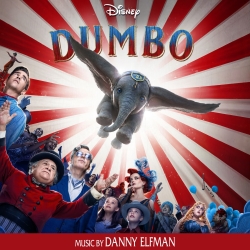
DUMBO – Danny Elfman
 Original Review by Jonathan Broxton
The recent Disney trend of making live-action versions of their animated classics continues with Dumbo, a re-imagined version of their 1941 film about a baby elephant with ears so big that he can use them to fly. The original Dumbo was short – just over an hour – and so director Tim Burton and screenwriter Ehren Kruger had to flesh out some additional material to make it feature length. The basic core of the story is the same – a young baby elephant is born in a traveling circus and is ridiculed by crowds for his enormous ears, until he wins over audiences with his ability to fly – but it adds a great deal of depth and back story to the supporting human characters, including the good-hearted elephant keeper Holt (Colin Farrell), circus owner Medici (Danny De Vito), trapeze artist Colette (Eva Green), and unscrupulous businessman Vandevere (Michael Keaton), who wants to take over Medici’s circus for his own nefarious purposes. Interestingly, the new film excises several of the original film’s plot points entirely, including Dumbo’s relationship with the anthropomorphic ringmaster mouse Timothy, and Dumbo’s encounter with the ‘Jim crows,’ although the latter is probably a good thing due to the overtly racist overtones of those characters. Read more…
TITANIC – James Horner
 GREATEST SCORES OF THE TWENTIETH CENTURY
Original Review by Craig Lysy
James Cameron had long been fascinated with shipwrecks and conceived to write a love story set on the greatest shipwreck of all time – the RMS Titanic. He believed that telling the story of the sinking of the great ship in and of itself was insufficient, so the addition of a love story as well as an intimate exploration of the lives of the people who died would add a compelling narrative to the tale. He pitched his story to 20th Century Fox executives as ‘Romeo and Juliet on the Titanic’. They bought his idea given his resume of directorial success, as they wanted to secure him for future projects. He was provided with the largest budget ever for a film at that time – $200 million – and took it upon himself to do what had never been done before; to produce, direct, write and edit a film. He brought in a fine cast to support his vision, including Leonardo Di Caprio as Jack Dawson, Kate Winslet as Rose DeWitt Bukater, Billy Zane as Cal Hockley, Frances Fisher as Ruth DeWitt Bukater, Gloria Stuart as the older Rose, Kathy Bates as the Unsinkable Margaret “Molly” Brown, Victor Garber as Thomas Andrews, Bill Paxton as Brock Lovett, David Warner as Spicer Lovejoy, and Danny Nucci as Fabrizio De Rossi. Read more…
FAREWELL TO THE KING – Basil Poledouris
 THROWBACK THIRTY
Original Review by Jonathan Broxton
Farewell to the King is an action-adventure-drama written and directed by John Milius, adapted from the 1969 novel L’Adieu au Roi by Pierre Schoendoerffer. The film stars Nick Nolte as Learoyd, an American soldier during World War II, who escapes from a Japanese firing squad and flees into the jungles of Borneo. Over time, Learoyd is adopted into a tribe of Dayaks, the original inhabitants of the island, and becomes their leader, finding peace and tranquility in his new, simple life. That life is shattered, however, when British soldiers led by Captain Fairbourne (Nigel Havers) and Colonel Ferguson (James Fox), approach the tribe and try to convince Learoyd to re-join the war against the Japanese. When he refuses to do so, Learoyd quickly finds himself having to fight to protect his new tribe. The film, which shares tonal and story similarities with films ranging from The Man Who Would Be King, Heart of Darkness, and Dances With Wolves, to Avatar, is virtually forgotten today. Behind-the-scenes in-fighting between Milius and the studio led to the film staggering into cinemas in the spring of 1989, having been heavily re-edited against the director’s wishes. It was not a success, either critically or financially, and would likely not be on anyone’s radar today were it not for the score, by Basil Poledouris. Read more…
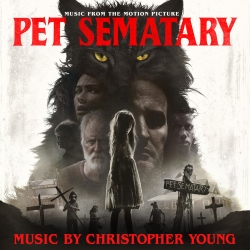
PET SEMATARY – Christopher Young
 Original Review by Jonathan Broxton
For many years, from the late 1970s through to the end of the 1990s, cinematic adaptations of novels by Stephen King were everywhere. Director Brian de Palma started it all with Carrie in 1976, and over the course of the next 20 years or so, film after film and TV series after TV series came out. Titles like Salem’s Lot, The Shining, Cujo, The Dead Zone, Christine, Children of the Corn, Stand By Me, The Running Man, It, Misery, The Dark Half, Needful Things, The Tommyknockers, The Stand, The Shawshank Redemption, Dolores Claiborne, The Green Mile, and many others, have received critical acclaim, box office success, cult status, or all three. Such is their enduring popularity that we are now in the realm where certain titles are on their second or third version, and this is the case with Pet Sematary. It is based on King’s 1983 novel, and was originally adapted for the screen in 1989 by director Mary Lambert. The film tells the story of the Creed family, who move to Maine when the father, Louis, accepts a job as the doctor at a local school. When Church, the family cat, is run over on the road outside their home, Louis and his elderly neighbor Jud Crandall take the body to a ‘pet cemetery’ deep in the woods by the Creed property, and bury it; the following day, the cat returns, apparently having been supernaturally resurrected. However, Church is now vicious and aggressive, whereas before he was sweet-natured and lovable. Some months later, Louis’s daughter Ellie is killed in a terrible traffic accident on the same road; distraught, and despite Jud’s dire warnings, Louis takes her body to the pet cemetery too… with naturally horrific results. The film stars Jason Clarke, John Lithgow, Amy Seimetz, and Jeté Laurence, and is directed by Dennis Widmyer and Kevin Kolsch. Read more…
CRIMSON TIDE – Hans Zimmer
 GREATEST SCORES OF THE TWENTIETH CENTURY
Original Review by Craig Lysy
Producers Don Simpson and Jerry Bruckheimer happen to view a documentary film titled Submarines: Sharks of Steel, and became inspired to bring a submarine drama to the big screen. The initial screenplay told the story of a Trident submarine crew attempting to stop the ship’s computer from independently launching nuclear missiles and starting World War III. When they pitched their idea to the Department of the Navy they characterized the movie as “The Hunt for Red October meets 2001: A Space Odyssey.” They obtained permission from the U.S. Navy for the creative team to perform research by sailing aboard the Trident missile submarine USS Florida from Bangor, Washington. A few months later they submitted a revised script by Michael Schiffer in which an Executive Officer leads a mutiny against the Captain to prevent a nuclear missile launch. Well, the Navy balked against this assault on its traditions and refused to cooperate further. Undeterred, the production team secured assistance from the French navy to support the film. Jerry Bruckheimer and Don Simpson would produce the film, with Tony Scott tasked with directing. A fine cast was brought in, including Gene Hackman as the imperious Captain Frank Ramsey, Denzel Washington as Executive Officer (XO) Ron Hunter, George Dzundza as Chief of Boat (COB) Walters, Matt Craven as Communications Officer Roy Zimmer, Viggo Mortensen as Weapons Officer Peter Ince, and James Gandolfini as Supplies Officer. Read more…
SHAZAM – Benjamin Wallfisch
 Original Review by Jonathan Broxton
In the race to make a movie about every single comic book character in history, DC have lagged behind Marvel in terms of mining their back catalogue in the search for box office gold. Whereas Marvel have unearthed hitherto little-known gems like the Guardians of the Galaxy, Ant-Man, and Black Panther to sit alongside Spider-Man, Captain America, the Hulk, and Iron Man, the folks over at DC have tended to build everything around their ‘big three’ – Superman, Batman, and Wonder Woman. However, having suffered lackluster critical reviews for their most recent efforts at putting these luminary characters on the silver screen, the producers have now started to dip into their archives in search of characters to explore. The latest of these is Shazam, written by Henry Gayden and Darren Lemke, and directed by horror movie veteran David F. Sandberg. The film stars Asher Angel as Billy Batson, a 14-year-old orphan kid with a ‘pure heart’ who is chosen by an ancient wizard to become a super hero. When he says the wizard’s name – Shazam! – Billy is magically transformed into an adult super hero (Zachary Levi), and together with his best friend Freddy (Jack Dylan Grazer), Billy sets about discovering his powers. However, this attracts the attention of the evil Dr Thaddeus Sivana (Mark Strong), who has spent his entire life trying to discover the secret of Shazam’s power, and who has harnessed the physical manifestations of the seven deadly sins in order to do so. Read more…
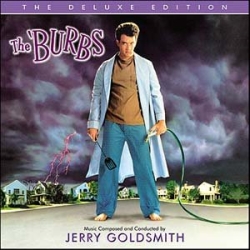
THE BURBS – Jerry Goldsmith
 THROWBACK THIRTY
Original Review by Jonathan Broxton
Director Joe Dante has made a career of peeking behind the white picket fences of suburban America and making films about the mysteries and horrors he finds there. In The Howling in 1978 he found werewolves. In Gremlins in 1984 he found an entire species of murderous little monsters. In 1989’s The Burbs, however, what Dante found was that, sometimes, the monsters are us. It’s a comedy-horror that explores the concept of the ‘nosy neighbor,’ and stars Tom Hanks as Ray Peterson, who lives on a quiet Norman Rockwell cul-de-sac with his wife Carol (Carrie Fisher), and spends time goofing off with his best friends Art (Rick Ducommun), who lives next door, and Mark (Bruce Dern), a slightly eccentric military veteran. Ray becomes obsessed with the sinister-seeming Klopek family when they move into a recently-vacated home on their block; convinced that the Klopeks are murderers, Ray and his buddies begin to stalk the family, determined to uncover the truth. The Burbs is a clever, subversive film that blends broad comedy hi-jinks with some more meaningful satire, something which also translated into Jerry Goldsmith’s original score. Read more…
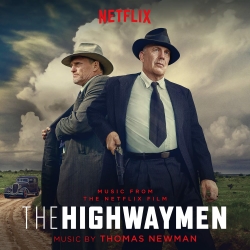
THE HIGHWAYMEN – Thomas Newman
 Original Review by Jonathan Broxton
Bonnie Parker and Clyde Darrow were two of the most notorious American criminals of the 20th century, bank robbers and murderers who during their lifetimes attained an unlikely level of celebrity and public affection. Their most successful crime spree came at the peak of the Great Depression, in the early 1930s, and as lurid tales of their exploits did the rounds in the pulp press, they quickly became famous as modern-day outlaws, striking back at the ‘system’ that failed so many others. Their story came to an end in a hail of bullets on a rural Louisiana back road in May 1934, when they were shot and killed by a posse of Texas Rangers who had been tracking them for months. Their exploits were famously chronicled on film in 1967 in Arthur Penn’s Bonnie and Clyde; this new film from director John Lee Hancock takes a slightly different perspective in that it is told from the point of view of Frank Hamer and Maney Gault, the two Texas Rangers who led the investigation and eventually made the decision to open fire on the crooks. The film stars Kevin Costner and Woody Harrelson as Hamer and Gault, and has a supporting cast that includes Kathy Bates, John Carroll Lynch, Kim Dickens, Thomas Mann, and William Sadler. Read more…
BRAVEHEART – James Horner
 GREATEST SCORES OF THE TWENTIETH CENTURY
Original Review by Craig Lysy
During a visit to Scotland screenwriter Randall Wallace was inspired by the lore of the Scottish patriot William Wallace. He conceived and wrote a screenplay for a grand historical epic, which would bring this heroic figure to the big screen. MGM producer Alan Ladd Jr. realized he had a winner and purchased the script, which he shared with Mel Gibson. Gibson initially passed on the project, but eventually relented, agreeing to direct, however he declined to star as he felt he was too old at age 40 to play the part of Wallace, who was in his late twenties. Financing constraints led to a reversal as Paramount Studios would only agree to finance the film if he starred in it. Gibson agreed to take on the titular role and brought in a fine cast to support, which included Sophie Marceau as Princess Isabelle, Angus MacFadyen as Robert the Bruce, Patrick McGoohan as King Edward I, Catherine McCormack as Murron, Brendan Gleeson as Hamish, Peter Hanly as Prince Edward, and Ian Bannen as Robert the Elder. Gibson’s final script took significant license with historical accuracy, so as to make the story more intimate, dramatic and grand. The film is set in Scotland the year 1280, when the country is occupied by the forces of English King Edward I, and it tells the story of the rise and fall of the legendary Scottish patriot and freedom fighter. Read more…
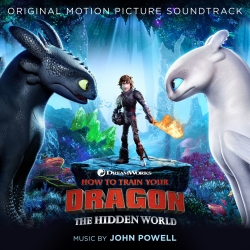
HOW TO TRAIN YOUR DRAGON: THE HIDDEN WORLD – John Powell
 Original Review by Jonathan Broxton
Prior to its premiere in 2010, I had never heard of How to Train Your Dragon. I knew nothing of Cressida Cowell’s book series, had pretty much zero interest in watching the film (I assumed it was a silly thing for children), and I certainly had no expectations about John Powell’s score. I thought it might be a fun diversion – Powell had scored several excellent animated films before it, including Antz, Chicken Run, Shrek, Kung-Fu Panda, and several entries in the Ice Age series – but beyond that, my anticipation levels were low. Flash forward nine years and How to Train Your Dragon is a beloved animated franchise boasting not only a trilogy of films but a slew of straight-to-DVD shorts, a television series, video games, and more. The three Dragons films have grossed a combined $1.5 billion worldwide, both the first two films were nominated for the Oscar for Best Animated Feature, and Powell’s scores are now regarded as some of the finest film music written anywhere in the world over the last decade. Read more…
US – Michael Abels
 Original Review by Jonathan Broxton
Us is the sophomore effort of writer-director Jordan Peele, who took the box office by storm, and won critical praise, for his debut film Get Out in 2017. Both films are nominally horror films, with Us being more traditionally scary than Get Out was, but both films also delve much deeper into a whole host of political and sociological issues that most genre films don’t touch. Us provides scares a-plenty, but also takes its time to offer ruminations on identity, childhood trauma, and the overwhelming fear of ‘outsiders’ that currently permeates contemporary American culture. Oscar-winner Lupita Nyongo stars as Adelaide, who as a child had a horrifying experience in a funhouse by the Santa Cruz seaside boardwalk that left her psychologically scarred; now grown up, she reluctantly returns to the same resort with her husband Gabe (Winston Duke) and pre-teen children Zoe and Jason (Shahadi Wright Joseph and Evan Alex). Adelaide and Gabe are a normal, middle-class, affluent all-American family, and after spending the day on the beach with their friends (Elisabeth Moss and Tim Heidecker), they retire to their beach house. However, that night, they are assailed by four mysterious strangers clad in red jumpsuits, each of whom look like almost perfect mirror images of Adelaide and her family. What these doppelgängers want, who they are, and where they come from, is soon revealed to be literal stuff of nightmares. Read more…
APOLLO 13 – James Horner
 GREATEST SCORES OF THE TWENTIETH CENTURY
Original Review by Craig Lysy
Following his retirement from NASA in 1973, Apollo 13 astronaut James Lovell collaborated with journalist Jeffrey Kluger to recount the riveting tale of his failed moon landing, titled ‘Lost Moon: The Perilous Voyage of Apollo 13’. In 1993 director Ron Howard and producer Brian Grazer of Imagine Entertainment received a pre-publication copy of the novel and immediately realized that this story offered classic American heroism, which needed to be brought to the big screen. They secured the film rights and, in partnership with Universal Pictures, undertook the project with a modest budget of $52 million. Howard secured a stellar cast, which included NASA fan Tom Hanks as Commander Jim Lovell, Kathleen Quinlan as his wife Marilyn, Kevin Bacon and Bill Paxton as fellow astronauts Jack Swigert and Fred Haise, Gary Sinise as Ken Mattingly, and Ed Harris as NASA Flight Director Gene Kranz. The story retells the harrowing tale of the Apollo 13 mission, which was intended to bring a third astronaut team to the moon. Read more…
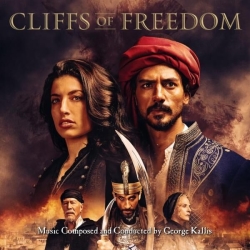
CLIFFS OF FREEDOM – George Kallis
 Original Review by Jonathan Broxton
The Romeo and Juliet story has been told over and over again in cinema; Cliffs of Freedom is the latest re-working of that classic tale of star-crossed lovers, but instead of Montagues and Capulets, we have Greeks and Turks facing off in a sweeping historical epic drama of love and conflict. The film is set in 1821 during the Greek War for Independence against the Ottoman Empire, and focuses on Anna Christina, a Greek peasant girl who is in love with Tariq, a colonel in the Turkish army whose career is on the rise even as he is unnerved by his country’s violent response to the Greek nationalistic uprising. As tensions mount and political divisions lead to all-out war, Anna Christina and Tariq struggle to keep their relationship alive. The film is directed by Van Ling, a special effects genius making his feature debut, and is based on a popular novel by Marianne Metropoulos; it stars Tania Raymonde and Jan Uddin as the central pair, and has a surprisingly rich supporting cast including Christopher Plummer, Patti LuPone, Billy Zane, Lance Henriksen, and Raza Jaffrey. Unfortunately the film came and went from cinemas like lightning (despite its trailer playing every night for what felt like weeks during the NBC late night news broadcast in Los Angeles), meaning that the film’s lasting legacy might be its score, by George Kallis. Read more…
THE FLY II – Christopher Young
 THROWBACK THIRTY
Original Review by Jonathan Broxton
David Cronenberg’s horror classic The Fly was such a critical and commercial success in 1986 that 20th Century Fox and Brooksfilms green-lit a sequel almost immediately. The Fly II was written by Frank Darabont and Mick Garris, and directed by Chris Walas, who supervised the first film’s makeup effects, and won an Academy Award for his grotesque efforts. The film is set several months after the events of the first one, and begins when Veronica (Geena Davis’s character from the first movie) gives birth to a baby, the son of Seth Brundle (Jeff Goldblum’s character). The baby was conceived after Seth began mutating into a fly, and Veronica dies in childbirth, but the infant – who is named Martin – initially appears to be healthy. Martin grows up in a laboratory owned by Anton Bartok (Lee Richardson), the scientist-businessmen who funded Seth’s research, but before long it becomes clear that Martin is different – he possesses a genius-level intellect, has incredible reflexes, and grows faster than a normal human, so much so that by the age of five he has the mental capacity of a 25-year-old man, and looks like Eric Stoltz. Eventually, Martin begins to question his life and existence, and slowly begins to learn some unnerving truths about Bartok, especially when he starts to exhibit some of the same fly-related symptoms as his father… Read more…

Shop at the Movie Music UK Store

Member of the

 MOVIE MUSIC UK