THE STRAIGHT STORY – Angelo Badalamenti
 Original Review by Jonathan Broxton
Having regard to a track record that includes such brilliantly off-the-wall films as Eraserhead, Blue Velvet, Wild At Heart and the Twin Peaks TV series, one would have never expected director David Lynch to craft such a beautiful, poignant, heart-warming movie as The Straight Story. Although the title is something of a pun, and although Lynch has never made one before, this is a completely straightforward story about a man named Straight, who leaves his slightly backward daughter at home in Iowa and travels across the American Midwest to Wisconsin on a converted lawn mower to see his estranged brother before one of them dies. Read more…
ARISTOCRATS – Mark Thomas
 Original Review by Jonathan Broxton
The BBC have always been good at costume dramas. Whether it be Jane Austen or Emily Brontë or Charles Dickens or William Shakespeare, the Brits lead the way in showing the world how to lace up a corset, adopt a regal tone and keep a respectful distance from your potential suitors. The BBC are also good at television music. In recent years, established composers such as Carl Davis, Geoffrey Burgon and Jim Parker have rubbed shoulders with talented new names such Richard G. Mitchell, Murray Gold and Julian Nott in composing some of the finest television music around. In my opinion, Aristocrats marks the absolute pinnacle in BBC television music, and is by far the best score to emerge from Auntie’s vaults in years. Read more…
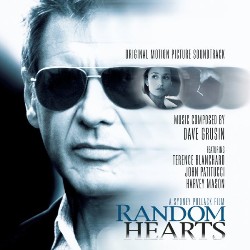
RANDOM HEARTS – Dave Grusin
 Original Review by Jonathan Broxton
Despite having written some truly lovely orchestral scores in his career, notably Havana and On Golden Pond, Dave Grusin’s first love is and always will be jazz. In the liner notes for this release of his score for Random Hearts, Grusin muses that “no-one loves romantic music more than Sidney Pollack”, but it was felt that on this project he was “looking for something a little more lean and stark” than on their other nine collaborations. A consummate craftsman, Grusin responded with an intriguing, engaging jazz score. Random Hearts stars Harrison Ford and Kristin Scott-Thomas, two secure professional people in fulfilling relationships whose lives are torn apart when their respective partners are killed in the same plane crash. It soon transpires that, unbeknown to Ford and Thomas, his wife and her husband were having an affair with each other, a fact which, when combined with the sense of grief and betrayal felt by the surviving spouses, gradually draws them together. Part tragedy, part melodrama, part romance, Random Hearts sounds great on paper but, unfortunately, failed to set the box office alight, instead ending up as Harrison Ford’s first major flop in over a decade. Read more…
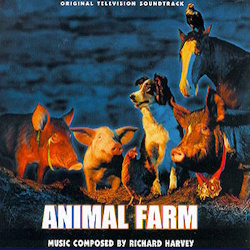
ANIMAL FARM – Richard Harvey
 Original Review by Jonathan Broxton
I love it when a score comes out of nowhere, bowls you over with its brilliance, and restores your faith in the genre as a whole. Animal Farm, the latest movie in the continually excellent Hallmark Hall of Fame series for American TV, has done just that, by emerging from the shadow of more popular and well-regarded works such as Merlin, Durango, Moby Dick and the Emmy-winning Alice In Wonderland to take its place as the series’ musical pinnacle. Animal Farm is based, of course, on the classic George Orwell novel, which candidly illustrates the corruptive nature of absolute power and charts the terrible rise of fascism in the microcosm of a farmyard barn. The story, for those who are unfamiliar with the tale, follows a restless pig named Napoleon who, unsatisfied with the current balance of power between the animals, mounts a kind of coup, overthrowing what he sees to be the unfairness of the regime. However, it soon becomes apparent that, having had the responsibility passed on to him, Napoleon is no more objective than those he removed from office. With a voice cast including Kelsey Grammar, Ian Holm, Patrick Stewart, Julia Ormond, Pete Postlethwaite, Peter Ustinov and Paul Scofield bringing Jim Henson’s eye-popping animatronic livestock to life, this is arguably the best movie of the entire series to date. Read more…
PLUNKETT & MACLEANE – Craig Armstrong
 Original Review by Jonathan Broxton
The phenomenal success of the film William Shakespeare’s Romeo + Juliet was not only responsible for making bonafide movie stars out of its leading players, Leonardo Di Caprio and Clare Danes – it also thrust the name of Scottish composer Craig Armstrong into the soundtrack limelight. Armstrong, who won a BAFTA Award for his work with Nellee Hooper and Marius De Vreis on that film, is an interesting and somewhat unconventional writer. He doggedly refuses to be labeled either as an orchestral or electronic specialist, and has proven that he is adept at creating both modern soundscapes, as in Romeo + Juliet and his other recent work, Best Laid Plans, as well as “proper” music, as heard in Peter Mullan’s acclaimed drama Orphans. With Plunkett & Macleane, Armstrong has shifted again and combined both these markedly different styles into one engaging whole. Read more…
Remembering Irving Berlin, 1888-1989
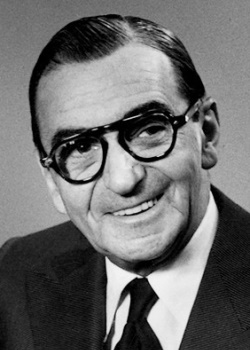 Composer and lyricist Irving Berlin died ten years ago today at his home in Manhattan on September 22, 1989, at the age of 101.
One of the most important songwriters in American history, Berlin’s career stretched from Tin Pan Alley and vaudeville through Broadway and the golden age of the Hollywood musical. He wrote more than 1,200 songs, including “Alexander’s Ragtime Band,” “Always,” “Blue Skies,” “Puttin’ on the Ritz,” “Cheek to Cheek,” “There’s No Business Like Show Business,” “God Bless America” and “White Christmas,” and his music became an essential part of the American popular songbook.
Berlin was born Israel Beilin in the Russian Empire on May 11, 1888, into a Jewish family that emigrated to the United States when he was a child. Growing up in poverty on New York’s Lower East Side, he left school early and worked as a singing waiter and song plugger before beginning to write songs himself. His breakthrough came with “Alexander’s Ragtime Band” in 1911, an international sensation that established him as one of America’s leading popular composers. Remarkably, Berlin never became a conventionally trained musician and could read music only with difficulty, generally composing at the piano and relying on musical assistants to transcribe and arrange his ideas.
Cinema became increasingly important to Berlin as talking pictures transformed Hollywood during the late 1920s. His songs appeared in some of the earliest musicals, including The Cocoanuts (1929), based on the Marx Brothers’ Broadway show, Puttin’ on the Ritz (1930), and Reaching for the Moon (1930). Unlike conventional film composers, Berlin rarely wrote dramatic underscore; instead he created complete song scores in which the numbers themselves drove the entertainment and often became hits independently of the films. Read more…
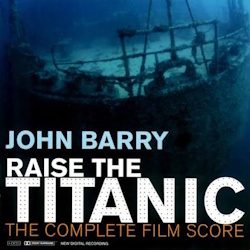
RAISE THE TITANIC – John Barry
 Original Review by Jonathan Broxton
Sometimes, a film score can reach almost mythic proportions, mainly due to the fact of its unavailability. In recent years, this has not happened – the advent of promos, DVDs with isolated score tracks and those horrible “bootlegs” mean that only a very small number of scores go without any kind of release – legitimate or otherwise. During the 1980s, however, a film score going unreleased was a much more common occurrence, especially if the film was a commercial flop, regardless of the quality of the music. This fate befell John Barry’s score for Raise The Titanic, arguably one of the most requested and sought-after scores in the history of modern film music. Read more…
AMERICAN BEAUTY – Thomas Newman
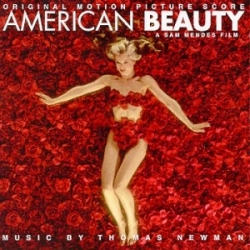 Original Review by Jonathan Broxton
It’s difficult to imagine another film this year achieving the level of perfection American Beauty achieves. Perfect direction from Sam Mendes. A perfect screenplay by Alan Ball. Perfect performances from Kevin Spacey, Annette Bening, Thora Birch and Chris Cooper. It’s just a shame that, in the synopsis, the movie sounds so dull because, in reality nothing could be further from the truth. We have seen scathing examinations of suburban American before. We have witnessed breakdowns of family units in the cinema, and exposed the sordid underbelly of the lives of people whose outward “normality” masks a level of cynicism, hate and deprivation. American Beauty does all those things, but somehow puts a fresh new spin on them that turns the familiar clichés on their head with wit, energy, humor and genuine emotion. Read more…
FOR LOVE OF THE GAME – Basil Poledouris
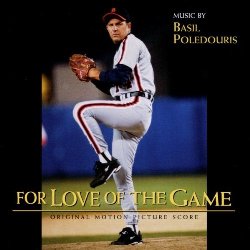 Original Review by Jonathan Broxton
It’s been a long time coming, but Basil Poledouris has finally returned to top form with For Love of the Game, Sam Raimi’s unexpectedly beautiful homage to the American pastime. Based on Michael Shaara’s novel, the film stars Kevin Costner as an ageing, washed-up pitcher given one last chance at the big time by his Detroit team mates. It’s one of those traditional, “go out and win one for the Gipper” sporting wish-fulfillment fantasies, where victory in the ultimate competition hinges on the last chance of the day, and where the once-great player returns from obscurity to triumph against all the odds. It’s been done a million times before, and will be done a million times again, but Costner and his co-stars, Kelly Preston and John C. Reilly, make it wholly believable. Read more…
THE MINUS MAN – Marco Beltrami
 Original Review by Jonathan Broxton
In the UK, Hampton Fancher’s movie The Minus Man was bought by the satellite TV network Sky and shown as a “cable premiere”, completely bypassing cinema screens and video store shelves. As a result, I got to see this curious little thriller back in July, well before it opened in the States, and well before Marco Beltrami’s equally curious score surfaced on CD. The film stars Owen Wilson as Vann, an oddly mannered but seemingly pleasant enough chap who travels around middle-America in his battered pickup, getting menial jobs when he can, living in rented accommodation, and murdering people on the side. Fancher’s seemingly emotionless depiction of Vann makes the film just a little disconcerting – everything is told from his own cool and distorted point of view, blurring the line between what is real and what is purely imagined inside his own little mind. With support from Janeane Garofalo, Brian Cox, Mercedes Ruehl and singer-turned-actress Sheryl Crow as Vann’s first victim, The Minus Man is an oddball movie which will surely find a cult audience in years to come. Read more…
THE ASTRONAUT’S WIFE – George S. Clinton
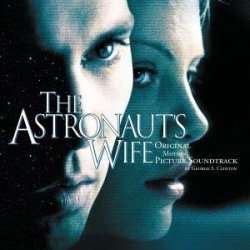 Original Review by Jonathan Broxton
Ever since the Austin Powers phenomenon took hold, the work of composer George S. Clinton has become increasingly in demand. Until the world became aware of the amorous adventures of the British super-spy, Clinton was merely the guy who wrote all that sleazy saxophone music to accompany Zalman King’s soft-core Red Shoe Diary movies, and who created all that stupid technobabble for Mortal Kombat. But there is a whole other side to his talents waiting to be discovered – like the music for The Astronaut’s Wife, a peculiar sci-fi thriller which attempts to bring together plot threads from movies as diverse as Rosemary’s Baby and Invasion of the Body Snatchers. Read more…
IN TOO DEEP – Christopher Young
 Original Review by Jonathan Broxton
I suppose everyone can have an off day once in a while, and even though Chris Young’s off days are often better than other composer’s best, In Too Deep still remains one of his least-inspired scores for many a year. It’s interesting that Young should score movies like this because – and I don’t want this to sound in any way racist – he is one of the few white composers who can write music for black movies. Normally, the director of a film like In Too Deep would employ someone like Terence Blanchard or Stanley Clarke to provide a culturally appropriate underscore. But Young, having written for movies like Tales From The Hood and Set It Off, seems able to convincingly convey the same musical identity. Read more…
THE 13th WARRIOR – Jerry Goldsmith
 Original Review by Jonathan Broxton
In my opinion, the last two sword and sorcery movies to have truly great scores were Basil Poledouris’s Conan the Barbarian in 1981 and James Horner’s Krull in 1983 – the enduring legacy of a genre which, in recent years, has virtually died out in Hollywood. Although there is not very much sorcery in The 13th Warrior, there are plenty of flashing blades, and Jerry Goldsmith has conjured up a rousing, magnificent musical work to accompany them, the first “medieval epic” score for quite a few years that can be compared on equal terms to those earlier classics. Read more…
TEACHING MRS. TINGLE – John Frizzell
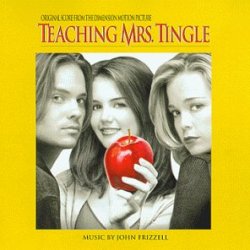 Original Review by Jonathan Broxton
Of the young new composers to emerge during the latter half of the nineties, John Frizzell is the only one to have not yet developed a truly original voice of his own. Contemporaries such as John Ottman and Marco Beltrami have already established an earmarking “sound”, stylistic trademarks and compositional techniques, and while Frizzell has shown an adeptness in a number of genres (horror in Alien Resurrection, comedy in Beavis and Butt-head, action in Dante’s Peak) he is still musically anonymous – his new score for Teaching Mrs. Tingle being a prime example. Read more…
MICKEY BLUE EYES – Basil Poledouris, Wolfgang Hammerschmid
 Original Review by Jonathan Broxton
After almost a year’s respite from the pressures of the film scoring circuit, Basil Poledouris returns to the fray with Mickey Blue Eyes, the second of 1999’s two Mafia comedy films. Since Nino Rota’s legendary mobster music for The Godfather way back in 1972, the mobster movie has developed its own musical standard, typified by genre ballads by crooners Dean Martin, Frank Sinatra, Sammy Davis Jr. Whether it was an intentional homage to his contemporaries, or whether it was just a lack inspiration that led Poledouris down the well-trodden path is open to debate, but whatever the case may be it is certain that Mickey Blue Eyes is one of his weakest scores in many a year. Read more…

Shop at the Movie Music UK Store

Member of the


