Remembering Irving Berlin, 1888-1989
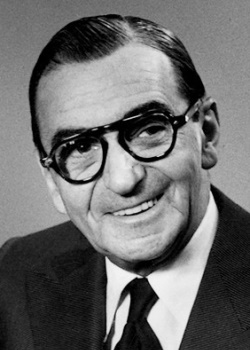 Composer and lyricist Irving Berlin died ten years ago today at his home in Manhattan on September 22, 1989, at the age of 101.
One of the most important songwriters in American history, Berlin’s career stretched from Tin Pan Alley and vaudeville through Broadway and the golden age of the Hollywood musical. He wrote more than 1,200 songs, including “Alexander’s Ragtime Band,” “Always,” “Blue Skies,” “Puttin’ on the Ritz,” “Cheek to Cheek,” “There’s No Business Like Show Business,” “God Bless America” and “White Christmas,” and his music became an essential part of the American popular songbook.
Berlin was born Israel Beilin in the Russian Empire on May 11, 1888, into a Jewish family that emigrated to the United States when he was a child. Growing up in poverty on New York’s Lower East Side, he left school early and worked as a singing waiter and song plugger before beginning to write songs himself. His breakthrough came with “Alexander’s Ragtime Band” in 1911, an international sensation that established him as one of America’s leading popular composers. Remarkably, Berlin never became a conventionally trained musician and could read music only with difficulty, generally composing at the piano and relying on musical assistants to transcribe and arrange his ideas.
Cinema became increasingly important to Berlin as talking pictures transformed Hollywood during the late 1920s. His songs appeared in some of the earliest musicals, including The Cocoanuts (1929), based on the Marx Brothers’ Broadway show, Puttin’ on the Ritz (1930), and Reaching for the Moon (1930). Unlike conventional film composers, Berlin rarely wrote dramatic underscore; instead he created complete song scores in which the numbers themselves drove the entertainment and often became hits independently of the films.
His greatest early Hollywood partnership was with Fred Astaire. Berlin wrote the songs for Top Hat (1935), perhaps the quintessential Astaire-Ginger Rogers musical, including “Isn’t This a Lovely Day?,” “Top Hat, White Tie and Tails” and “Cheek to Cheek.” The latter accompanied one of Astaire and Rogers’s most celebrated dances and received an Academy Award nomination for Best Song. Berlin followed with Follow the Fleet (1936), which produced the magnificent “Let’s Face the Music and Dance,” and later Carefree (1938), whose songs included “Change Partners.” The combination of Berlin’s seemingly effortless melodies and Astaire’s elegant delivery became one of the defining musical partnerships of 1930s cinema.
Berlin’s music also provided the foundation for Alexander’s Ragtime Band (1938), a hugely successful musical built around more than two decades of his songs. By this point his catalogue had become so extensive that Hollywood could construct entire films from existing material, a practice repeated throughout the remainder of his career.
His greatest cinematic success came with Holiday Inn (1942), starring Bing Crosby and Astaire. Berlin conceived the film around songs celebrating different holidays, including “Happy Holiday,” “Easter Parade” and, almost incidentally, “White Christmas.” Bing Crosby’s understated performance transformed the latter into a phenomenon. Berlin won the Academy Award for Best Original Song and, in one of Oscar history’s strangest moments, happened to be presenting the category himself and therefore opened the envelope announcing his own victory. “White Christmas” subsequently became one of the most commercially successful and frequently recorded songs ever written.
During World War II Berlin also brought his enormously successful military stage revue This Is the Army to the screen in 1943. The production, in which Berlin himself appeared performing “Oh! How I Hate to Get Up in the Morning,” raised millions of dollars for Army Emergency Relief and reflected the strong patriotic element that ran throughout his career. His earlier “God Bless America,” revived by singer Kate Smith in 1938, had already become an unofficial national anthem.
The post-war years produced another remarkable series of screen musicals. Blue Skies (1946), again starring Crosby and Astaire, drew extensively on Berlin’s existing catalogue, while Easter Parade (1948), starring Astaire and Judy Garland, combined older standards with new songs including “Steppin’ Out with My Baby.” One of MGM’s biggest musical successes, Easter Parade demonstrated how easily Berlin’s music could bridge different generations of performers and audiences.
Meanwhile, Broadway produced one of Berlin’s greatest triumphs with Annie Get Your Gun (1946), written for Ethel Merman. Its extraordinary collection of songs included “There’s No Business Like Show Business,” “Anything You Can Do,” “I Got the Sun in the Morning” and “They Say It’s Wonderful.” MGM adapted the show for the screen in 1950 with Betty Hutton and Howard Keel, while Berlin’s next major Broadway success, Call Me Madam (1950), reached cinemas three years later with Merman recreating her stage role. Call Me Madam won Berlin the Tony Award for Best Original Score.
Berlin’s association with Hollywood culminated in two lavish 1954 productions. There’s No Business Like Show Business, starring Ethel Merman, Marilyn Monroe and Donald O’Connor, was built around his catalogue, while White Christmas reunited the famous song with Bing Crosby and surrounded it with additional Berlin standards. The new song “Count Your Blessings Instead of Sheep” brought Berlin another Academy Award nomination.
Berlin gradually withdrew from active songwriting after the disappointing Broadway reception of Mr. President in 1962, although his music never disappeared from popular culture. He received a Grammy Lifetime Achievement Award, the Presidential Medal of Freedom, the Congressional Gold Medal and numerous theatrical honors, and was among the inaugural inductees into the Songwriters Hall of Fame.
Few composers had a greater influence on the sound of American popular entertainment. Berlin could write patriotic anthems, comic novelty songs, romantic ballads and sophisticated dance numbers with apparently equal ease, yet his melodies almost always possessed a directness that made them immediately memorable. Hollywood benefited enormously from that gift. From Astaire and Rogers dancing “Cheek to Cheek” to Bing Crosby singing “White Christmas,” some of the most enduring moments in the history of the screen musical are inseparable from his songs. Jerome Kern famously remarked that Berlin had no place in American music because “Irving Berlin is American music,” and across Broadway, Hollywood and more than half a century of popular song, few composers ever did more to justify such an extraordinary tribute.

Shop at the Movie Music UK Store

Member of the


