PASSENGER – Christopher Young
 Original Review by Jonathan Broxton
Passenger is the latest film from Norwegian director André Øvredal, whose previous works include films like Trollhunter, Scary Stories to Tell in the Dark, and The Last Voyage of the Demeter, the latter of which featured an excellent score by Bear McCreary. The film follows Tyler and Maddie (played by Jacob Scipio and Lou Llobell), a young couple living the “van life” dream across America, who witness a gruesome highway accident, and then unknowingly pick up a demonic hitchhiker, leading to a nightmare journey filled with supernatural terror. As one would expect from Øvredal, the film has already found a receptive audience among horror fans, with Rotten Tomatoes concluding that the film is “a stylish ride weighed down by the litany of clichés it picks up along the way, but which has some memorable bumps and jolts during the journey.”
The score for Passenger is by the great Christopher Young who, after a few lean years in the late 2010s, seems to have found a new niche writing music for a new generation of arthouse horror directors, including The Offering for Oliver Park in 2022 and, especially, the sensational The Piper for Erlingur Thoroddsen in 2023. Few composers have such a long and distinguished relationship with the horror genre, and even fewer continue to find new ways to approach it after more than four decades in the business. From the gothic romanticism of scores like Hellraiser and Bless the Child to the avant-garde experimentation of works such as Sinister, Young has explored virtually every corner of horror scoring imaginable. Remarkably, however, Passenger still manages to sound unlike anything else in his catalogue.
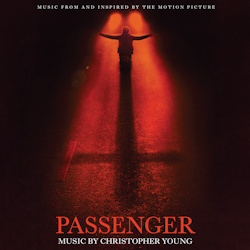
 As is often the case with Young’s recent soundtrack albums, this is not a straightforward presentation of the score as heard in the film. The cover’s “music from and inspired by” credit is a clue that some of the material was written specifically for the album experience, and the result is a listening program that feels carefully curated rather than merely assembled. The album essentially alternates between two distinct musical identities. The first comprises the opening “Prelude” and three tracks titled “Passenger,” performed by Young and guitarist Brandon Brown. This material is dark, unsettling, and deeply uncomfortable in ways that some listeners may find completely unpalatable.
Young makes use of extended dissonant string passages and prepared pianos, incorporating all manner of strange instrumental textures, electronic ambiences, and manipulated sounds, all designed to keep the listener on edge. The second and third “Passenger” tracks contain some genuinely extraordinary vocal effects that are quite unlike anything I can recall hearing before – groaning, breathing, gasping, gurgling, and shouting sounds that feel wholly (and appropriately) unnatural. Young previously created a sort of “musical vomiting” effect for Drag Me to Hell in 2009, and this feels like a variation on that idea. He has, of course, been fascinated with the concept of musique concrète for many years, dating all the way back to projects such as The Vagrant in the early 1990s, but his experiments here push those boundaries in entirely new ways.
Alternating with these cues are the four tracks titled “St. Christopher” (St. Christopher being the patron saint of travellers), and they could hardly be more different. Built around exquisite liturgical polyphonic a cappella choral writing – meaning two or more independent melodic lines sung simultaneously without instrumental accompaniment – they are beautiful, reverential, and deeply spiritual, coming across more like traditional church music than something accompanying a modern horror film. Young has made use of religious chorales many times before – notably in works such as the aforementioned Bless the Child, as well as his recent score for the 1922 silent horror film Nosferatu – but those scores also featured orchestral accompaniment, so it’s a wonderful experience to hear a new take on the sound.
What’s most impressive about these “St. Christopher” cues is how authentic they sound. I’m not an expert on sacred choral music by any means, but while listening to them, you could easily believe they were written hundreds of years ago by Renaissance or medieval monks. It’s really quite extraordinary, and a testament to Young’s talent and mastery of the form.
What makes the album so fascinating, however, is the way these two seemingly incompatible styles interact with one another. Every transition from the abrasive horror material into the sacred choral writing comes as a surprise, yet the lingering unease from the former somehow infects the latter. No matter how beautiful the choral passages become, there remains a sense that something dreadful is lurking just beneath the surface. It’s a remarkably effective psychological trick, and one that keeps the entire album in a state of tension from beginning to end.
Christopher Young has always understood that true terror comes from atmosphere, uncertainty, and suggestion rather than volume, shock effects, or aggressive orchestration, and Passenger demonstrates that he remains one of the absolute masters of the genre – one of the best ever to do it. However, be warned: this score is unquestionably a challenging listen in places, and some listeners may find its more experimental passages difficult to embrace, if not entirely unpalatable or even unlistenable, especially in the cues where the music seems to be literally yelling at you. For those willing to take the journey, however, the rewards are considerable, with the “St. Christopher” cues standing among the most traditionally beautiful music the composer has written to date.
Buy the Passenger soundtrack from the Movie Music UK Store
Track Listing:
- Prelude (10:07)
- St. Christopher #1 (4:25)
- Passenger Part 1 (7:31)
- St. Christopher #2 (6:12)
- Passenger Part 2 (7:51)
- St. Christopher #3 (6:57)
- Passenger Part 3 (7:21)
- St. Christopher #4 (3:48)
Intrada/Lakeshore Records (2026)
Running Time: 54 minutes 14 seconds
Music composed by Christopher Young. Orchestrations by Jacob Moss. Recorded and mixed by John Jae Lee and Matthew Rosales. Edited by Thomas Milano. Album produced by Christopher Young.

Shop at the Movie Music UK Store

Member of the


