Archive
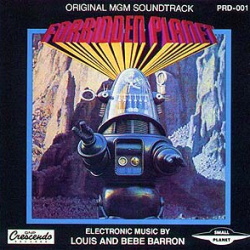
FORBIDDEN PLANET – Louis Barron, Bebe Barron
 GREATEST SCORES OF THE TWENTIETH CENTURY
Original Review by Craig Lysy
The massive commercial success of the science fiction film The Day The Earth Stood Still in 1951 motivated MGM executives to cash in on the emerging genre, which had captured the public’s imagination. They came upon a screenplay entitled Fatal Planet by Irving Block and Allen Adler, and believed they had found their film. Nicholas Nayfack was hired to produce, and he brought in Fred Wilcox to direct. They were not fully satisfied with the script and brought in screenwriter Cyril Hume to make adjustments, beginning with the title, which was changed to “Forbidden Planet” as it was believed to have greater mystery and box office appeal. An excellent cast was hired, which included Walter Pidgeon as Dr. Edward Morbius, Ann Francis as his daughter Altaira, Leslie Nielsen in his acting debut as Commander John Adams, Robby the Robot as himself, Warren Stevens as Lieutenant Doc Ostrow, Jack Kelly as Lieutenant Jerry Farman, Richard Anderson as Chief Quinn, and Earl Holliman as the Cook. The story draws inspiration from William Shakespeare’s play “The Tempest” 1610. It takes place in the distant 23rd century on the planet Altair IV. Captain Adams commands the starship C-57D on a mission to discover the fate of the starship Bellerophon, which was sent there on a mission 20 years earlier. They discover two survivors, Dr. Mobius and his daughter Altaira along with their robot Robby, who relate that an unknown entity killed the other crew members and destroyed the Bellerophon. They also learn that Dr. Mobius has discovered technology from an ancient race known as the Krell, which inhabited this planet yet disappeared in a cataclysm some 200,000 years ago. Read more…
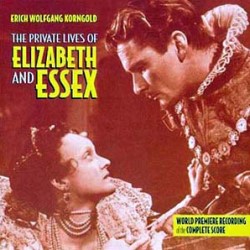
THE PRIVATE LIVES OF ELIZABETH AND ESSEX – Erich Wolfgang Korngold
 GREATEST SCORES OF THE TWENTIETH CENTURY
Original Review by Craig Lysy
Warner Brothers Studio executives saw the commercial success of Maxwell Anderson’s 1930 New York stage production of “Elizabeth The Queen,” which ran for an impressive 147 performances, and decided to purchase the film rights. Hal B. Wallis would produce the film, Michael Curtiz was tasked with directing, and Norman Reilly Raine and Aeneas MacKenzie were hired to write the screenplay. A stellar cast was assembled with Bette Davis starring as Queen Elizabeth I, Errol Flynn as Robert Devereux the Earl of Essex, Olivia de Havilland as Lady Penelope Gray, Donald Crisp as Francis Bacon, Alan Hale Sr. as Earl of Tyrone and Vincent Price as Sir Walter Raleigh. Drama arose immediately as Davis and Flynn did not like each other, something which was exacerbated by his insistence that his character be included in the film title led. This did not sit well with Davis; in a dress rehearsal scene, she purposely slapped Flynn’s face hard in front of the entire production crew instead of feigning it. Flynn did not retaliate and luckily, she did not reprise the slap during live filming. as he related in his memoirs that he would have slapped her back! Read more…
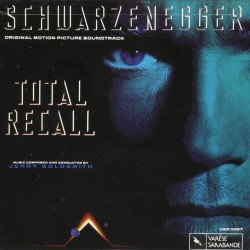
TOTAL RECALL – Jerry Goldsmith
 THROWBACK THIRTY
GREATEST SCORES OF THE TWENTIETH CENTURY
Original Review by Jonathan Broxton
Total Recall is one of my all-time favorite sci-fi action films, and is one of the best movies Arnold Schwarzenegger ever made. Adapted from the short story ‘We Can Remember It For You Wholesale’ by Philip K. Dick, it was the third English-language film from Dutch director Paul Verhoeven, following Flesh + Blood in 1985 and Robocop in 1987, and continued his explorations of American consumerism and capitalism through thinly-veiled satire, dressed up with large-scale action sequences. The film is set in a future time period where humans have colonized other planets, and have invented technology that allows ‘false memories’ to be implanted into the mind. Schwarzenegger plays Doug Quaid, a regular blue collar worker who has vivid recurring dreams of visiting Mars. One day Quaid decides to visit Rekall, a company which implants memories of vacations in people who have never been on them. However, the process goes wrong, and Quaid learns that he has already had his memory wiped; he is, in fact, a deep-cover elite secret agent with ties to Vilos Cohaagen, the corrupt and ruthless governor of the Mars Colony. Before long Quaid is knee deep in an inter-planetary adventure involving shady secret organizations and underground resistance movements seeking to overthrow the Martian government. The film co-stars Rachel Ticotin, Ronny Cox, Michael Ironside, and a pre-Basic Instinct Sharon Stone, and was a massive hit with both critics and audiences, who praised its clever story, vivid action sequences, impressive (if occasionally gory) special effects, and mind-bending distortions of what is real and what isn’t. Read more…
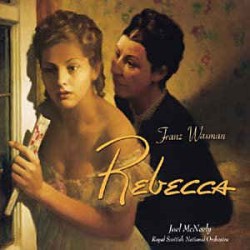
REBECCA – Franz Waxman
 GREATEST SCORES OF THE TWENTIETH CENTURY
Original Review by Craig Lysy
David O. Selznick was captivated by the 1938 novel Rebecca by Daphne du Maurier, a romantic psychological thriller, which he was determined to bring to the big screen. He purchased the film rights for $50,000, took on producing the film, and tasked Alfred Hitchcock to direct – his debut film in America. The screenplay was written by Robert Sherwood and Joan Harrison with adaptation by Philip MacDonald and Michael Hogan. Selznick insisted that the film remain faithful to the novel, and friction occurred when he overruled a number of changes made by Hitchcock. Selznick’s initial choices for the lead roles were Ronald Coleman and Carole Lombard, but both declined. Nevertheless a stellar cast was assembled, which included Joan Fontaine as the second Mrs. De Winter, Laurence Olivier as Maxim de Winter, Judith Anderson as the housekeeper Mrs. Danvers, George Sanders as Jack Favell, Reginald Denny as Frank Crawley, and C. Aubrey Smith as Colonel Julyan. Read more…
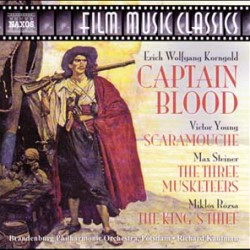
CAPTAIN BLOOD – Erich Wolfgang Korngold
 GREATEST SCORES OF THE TWENTIETH CENTURY
Original Review by Craig Lysy
The commercial success of Treasure Island and The Count of Monte Cristo in 1934 inspired Warner Brothers Studio executives to remake their earlier silent film of Captain Blood, which first hit the silver screen in 1923. They tasked producers Harry Joe Brown and Gordon Hollingshead to manage the project with a generous $1.24 million budget and hired Michael Curtiz to direct. They would again adapt the film from the 1922 novel Captain Blood by Rafael Sabatini and hired Casey Robinson to write the screenplay. However, casting got off on the wrong foot; Robert Donat and Jean Muir were originally sought for the lead roles, but when Donat declined the offer, the studio decided to bypass Muir and recruit new young talent. 24-year-old Australian actor Errol Flynn would make his Hollywood debut, cast in the titular role supported by 19-year-old Olivia de Havilland, who would play Arabella Bishop. Joining them would be Lionel Atwill as Colonel Bishop, Basil Rathbone as Levasseur, Ross Alexander as Jeremy Pitt, and Henry Stephensen as Lord Willoughby. Read more…
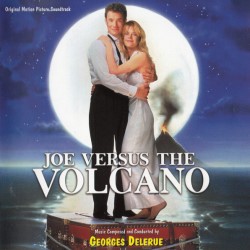
JOE VERSUS THE VOLCANO – Georges Delerue
 THROWBACK THIRTY
GREATEST SCORES OF THE TWENTIETH CENTURY
Original Review by Jonathan Broxton
After receiving his first Oscar nomination for Big in 1988, but before he became an established box office draw with titles like Sleepless in Seattle and Philadelphia, Tom Hanks spent a couple of years trying to find his niche. One of the projects he tried which never took off was Joe Versus the Volcano, a highly peculiar comedy written and directed by John Patrick Shanley. Hanks plays Joe Banks, a luckless everyman who works a terrible dead-end job and is chronically sick. One day Joe is told he is dying of a mysterious and incurable rare disease, and accepts a financial offer from billionaire Samuel Graynamore (Lloyd Bridges) – he can live like a king for a short period, but then has to travel to a South Pacific island and throw himself into a volcano to appease the superstitious natives. With nothing to lose, Joe agrees, but when he meets and falls in love with Patricia (Meg Ryan), Graynamore’s daughter, who is captaining the yacht taking him to the island, he realizes he may have something to live for after all. The film was a critical and commercial flop when it was first released, but has become something of a cult film in the intervening years, receiving praise for its offbeat tone and sweet nature, and for the fact that this was the first on-screen pairing of Hanks and Ryan, who would go on to be Hollywood’s romantic comedy golden couple. Read more…
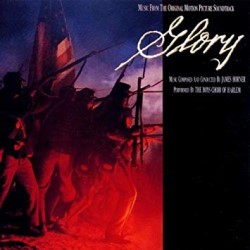
GLORY – James Horner
 THROWBACK THIRTY
GREATEST SCORES OF THE TWENTIETH CENTURY
Original Review by Jonathan Broxton
Blow the horn, play the fife, beat the drum so slowly. Blow the horn, play the fife, make the drum beat glory…
Stories from the American Civil War have fascinated filmmakers for decades. Films as great and respected as Gone With the Wind, The Red Badge of Courage, and even things like The Outlaw Josey Wales, have examined different elements of the conflict that so ravaged the fledgling nation from 1861 to 1865. However, for my money, one of the best movies about that period was the 1989 epic Glory, written by Kevin Jarre and directed by Edward Zwick. It tells the story of the 54th Massachusetts Infantry Regiment, a platoon of ‘free black’ soldiers and former slaves fighting for the Union Army. Under the command of Colonel Robert Shaw, the regiment becomes involved in numerous battles and incidents, culminating with their heroic charge on Fort Wagner, a Confederate stronghold in South Carolina. But the film is about more than that – it’s about bravery, and honor, and courage. It’s about the dignity of these African American soldiers, and how they inspired similar feelings of honor and dignity in their communities. It’s about the relationships between Shaw and his officers and soldiers, and how the racism and prejudice that still existed in the North was turned into friendship and mutual respect as a result of their experiences. The film has an astonishing cast – Matthew Broderick, Cary Elwes, Morgan Freeman, Denzel Washington who won an Oscar – and was a major critical success. Read more…
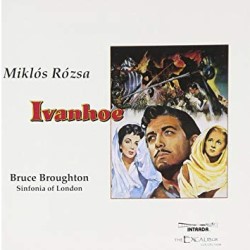
IVANHOE – Miklós Rózsa
 GREATEST SCORES OF THE TWENTIETH CENTURY
Original Review by Craig Lysy
In 1935 MGM Studio sought to bring Sir Walter Scott’s epic Medieval Knight tale Ivanhoe (1819) to the big screen. After crafting a screenplay, the project never got off the ground as production delays resulted in selecting two different casts, one in 1935 starring Fredric March, Loretta Young and Gary Cooper, and another in 1938 starring Robert Taylor, Myrna Loy and Clark Gable. Another setback to production occurred with the onset of WWII, which caused filming on location in England to be put hold. New energy for the project arose in 1946 when Æneas MacKenzie crafted a new script, which satisfied MGM executives. Pandro S. Berman was given a very generous budget to produce the film and he brought in Richard Thorpe to direct. A third stellar cast was hired, which included; Robert Taylor as Ivanhoe, Elizabeth Taylor as Rebecca, Joan Fontaine as Rowena, George Sanders as Sir Brian De Bois-Guilbert, Emlyn Williams as Wamba and also the Narrator, Felix Aylmer as Isaac, Finlay Currie as Cedric, and Guy Rolfe as Prince John. Read more…
ODNA/ALONE – Dmitri Shostakovich
 GREATEST SCORES OF THE TWENTIETH CENTURY
Original Review by Craig Lysy
Film-making in the 1930s Soviet Union was very tightly regulated by the state to ensure fidelity to the ideals of the revolution. Directors Leonid Trauberg and Grigori Kozintsev found inspiration in news reports of the dire challenges faced by two teachers. They conceived their film to address three political issues of the day; the State’s promotion of education, the elimination of the kulaks (land owning peasants), and the introduction of modern technology. The film was originally conceived as a silent film, but was later changed to include dialogue and music by composer Dmitri Shostakovich. With the additional demand by the State for realism in film, each actor would use their real names as the characters. Yelena Kuzima would star in the lead role as the school teacher Joining her would be Pyotr Sobolevsky as her husband, Sergey Gerasimov as the local Council Chairman and Mariya Babanova as the Chairman’s wife. Read more…
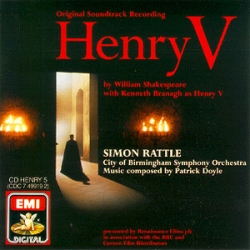
HENRY V – Patrick Doyle
 THROWBACK THIRTY
GREATEST SCORES OF THE TWENTIETH CENTURY
Original Review by Jonathan Broxton
In 1989 Kenneth Branagh was a brash, handsome, dazzlingly talented young actor and director, who emerged from the Royal Academy of Dramatic Arts in the early 1980s and set the British theatrical world alight with his electrifying Shakespearean productions. He was part of a group of talented contemporaries which included people like Emma Thompson, Alan Rickman, Jonathan Pryce, Stephen Fry, Hugh Laurie, and Rowan Atkinson, all of whom began to have a profound effect on British stage society through their respective careers in drama and comedy. Branagh then went on to create the Renaissance Theatre Company, which brought his troupe of players into the circle of beloved stage veterans like Judi Dench, Richard Briers, Derek Jacobi, and Sir John Gielgud. Together they made enormously successful stage productions of Much Ado About Nothing, Hamlet, As You Like It, and Twelfth Night, the latter of which directly led to Branagh receiving funding to make a big-screen adaptation of one of Shakespeare’s most beloved works, Henry V. Read more…
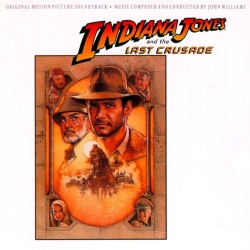
INDIANA JONES AND THE LAST CRUSADE – John Williams
 THROWBACK THIRTY
GREATEST SCORES OF THE TWENTIETH CENTURY
Original Review by Jonathan Broxton
The third movie in director Steven Spielberg’s Indiana Jones series was Indiana Jones and the Last Crusade, and whereas 1984’s Temple of Doom was a prequel to Raiders of the Lost Ark, Last Crusade was a direct sequel, set just two years later in 1938. Harrison Ford returns as the titular archaeologist-adventurer, who is sent off on a globe-trotting escapade when he receives news from American billionaire Walter Donovan (Julian Glover) that his long-estranged father Henry Jones (Sean Connery) has gone missing while searching for the holy grail. Jones teams up with his old friends and colleagues Marcus Brody (Denholm Elliott) and Sallah (John Rhys-Davies) on the quest to find his father, and quickly becomes embroiled in a vast labyrinthine plot involving ancient myths and legends, a brotherhood of religious warriors, way too many Nazis, and a beautiful Austrian art professor named Elsa Schneider (Alison Doody) to whom there is more than meets the eye. The whole thing is a delight from start to finish, with several wonderfully exciting action set pieces, and beautiful location settings, but the cornerstone of the film is the father-and-son chemistry between Ford and Connery, whose outward gruffness and constant bickering masks a deep love and affection. Whereas Ford is an all-action matinee idol hero, Connery is a slightly bumbling academic, more at home with books and libraries than punching Nazis in the face, but who is still able to make his son feel like a 12-year old when he calls him ‘junior’. Read more…
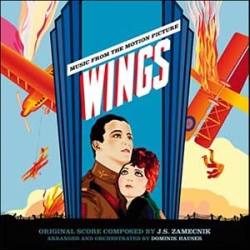
WINGS – J. S. Zamecnik
 GREATEST SCORES OF THE TWENTIETH CENTURY
Original Review by Craig Lysy
John Monk Saunders served in the US Air Corp during WWI as a flight instructor in Florida. He had lifelong regrets that he was never able to serve his country in combat, and so conceived a story, which would allow him to realize that ambition in film. He pitched his idea to producer Jessie Lasky who was unreceptive due to the logistics required to film aerial combat. Yet Saunders would not be denied and secured support from the War Department, which included 220 planes, and airmen, artillery, tanks, trucks and troops. Lasky was impressed and decided to proceed with his Famous Players-Lasky company financing the project and Paramount Studio securing distribution rights. A massive budget of $2 million was budgeted and Louis Lighton and Hope Loring were hired to write the screenplay. Lasky and four others would produce the film, and William Wellman was tasked with directing as he was the only director in Hollywood who had actual combat pilot experience. Securing a cast was an adventure however when Paramount’s greatest star Clara Bow, demanded a rewrite stating “Wings is a man’s picture and I am just the whipped cream on top of the pie”. Her demands were met and the story evolved into a war time romance. She would star as Mary Preston, with Charles “Buddy” Rogers as Jack Powell, Richard Arlen as David Armstrong, Gary Cooper as Cadet White, and Jobyna Ralston as Sylvia Lewis. Read more…
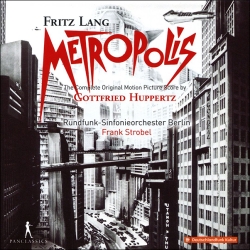
METROPOLIS – Gottfried Huppertz
 GREATEST SCORES OF THE TWENTIETH CENTURY
Original Review by Craig Lysy
Director Fritz Lang had early access to his wife Thea von Harbou’s 1925 novel Metropolis, and was inspired to bring its bold futuristic social commentary to the big screen. The couple worked together to fashion the screenplay and secured financing from the German production company WFA and the German distribution company Parufamet, which was created by investment from Paramount and MGM studios. He pitched his screenplay to Erich Pommer, the most powerful film producer in Germany of the time, and secured his backing to produce the film. A fine cast was assembled which included Alfred Abel as the Master of Metropolis Joh Fredersen, Gustav Fröhlich as Joh Fredersen’s son, Rudolph Klein-Rogge as Rotwang the inventor, and Brigitte Helm as the unforgettable Maria. The film’s narrative offers a potent social commentary, which is set in the far future in the great city of Metropolis. The society is dystopian with an elite ruling class of capitalist industrial oligarchs who live above ground in luxurious skyscrapers and hold power over a lower working class who live impoverished underground, toiling endlessly to operate and maintain the great machines that power the city. They share not in the profits, nor any of the benefits, which go solely to the ruling elite. Freder, who is the son of the Master of Metropolis, bears witness to the misery of the working class and resolves to advocate for them. Freder meets a worker prophetess named Maria who foresees the arrival of a Mediator who will unify the workers and ruling elite of Metropolis in a new Utopia. He falls in love with Maria and aspires to assume the role of Mediator. Against this backdrop the evil inventor Rotwang creates a robot bearing Maria’s likeness to foment dissent and revolution, which will bring him to power. In the end, after much intrigue and fighting, Freder kills Rotwang and fulfills his role as Mediator. Read more…
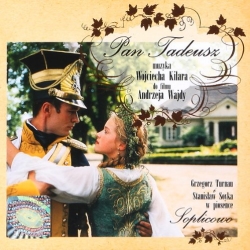
PAN TADEUSZ – Wojciech Kilar
 GREATEST SCORES OF THE TWENTIETH CENTURY
Original Review by Craig Lysy
Poland had a decade earlier thrown off the foreign shackles of Russian domination, yet the country was struggling to regain its identity, and find its place in the world. Against this backdrop, the great Polish director Andrrzej Wajda conceived for his next project a grand tale based on Adam Mickiewicz’s epic 1834 poem Pan Tadeusz. The poem is considered by Poles to be the greatest achievement in Polish literature and by most professors of literature to be the last epic poem in European literature. Wajda describes it as “a great story that focuses on our national characteristics. The Poles in Pan Tadeusz are the same as we are now: sometimes wise, sometimes stupid. It’s basically a picture of how we are now and allows us to look at ourselves and see who we are and where we’re going.” Wajda pitched his idea to several studios and secured funding from a conglomerate of twelve companies. He would direct and write the screenplay, and Lew Rywin would produce. A fine cast was assembled, which included; Boguslaw Linda as Jacek Soplica/Father Robak, Michal Zebrowski as Tadeusz Soplica, Alicia Bachleda-Curus as Zosia Horeszko, Grazyna Szapolowska as Telimena, Andrzej Seweryn as Judge Soplica, and Marek Kondrat as Count Horeszko. Read more…
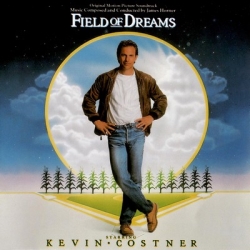
FIELD OF DREAMS – James Horner
 THROWBACK THIRTY
GREATEST SCORES OF THE TWENTIETH CENTURY
Original Review by Jonathan Broxton
Field of Dreams is a film about baseball, but it’s also about much, much more than that. It’s a film about regret, about missed opportunities, about the relationships we allow to fritter away through petty disagreements and neglect. It’s a film about life, about how the ambitions we had in our youth turn into something completely different in adulthood, and how we deal with that change. It’s a film about hope, about how each of us longs to re-capture that innocence and optimism we once had, and the things we will do to get it. And it’s a film about reconciliation, coming to terms with the mistakes we have made, and making things right. The film is written and directed by Phil Alden Robinson, based on the novel ‘Shoeless Joe’ by W. P. Kinsella; it stars Kevin Costner as Ray, a corn farmer who lives in Iowa with his wife Annie (Amy Madigan), and their young daughter Karen (Gaby Hoffmann), on the property that his late father left him. Ray had been estranged from his father for many years before he died, and the legacy of that relationship weighs heavily upon him. One day, while out in the cornfield, Ray hears a spectral voice whispering the words ‘if you build it, he will come,’ and he is subsequently inspired to build a full-size baseball diamond on his property. This event sends Ray off on a voyage of personal self-discovery involving Shoeless Joe Jackson (Ray Liotta) and the ghosts of the disgraced 1919 Chicago White Sox team, a reclusive political author (James Earl Jones), and a beloved country doctor (Burt Lancaster) who played just a single game in the major leagues for the New York Giants in 1922. Read more…

Shop at the Movie Music UK Store

Member of the

 MOVIE MUSIC UK