Archive
BRAVEHEART – James Horner
 GREATEST SCORES OF THE TWENTIETH CENTURY
Original Review by Craig Lysy
During a visit to Scotland screenwriter Randall Wallace was inspired by the lore of the Scottish patriot William Wallace. He conceived and wrote a screenplay for a grand historical epic, which would bring this heroic figure to the big screen. MGM producer Alan Ladd Jr. realized he had a winner and purchased the script, which he shared with Mel Gibson. Gibson initially passed on the project, but eventually relented, agreeing to direct, however he declined to star as he felt he was too old at age 40 to play the part of Wallace, who was in his late twenties. Financing constraints led to a reversal as Paramount Studios would only agree to finance the film if he starred in it. Gibson agreed to take on the titular role and brought in a fine cast to support, which included Sophie Marceau as Princess Isabelle, Angus MacFadyen as Robert the Bruce, Patrick McGoohan as King Edward I, Catherine McCormack as Murron, Brendan Gleeson as Hamish, Peter Hanly as Prince Edward, and Ian Bannen as Robert the Elder. Gibson’s final script took significant license with historical accuracy, so as to make the story more intimate, dramatic and grand. The film is set in Scotland the year 1280, when the country is occupied by the forces of English King Edward I, and it tells the story of the rise and fall of the legendary Scottish patriot and freedom fighter. Read more…
APOLLO 13 – James Horner
 GREATEST SCORES OF THE TWENTIETH CENTURY
Original Review by Craig Lysy
Following his retirement from NASA in 1973, Apollo 13 astronaut James Lovell collaborated with journalist Jeffrey Kluger to recount the riveting tale of his failed moon landing, titled ‘Lost Moon: The Perilous Voyage of Apollo 13’. In 1993 director Ron Howard and producer Brian Grazer of Imagine Entertainment received a pre-publication copy of the novel and immediately realized that this story offered classic American heroism, which needed to be brought to the big screen. They secured the film rights and, in partnership with Universal Pictures, undertook the project with a modest budget of $52 million. Howard secured a stellar cast, which included NASA fan Tom Hanks as Commander Jim Lovell, Kathleen Quinlan as his wife Marilyn, Kevin Bacon and Bill Paxton as fellow astronauts Jack Swigert and Fred Haise, Gary Sinise as Ken Mattingly, and Ed Harris as NASA Flight Director Gene Kranz. The story retells the harrowing tale of the Apollo 13 mission, which was intended to bring a third astronaut team to the moon. Read more…
LEGENDS OF THE FALL – James Horner
 GREATEST SCORES OF THE TWENTIETH CENTURY
Original Review by Craig Lysy
Having just finished the comedy Leaving Normal, director Edward Zwick decided to change direction and film an epic historical drama, which showcased the talent of rising star Brad Pitt as a romantic leading man. To that end he found the perfect vehicle in the 1978 novella Legends of the Fall by Jim Harrison. His production company Bedford Falls purchased the film rights with TriStar Pictures agreeing to distribute. Zwick, William Wittliff and Marshal Herskovist would produce the film, with Zwick directing. He hired screenwriters Susan Shilliday and William D. Wittliff to adapt the story for the big screen and brought in an outstanding cast, which included Brad Pitt as Tristan Ludlow, Anthony Hopkins as Colonel William Ludlow, Aiden Quinn as Alfred Ludlow, Henry Thomas as Samuel Ludlow, and Juilia Ormond as Susannah Fincannon. The film is set in the territory of Montana circa 1890 when Colonel William Ludlow resigns his commission, loathe to continue his part in the army’s cruel betrayal and slaughter of native Americans. He settles on a ranch in a remote part of Montana where he and his wife Isabel live a tranquil existence in peace. Isabel bears him three sons – Tristan, Alfred, and Samuel – but ends up leaving him as she is unable to bear the isolation and long harsh winters, which forces William to raise the boys himself. Almost 20 years later, the the now-grown Samuel returns home to the ranch with his fiancé Susannah, but this is a harbinger of sorrow as it precipitates a series of tragic events which fracture the family and set brother against brother as they compete for her affections. Read more…
JURASSIC PARK – John Williams
 GREATEST SCORES OF THE TWENTIETH CENTURY
Original Review by Craig Lysy
Steven Spielberg became aware of Michael Crichton’s novel Jurassic Park as the two collaborated on the television series E.R. A bidding war for the rights ensued, with Spielberg and Universal Pictures prevailing over Warner Brothers and Tim Burton, Columbia Pictures and Richard Donner, James Cameron and Joe Dante. Kathleen Kennedy and Gerald Molen would produce the film with Spielberg directing. Spielberg understood the challenges he faced bring the dinosaurs to life and sought at all costs to not repeat the technical nightmare he experienced in Jaws. He turned to George Lucas’ Industrial Light and Magic Company to create groundbreaking computer –generated imagery and ended up making history. Crichton was hired to adapt his novel to the screen but Spielberg was unsatisfied with the violence. Malia Scotch Marmo was tasked with the rewrite in late 1991, but she also did not satisfy Spielberg’s vision. Universal executives brought in Casey Silver and David Koepp who ultimately crafted the script used in the film. A fine cast was assembled with Sam Neill securing the role of Alan Grant after William Hurt and Harrison Ford both declined. Joining him would be Laura Dern as Ellie Sattler, Jeff Goldblum as Ian Malcolm, Richard Attenborough as John Hammond, Bob Peck as Robert Muldoon, Samuel Jackson as Ray Arnold, B.D. Wong as Henry Wu, and Ariana Richards and Joseph Mazzello as Hammond’s niece and nephew Lex and Tim. Read more…
SCHINDLER’S LIST – John Williams
 GREATEST SCORES OF THE TWENTIETH CENTURY
Original Review by Craig Lysy
The genesis of Schindler’s List lay with holocaust survivor Leopold Pfefferberg, whose tale of Oskar Schindler inspired Thomas Keneally to write his Booker Prize winning novel, Schindler’s Ark, in 1982. It came to pass that studio president Sid Sheinberg saw opportunity in the story and mailed Steven Spielberg a review of the book by the New York Times. Spielberg was deeply moved by the narrative and secured financial backing from Universal Pictures, which purchased the screen rights. Yet the then 37-year-old hesitated and ultimately delayed production ten years as he felt himself too young to take on the pathos of the Holocaust. When the time eventually came to begin production, he tasked Steven Zaillian with writing the screenplay, and the struggled to hire a director, soliciting several including Roman Polanski, Sydney Pollack, Billy Wilder and Martin Scorsese. Ultimately Spielberg took Wilder’s counsel to direct the film himself. For the cast he brought in an outstanding ensemble, which included Liam Neeson as Oskar Schindler, Ben Kingsley as Itzhak Stern, Ralph Fiennes as Captain Amon Göth, Caroline Goodall as Emilie Schindler, Jonathan Sagalle as Poldek Pfefferberg, and Embeth Davidtz as Helen Hirsch. Read more…
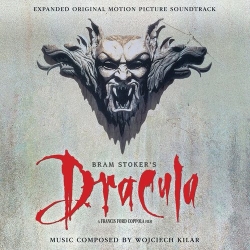
BRAM STOKER’S DRACULA – Wojciech Kilar
 GREATEST SCORES OF THE TWENTIETH CENTURY
Original Review by Craig Lysy
The genesis of the film lay with actress Winona Ryder, who wished to make amends with director Francis Ford Coppola after her late withdrawal from The Godfather Part III. She brought him a script written by James V. Hart, which provided an adaptation of the famous 1897 novel Dracula by Irish author Bram Stoker. Coppola was intrigued by the sensuality and eroticism of Hart’s retelling and immediately moved forward to bring it to the big screen. He would produce the film with Fred Fuchs and Charles Mulvehill using his own production company of American Zoetrope. Coppola had an uncompromising conception of the film and went to great lengths to create his cinematic vision. Indeed, the film shattered the traditional mythos and caricature of the black caped Dracula with a new, stylish, and significantly more erotic rendering. He assembled a fine, but controversial cast with Gary Oldman playing the titular role. Supporting him would be Winona Ryder as Mina, Anthony Hopkins as Professor Abraham Van Helsing, Keanu Reeves as Jonathan Harker, Richard E. Grant as Dr. Jack Seward, Cary Elwes as Lord Arthur Holmwood, Billy Campbell as Quincy Morris, Tom Waits as Renfield, and Sadie Frost as Lucy Westenra. Read more…
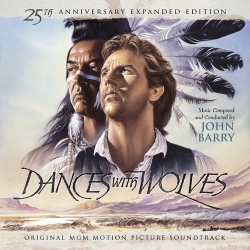
DANCES WITH WOLVES – John Barry
 GREATEST SCORES OF THE TWENTIETH CENTURY
Original Review by Craig Lysy
Kevin Costner had long wished to produce and star in a western and, after several years of searching, finally came upon a script by his friend Michael Blake that piqued his interest. Set in the post-Civil War era, the tale explored the clash of civilizations between the indigenous American Indians and the westward expanding white Europeans. Costner asked Blake to expand his script into a novel to improve its chances of being adapted to the big screen. He did so, and Dances With Wolves was published in 1988. Costner immediately purchased the film rights and set his plan into motion, using his own Tig Productions Company to finance the film. He would audaciously produce, direct and star in the film. He began with a production budget of $15 million dollars, which ballooned to $22 million due to his insistence on geographical, linguistic and cultural authenticity. To support him in the lead role of Lieutenant John Dunbar he hired Mary McDonnell as Stands With A Fist, Graham Greene as Kicking Bird, and Rodney A. Grant as Wind In His Hair. Read more…
EDWARD SCISSORHANDS – Danny Elfman
 GREATEST SCORES OF THE TWENTIETH CENTURY
Original Review by Craig Lysy
Director Tim Burton related that, as a teenager growing up in Burbank California, he felt estranged, isolated and misunderstood. A drawing by him of a solemn man bearing long sharp blades spoke to his inability to form and retain friends. The drawing served as inspiration for his film Edward Scissorhands, where he sought to explore a young man dealing with feelings of isolation and self-discovery. After reading First Born, a 1983 novelette by Caroline Thompson, he was sufficiently impressed to hire her to write the screenplay for the film. Burton and her sought inspiration from the classic monster movies of the past including The Hunchback of Notre Dame, The Phantom of the Opera, and Frankenstein, as well traditional fairy tales. The project was very personal to Burton, and Thompson relates she wrote the screenplay as a love poem to the director. 20th Century Fox acquired the film rights, and given Burton’s stunning commercial success with Batman in 1989, gave him complete creative control. He assembled a fine cast, including Johnny Depp for the titular role. Joining him would be Winona Ryder as Kim Boggs, Dianne Wiest as Peg Boggs, Anthony Michael Hall as Jim, Kathy Baker as Joyce, Robert Oliveri as Kevin Boggs, Alan Arkin as Bill Boggs, O-Lan Jones as Esmeralda, and Vincent Price in his final screen role as Edward’s creator. Read more…
HELLBOUND: HELLRAISER II – Christopher Young
 THROWBACK THIRTY
GREATEST SCORES OF THE TWENTIETH CENTURY
Original Review by Jonathan Broxton
The 1987 film Hellraiser, based on the novella The Hellbound Heart by British horror author Clive Barker, was an unexpected critical and commercial success at the box office, and as such an immediate sequel was commissioned to cash in on the new popularity of Pinhead and his merry band of ‘cenobite’ demons, who live in a realm of hell where pleasure, pain, and suffering are one. The resulting film, titled Hellbound: Hellraiser II, takes place in the immediate aftermath of the first film, and finds protagonist Kirsty (Ashley Laurence) – having escaped from Pinhead (Doug Bradley) – recovering in a mental institution under the care of Dr Channard (Kenneth Cranham). However, it is revealed that Channard is secretly obsessed with cenobites, and has been searching for the ‘lament configuration’ puzzle box that summons them for years. Despite Kirsty’s desperate pleas, Channard recovers the bloody mattress that Kirsty’s stepmother Julia (Clare Higgins) died on in the last film, and uses it to resurrect her; so begins a gruesome, desperate game, as Channard and Julia explore the realms of hell together, while Kirsty tries to stop the cenobites once and for all. The film was written by Peter Atkins and is directed by journeyman Tony Randel, taking over duties from Barker. Read more…
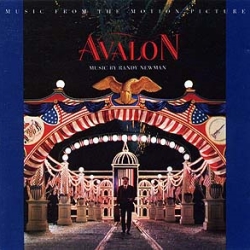
AVALON – Randy Newman
 GREATEST SCORES OF THE TWENTIETH CENTURY
Original Review by Craig Lysy
Avalon offered Barry Levinson’s third installment of his semi-autobiographical tetralogy of ”Baltimore Films” – Diner (1982), Tin Men (1987), Avalon (1990) and Liberty Heights (1999) – which explored immigrant life in his hometown Baltimore from the 1940s through the 1960s. He served as producer, director and screenwriter for the project and his production company Baltimore Pictures financed the film. He brought in a first class cast, which included Leo Fuchs as Hymie Krichinsky, Lou Jacobi as Gabriel Krichinsky, Armin Mueller-Stahl as Sam Krichinsky, Joan Plowright as Eva Krichinsky, Israel Rubinek as Nathan Krichinsky, Eve Gordon as Dottie Kirk, Elizabeth Perkins as Ann Kaye, Aiden Quinn as Jules Kaye and Elijah Wood as Michael Kaye. The film offers a commentary on the challenges of immigrant Russian-Jews trying to assimilate in America. Sam, the patriarch of the Krichinsky family, arrives in 1914 to forge a new life, eventually settling in Baltimore where he works as a wallpaper man. Matriarch Eva is firmly grounded in the old ways and ensures the family stays true to its roots. Conflicts between old country familial culture and modern American culture are inevitable and elicit generational clashes as Sam and Eva struggle to balance the old with the new. Despite hardships, which include an armed robbery, a devastating home fire, and children abandoning their surname for an American one, the family holds together, weathering the storm, united in love. The film was a commercial success and secured four Academy Award nominations including Best Screenplay, Best Cinematography, Best Costume Design and Best Film Score. Read more…
BATMAN – Danny Elfman
 GREATEST SCORES OF THE TWENTIETH CENTURY
Original Review by Craig Lysy
Bringing Batman to the cinema was a torturous journey that took ten years to come to fruition. Producers Benjamin Melniker and Micheal Uslan purchased screen rights from DC Comics in 1979, and their creative vision was to abandon the campy TV iteration and fashion a dark and serious exposition of the hero. Regretfully United Artists, Columbia Pictures and Universal Pictures all turned down the project, as they wanted a script that reprised the campiness of the TV series. Eventually in 1980 Warner Brothers took on the project seeking to capitalize on its massive success with Superman. Tom Mankiewicz was hired to write the script, which was completed in 1983. Yet the project stalled until 1985 when Tim Burton was hired. Burton wanted his own vision and so rejected Mankiewicz’s script, instead tasking Sam Hamm, a comic book fan, to write a new screenplay. After three years of delays by Warner Brothers executives, the film was given the green light to proceed in April of 1988. Casting the principles could have supported a feature film of its own. Instead of going with one of the leading male action movie stars of the day, Burton selected Michael Keaton whom he had directed in Beetlejuice, which caused uproar among comic book fans who sent 50,000 letters of protest to studio executives. The casting drama continued when Robin Williams was hired for the role of the Joker and then let go in favor of Jack Nicholson. Rounding out the cast would be Kim Basinger as Vicki Vale, Pat Hingle as Commissioner Gordon, Billy Dee Williams as Harvey Dent, and Jack Palance as Carl Grissom. Read more…
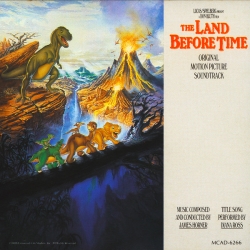
THE LAND BEFORE TIME – James Horner
 THROWBACK THIRTY
GREATEST SCORES OF THE TWENTIETH CENTURY
Original Review by Jonathan Broxton
The Land Before Time is an animated feature film for children, directed by Don Bluth and produced by Steven Spielberg and George Lucas. It’s set in the late cretaceous period, and follows the adventures of a group of orphaned dinosaurs searching for a fabled oasis where there is food, water, and safety. The main character is Littlefoot, a young Apatosaurus, who along with his friends – each of whom is a different species, such as a triceratops or a pteranodon – find themselves having to escape from numerous dangers, not least of which is a deadly ‘sharptooth’ Tyrannosaurus Rex that is hunting them. The film was incredibly popular at the time, and it works on multiple levels. Firstly, it is a fun story for children, with playful characters and a friendly cartoonish animation style. However, it also has some deeper meaning, addressing issues of racism (some of the adult dinosaurs are prejudiced against different species), climate change (the dinosaurs don’t know it, but they are living through a famine that heralds the beginning of their extinction event), friendship, and family. There is also some surprisingly dark material too, including some quite intense and frightening sequences involving the Tyrannosaurus, as well as character deaths which left real emotional scars on an entire generation of kids. Amazingly, the film spawned an incredible thirteen direct-to-video sequels and even a TV series, although none of them reached the level of acclaim the original had. Read more…
THE VIKINGS – Mario Nascimbene
 GREATEST SCORES OF THE TWENTIETH CENTURY
Original Review by Craig Lysy
Kirk Douglas came upon the 1951 novel The Viking by Edison Marshall and thought it offered a great opportunity to showcase his talents as a leading man. His production company Bryna Productions purchased the screen rights, and he brought in Jerry Bresler to produce. He tasked veteran Richard Fleischer whom he had successfully collaborated with on 20,000 Leagues Under The Sea (1954) to direct. Calder Willingham and Dale Wasserman were hired to write the screenplay, and after several incarnations, a final script was realized. To achieve his vision, Douglas insisted on authenticity and so the film was shot on location in Norway, whose harsh, damp and cold weather placed actors and crew under great duress. Douglas would play the lead role of Einar and be supported by Tony Curtis as Eric, Ernest Borgnine as Ragnar Lodbrok, Janet Leigh as Princess Morgana, James Donald as Lord Egbert, Alexander Knox as Father Goodwin, and Frank Thring as King Aella of Northumbria, with narration provided by Orson Welles. Read more…
CINEMA PARADISO – Ennio Morricone
 GREATEST SCORES OF THE TWENTIETH CENTURY
Original Review by Craig Lysy
As a young small town Sicilian boy, director Giuseppe Tornatore fell in love with the cinema where he would spend hours every day insatiably viewing films. With the advent of television and the VCR, many believed that the days of the town cinema were numbered. This film abounds with nostalgia as Tornatore explores his movie going memories and how they affected his life. Drawing from his own life experiences, he crafted a screenplay, which secured the financial backing of the French production company Les Films Ariane. A fine cast was assembled, which included; Philippe Noiret as Alfredo, Salvatore Cascio as Salvatore Di Vita (child), Marco Leonardo as Salvatore Di Vita (adolescent), Jacques Perrin as Salvatore Di Vita (adult), Agnese Nano as Elena Mendola (young), Leopoldo Trieste as Father Adelfio, Antonella Attili as Maria (young), Pupella Maggio as Maria (adult) and Isa Danieli as Ana. Salvatore Di Vita, aka Toto, is a precocious kid who falls in love with movies shown at his town’s theater, Cinema Paradiso. It comes to pass that he worms his way into the heart of projectionist Alfredo, who befriends him and takes him on as his apprentice. Over time Salvatore masters the projector and often runs it himself. So great is his love of movies that he buys a movie camera and begins making his own home movies. Tragedy strikes one night when the Cinema Paradiso catches fire and burns down, with Salvatore saving Alfredo’s life, but not before he is badly burned and blinded. Read more…
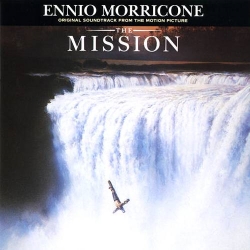
THE MISSION – Ennio Morricone
 GREATEST SCORES OF THE TWENTIETH CENTURY
Original Review by Craig Lysy
Producer David Putnam and director Roland Joffe were seeking to sustain the acclaim of their last collaboration, The Killing Fields (1984), and so recruited renowned screenwriter Robert Bolt to compose a compelling historical drama. The independent British production company Goldcrest Films financed the project, providing a generous budget, and a fine cast was assembled, which included Robert De Niro as Captain Rodrigo Mendoza, Jeremy Irons as Father Gabriel, Ray McAnally as Cardinal Altamirano, Aidan Quinn as Felipe Mendoza, Cherie Lunghi as Carlotta, Ronald Pickup as Don Hatar, Chuck Low as Don Cabeza and Liam Neeson as Father John Fielding. The film offers a classic morality play, which explores the tragic events surrounding the 1750 Treaty of Madrid. The Spanish and Portuguese are warring along the Brazil and Paraguayan border and the treaty ended the conflict by requiring Spain to cede territory south and east of the Rio Uruguay to Portugal. This would require the seven Jesuit missionaries to leave and place the Guarani inhabitants in peril as Portugal, unlike Spain, used slavery to man their plantations. The film opens in 1740 with Jesuit missionary Father Gabriel seeking to convert the Guarani to Catholicism. The opening scene of a Jesuit cast over the waterfall tied to a cross reveals the Guarani’s hostility to outsiders. He is joined by slaver Rodrigo Mendoza who seeks repentance following the murder of his brother, who he caught sleeping with his fiancée. Father Gabriel gains the trust of the Guarani through his oboe playing and they over time convert. Rodrigo finds new meaning to his life, abandons weapons, and commits to joining the priesthood. Read more…

Shop at the Movie Music UK Store

Member of the

 MOVIE MUSIC UK