Archive
TITANIC – James Horner
 GREATEST SCORES OF THE TWENTIETH CENTURY
Original Review by Craig Lysy
James Cameron had long been fascinated with shipwrecks and conceived to write a love story set on the greatest shipwreck of all time – the RMS Titanic. He believed that telling the story of the sinking of the great ship in and of itself was insufficient, so the addition of a love story as well as an intimate exploration of the lives of the people who died would add a compelling narrative to the tale. He pitched his story to 20th Century Fox executives as ‘Romeo and Juliet on the Titanic’. They bought his idea given his resume of directorial success, as they wanted to secure him for future projects. He was provided with the largest budget ever for a film at that time – $200 million – and took it upon himself to do what had never been done before; to produce, direct, write and edit a film. He brought in a fine cast to support his vision, including Leonardo Di Caprio as Jack Dawson, Kate Winslet as Rose DeWitt Bukater, Billy Zane as Cal Hockley, Frances Fisher as Ruth DeWitt Bukater, Gloria Stuart as the older Rose, Kathy Bates as the Unsinkable Margaret “Molly” Brown, Victor Garber as Thomas Andrews, Bill Paxton as Brock Lovett, David Warner as Spicer Lovejoy, and Danny Nucci as Fabrizio De Rossi. Read more…
Academy Award Winners 1997
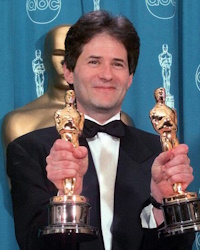 The Academy of Motion Picture Arts and Sciences (AMPAS) have announced the winners of the 70th Academy Awards, honoring the best in film in 1997.
In the Best Original Dramatic Score category James Horner won the award for his score for director James Cameron’s epic drama Titanic. In his acceptance speech, Horner said:
“Oh my dear God. I’m sort of speechless. One wants this to happen, of course, but I’ve been so close quite a few times but never actually won. I’ve got to get my wits about me. I don’t write speeches because I’m always so superstitious. I want to thank my wife, my family for all of their support and nourishment. Jim, thank you so much for the chance to do it. And the musicians who I know so well, and so many other people but I have so little time. I want to thank Michael Gorfaine, Jim Henrikson, but Michael Gorfaine especially. You’ve been around so long and I cannot thank you enough. Thanks, everybody.”
The other nominees for Best Original Dramatic Score were John Williams for Amistad, Danny Elfman for Good Will Hunting, Philip Glass for Kundun, and Jerry Goldsmith for L.A. Confidential.
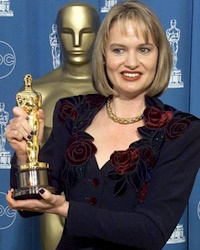 In the Best Original Comedy Score category Anne Dudley won the award for her score for The Full Monty, about a group of former steelworkers from Sheffield who become male strippers. In her acceptance speech, Dudley said:
“Thank you very much. This is a great honor. It’s great to be here; it’s wonderful. It’s been amazing being part of the success of “The Full Monty” over the past year. Nobody, of course, works alone on a film, and I’d really like to thank Peter Cattaneo and Uberto Pasolini for their brilliance and inspiration and encouragement. And the musicians who played the music and brought it to life. Thank you very much.”
The other nominees were Stephen Flaherty, Lynn Ahrens and David Newman for Anastasia; Hans Zimmer for As Good as It Gets; Danny Elfman for Men in Black; and James Newton Howard for My Best Friend’s Wedding.
In the Best Original Song category, James Horner won his second Oscar of the evening alongside lyricist Will Jennings for “My Heart Will Go On” from Titanic performed by Céline Dion.
The other nominees for Best Original Song were Alan Menken and David Zippel for “Go the Distance” from Hercules; Diane Warren for “How Do I Live” from Con Air; Stephen Flaherty and Lynn Ahrens for “Journey to the Past” from Anastasia; and Elliott Smith for “Miss Misery” from Good Will Hunting.

Shop at the Movie Music UK Store

Member of the


