COOKIE’S FORTUNE – David A. Stewart
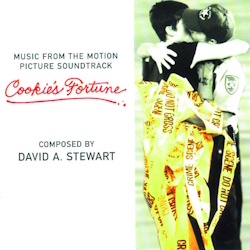 Original Review by Jonathan Broxton
Director Robert Altman is equally known for his for his “eclectic” tastes in casting and subject matter as he is for brilliance as a visual dramatist and storyteller. Altman is the man who, in the past, has helmed such notable works as M*A*S*H, McCabe and Mrs. Miller, The Long Goodbye, Nashville and the ill-fated Popeye. Recently, Altman has brought us a scathing satire of the Hollywood studio system in The Player, an examination of life in suburban American in Short Cuts, a look inside the world of high fashion with Pret-A-Porter, and a relatively straightforward court room thriller with The Gingerbread Man. For his latest effort, Altman is returning to the location he visited in Short Cuts by taking a look behind the white picket fences of small town USA in the critically acclaimed Cookie’s Fortune. Read more…
Academy Award Winners 1998
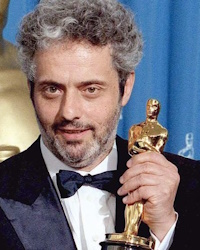 The Academy of Motion Picture Arts and Sciences (AMPAS) have announced the winners of the 71st Academy Awards, honoring the best in film in 1998.
In the Best Original Dramatic Score category, Italian composer Nicola Piovani won the award for his score for Roberto Benigni’s Life Is Beautiful. In his acceptance speech, Piovani said:
It’s impossible for me in this moment [to] speak about my emotion in English. I can tell just: Thank you to the jury. Thank you, the Academy. Thank you, Roberto.
The other nominees for Best Original Dramatic Score were David Hirschfelder for Elizabeth, Randy Newman for Pleasantville, John Williams for Saving Private Ryan, and Hans Zimmer for The Thin Red Line.
In the Best Original Comedy Score category composer Stephen Warbeck won for his score for the Elizabethan-era comedy Shakespeare in Love. In her acceptance speech, Warbeck said:
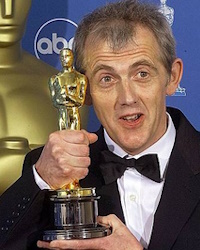 It’s a very, very exciting moment. Thank you very much. Especially exciting because John Madden is such a fantastically stimulating person to collaborate with. So thank you, John. Thank you to the Academy. Thank you to Sarah, Jessica, Herbert, Matilda. And thank you to my mother and father. Thank you to the lovely producers, without whom we wouldn’t be here or the people involved in this. Thank you to William Shakespeare, Bertolt Brecht, and The Kippers, for inspiring me to write music for the theater and other things. And thank you, thank you to all the friends who worked on the music, without whom it would just be squiggles on a piece of paper: John Parricelli, Eleanor Alberga, Chris Dibble, Nick Ingman, Martin Robinson, Paul, Gary and Frank. Thank you very much indeed. This is lovely. Thank you.
The other nominees were Randy Newman for A Bug’s Life; Matthew Wilder, David Zippel and Jerry Goldsmith for Mulan; Marc Shaiman for Patch Adams; and Stephen Schwartz and Hans Zimmer for The Prince of Egypt.
In the Best Original Song category, composer and lyricist Stephen Schwartz won for “When You Believe” from The Prince of Egypt performed by Whitney Houston and Mariah Carey. Schwartz, however, was not present to accept the award, as he was in New York rehearsing a show.
The other nominees were Diane Warren for “I Don’t Want to Miss a Thing” from Armageddon; Carole Bayer Sager, David Foster, Tony Renis and Alberto Testa for “The Prayer” from Quest for Camelot; Allison Moorer and Gwil Owen for “A Soft Place to Fall” from The Horse Whisperer; and Randy Newman for “That’ll Do” from Babe: Pig in the City.
Ernest Gold, 1921-1999
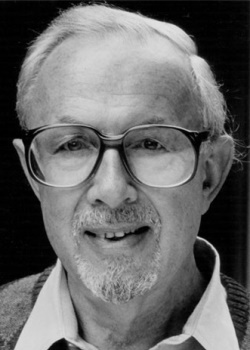 Composer and conductor Ernest Gold died in Santa Monica, California, on March 17, 1999, at the age of 77, following a stroke.
An Austrian-born composer who became one of Hollywood’s leading musical voices during the 1950s and 1960s, Gold wrote scores for more than 100 film and television productions. He received four Academy Award nominations, winning for Otto Preminger’s Exodus, and enjoyed an especially fruitful collaboration with director Stanley Kramer.
Gold was born Ernst Sigmund Goldner in Vienna on July 13, 1921, into a musical family and began composing while still a child. Following the Nazi annexation of Austria, his family emigrated to the United States in 1938, settling in New York. Gold initially wrote popular songs while continuing his musical studies, and eventually moved to Hollywood, where he began working on low-budget features while also orchestrating and conducting for other composers.
After a decade of smaller assignments, Gold’s career accelerated in the late 1950s. He worked with Stanley Kramer on The Defiant Ones (1958) and then composed On the Beach (1959), Kramer’s bleak drama about the aftermath of nuclear war. Gold ingeniously incorporated the Australian song “Waltzing Matilda” throughout the score, transforming the familiar melody from something nostalgic and comforting into an increasingly tragic reminder of a world facing extinction. The score earned him his first Academy Award nomination and won the Golden Globe for Best Original Score.
Gold’s greatest success came the following year with Otto Preminger’s epic Exodus (1960), starring Paul Newman. Its expansive main theme, combining sweeping romanticism with musical gestures intended to evoke the film’s Israeli setting, became one of the most popular film themes of its era. The soundtrack was an enormous commercial success, the theme was recorded by numerous artists, and Gold won the Academy Award for Best Dramatic or Comedy Score as well as two Grammy Awards. Exodus remains by far his best-known work and established him internationally as a major film composer. Read more…
NINETEEN EIGHTY-FOUR – Dominic Muldowney
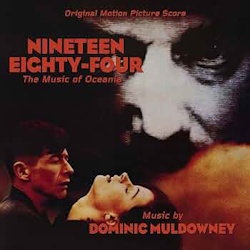 Original Review by Jonathan Broxton
The thought police. Big brother is watching you. Who, if anyone, can claim to be unaware of the legacy left by George Orwell’s novel Nineteen Eighty-Four, in which he outlined his terrifying vision of a totalitarian, oppressive future in the land of Oceania. Director Michael Radford, who would later go on to helm the recent Oscar winner Il Postino, adhered faithfully to the guidelines set out by Orwell during filming, using the precise locations and dates set out in the text, assembling a stellar cast including Richard Burton, John Hurt and Cyril Cusack to breathe life into the classic prose.
Upon its release, Nineteen Eighty-Four was a critical and commercial smash hit, but one of the most debated elements of the film surrounded the eventual removal of the original score in favour of pop songs by the British rock group, the Eurythmics. Since the release of Nineteen Eighty-Four, Dominic Muldowney has become one of the most influential composers in English theatre, but has limited his screen work to a few feature films and episodes of the TV series Sharpe. Nineteen Eighty-Four remains his most celebrated cinematic work to date, but until now has been unavailable on CD. This release from the Airstrip One company and producer Christopher Landry marks the first time the complete score has ever been heard on CD. Read more…
BAFTA Nominations 1998
 The British Academy of Film and Television Arts (BAFTA) has announced the nominations for the 52nd British Academy Film Awards, honoring the best in film in 1998.
In the Best Original Music category, which is named in memory of the film director Anthony Asquith, the nominees are:
- DAVID HIRSCHFELDER for Elizabeth
- BARRINGTON PHELOUNG for Hilary and Jackie
- STEPHEN WARBECK for Shakespeare In Love
- JOHN WILLIAMS for Saving Private Ryan
These are the first nominations for Pheloung and Warbeck. It is the third nomination for Hirschfelder, and the ninth nomination for Williams. Hirschfelder previously won for Strictly Ballroom in 1992. Williams previously won for Jaws and The Towering Inferno in 1975, Star Wars in 1978, The Empire Strikes Back in 1980, E.T. the Extra-Terrestrial in 1982, Empire of the Sun in 1988, and Schindler’s List in 1993.
The winners of the 52nd BAFTA Awards will be announced on April 11, 1999.
THE BEYONDNESS OF THINGS – John Barry
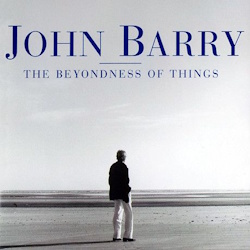 Original Review by Jonathan Broxton
If one was to take everything that is good about John Barry’s music and compress it into one, all-encompassing album, you would end up with The Beyondness of Things. Strictly, The Beyondness of Things is not a soundtrack: it is a unique, individual classical piece written by Barry for his own pleasure and released by London Records for us all to enjoy. But, more than that, it is a celebration of the work of a true film music legend – a testament to nearly forty years of dedicated service to the industry, in which time he has composed some of the most well loved and beautiful music the cinema has ever known. It is also a personal odyssey on Barry’s part, in which he has tried to musically sum up his life to date, capturing the innocence and wonder of his childhood in the Yorkshire countryside, the heady heights of fame in America, with all its trappings and temptations, and finally the satisfied, relaxed semi-retirement he enjoys today (I say semi-retirement – he has just released Mercury Rising and has two other scores currently on the back burner, so it is not as though he is not working!) Read more…
Academy Award Nominations 1998
 The Academy of Motion Picture Arts and Sciences (AMPAS) have announced the nominations for the 71st Academy Awards, honoring the best in film in 1998.
In the Best Original Dramatic Score category, the nominees are:
- DAVID HIRSCHFELDER for Elizabeth
- RANDY NEWMAN for Pleasantville
- NICOLA PIOVANI for Life is Beautiful
- JOHN WILLIAMS for Saving Private Ryan
- HANS ZIMMER for The Thin Red Line
In the Best Original Musical or Comedy Score category, the nominees are:
- JERRY GOLDSMITH, MATTHEW WILDER, and DAVID ZIPPEL for Mulan
- RANDY NEWMAN for A Bug’s Life
- MARC SHAIMAN for Patch Adams
- STEPHEN WARBECK for Shakespeare in Love
- HANS ZIMMER and STEPHEN SCHWARTZ for The Prince of Egypt
These are the first Oscar nominations for Piovani, Warbeck, Wilder, and Zippel, and is the second nomination for Hirschfelder. These are the 6th and 7th nominations for Newman, the 32nd nomination for Williams, the 5th nomination for Zimmer, the 17th nomination for Goldsmith, the 3rd nomination for Shaiman, and the 3rd nomination for Schwartz.
Goldsmith previously won for The Omen in 1976. Schwartz previously won for Pocahontas in 1996. Williams previously won for Fiddler on the Roof in 1971, Jaws in 1975, Star Wars in 1977, E.T. the Extra Terrestrial in 1982, and Schindler’s List in 1993. Zimmer previously won for The Lion King in 1994.
In the Best Original Song category, the nominees are:
- CAROLE BAYER SAGER, DAVID FOSTER, TONY RENIS, and ALBERTO TESTA for “The Prayer” from Quest for Camelot
- ALLISON MOORER and GWIL OWEN for “A Soft Place to Fall” from The Horse Whisperer
- RANDY NEWMAN for “That’ll Do” from Babe: Pig in the City
- STEPHEN SCHWARTZ for “When You Believe” from The Prince of Egypt
- DIANE WARREN for “”I Don’t Want to Miss a Thing” from Armageddon
The winners of the 71st Academy Awards will be announced on March 21, 1999.
Remembering Lionel Newman, 1916-1989
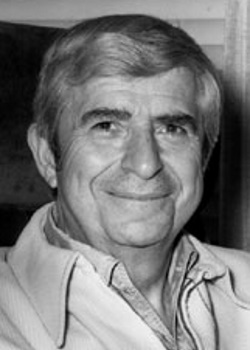 Composer, conductor, arranger and music executive Lionel Newman died in Los Angeles ten years ago today, on February 3, 1989, at the age of 73, following a heart attack.
A member of Hollywood’s extraordinary Newman musical dynasty, he spent more than four decades at 20th Century Fox, eventually becoming senior vice president of music. Newman received 11 Academy Award nominations and won for his adaptation of Hello, Dolly! in 1970.
Newman was born in New Haven, Connecticut, on January 4, 1916, the youngest of several musically gifted brothers, including composers Alfred and Emil Newman. He began working professionally while still a teenager, conducted for producer Earl Carroll and spent several years accompanying Mae West before following Alfred to Hollywood. In 1943 he joined 20th Century Fox as a rehearsal pianist and gradually progressed through the studio’s music department as conductor, composer, arranger and musical supervisor.
As an original composer, Newman worked on films including Cheaper by the Dozen (1950), Road House (1948), Love Me Tender (1956), The Proud Ones (1956), April Love (1957) and North to Alaska (1960). His song “Again,” written with Dorcas Cochran for Road House, became a popular standard, while Love Me Tender, Elvis Presley’s screen debut, demonstrated Newman’s ability to work comfortably within the changing musical world of 1950s Hollywood. Read more…
Golden Globe Nominations 1998
 The Hollywood Foreign Press Association (HFPA) has announced the nominations for the 56th Golden Globe Awards, honoring the best in film and American television of 1998.
In the Best Original Score category, the nominees are:
- BURKHARD DALLWITZ and PHILIP GLASS for The Truman Show
- JERRY GOLDSMITH for Mulan
- RANDY NEWMAN for A Bug’s Life
- JOHN WILLIAMS for Saving Private Ryan
- HANS ZIMMER and STEPHEN SCHWARTZ for The Prince of Egypt
These are the first nominations for Dallwitz and Schwartz. This is the second nomination for Glass, the second nomination for Newman, the second nomination for Zimmer, the ninth nomination for Goldsmith, and the seventeenth nomination for Williams. Zimmer previously won for The Lion King in 1994. Williams previously won for Jaws in 1975, Star Wars in 1977, and E.T. The Extra-Terrestrial in 1982
In the Best Original Song category, the nominees are:
- CAROLE BAYER SAGER, DAVID FOSTER, TONY RENIS, and ALBERTO TESTA for “The Prayer” from Quest for Camelot
- CHRIS DIFFORD, MARTI FREDERIKSEN, and MICK JONES for “The Flame Still Burns” from Still Crazy
- ALANIS MORISSETTE for “Uninvited” from City of Angels
- STEPHEN SCHWARTZ and KENNETH EDMONDS (BABYFACE) for “When You Believe” from The Prince of Egypt
- GORDON SUMNER (STING) for “The Mighty” from The Mighty
- MATTHEW WILDER and DAVID ZIPPEL for “Reflection” from Mulan
The winners of the 56th Golden Globe Awards will be announced on January 24, 1999.
John Addison, 1920-1998
 Composer John Addison died on December 7, 1998, at his home in Bennington, Vermont, after a short illness. He was 78.
John Mervyn Addison was born in Chobham, Surrey, England, in March 1920, and studied composition at the Royal College of Music. His education was interrupted by service in World War II, where he served with distinction in the British Army, seeing action in Normandy and the Netherlands, and participating in Operation Market Garden. The experience would later inform one of his best-known works: the rousing score to A Bridge Too Far (1977), a film about the Allied operation that Addison survived.
Addison’s breakthrough in film came in 1950 with the British thriller Seven Days to Noon, and over the course of the subsequent decade he wrote scores for popular British films such as The Man Between (1953), The Cockleshell Heroes (1955), Reach for the Sky (1956), Three Men in a Boat (1956), Lucky Jim (1957), A Taste of Honey (1961), and The Loneliness of the Long Distance Runner (1962).
It was Addison’s sparkling, Oscar-winning score for Tony Richardson’s Tom Jones in 1963 that brought him international recognition. The music’s vivacious period stylings, full of energy and wit, became a defining element of the film’s success. Following his Oscar win Addison split his time between the UK and Hollywood, and in the years thereafter he composed scores for films such as Smashing Time (1967), The Honey Pot (1967), The Charge of the Light Brigade (1968), Sleuth (1972, his second Oscar nomination), Swashbuckler (1976), and The Seven-Per-Cent Solution (1976), earning both critical acclaim and popular success. Notably, Addison also composed the replacement score for Alfred Hitchcock’s film Torn Curtain in 1966, which is now remembered as the film which ended Hitchcock’s relationship with Bernard Herrmann. Read more…
AMERICAN HISTORY X – Anne Dudley
 Original Review by Jonathan Broxton
Tony Kaye, the director of American History X, was so incensed when New Line Pictures re-edited his film against his wishes, he threatened to remove his name from the final cut and replace it with Humpty Dumpty. He believed that the core of the film, its very essence, had been stripped away by the barbarous production company, and that the finished product was now only half the movie it used to be. Having seen New Line’s end result, I can only wonder just what Kaye’s original cut was like, because as it stands American History X is still one of the most emotionally shattering, intellectually stimulating, totally amazing movies I have seen in years. Read more…
Paul Misraki, 1908-1998
 Composer and songwriter Paul Misraki died in Paris on October 29, 1998, at the age of 90.
One of the most prolific figures in French popular music and cinema, Misraki enjoyed a career spanning more than six decades, writing hundreds of songs and scores for well over 100 films. Although best remembered in France for a succession of enormously popular songs, film-music enthusiasts know him for works including And God Created Woman, Les Cousins, Le Doulos and Jean-Luc Godard’s science-fiction classic Alphaville.
Paul Misrachi was born in Constantinople, then part of the Ottoman Empire, on January 28, 1908, into a Jewish family of Italian ancestry. He spent part of his childhood in Bucharest before the family settled in Paris, where he received a classical musical education and developed an enthusiasm for jazz and popular song. His professional breakthrough came when he joined Ray Ventura’s celebrated orchestra, Les Collégiens, initially as a pianist and arranger and soon as one of its principal songwriters.
During the 1930s Misraki became one of France’s most successful popular composers. His songs included “Tout va très bien, Madame la Marquise,” “Qu’est-ce qu’on attend pour être heureux?” and “Ça vaut mieux que d’attraper la scarlatine,” witty and immediately memorable pieces that became closely associated with Ventura and the carefree musical culture of pre-war France. He also began composing for films, an activity which eventually became a major part of his career. Read more…
A RESPECTABLE TRADE – Julian Nott
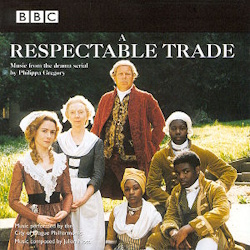 Original Review by Jonathan Broxton
The BBC are renowned the world over for their high quality TV features and drama series, and many high profile composers cut their musical teeth on these comparatively small-scale projects. One of Rachel Portman’s first assignments was for the mini-series Oranges Are Not The Only Fruit. Debbie Wiseman wrote for sitcoms before getting her big break with Tom & Viv, and people like Harry Gregson-Williams, Barrington Pheloung and Richard Hartley were working on British TV movies as recently as 1996. The latest addition to the list of composers making names for themselves on this side of the pond is Julian Nott. Nott is probably most famous for the bouncy brass band march he wrote for the main titles of the cult Wallace and Gromit animated shorts, so the beautiful, emotional music in A Respectable Trade may come as something of a surprise to those unfamiliar with his other works. Read more…
Remembering Ronald Stein, 1930-1988
 Composer Ronald Stein died in Los Angeles ten years ago today, on August 15, 1988, at the age of 58, from pancreatic cancer.
One of the defining musical voices of American low-budget genre cinema, Stein wrote music for more than 140 films during a career stretching from the mid-1950s into the 1970s. He was especially associated with American International Pictures and producer-director Roger Corman, bringing invention and musical seriousness to films including It Conquered the World, Attack of the Crab Monsters, Attack of the 50 Foot Woman, The Premature Burial and The Haunted Palace.
Louis Ronald Stein was born in St. Louis, Missouri, on April 12, 1930. His mother, Cecilia, had played piano for silent films and gave him his earliest musical training, encouraging both his musicianship and his fascination with cinema. He studied at Washington University in St. Louis, where he wrote for theatrical productions and worked with the Municipal Opera, before continuing his studies at Yale. His education was interrupted by military service, during which he composed and conducted shows for the U.S. Army Special Services.
After leaving the Army, Stein moved to Hollywood determined to become a film composer, despite receiving discouraging advice from established studio musicians. His opportunity came through Roger Corman, who hired him to score the western Apache Woman in 1955. Stein’s ability to compose and conduct quickly on tiny budgets led to a five-year contract with American International Pictures and an extraordinary period of productivity. Read more…
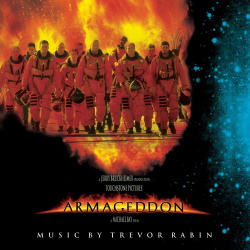
ARMAGEDDON – Trevor Rabin
 Original Review by Jonathan Broxton
In the all-spectacle, no-brains world of the Hollywood summer blockbuster, Armageddon became the antithesis of everything that people find wrong with commercial film making. Even the title – “commercial” film making – smacks of financial return being held in higher esteem than artistic merit. Everyone hated it, from the critics at Cannes who laughed during the premiere, to the newspaper hacks who decried the banal dialogue, Bruce Willis’ wooden lead performance, and the glaring implausibilities in the plotline. Despite this, audiences loved it. For all its shortcomings, Armageddon was an out-and-out crowdpleaser, with genuinely spectacular special effects, plenty of action and romance and, in the shape of Ben Affleck and Liv Tyler, two cover-story attractive protagonists. Read more…

Shop at the Movie Music UK Store

Member of the


