Archive
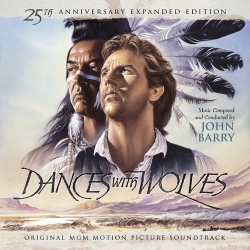
DANCES WITH WOLVES – John Barry
 GREATEST SCORES OF THE TWENTIETH CENTURY
Original Review by Craig Lysy
Kevin Costner had long wished to produce and star in a western and, after several years of searching, finally came upon a script by his friend Michael Blake that piqued his interest. Set in the post-Civil War era, the tale explored the clash of civilizations between the indigenous American Indians and the westward expanding white Europeans. Costner asked Blake to expand his script into a novel to improve its chances of being adapted to the big screen. He did so, and Dances With Wolves was published in 1988. Costner immediately purchased the film rights and set his plan into motion, using his own Tig Productions Company to finance the film. He would audaciously produce, direct and star in the film. He began with a production budget of $15 million dollars, which ballooned to $22 million due to his insistence on geographical, linguistic and cultural authenticity. To support him in the lead role of Lieutenant John Dunbar he hired Mary McDonnell as Stands With A Fist, Graham Greene as Kicking Bird, and Rodney A. Grant as Wind In His Hair. Read more…
EDWARD SCISSORHANDS – Danny Elfman
 GREATEST SCORES OF THE TWENTIETH CENTURY
Original Review by Craig Lysy
Director Tim Burton related that, as a teenager growing up in Burbank California, he felt estranged, isolated and misunderstood. A drawing by him of a solemn man bearing long sharp blades spoke to his inability to form and retain friends. The drawing served as inspiration for his film Edward Scissorhands, where he sought to explore a young man dealing with feelings of isolation and self-discovery. After reading First Born, a 1983 novelette by Caroline Thompson, he was sufficiently impressed to hire her to write the screenplay for the film. Burton and her sought inspiration from the classic monster movies of the past including The Hunchback of Notre Dame, The Phantom of the Opera, and Frankenstein, as well traditional fairy tales. The project was very personal to Burton, and Thompson relates she wrote the screenplay as a love poem to the director. 20th Century Fox acquired the film rights, and given Burton’s stunning commercial success with Batman in 1989, gave him complete creative control. He assembled a fine cast, including Johnny Depp for the titular role. Joining him would be Winona Ryder as Kim Boggs, Dianne Wiest as Peg Boggs, Anthony Michael Hall as Jim, Kathy Baker as Joyce, Robert Oliveri as Kevin Boggs, Alan Arkin as Bill Boggs, O-Lan Jones as Esmeralda, and Vincent Price in his final screen role as Edward’s creator. Read more…
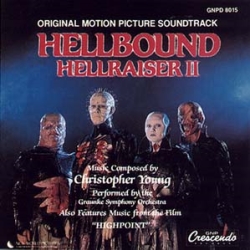
HELLBOUND: HELLRAISER II – Christopher Young
 THROWBACK THIRTY
GREATEST SCORES OF THE TWENTIETH CENTURY
Original Review by Jonathan Broxton
The 1987 film Hellraiser, based on the novella The Hellbound Heart by British horror author Clive Barker, was an unexpected critical and commercial success at the box office, and as such an immediate sequel was commissioned to cash in on the new popularity of Pinhead and his merry band of ‘cenobite’ demons, who live in a realm of hell where pleasure, pain, and suffering are one. The resulting film, titled Hellbound: Hellraiser II, takes place in the immediate aftermath of the first film, and finds protagonist Kirsty (Ashley Laurence) – having escaped from Pinhead (Doug Bradley) – recovering in a mental institution under the care of Dr Channard (Kenneth Cranham). However, it is revealed that Channard is secretly obsessed with cenobites, and has been searching for the ‘lament configuration’ puzzle box that summons them for years. Despite Kirsty’s desperate pleas, Channard recovers the bloody mattress that Kirsty’s stepmother Julia (Clare Higgins) died on in the last film, and uses it to resurrect her; so begins a gruesome, desperate game, as Channard and Julia explore the realms of hell together, while Kirsty tries to stop the cenobites once and for all. The film was written by Peter Atkins and is directed by journeyman Tony Randel, taking over duties from Barker. Read more…
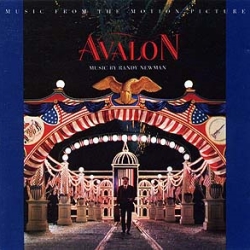
AVALON – Randy Newman
 GREATEST SCORES OF THE TWENTIETH CENTURY
Original Review by Craig Lysy
Avalon offered Barry Levinson’s third installment of his semi-autobiographical tetralogy of ”Baltimore Films” – Diner (1982), Tin Men (1987), Avalon (1990) and Liberty Heights (1999) – which explored immigrant life in his hometown Baltimore from the 1940s through the 1960s. He served as producer, director and screenwriter for the project and his production company Baltimore Pictures financed the film. He brought in a first class cast, which included Leo Fuchs as Hymie Krichinsky, Lou Jacobi as Gabriel Krichinsky, Armin Mueller-Stahl as Sam Krichinsky, Joan Plowright as Eva Krichinsky, Israel Rubinek as Nathan Krichinsky, Eve Gordon as Dottie Kirk, Elizabeth Perkins as Ann Kaye, Aiden Quinn as Jules Kaye and Elijah Wood as Michael Kaye. The film offers a commentary on the challenges of immigrant Russian-Jews trying to assimilate in America. Sam, the patriarch of the Krichinsky family, arrives in 1914 to forge a new life, eventually settling in Baltimore where he works as a wallpaper man. Matriarch Eva is firmly grounded in the old ways and ensures the family stays true to its roots. Conflicts between old country familial culture and modern American culture are inevitable and elicit generational clashes as Sam and Eva struggle to balance the old with the new. Despite hardships, which include an armed robbery, a devastating home fire, and children abandoning their surname for an American one, the family holds together, weathering the storm, united in love. The film was a commercial success and secured four Academy Award nominations including Best Screenplay, Best Cinematography, Best Costume Design and Best Film Score. Read more…
BATMAN – Danny Elfman
 GREATEST SCORES OF THE TWENTIETH CENTURY
Original Review by Craig Lysy
Bringing Batman to the cinema was a torturous journey that took ten years to come to fruition. Producers Benjamin Melniker and Micheal Uslan purchased screen rights from DC Comics in 1979, and their creative vision was to abandon the campy TV iteration and fashion a dark and serious exposition of the hero. Regretfully United Artists, Columbia Pictures and Universal Pictures all turned down the project, as they wanted a script that reprised the campiness of the TV series. Eventually in 1980 Warner Brothers took on the project seeking to capitalize on its massive success with Superman. Tom Mankiewicz was hired to write the script, which was completed in 1983. Yet the project stalled until 1985 when Tim Burton was hired. Burton wanted his own vision and so rejected Mankiewicz’s script, instead tasking Sam Hamm, a comic book fan, to write a new screenplay. After three years of delays by Warner Brothers executives, the film was given the green light to proceed in April of 1988. Casting the principles could have supported a feature film of its own. Instead of going with one of the leading male action movie stars of the day, Burton selected Michael Keaton whom he had directed in Beetlejuice, which caused uproar among comic book fans who sent 50,000 letters of protest to studio executives. The casting drama continued when Robin Williams was hired for the role of the Joker and then let go in favor of Jack Nicholson. Rounding out the cast would be Kim Basinger as Vicki Vale, Pat Hingle as Commissioner Gordon, Billy Dee Williams as Harvey Dent, and Jack Palance as Carl Grissom. Read more…
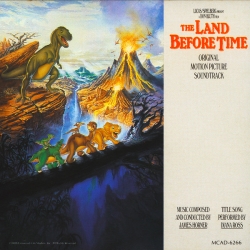
THE LAND BEFORE TIME – James Horner
 THROWBACK THIRTY
GREATEST SCORES OF THE TWENTIETH CENTURY
Original Review by Jonathan Broxton
The Land Before Time is an animated feature film for children, directed by Don Bluth and produced by Steven Spielberg and George Lucas. It’s set in the late cretaceous period, and follows the adventures of a group of orphaned dinosaurs searching for a fabled oasis where there is food, water, and safety. The main character is Littlefoot, a young Apatosaurus, who along with his friends – each of whom is a different species, such as a triceratops or a pteranodon – find themselves having to escape from numerous dangers, not least of which is a deadly ‘sharptooth’ Tyrannosaurus Rex that is hunting them. The film was incredibly popular at the time, and it works on multiple levels. Firstly, it is a fun story for children, with playful characters and a friendly cartoonish animation style. However, it also has some deeper meaning, addressing issues of racism (some of the adult dinosaurs are prejudiced against different species), climate change (the dinosaurs don’t know it, but they are living through a famine that heralds the beginning of their extinction event), friendship, and family. There is also some surprisingly dark material too, including some quite intense and frightening sequences involving the Tyrannosaurus, as well as character deaths which left real emotional scars on an entire generation of kids. Amazingly, the film spawned an incredible thirteen direct-to-video sequels and even a TV series, although none of them reached the level of acclaim the original had. Read more…
THE VIKINGS – Mario Nascimbene
 GREATEST SCORES OF THE TWENTIETH CENTURY
Original Review by Craig Lysy
Kirk Douglas came upon the 1951 novel The Viking by Edison Marshall and thought it offered a great opportunity to showcase his talents as a leading man. His production company Bryna Productions purchased the screen rights, and he brought in Jerry Bresler to produce. He tasked veteran Richard Fleischer whom he had successfully collaborated with on 20,000 Leagues Under The Sea (1954) to direct. Calder Willingham and Dale Wasserman were hired to write the screenplay, and after several incarnations, a final script was realized. To achieve his vision, Douglas insisted on authenticity and so the film was shot on location in Norway, whose harsh, damp and cold weather placed actors and crew under great duress. Douglas would play the lead role of Einar and be supported by Tony Curtis as Eric, Ernest Borgnine as Ragnar Lodbrok, Janet Leigh as Princess Morgana, James Donald as Lord Egbert, Alexander Knox as Father Goodwin, and Frank Thring as King Aella of Northumbria, with narration provided by Orson Welles. Read more…
CINEMA PARADISO – Ennio Morricone
 GREATEST SCORES OF THE TWENTIETH CENTURY
Original Review by Craig Lysy
As a young small town Sicilian boy, director Giuseppe Tornatore fell in love with the cinema where he would spend hours every day insatiably viewing films. With the advent of television and the VCR, many believed that the days of the town cinema were numbered. This film abounds with nostalgia as Tornatore explores his movie going memories and how they affected his life. Drawing from his own life experiences, he crafted a screenplay, which secured the financial backing of the French production company Les Films Ariane. A fine cast was assembled, which included; Philippe Noiret as Alfredo, Salvatore Cascio as Salvatore Di Vita (child), Marco Leonardo as Salvatore Di Vita (adolescent), Jacques Perrin as Salvatore Di Vita (adult), Agnese Nano as Elena Mendola (young), Leopoldo Trieste as Father Adelfio, Antonella Attili as Maria (young), Pupella Maggio as Maria (adult) and Isa Danieli as Ana. Salvatore Di Vita, aka Toto, is a precocious kid who falls in love with movies shown at his town’s theater, Cinema Paradiso. It comes to pass that he worms his way into the heart of projectionist Alfredo, who befriends him and takes him on as his apprentice. Over time Salvatore masters the projector and often runs it himself. So great is his love of movies that he buys a movie camera and begins making his own home movies. Tragedy strikes one night when the Cinema Paradiso catches fire and burns down, with Salvatore saving Alfredo’s life, but not before he is badly burned and blinded. Read more…
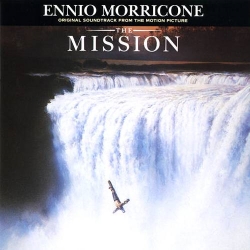
THE MISSION – Ennio Morricone
 GREATEST SCORES OF THE TWENTIETH CENTURY
Original Review by Craig Lysy
Producer David Putnam and director Roland Joffe were seeking to sustain the acclaim of their last collaboration, The Killing Fields (1984), and so recruited renowned screenwriter Robert Bolt to compose a compelling historical drama. The independent British production company Goldcrest Films financed the project, providing a generous budget, and a fine cast was assembled, which included Robert De Niro as Captain Rodrigo Mendoza, Jeremy Irons as Father Gabriel, Ray McAnally as Cardinal Altamirano, Aidan Quinn as Felipe Mendoza, Cherie Lunghi as Carlotta, Ronald Pickup as Don Hatar, Chuck Low as Don Cabeza and Liam Neeson as Father John Fielding. The film offers a classic morality play, which explores the tragic events surrounding the 1750 Treaty of Madrid. The Spanish and Portuguese are warring along the Brazil and Paraguayan border and the treaty ended the conflict by requiring Spain to cede territory south and east of the Rio Uruguay to Portugal. This would require the seven Jesuit missionaries to leave and place the Guarani inhabitants in peril as Portugal, unlike Spain, used slavery to man their plantations. The film opens in 1740 with Jesuit missionary Father Gabriel seeking to convert the Guarani to Catholicism. The opening scene of a Jesuit cast over the waterfall tied to a cross reveals the Guarani’s hostility to outsiders. He is joined by slaver Rodrigo Mendoza who seeks repentance following the murder of his brother, who he caught sleeping with his fiancée. Father Gabriel gains the trust of the Guarani through his oboe playing and they over time convert. Rodrigo finds new meaning to his life, abandons weapons, and commits to joining the priesthood. Read more…
AGNES OF GOD – Georges Delerue
 GREATEST SCORES OF THE TWENTIETH CENTURY
Original Review by Craig Lysy
John Pielmeier’s play 1979 Agnes of God was both a commercial and critical success, achieving a respectable run on Broadway. Norman Jewison convinced Columbia Pictures that the story had big screen potential, and secured backing for the project. He would both produce and direct the film, and brought in Pielmeier to adapt his play for the cinema. Crucial to the film’s success would be finding three actresses to fill the trio of roles on which the story unfolds. Jane Fonda was cast as Dr. Martha Livingston. Joining her would be Anne Bancroft as Mother Superior Miriam Ruth, and Meg Tilly as Sister Agnes Devereaux. The film offers a murder mystery where science and faith intersect and clash. The story reveals nuns rushing from evening prayers to Sister Agnes’s room in answer to her screaming. They discover her bleeding profusely and a dead baby lying in a basket strangled by its umbilical cord. The court assigns Dr. Livingston to assess Sister Agnes for competency to stand trial. A clash of wills unfolds between Dr. Livingston efforts to discover the truth, and Mother Superior efforts to protect her niece, who she believes is innocent. What results is a classic confrontation of science and faith, with both sides working with the best of intentions. Read more…
OUT OF AFRICA – John Barry
 GREATEST SCORES OF THE TWENTIETH CENTURY
Original Review by Craig Lysy
Notable directors such as Orson Welles, David Lean and Nicolas Roeg had long sought to bring to the big screen the 1937 novel Out of Africa by Isak Dinesan (Karen Blixen). None were successful in adapting the story into a cogent screenplay. Sydney Pollack however was determined to succeed, and after two years of struggle managed with the assistance of screenwriter Kurt Luedtke to fashion a screenplay drawing from Blixen’s “Out of Africa”, but also her novel “Shadows on the Grass” and Elsbeth Huxley’s novel, “The Flame Trees of Thika”. Mirage Enterprises agreed to fund the project, which would be produced by Kim Jurgensen and Sydney Pollack, who would also direct. A fine cast was assembled, which included the dashing Robert Redford as Denys Hatton, Meryl Streep as Karen Blixen, and Klaus Maria Brandauer as Baron Bror von Blixen. The story offers a sad testament to the life of a wealthy Danish woman Karen Blixen, and the love of her life, Denys Hatton. After she is spurned by her Swedish lover, Karen relocates to British East Africa and enters into a loveless marriage of convenience with his brother, Baron Bror Blixen. They plan to start a dairy cattle farm, but on the wedding day Bror informs her that he plans to instead start a coffee plantation. His infidelity leads to her contracting syphilis, which requires that she return to Denmark for treatment. She returns to find Bror more interested in Safaris than her and they separate. Read more…
RAN – Tôru Takemitsu
 GREATEST SCORES OF THE TWENTIETH CENTURY
Original Review by Craig Lysy
Ran, which translates as Chaos, was a passion project for the legendary Japanese director Akira Kurosawa, and most critics believe it to be his last great film. He had envisioned the film for many years, and he even made detailed paintings of the castles and sets he hoped to one day construct. He began writing the screenplay in 1976 but production was delayed by Tōhō Studios executives who balked at the estimated $5 million price tag, which would have made it the most expensive Japanese film ever made. The fact that his last film, Dodes’kaden, was a box office flop also served to harden studio resistance. Fortunately the great success of his film Kagemusha restored studio confidence in Kurosawa, and he was able to forge a partnership, securing funds from French producer Serge Silberman. There are recognizable parallels between Ran and Shakespeare’s King Lear, although Kurosawa related that the similarities did not become apparent to him until after he had conceived his script. Ran was Kurosawa’s last great epic film, one that offers a classic morality play, which affirms the truism that the road to Hell is paved with good intentions. We are offered an excruciating tragedy, which reveals deception, envy, treachery, betrayal and hubris. Read more…
THE NATURAL – Randy Newman
 GREATEST SCORES OF THE TWENTIETH CENTURY
Original Review by Craig Lysy
In 1982 Columbia Pictures studio executive Victor Kaufman created a joint venture, TriStar Pictures, with CBS and HBO. The goal was to pool their resources given the ever-escalating costs of making movies. For their first film they chose to celebrate America’s national pastime by adapting The Natural, a baseball biopic novel by Bernard Malamud. The film offered classic Americana and Kaufman believed it was the perfect vehicle for launching TriStar Pictures. Mark Johnson was given the reigns to produce the film, and Barry Levinson was tasked with directing. Roger Towne and Phil Dusenberry were brought in to write the screenplay, which would be loosely based on the life of Roy Hobbs, a man of incredible “natural” baseball talent. Robert Redford, whose good looks and leading man talents were ascendant, was cast for the titular role. Joining him would be Robert Duvall as Max Mercy, Glenn Close as Iris Gaines, Kim Basinger as Memo Paris, Barbara Hershey as Harriet Bird, Wilford Brimley as Pop Fischer, Darren McGavin as Gus Sands, and Robert Prosky as the Judge. Read more…
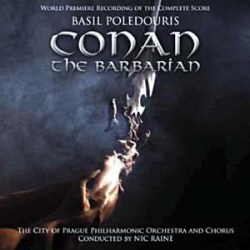
CONAN THE BARBARIAN – Basil Poledouris
 GREATEST SCORES OF THE TWENTIETH CENTURY
Original Review by Craig Lysy
Conan The Barbarian is based on the Conan stories penned by author Robert E. Howard. The movie adaptation tells the story of a young Conan who lives in the mythic Hyborean Age and suffers grievously at the hands of an evil ruler of the Snake Cult, Thulsa Doom, who kills his parents and sells him into slavery. Eventually after much suffering he gains his freedom and trains to become a mighty warrior. He then sets out to solve the riddle of steel and avenge his parent’s death. As such, this is a classic morality tale with an unambiguous hero and villain. The film was a commercial success, which spawned a sequel and served to reinvigorate the fantasy genre. Read more…
E.T. THE EXTRA-TERRESTRIAL – John Williams
 GREATEST SCORES OF THE TWENTIETH CENTURY
Original Review by Craig Lysy
Steven Spielberg, like most kids, suffered with the divorce of his parents. He was 14, and to cope with his circumstances, he created an imaginary alien friend, who became a surrogate brother. Over time this evolved into a story, which his sought to film called “Growing Up”. After the success of Raiders of The Lost Ark, he returned to fashioning his childhood story, which would now incorporate elements from another story he had written called “Night Skies,” where aliens terrorize a family. He brought in screenwriter to Melissa Mathison to craft a story of a special needs child bonding with a friendly alien. The result was a story to be called “E.T. and Me,” which Spielberg pitched to Columbia Studios. Remarkably they rejected the project, believing that it would only appeal to small kids. Well, Spielberg was undeterred, and approached Sid Sheinberg of MCA, who saw the success of Raiders of the Lost Ark, and agreed to fund the project. They bought back the script from Columbia Pictures for $1 million dollars and granted 5% of the film’s net profits. Spielberg and Kathleen Kennedy would produce the film, with Spielberg also directing. For his creative team, he brought in Carlo Rambaldi, who had created the aliens seen in Close Encounters of the Third Kind. The story required Spielberg to cast child actors, and he screened hundreds. His patience and hard effort paid off as he managed to secure a perfect cast, which included; Henry Thomas as Elliot, Drew Barrymore as Gertie, Dee Wallace as Mary, Peter Coyote as Keys, and Robert MacNaughton as Michael. Read more…

Shop at the Movie Music UK Store

Member of the

 MOVIE MUSIC UK