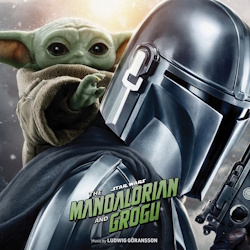
THE MANDALORIAN AND GROGU – Ludwig Göransson
 Original Review by Jonathan Broxton
WARNING: THIS REVIEW CONTAINS PLOT SPOILERS. IF YOU HAVE NOT YET SEEN THE FILM, YOU MIGHT WANT TO CONSIDER WAITING UNTIL AFTER YOU HAVE DONE SO TO READ IT.
Following the conclusion of the 9-movie saga, which ended in 2019 with The Rise of Skywalker, the Star Wars universe found a new home on television. Shows such as Obi-Wan Kenobi, Andor, Ahsoka, The Acolyte, and Skeleton Crew all deepened the lore of the Star Wars world, but arguably the most successful of the TV shows was The Mandalorian, which debuted in 2019. The show is set five years after the events of the 1983 film Return of the Jedi and focuses on Din Djarin, a Mandalorian warrior and bounty hunter who is hired by what is left of the Galactic Empire to retrieve a “package,” which turns out to be a Force-sensitive baby belonging to the same species as Jedi Master Yoda. Instead of turning the child – whose name is eventually revealed to be Grogu – over to Imperial forces, Djarin goes on the run to protect the infant, getting into adventures, and eventually becoming his surrogate father.
The series succeeded not only because it expanded the Star Wars universe, but because it managed to appeal to longtime fans and newcomers alike. Its blend of classic Western storytelling, cinematic production values, and episodic adventure gave audiences a version of Star Wars that felt both nostalgic and fresh. Much of the show’s cultural impact centered on the breakout popularity of Grogu, who became universally known by fans as “Baby Yoda” before his official name was revealed. The character’s enormous eyes, expressive behavior, and childlike vulnerability instantly made him an internet phenomenon. Images and GIFs of Grogu spread rapidly across social media platforms, inspiring memes, merchandise, and endless references in everyday conversation. His popularity demonstrated how a single character could transcend the boundaries of a television show and become a shared cultural symbol recognized even by people who had never watched the series.
After season three of The Mandalorian aired in 2023, it was announced that a theatrical feature starring The Mandalorian and Grogu was in production, and this is that film. Directed by Jon Favreau and again starring Pedro Pascal as Din Djarin, it sees the intrepid duo being hired to work for the New Republic, hunting down rogue warlords from the former Galactic Empire. Djarin and Grogu receive intel that the Hutt Twins, siblings of the deceased crime-lord Jabba the Hutt, know the whereabouts of their next Imperial target, the mysterious Commander Coin, but they will only provide it in exchange for Djarin rescuing Jabba’s son and heir, Rotta, who they believe is being held captive on the planet Shakari. This leads Djarin and Grogu on an adventure across the galaxy, first to save Rotta, and then to track down Coin. The film co-stars Sigourney Weaver and Jonny Coyne, Brendan Wayne and Lateef Crowder perform the on-set Mandalorian stunts, Jeremy Allen White provides the voice of Rotta, and there is a bizarre cameo from Martin Scorsese as a shopkeeper who reluctantly provides the Mandalorian with information.
Unfortunately, and despite the fact that I genuinely like The Mandalorian TV show, The Mandalorian and Grogu is an enormous anticlimax. The film ultimately feels like an overextended television episode stretched to blockbuster length; what once worked in short, self-contained adventures begins to feel repetitive on the big screen, with long action sequences and familiar plot beats replacing genuine emotional momentum. The story leans heavily on audience affection for Djarin and Grogu without giving either character meaningful development, resulting in a film that feels more like brand maintenance than compelling storytelling. They are treading water the whole time. My initial understanding was that this film was intended to provide some sort of conclusion to the entire Mandalorian and Grogu storyline, and that it would link into the plot of season 2 of Ahsoka in 2027, but the movie offers no closure whatsoever – the entire thing is little more than a glorified side quest, and both characters end up exactly where they started by the end of the film.
The action sequences are impressively staged, there are some fun chases, there are several cool moments of Star Wars fan service and lore, the cinematography is pretty, and Grogu is cute enough, but unfortunately there is little else going on to recommend it. Sigourney Weaver is completely wasted as Ward, the New Republic commander who gives Djarin his assignments. Rotta the Hutt is a terrible character, a hulked-up petulant teenager who completely undermines everything that made Hutt culture so fascinating in Return of the Jedi by being a nice guy and speaking in English; somehow, the Hutts look worse here than they did in 1983, sloppy modern CGI versus Phil Tippett’s realistic ILM puppet. Bo-Katan and the other Mandalorians are completely absent, and there are no references to the events of the other spin-off, The Book of Boba Fett, which feels like a wasted opportunity to link everything together. Overall, and while I was mostly entertained in the moment, this is the first Star Wars movie that, with hindsight, I found disappointing.
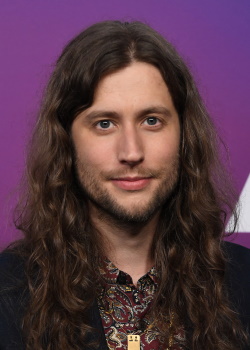 The score for The Mandalorian and Grogu is by the three-time Oscar-winning composer Ludwig Göransson, who also scored the majority of The Mandalorian TV series and The Book of Boba Fett spin-off with his lead assistant, Joseph Shirley. Göransson was considered a somewhat unusual choice for a Star Wars project when he was first hired in 2018; at that point the only composers who had scored a major live-action Star Wars story other than John Williams were Michael Giacchino on Rogue One in 2016, and John Powell on Solo earlier that year. Göransson’s approach to Star Wars was very different; Favreau wanted the series to sound “a little grittier, a little edgier and a little more tech-oriented,” and to that end Göransson wrote a score which was much grungier, and also more orchestrally unusual – a sort of a blend between an Ennio Morricone spaghetti western, a Japanese samurai film, and minimalist electronic music.
The centerpiece of the Mandalorian score is the main theme, which is actually a theme in three parts: the first part of the theme is an echoing motif that was created by Göransson while experimenting with a bass recorder, digitally manipulating it to make it more futuristic. The second part is the main Mandalorian Theme, which uses pounding percussion, guitars, a piano, and distorted synth textures, blending old frontier imagery with futuristic science fiction. The third part of the theme is the heroic Mandalorian Fanfare, a blast of triumphant brassy energy that, tonally, has always reminded me of Bill Conti’s score for Rocky, and often fulfils similar emotional goals. It’s all very different from anything John Williams ever wrote for the saga, and some people still find it too jarring (djarin?), but I have actually grown to like it quite a lot.
As one would expect, the three elements of the Mandalorian theme are all over this score. Göransson finds endless ways to play around with them – orchestration, tone, speed, emotional intent – and he plays them individually, sequentially, in different combinations, as well as having them embedded into the fabric of different action cues. The four-note motif for Grogu himself that emerged from the score of the series as it progressed is here too, and there are a couple of new ideas unique to this score that make their presence felt, including a new idea for the Hutt Twins and the planet Nal-Hutta, a specific theme for Rotta the Hutt, a guttural electronic motif for the bounty hunter Embo, and an extended sequence of impressionistic, abstractly pastoral music that accompanies Grogu during a series of scenes where he is left alone to fend for himself in a forest. It is in these scenes that Göransson comes closest to sounding like John Williams, and it’s a very welcome development.
One thing that isn’t a welcome development, however, is the couple of cues where Göransson interpolates sound effects into the score, including an abrasive alarm sound in “This Is the Way,” twittering droid noises in “Next Mission,” and crowd roars in “The Pit Fight”. Göransson explains that he was inspired to use the crowd noises due to his fond memories of the 1990s TV show American Gladiators, which he recalls watching as a child; and he says he wanted to evoke a similar feeling in that cue. Your mileage may vary.
The opening pair comprising “This Is the Way” and “The Mandalorian and Grogu” offers a number of interesting variations on all three parts of the main Mandalorian theme, including an extended introduction featuring the flute motif and the four-note Grogu motif, as well as some quite vigorous action music that underscores the opening scene where Mando and Grogu infiltrate an Imperial base on a remote snowy planet. I like the brass variation on the “echoing motif” at the start of the second cue, and the choral accents and fun string countermelody he attaches to the main Mandalorian Theme. The action music is typically great too – it’s full of flashing string writing, brass fanfares, choral outbursts and more – but there is a great deal of pounding percussion, in addition to the aforementioned shrill electric alarm sounds, some of which may prove to be too abrasive for some listeners. Personally, I thought it was terrific, and it really establishes the action tone for the rest of the score to come.
It’s interesting; despite having written some fantastic action music, especially for things like Black Panther, I have never really been able to pin down a clear “Göransson action style,” and I’m still not sure whether this is a good thing or not – but either way, it’s always enjoyable in the moment, even if there is nothing truly distinctive about it.
“Next Mission” is mostly light and playful, and weaves together elements of both the main Mandalorian Theme and Grogu’s theme for a prominent harp, but ends with some staccato string darkness and trepidation, before the score introduces its first new theme for the Hutt Twins and the planet Nal-Hutta in “The Twins”. The Hutt theme is mostly written for low, ominous rumblings and almost imperceptible voices, and stylistically it hearkens back to John Williams’s music for the scene in Return of the Jedi where Luke Skywalker first infiltrates Jabba’s palace. It picks up some electronic tonalities in the second half, which then become much more prominent in the establishing shots of “Shakari,” the neon-soaked planet Djarin and Grogu travel to in order to rescue Rotta the Hutt; the slick synthy rendering of the main Mandalorian theme that plays when they arrive is actually pretty cool. Less successful is the Django Reinhardt-style jazz guitar version of the Mandalorian theme that plays during the bizarre “Hugo Durant’s Snack Shack,” which Göransson specifically wrote for Andreas Öberg, his old guitar teacher from Stockholm, to play.
The character theme for Rotta the Hutt is introduced in “Rotta,” which is sort of a variation on the Nal-Hutta theme and features a weird collision of harshly brutal electronic dance music tones, Bill Conti-style jazzy brass, and guttural chanting (similar to his main theme from The Book of Boba Fett, which was itself inspired by a Björn Isfält theme from the 1984 Swedish film Ronja Rövardotter). This style then blends with the main Mandalorian theme, clattering African-inspired percussion, and some wonderfully bombastic orchestral action music in “The Pit Fight,” which underscores the scene where Djarin and Rotta find themselves inside a gladiator arena and must team up to win a “dejarik match” against real-life versions of the vicious creatures from the holographic chess game that Chewbacca plays in Star Wars; there’s a moment towards the end of the cue where Göransson re-arranges the Mandalorian theme with Rotta’s trumpets that is brilliant.
“Rotta Chase,” “Tracking Lord Janu,” and “Strap In” see Djarin and Grogu thundering after Rotta in speeders through the fast streets of Shakari, before moving on to a confrontation with Rotta’s manager/captor, and then eventually escaping the planet. This trio of cues is equally entertaining, full of flamboyant string runs, complicated percussion patterns, electronic pulses, and heroic brass outbursts, as well as more references to Rotta’s theme and different elements of the Mandalorian theme. There’s a fascinating, nimble interlude halfway through “Tracking Lord Janu” where Göransson transfers the main percussive drive to what appears to be a combo of glockenspiels and dulcimers, an eccentric choice that nevertheless works really well.
“Flying Home to Nevarro” offers a lovely, almost romantic string-led statement of the Mandalorian Fanfare as the heroes return home, but this is quickly overtaken by the percussive electronic pulses and dark orchestral textures for “Embo,” the droid-like bounty hunter hired by the Hutt Twins to capture Djarin and bring him back to Nal-Hutta as punishment for him double-crossing them with regard to Rotta. The subsequent “We Got to Find Him” is a four-minute oddity, comprising little more than tinkling percussion effects, brooding string textures, and grating electronics, before ending with some abstract references to the echoing flute motif.
There’s a wonderfully bold, epic sweep to “The Helmet” that is quite tremendous, an extended action setting of the Mandalorian Theme and the Mandalorian Fanfare that underscores part of the sequence where Djarin is forced to fight a deadly Dragonsnake in the pit underneath the Hutt Twins’ throne room – an intentional echo of the Luke Skywalker-Rancor fight from Return of the Jedi. Göransson allows his orchestra and chorus to reach some quite spectacular heights here; at times they lumber forward with percussive energy, whereas at other times the music is fast, agile, and kinetic.
“Go Kid” underscores Djarin’s apparent death sequence – him having been poisoned by a Dragonsnake bite in his fight with it – and to capture the sadness and tragedy of the moment Göransson blends the echoing flute motif with elements of Grogu’s theme in an ambient, new-age way. This leads into the 8-minute “Grogu’s World,” a pastoral orchestral tone poem that accompanies Grogu’s period of solitude in the forests of Nal-Hutta, as he explores his surroundings and tries to find a way to save Djarin’s life. The music in this sequence is superb; magical, playful, impressionistic, but very evocative, coming across as sort of a combination of John Williams at his most avant-garde, and a Thomas Newman Pixar score – perhaps WALL-E or Finding Nemo – all building off of Grogu’s four-note theme. Göransson apparently had a very difficult time writing this music, but it works wonderfully well in context, and it’s one of the few moments in the score where Göransson seems to be channeling the spirit of Williams in a tangible way; there’s something in the instrumental phrasing, the textures, the chord structure, and the emotional intent, that reminds me of the more abstract parts of Close Encounters of the Third Kind, or maybe E.T.
The score’s big heroic finale – the attack on, and eventual destruction of, the Hutt Palace by Djarin, Grogu, and a New Republic squadron led by Colonel Ward – begins with “Do We Run? Or Do We Fight?” and continues on through “All Weapons Hot,” before concluding with the brilliant “Red Jammer”. Göransson revisits all three elements of the Mandalorian theme and Grogu’s theme, makes reference to the Hutt theme and Rotta’s theme, and turns up the heroism level to max by slathering everything in epic chorales and purposeful electronic countermelodies. The middle part of “Do We Run? Or Do We Fight?” is a festival of complicated brass writing, and the Embo motif makes a startling return during the same cue’s conclusion. There is a terrific militaristic quality to the statement of the main Mandalorian theme in “All Weapons Hot” that carries a similar vibe to Williams’s “March of the Resistance” from The Force Awakens score, and then in “Red Jammer” Göransson bathes the Mandalorian Fanfare in a sense of glorious relief, again with enormous emphasis on the choir.
Ultimately, your enjoyment of the score for The Mandalorian and Grogu will rest entirely on whether you can reconcile yourself to Ludwig Göransson’s Star Wars sound, because the truth is: this isn’t John Williams music. To boil it down to generalizations, it’s Bill Conti sports heroism meets Ennio Morricone spaghetti western, and if that approach is too much of a departure from the John Williams sound, then this score will not be for you, irrespective of how creative it is, or how artfully it is rendered. If you didn’t like the score in the TV show, you won’t like it here.
For me, I think I have been able to compartmentalize my feelings and recognize the fact that, as much as I love the John Williams sound, there are other valid approaches to scoring Star Wars too, and what Ludwig Göransson is doing here is worthy of praise and appreciation on its own terms. The main Mandalorian theme is a terrific earworm, the way he adapts and re-frames it here is impressive, the action music is fun and exciting, and the “Grogu’s World” sequence is a pastoral delight. I might have appreciated a stronger melodic identity for Rotta and the Hutts, and in general the electronic elements of the score are perhaps a little too pronounced for my personal taste, but that’s a me thing, and others may find it to be more in line with what they want Star Wars music to sound like in the year 2026. As they say, this is the way.
Buy the Mandalorian and Grogu soundtrack from the Movie Music UK Store
Track Listing:
- This Is the Way (8:16)
- The Mandalorian and Grogu (3:08)
- Next Mission (4:21)
- The Twins (2:38)
- Shakari (1:30)
- Hugo Durant’s Snack Shack (4:20)
- Rotta (1:34)
- The Pit Fight (6:40)
- Rotta Chase (3:27)
- Tracking Lord Janu (3:21)
- Strap In (2:49)
- Flying Home to Nevarro (1:02)
- Embo (2:00)
- We Got to Find Him (4:12)
- The Helmet (4:10)
- Go Kid (3:01)
- Grogu’s World (7:46)
- Do We Run? Or Do We Fight? (6:41)
- All Weapons Hot (3:40)
- Red Jammer (1:55)
- Your Turn, Grogu (1:45)
Walt Disney Records (2026)
Running Time: 68 minutes 06 seconds
Music composed by Ludwig Göransson. Conducted by Pete Anthony. Orchestrations by Pete Anthony, Jeff Atmajian, Philip Klein, Andrew Kinney, Jon Kull, Gernot Wolfgang, and Jim Honeyman. Additional music and arrangements by Ngawang Samphel, Caroline Ho, Vince Mendoza and Andreas Öberg. Recorded and mixed by Chris Fogel. Edited by Felipe Pacheco. Album produced by Ludwig Göransson.

Shop at the Movie Music UK Store

Member of the


