Archive
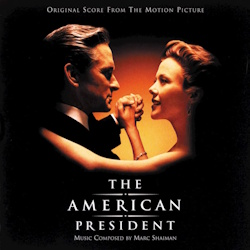
THE AMERICAN PRESIDENT – Marc Shaiman
 THROWBACK THIRTY
Original Review by Jonathan Broxton
Looking back now, considering where we are today in terms of what the American political landscape has become over the past decade, it seems almost unbelievably naïve and quaint to think that, in the 1990s, people were still making films about US presidents who were good, upstanding people who cared about their jobs and the electorate that voted for them. The American President is one of those films; written by Aaron Sorkin and directed by Rob Reiner, the film is a romantic drama set in the White House. Michael Douglas plays President Andrew Shepherd, a widower nearing the end of his first term. He is well-liked, pragmatic, and politically savvy, but cautious about jeopardizing his public image. Things change when Shepherd becomes romantically involved with Sydney Wade (Annette Bening), an environmental lobbyist who comes to Washington to push for a bold emissions-reduction bill. Their relationship quickly becomes serious, but because it unfolds under intense media scrutiny, it also becomes a political liability. As Shepherd’s approval ratings fall, his opponents – especially conservative senator Bob Rumson (Richard Dreyfuss) – exploit the situation, framing the relationship as unpresidential. Shepherd initially tries to keep politics and romance separate, hoping the story will fizzle out, but before long public pressure forces him to choose between maintaining power and standing up for the values he claims to represent. Read more…
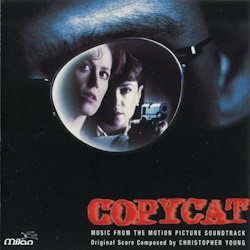
COPYCAT – Christopher Young
 THROWBACK THIRTY
Original Review by Jonathan Broxton
Copycat is a psychological thriller directed by Jon Amiel, starring Sigourney Weaver, Holly Hunter, Dermot Mulroney, and William McNamara. Weaver plays Dr. Helen Hudson, a brilliant criminal psychologist and expert on serial killers who becomes agoraphobic after being attacked by one of her former subjects, Daryll Lee Cullum, played in an extended cameo by jazz singer Harry Connick Jr. Years later, and now living in near-total isolation in her San Francisco apartment, Helen is drawn back into criminal investigation when a new serial killer begins terrorizing the city, and she is asked to consult with the lead detectives, M. J. Monahan (Hunter) and Reuben Goetz (Mulroney). Eventually the trio realizes that the killer appears to be copying famous murderers, mimicking the methods of killers such as the Boston Strangler, Son of Sam, Jeffrey Dahmer, and Ted Bundy. However, things quickly become personal when the killer begins targeting Helen herself, forcing her to confront her trauma and step outside her apartment for the first time in years. Read more…
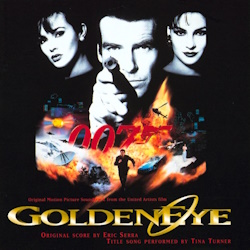
GOLDENEYE – Éric Serra
 THROWBACK THIRTY
Original Review by Jonathan Broxton
Six years after Timothy Dalton vacated the role, in the wake of the comparative commercial flop of License to Kill, and after several years of protracted contract negotiations, legal disagreements and financial disputes at MGM, and stalled screenplay ideas, James Bond returned with a new face, a new style, and a new sound in 1995 with GoldenEye. Having been previously thwarted by the fact that he was contracted to play Remington Steele on American television in the 1980s, the producers finally cast Irish actor Pierce Brosnan as their preferred 007, and the main supporting cast was rounded out by Sean Bean, Izabella Scorupco, Famke Janssen, and Judi Dench as M, the new head of MI6. New Zealander Martin Campbell was hired as director, and the screenplay was credited to Jeffrey Caine and Bruce Feirstein, based on a story by Michael France. Read more…
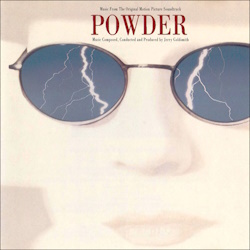
POWDER – Jerry Goldsmith
 THROWBACK THIRTY
Original Review by Jonathan Broxton
Powder is a science fiction-drama film written and directed by Victor Salva, starring Jeff Goldblum, Mary Steenburgen, Lance Henriksen, and Sean Patrick Flanery in the title role as Jeremy “Powder” Reed, a reclusive young man with albinism and extraordinary intellectual and psychic abilities. Jeremy was raised in isolation by his grandparents after his mother was struck by lightning while pregnant with him, but after their deaths Jeremy is brought into the wider world by the kind local sheriff Barnum (Henriksen), school counselor Jessie (Steenburgen), and science teacher Ripley (Goldblum), who recognizes Jeremy’s genius-level intellect and apparently paranormal abilities, which include reading minds, sensing emotions, and even manipulating electrical energy. However, despite their efforts to help him adjust, Jeremy faces alienation, ridicule, and even violence from his peers due to his appearance and strange powers. Read more…
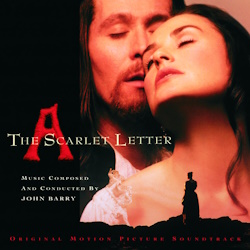
THE SCARLET LETTER – John Barry
 THROWBACK THIRTY
Original Review by Jonathan Broxton
Nathaniel Hawthorne’s 1850 work The Scarlet Letter is widely considered one of the greatest American novels, blending psychological depth, historical setting, and moral allegory into a story of sin, adultery and redemption. Set in 17th-century Puritan Boston, the story follows Hester Prynne who, while estranged from her cruel husband Roger, had an affair, conceived out of wedlock, and ultimately gave birth to a daughter, Pearl. Convicted of adultery, Hester is punished and forced wear a scarlet letter “A” sewn onto her clothing as a constant reminder of her sin. Hester refuses to publicly reveal the identity of Pearl’s father, but the reader eventually learns that the father is Reverend Arthur Dimmesdale, a young and respected local minister. Dimmesdale is consumed by guilt over what happened to Hester but lacks the courage to confess; things are then made worse when Roger returns to Boston and vows to uncover and torment the man responsible for what happened to Hester. Read more…
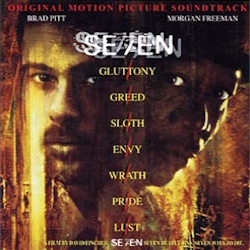
SEVEN – Howard Shore
 THROWBACK THIRTY
Original Review by Jonathan Broxton
The world is a fine place and worth fighting for. I agree with the second part. — Ernest Hemingway.
What’s in the box?!? — Detective David Mills.
Seven – usually stylized as ‘Se7en’ – is a dark psychological crime thriller written by Andrew Kevin Walker and directed by David Fincher, in what was his second feature film after his 1992 debut Alien 3. The film follows two homicide detectives – weary veteran William Somerset (Morgan Freeman), who is on the verge of retirement, and impulsive newcomer David Mills (Brad Pitt), who has recently transferred to the city with his wife Tracy (Gwyneth Paltrow) – as they investigate a string of grisly murders staged around the seven deadly sins: gluttony, greed, sloth, lust, pride, envy, and wrath. Each crime scene is meticulously designed by the killer to reflect the sin being punished, and the murders grow increasingly disturbing. The investigation eventually leads the detectives to a deranged but calculating serial killer known only as John Doe (Kevin Spacey), who sees himself as a moral avenger exposing society’s corruption through his crimes, and whose final murder is directly targeted at the detectives investigating him. Read more…
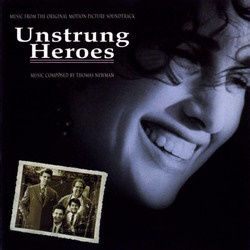
UNSTRUNG HEROES – Thomas Newman
 THROWBACK THIRTY
Original Review by Jonathan Broxton
Unstrung Heroes is a coming-of-age comedy-drama directed by Diane Keaton, adapted from journalist Franz Lidz’s memoir of the same name. The story is set in the 1960s and follows twelve-year-old Steven Lidz (Nathan Watt), a sensitive and imaginative boy growing up in Los Angeles. Steven’s father Sid (John Turturro) is a brilliant but eccentric inventor who is emotionally distant, while his mother, Selma (Andie MacDowell), is warm, loving, and supportive. However, when Selma is diagnosed with terminal cancer, the family is shaken; struggling to cope with his mother’s illness and his father’s inability to express vulnerability, Steven decides to leave home and live with his two eccentric uncles, Arthur (Michael Richards) a paranoid conspiracy theorist, and Danny (Maury Chaykin), a gentle, childlike dreamer. Though unconventional, the uncles provide Steven with comfort, eccentric wisdom, and a sense of belonging, and through their unconventional guidance, Steven learns to process grief, embrace imagination, and find resilience in the face of loss. Read more…
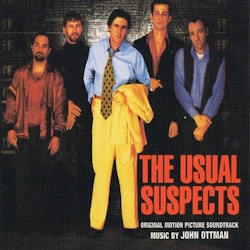
THE USUAL SUSPECTS – John Ottman
 THROWBACK THIRTY
Original Review by Jonathan Broxton
The greatest trick the devil ever pulled was convincing the world he didn’t exist.
This famous quote from the writings of 19th century French poet Charles Baudelaire is at the heart of the story of The Usual Suspects, the film which marked the mainstream debuts of director Bryan Singer and screenwriter Christopher McQuarrie. It is a neo-noir crime thriller that unfolds as a story within a story, as told to federal agent Dave Kujan (Chazz Palminteri) by Verbal Kint (Kevin Spacey), a small-time con artist with cerebral palsy; Kint is one of two survivors of an explosion on a ship docked in San Pedro harbor in Los Angeles. Kint recounts the events leading up to the explosion, telling Kujan that five criminals – himself, plus Michael McManus (Stephen Baldwin), Fred Fenster (Benicio del Toro), Dean Keaton (Gabriel Byrne), and Todd Hockney (Kevin Pollak) – met during a police lineup in New York, and began committing heists together. Eventually, they are drawn into the orbit of the mysterious, almost mythical crime lord Keyser Söze, a figure so feared that most refuse to speak his name. Söze coerces the group into attacking the ship in San Pedro in order to eliminate witnesses who can identify him, and eventually Kujan comes to believe that Keaton – a former corrupt cop apparently trying to go straight – must have been Söze. Read more…
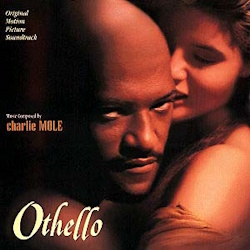
OTHELLO – Charlie Mole
 THROWBACK THIRTY
Original Review by Jonathan Broxton
O, beware, my lord, of jealousy, it is the green-eyed monster which doth mock the meat it feeds on.
One of William Shakespeare’s most enduring and celebrated plays, Othello is a classic tale of jealousy, manipulation, and betrayal, with hint of racism thrown in for good measure. In the story Othello, a respected Moorish general in Venice, secretly marries Desdemona, the daughter of a nobleman. His ensign, Iago, jealous of Othello’s success and resentful at being passed over for promotion, schemes to destroy him. Iago tricks Othello into believing that Desdemona has been unfaithful with his lieutenant, Cassio. Consumed by jealousy, Othello murders Desdemona – only to discover too late that she was innocent and that Iago deceived him. Overcome with grief and guilt, Othello takes his own life, while Iago is exposed and punished. Read more…
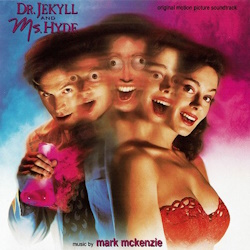
DR. JEKYLL AND MS. HYDE – Mark McKenzie
 THROWBACK THIRTY
Original Review by Jonathan Broxton
A classic sci-fi horror tale with a comic twist, Dr. Jekyll and Ms. Hyde is a modern reimagining of Robert Louis Stevenson’s 1886 novella The Strange Case of Dr Jekyll and Mr Hyde. Directed by David Price, the film stars Tim Daly as Dr. Richard Jacks, a chemist working at a fragrance company, who also happens to be the great-grandson of Dr Henry Jekyll, the protagonist of the original story. After he receives his great-grandfather’s scientific notes as part of an inheritance, the shy and bumbling Jacks tinkers with and creates a new serum, intending to use it as a base for a new women’s perfume; unfortunately, when he tests the serum on himself, he finds himself transformed into the beautiful, confident, and very female Helen Hyde (Sean Young) – and Helen is determined to take over Richard’s life. However, despite having a fun supporting cast – Lysette Anthony, Harvey Fierstein, Stephen Tobolowsky, Jeremy Piven – the film was both a critical and commercial flop, and is mostly forgotten today. Read more…
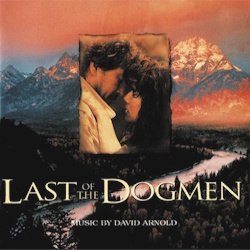
LAST OF THE DOGMEN – David Arnold
 THROWBACK THIRTY
Original Review by Jonathan Broxton
A wilderness action adventure with elements of mystery and historical fantasy, Last of the Dogmen stars Tom Berenger as Lewis Gates, a rugged bounty hunter tracking three escaped convicts in the remote and treacherous wilderness of the Montana Rockies near the Canadian border. During his search, Gates comes across bizarre signs that suggest the presence of a mysterious and elusive group living deep in the mountains – people who shouldn’t exist. After teaming up with anthropologist Professor Lillian Sloan (Barbara Hershey), an expert on Native American history, they investigate the mystery, and discover a hidden valley inhabited by a Native American tribe descended from the Cheyenne Dog Soldiers, fierce warriors who evaded the U.S. Cavalry over a century earlier and have lived in complete isolation ever since. Read more…
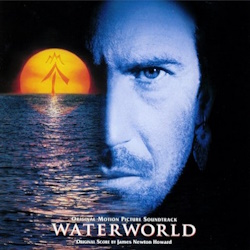
WATERWORLD – James Newton Howard
 THROWBACK THIRTY
Original Review by Jonathan Broxton
For many years in Hollywood Waterworld – the title of Kevin Costner’s 1995 action-adventure movie – was a byword for financial disaster in moviemaking. Originally conceived by screenwriter Peter Rader in the mid-1980s as a low budget ‘Mad Max on water’ the script was eventually rewritten by David Twohy, whose version leaned heavily into the post-apocalyptic sci-fi genre. Costner, then at the height of his fame following hits like Dances with Wolves and The Bodyguard, signed on to produce and star, and he recruited Kevin Reynolds, who directed him in Robin Hood: Prince of Thieves, to helm the film. However, what started as a modestly budgeted film ballooned into a then-record-breaking $175 million production, eventually earning it the industry nicknames “Fishtar” and “Kevin’s Gate,” after notorious flops Ishtar and Heaven’s Gate. The production was plagued by logistical challenges, including destroyed sets, weather delays, crew injuries, and creative clashes between Costner and Reynolds, who eventually left the project entirely during post-production, leaving Costner to oversee the final edit. Read more…
BEYOND RANGOON – Hans Zimmer
 THROWBACK THIRTY
Original Review by Jonathan Broxton
Beyond Rangoon is a political drama/thriller directed by John Boorman, inspired by the real events of the 1988 Burmese Uprising, when students and civilians protested against the military regime of then-dictator Ne Win, leading to thousands of deaths. Patricia Arquette stars as Laura Bowman, an American doctor who travels to Burma (now Myanmar) in the late 1980s with her sister Andi (played by Frances McDormand) in an attempt to recover from the traumatic murder of her husband and son. Their vacation unexpectedly coincides with the uprising, and while attempting to leave the country Laura loses her passport, inadvertently becoming trapped in the increasingly volatile nation. As she navigates a dangerous and unfamiliar landscape, Laura becomes a reluctant witness to the government’s violent repression of student demonstrators; however, she is guided by a former university professor turned dissident U Aung Ko (playing a fictionalized version of himself) who helps her understand the political crisis engulfing the country, and to flee to safety. Read more…
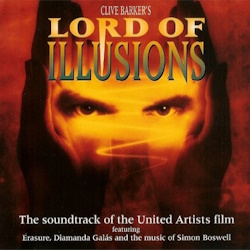
LORD OF ILLUSIONS – Simon Boswell
 THROWBACK THIRTY
Original Review by Jonathan Broxton
Lord of Illusions is an excellent, underrated film written and directed by horror legend Clive Barker, based on his own short story The Last Illusion. The story blends elements detective noir, supernatural horror, and dark fantasy, and was his third directorial effort following Hellraiser in 1987 and Nightbreed in 1990. Scott Bakula stars as Harry D’Amour, a hardboiled private investigator based in New York who specializes in cases involving the occult. After traveling to Los Angeles on a routine insurance case, D’Amour stumbles into a far more sinister world involving the remnants of a doomsday cult once led by the charismatic and sadistic sorcerer named Nix (Daniel von Bargen). Thirteen years earlier, Nix had attempted to unleash dark powers upon the world but was stopped by his former disciple Philip Swann (Kevin J. O’Connor) and a group of fellow magicians. Swann has since become a world-famous illusionist, having buried the truth of his real supernatural powers beneath a layer of stage trickery. As D’Amour investigates further, he becomes entangled in a deadly conspiracy when Swann is killed during a stage performance gone wrong, and Swann’s widow Dorothea (Famke Janssen) enlists D’Amour’s help to uncover the truth behind her husband’s death. Read more…
SPECIES – Christopher Young
 THROWBACK THIRTY
Original Review by Jonathan Broxton
Species is a science fiction horror film that blends alien-invasion tropes with creature-feature thrills. Directed by Roger Donaldson from a screenplay by Dennis Feldman, the story begins with a top-secret government project called SETI (Search for Extraterrestrial Intelligence), which receives a transmission from outer space containing DNA instructions for creating a hybrid organism – part human, part alien. Scientists follow the instructions and create a girl named Sil, who appears human but matures at an astonishing rate and soon exhibits alarming, inhuman traits. When the SETI lead scientist Xavier Fitch (Ben Kingsley) deems her too dangerous, they attempt to terminate her, but she escapes from the lab; now fully grown and played by Natasha Henstridge, Sil goes on the run in Los Angeles, driven by a primal urge to reproduce. Her alien DNA pushes her to find a mate, but any man she deems genetically unfit meets a gruesome end. A team is assembled to track her down, including an empath (Forest Whitaker), a molecular biologist (Alfred Molina), an anthropologist (Marg Helgenberger), and a government assassin (Michael Madsen), and as Sil leaves a trail of bodies behind her, the team races against time to prevent her from mating and giving birth to a potentially unstoppable alien species. Read more…

Shop at the Movie Music UK Store

Member of the


