Archive
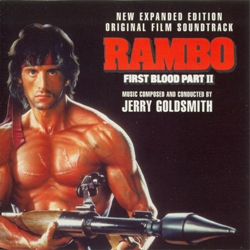
RAMBO: FIRST BLOOD PART II – Jerry Goldsmith
 THROWBACK THIRTY
Original Review by Jonathan Broxton
Following the massive success of the original First Blood movie in 1982, it was inevitable that a sequel would be forthcoming. Rambo: First Blood Part II once again saw Sylvester Stallone returning to one of his most iconic roles as former United States Special Forces commando John Rambo. Having spent a year in prison as punishment for his part in the events of the first film, Rambo is visited by his old commanding officer, Colonel Trautman (Richard Crenna), and offered a deal – in exchange for being pardoned by the government, Rambo must return to Vietnam and investigate reports of American soldiers still being held captive by the Viet Cong. However, as Rambo arrives in Southeast Asia, all hell breaks loose, and the one-man army finds himself waging war not only against the Vietnamese, but against a group of corrupt Soviets who are funding them. The film was directed by George P. Cosmatos from a screenplay by James Cameron, co-stars Charles Napier, Steven Berkoff, and Julia Nickson as a local intelligence agent, and was an even greater commercial success than the original, becoming one of the most iconic action movies of the 1980s. Read more…
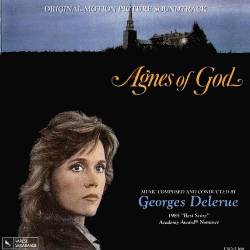
AGNES OF GOD – Georges Delerue
 THROWBACK THIRTY
GREATEST SCORES OF THE TWENTIETH CENTURY
Original Review by Jonathan Broxton
After he won the Oscar for Best Original Score in 1979 for A Little Romance, it appeared that the great French composer Georges Delerue would make the leap from the prestigious European films for which he was known, and begin a career scoring prestigious Hollywood fare. After all, Delerue was the musical voice of the French New Wave, the composer of choice for directors like François Truffaut, Jean-Luc Godard, and Alain Resnais, whose collaborations included such landmark works as Hiroshima Mon Amour in 1959, Shoot the Piano Player in 1960, Jules et Jim in 1962, Le Mépris in 1963, Les Deux Anglaises et le Continent in 1971, Une Belle Fille Comme Moi in 1972, and La Nuit Américaine in 1973. Unfortunately, that’s not what happened at all. Hollywood seemed to be completely at a loss with what to do to with Delerue, and instead of him being asked to score serious, worthy films, he ended up writing music for films that were, to put it mildly, deeply beneath him. Between 1980 and the summer of 1985 Delerue wrote music for such forgettable fare as Richard’s Things, Rich and Famous, and The Black Stallion Returns, and even had the ignominy of having his score for Something Wicked This Way Comes rejected by the studio. Thankfully, one person who appreciated his talent and knew what he could bring to the table was director Norman Jewison, who approached Delerue to score his serious religious drama, Agnes of God, in 1985. Read more…
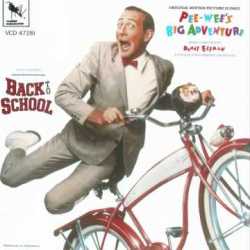
PEE-WEE’S BIG ADVENTURE – Danny Elfman
 THROWBACK THIRTY
Original Review by Jonathan Broxton
The story of how Tim Burton and Danny Elfman met has probably been turned into an urban myth, Chinese whispers-style, by now, but here’s my understanding of how it went down. In 1984, Burton was an aspiring filmmaker, a former animator for Disney who worked as an artist on films such as The Fox and the Hound, The Black Cauldron, and Tron, and who had impressed many with his animated short film Frankenweenie. One fan of Frankenweenie was actor and comedian Paul Reubens, who actively sought Burton out to direct Pee-Wee’s Big Adventure, the planned big-screen spinoff of his popular Pee-Wee Herman character, which has become a cult-success on stage. Burton was a fan of the theatrical rock band Oingo Boingo and its charismatic lead singer Danny Elfman and, when it came time to decide on a musical direction for Pee-Wee, he approached Elfman to offer him the gig. Unknown to Burton, Elfman had basically grown up as a ‘film music fanboy’, having a special affinity for the work of Bernard Herrmann, and jumped at the chance to work in the genre that had fascinated him all his life. The rest, as they say, is history. Read more…
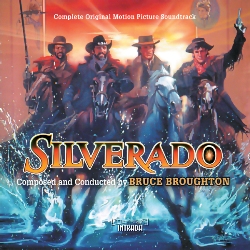
SILVERADO – Bruce Broughton
 THROWBACK THIRTY
Original Review by Jonathan Broxton
Despite being the quintessential genre of American cinema, the western often goes through periods of decline, lulls in production where very few films of quality are produced by Hollywood. The early 1980s was one of those periods when cowboys were seemingly out of fashion, having been tainted by the overblown budget and massive failure of Heaven’s Gate at the box office in 1980. It would take five years for someone to take a gamble on another one, but two came out in the summer of 1985 – Clint Eastwood’s introverted and introspective Pale Rider, and Lawrence Kasdan’s more traditionally adventurous Silverado. With an all-star cast of talented character actors including Kevin Kline, Scott Glenn, Kevin Costner, Jeff Goldblum, Brian Dennehy, Danny Glover, Linda Hunt, and even John Cleese, the film follows the escapades of four drifters who become unlikely friends and find themselves in the small town of Silverado, New Mexico, caught in the middle of a land war between open range cowboys and homesteading farmers, and dealing with individual demons from their own past. The film was a modest financial success, taking $32 million at the box office, and was generally well received at the time, but as the years have gone by Silverado is now looked on more favorably, and is considered a turning point in the revitalization of the genre. Read more…
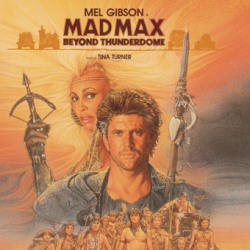
MAD MAX BEYOND THUNDERDOME – Maurice Jarre
 THROWBACK THIRTY
Original Review by Jonathan Broxton
The third in director George Miller’s series of Mad Max movies, Beyond Thunderdome once again starred Mel Gibson and continued the adventures of the former Australian Highway Patrol officer Max Rockatansky, as he tries to survive in a post-apocalyptic society. Fifteen years after the events of Mad Max II, Max finds himself in Bartertown, a vicious society of scavengers and opportunists overseen by the ruthless Aunty Entity, played by Tina Turner. In exchange for returning to him his vehicle – which she has scavenged – she forces him in to conflict with Master Blaster, a dwarf and his hulking masked bodyguard, who control Bartertown’s fuel supply; to resolve the conflict, Max finds himself taking part in gladiatorial games inside the ‘thunderdome’, an enormous metal arena where people duel to the death. The film was an enormous success – the highest grossing film of the original trilogy – and further cemented Mel Gibson’s box office bankability as a leading man; his next film would be the smash hit buddy-cop action movie Lethal Weapon, two years later. Read more…
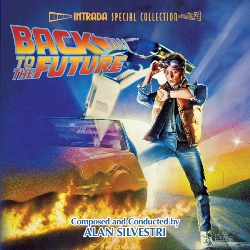
BACK TO THE FUTURE – Alan Silvestri
 THROWBACK THIRTY
GREATEST SCORES OF THE TWENTIETH CENTURY
Original Review by Jonathan Broxton
In the spring of 1985, Robert Zemeckis was a young up-and-coming director who had enjoyed some success with the Michael Douglas-Kathleen Turner adventure flick Romancing the Stone the year before, but for the most part was still largely an unknown quantity. His breakthrough came with the release of Back to the Future, a classic time-travelling comedy adventure which went on to become the biggest grossing film of the year, made Michael J. Fox a movie star, and cemented the much-derided DeLorean automobile into cinematic folklore forever. Fox stars as Marty McFly, a typical 1980s kid from suburban California, who is accidentally sent back to the year 1955 by his friend, scientist and inventor Doc Brown (Christopher Lloyd), who has built a time machine out of the aforementioned DeLorean. Stranded in time and without enough fuel to return home, Marty must seek help from the 1955 version of Doc – but, unfortunately, he inadvertently puts his own future at risk when the teenage version of his mother Lorraine (Lea Thompson) meets and develops a crush on him rather than George (Crispin Glover), the man destined to be his father… Read more…
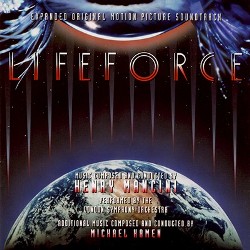
LIFEFORCE – Henry Mancini
 THROWBACK THIRTY
GREATEST SCORES OF THE TWENTIETH CENTURY
Original Review by Jonathan Broxton
What do you think of when you think of the music of Henry Mancini? The gentle romance of Breakfast at Tiffany’s? The effortlessly cool jazz of Peter Gunn or The Pink Panther? The forbidden passion of The Thorn Birds? The playful “Baby Elephant Walk” from Hatari? I’d bet my bottom dollar that most people would come up with those classics long before they thought of an epic orchestral sci-fi horror score, but that’s exactly what Mancini wrote for Lifeforce, a British-American production directed by Tobe Hooper and produced by the notorious Yoram Globus and Menahem Golan for Cannon Films. The film is a loose adaptation of Colin Wilson’s 1976 novel The Space Vampires, and stars Steve Railsback as the head of a multi-national space exploration team sent to investigate Halley’s Comet as it makes one of it’s regular 75-year passes past Earth. The team finds a space craft concealed inside the comet’s corona, and inside the space craft they find the preserved bodies of three seemingly humanoid aliens in suspended animation, including one incredibly beautiful female. However, when the space exploration team’s ship returns home, Mission Control in London finds it empty, save for the three aliens, which soon awake and begin draining ‘life force’ energies from every human they encounter. The film co-starred Peter Firth, Frank Finlay, Patrick Stewart, and Mathilda May, who spends almost the entire film completely naked; despite this obvious selling point, the film was a disaster, recouping less than half of its $25 million budget, and receiving terrible reviews from most critics of the time. Read more…
COCOON – James Horner
 THROWBACK THIRTY
GREATEST SCORES OF THE TWENTIETH CENTURY
Original Review by Jonathan Broxton
Cocoon was one of the major box-office successes of 1985, a winning combination of science fiction adventure and family drama directed by Ron Howard. The film stars Don Ameche, Wilford Brimley and Hume Cronyn as three old-timers living in a retirement community in Florida; part of their daily routine is to sneak into an unoccupied house next door and swim in its swimming pool. One day they find a number of strange, rock-like objects at the bottom of the water, but after checking them out, decide to swim there anyway; following their swim, the three geezers suddenly find themselves rejuvenated with a vigorous, youthful energy, and they share their discovery with their respective wives and lady friends, played by Gwen Verdon, Maureen Stapleton, and Jessica Tandy. However, much to the shock of the senior citizens, the ‘rocks in the pool’ turn out to be cocoons containing dozens of sick aliens, left behind by friendly extra-terrestrials centuries ago, and which were about to be returned to their home planet by their leader, Brian Dennehy, with the help of a local ship captain, played by Steve Guttenberg – until the pool was drained of its life force by the old folks. As such, the sextet of retirees must work with the aliens to help them find a way home, without revealing the secret of the pool. The film earned two Academy Awards – one for Best Supporting Actor for Don Ameche, and one for Best Visual Effects – and boasted a magnificent score by the then 32-year-old James Horner. Read more…
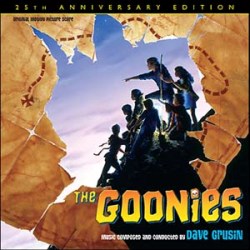
THE GOONIES – Dave Grusin
 THROWBACK THIRTY
Original Review by Jonathan Broxton
One of the most beloved children’s adventure films of the 1980s, The Goonies tells the story of seven friends – Sean Astin, Josh Brolin, Jeff Cohen, Corey Feldman, Kerri Green, Martha Plimpton, and Ke Huy Quan – who are about to be separated forever when their homes in small-town Oregon are bought by a ruthless developer. In a last-ditch attempt to raise the money they need to buy back their property, the Goonies embark on a mission to locate the long-lost treasure belonging to the pirate One Eyed Willie, whose shipwreck is rumored to be just off the coast; however, as they search for the booty, the friends quickly find themselves embroiled in a much more dangerous situation when they accidentally stumble across the Fratelli gang (Anne Ramsey, Robert Davi, Joe Pantoliano), bank robbers who are hiding from the law nearby. The film, which was directed by Richard Donner, produced by Steven Spielberg, and written by Chris Columbus, caught the imagination of a generation, and has gone on to be a genre classic, with a multitude of quotable lines and memorable scenes: the cry of “hey, you guys!,” and the term ‘truffle shuffle’ have since gone on to be part of the Hollywood lexicon. Read more…
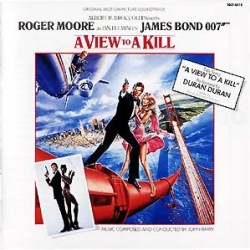
A VIEW TO A KILL – John Barry
 THROWBACK THIRTY
Original Review by Jonathan Broxton
A View to a Kill is the fourteenth official film in the James Bond canon, and the seventh and last to star Roger Moore as the fictional British secret agent. In this wide ranging story which spans the globe from Siberia to Paris to San Francisco, Bond locks horns with the psychopathic industrialist Max Zorin, played by Christopher Walken, who hatches a plan to destroy Silicon Valley in order to gain a monopoly in the worldwide microchip market. Bond is assisted in his assignment by wealthy geologist Stacey Sutton, played by Tanya Roberts, who helps uncover Zorin’s dastardly plan after he tries to strong-arm her into selling her family’s oil company, and there is the usual cast of supporting characters, evil henchmen, beautiful women, and ingenious gadgets. The film was directed by John Glen, co-stars Patrick Macnee and singer Grace Jones, and has an original score by John Barry, the tenth of his eleven works in the series. Read more…
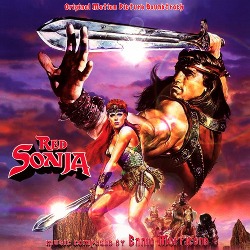
RED SONJA – Ennio Morricone
 THROWBACK THIRTY
Original Review by Jonathan Broxton
Cashing in on the popular success of Conan the Barbarian and the various other sword-and-sorcery epics of the early 1980s was Red Sonja, the tale of a barbarian warrior princess, based on the original story by Robert Howard, the creator of Conan, and directed by Richard Fleischer. The film starred Brigitte Nielsen, the Danish supermodel and future wife of Sylvester Stallone in her first acting job, in the title role as a woman seeking vengeance upon those who murdered her parents, while simultaneously embarking on a quest to find a magical talisman whose power could destroy the world. Despite the presence of Arnold Schwarzenegger in a supporting role as the legendary swordsman Lord Kalidor, the film was critically decimated, receiving brickbats for its acting, writing, direction, and wooden action sequences. In fact, possibly the only member of the cast and crew of Red Sonja to escape unscathed was the legendary composer Ennio Morricone, who unexpectedly found himself scoring the movie. Read more…
THE LAST PLACE ON EARTH – Trevor Jones
 THROWBACK THIRTY
Original Review by Jonathan Broxton
The Last Place on Earth was a critically acclaimed British TV mini-series, directed by Ferdinand Fairfax, which aired over seven episodes in the spring of 1985. It charted the epic race between two teams of intrepid adventurers and their efforts to become the first men to reach the South Pole – one from the United Kingdom led by Captain Robert Falcon Scott, and one from Norway led by Scott’s great rival, Roald Amundsen. Their trials and tribulations caught the attention of the world in 1912, but ended in great tragedy, as the entire British party famously died from a combination of exhaustion, starvation and extreme cold on the return journey, having been beaten to the Pole by Amundsen by just a matter of days. The series starred Martin Shaw as Scott, Sverre Anker Ousdal as Amundsen, Max von Sydow as Amundsen’s mentor, the famed explorer Fridtjof Nansen, and Brian Dennehy as the American Arctic exploration pioneer Frederick Cook, as well as several now-popular British actors in early supporting roles, including Hugh Grant and Bill Nighy. Read more…
THE COMPANY OF WOLVES – George Fenton
 THROWBACK THIRTY
Original Review by Jonathan Broxton
The Company of Wolves is a dark fantasy from director Neil Jordan, based on English author Angela Carter’s mature, sexualized take on the classic Little Red Riding Hood story. The film stars Sarah Patterson as a teenage girl named Rosaleen, who dreams that she lives in a fairytale forest with her parents and sister. In her dream, Rosaleen is given a bright red shawl by her kindly grandmother, accompanied by a warning to stay away from “any strange men whose eyebrows meet in the middle,” Of course, before long, Rosaleen meets a seductive and handsome young huntsman – whose eyebrows meet in the middle – and whose bestial nature proves to be overwhelmingly alluring to the impressionable young woman. The film tackles a number of interesting and complicated themes, ranging from the nature of dreams and nightmares, to emergent sexuality, desire, and revenge. The film, Jordan’s second as a director, co-starred a litany of British character actors, including Angela Lansbury, David Warner, Brian Glover, Stephen Rea, Jim Carter and Terence Stamp, and made liberal use of a number of gruesomely realistic special effects, inspired by the similarly lupine An American Werewolf in London. Read more…
LADYHAWKE – Andrew Powell
 THROWBACK THIRTY
Original Review by Jonathan Broxton
In 1985 the sword-and-sorcery genre was still very much at the height of its powers, with successful films like Dragonslayer, Conan the Barbarian, Red Sonja and Krull having been released to popular acclaim during the preceding few years. Ladyhawke was less an action-adventure, and more a love story, telling the tale of two cursed lovers in twelfth century France: Etienne Navarre, a brave and noble knight, and Isabeau d’Anjou, a beautiful young noblewoman. The twist of the story comes due to the fact that, despite being in love, they can never truly be together until a curse is lifted – by day, Isabeau assumes the form of a hawk, while Etienne is human; at night, Etienne becomes a wolf, while Isabeau returns to her human form. With the help of a wisecracking thief named Philippe and a kindly priest, Etienne and Isabeau resolve to try to break the curse so they can finally be together. The film was directed by Richard Donner, and stars Rutger Hauer, Michelle Pfeiffer and Matthew Broderick. Read more…
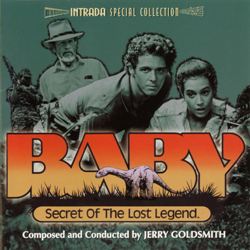
BABY: SECRET OF THE LOST LEGEND – Jerry Goldsmith
 THROWBACK THIRTY
Original Review by Jonathan Broxton
In my review of Supergirl earlier in this series, I remarked how a number of Jerry Goldsmith scores are essentially ‘parallel universe’ scores, inferior versions of films John Williams scored. From the late 1970s through the mid 1990s, Goldsmith wrote a lot of great music for some truly awful movies, and if you look at his filmography during that period, you can see the pattern developing: where John Williams had Superman, Goldsmith had Supergirl; as Williams had Raiders of the Lost Ark, so Goldsmith had King Solomon’s Mines; and so on. Baby: Secret of the Lost Legend is basically Goldsmith’s Jurassic Park, eight years before Steven Spielberg broke all box office records with his dinosaur movie. It’s a family adventure directed by Bill L. Norton, starring William Katt, Sean Young, Patrick McGoohan and (inexplicably) Downton Abbey creator Julian Fellowes in an early acting role; it tells the story of Susan and George Loomis, a paleontologist and her husband, who discover a mother and baby brontosaurus in Africa, and try to protect them from hunters who want to capture them. Read more…

Shop at the Movie Music UK Store

Member of the


