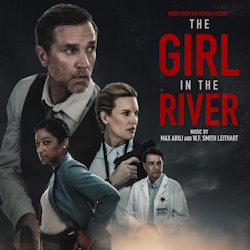
THE GIRL IN THE RIVER – Max Aruj, W.F. Smith Leithart
 Original Review by Jonathan Broxton
In the 1980s and 1990s there were a reasonably large number of mid-budget B-movie serial killer and crime thrillers released in cinemas in any given year, and many of them featured great scores by major composers. In recent years the genre has sort of dried up or, actually, moved to streamers like Netflix or Amazon, where they are now eight-episode miniseries as opposed to two-hour movies. That’s why The Girl in the River feels like something of a nostalgic throwback. The film stars Devon Sawa, Maggie Grace, Tiffany Haddish, and Ralph Macchio and concerns the abduction of twin teenage girls in a remote Mississippi community: one is found dead in the river, while the other remains missing, drawing veteran criminologist Alan Kramer and profiler Amelia Pembrock into an increasingly disturbing investigation.
The Girl in the River is the feature directorial debut of Franco-Italian filmmaker Brando Benetton, a grandson of billionaire businessman Luciano Benetton, one of the co-founders of the Benetton global fashion brand. Benetton actually began writing the screenplay during the isolation of the pandemic, and eventually shot the film in Canton, Mississippi, in 2025 on sets originally built for “A Time to Kill,” over a short 15-day schedule, before it was released theatrically and on demand earlier this month.
 The score for The Girl in the River is by up-and-coming composers Max Aruj and W.F. Smith Leithart. Aruj has been around for a little while – he began his career in the mid-2010s writing additional music for Hans Zimmer, Lorne Balfe, and Rupert Gregson-Williams, and scoring films such as Crawl and The Ice Road, before enjoying a mainstream breakthrough on Mission: Impossible: The Final Reckoning in 2025 alongside Alfie Godfrey. Leithart, meanwhile, is a relative newcomer: he wrote additional music for Aruj on Mission: Impossible: The Final Reckoning and the recent TV series Man on Fire, and impressed with his work on the low-budget horror film Dinner to Die For last year alongside fellow newcomer Jon G. Kaye, but unless you somehow discovered that score, this is likely to be most people’s first experience of his music.
What’s impressive about this music is how much it overachieves. These days most scores for films of this type are dull, dour, themeless, emotionless affairs, rumbling and groaning in the background and trying desperately hard not to say or do anything interesting. The Girl in the River is not like that at all; Aruj and Leithart seem to have intentionally returned to the dark but still musically engaging sound of those 1980s and 1990s thrillers and crafted a score that fits perfectly within the established tonal parameters of the genre, but still manages to offer genuine compositional interest.
The score is built around two principal ideas: an investigative theme heard in the opening titles, and a more emotional theme connected to the characters and the human cost of the case. That duality is the key to the score’s success. The music is tense without being oppressively grim, and emotional without being melodramatic; it balances the procedural mechanics of the investigation against the tragedy that has brought everyone together.
The instrumental palette is especially effective. Budget constraints meant the bulk of the score was performed on synthesizers and samplers by Aruj and Leithart themselves, but they were able to stretch to a few live musicians to give it a human touch: violinist Jon G. Kaye, cellist Marza Wilks, percussionist Logan Gammill, and vocalist Bekah Leithart, Smith’s wife. The result is contemporary thriller writing with real personality that is also controlled, intelligent, and musically distinctive.
The score opens impressively with the title cue “The Girl in the River,” a tense and urgent piece built around frantic string writing underpinned by a powerful brass idea that introduces one of the score’s principal thematic identities. Despite the darkness of the material there is a strong melodic core, while the restless orchestral movement creates an almost inexorable sense of forward motion, as though events are already being propelled toward an unavoidable conclusion. “Over the Bridge” moves into more overtly unsettling territory, combining Bekah Leithart’s eerie, ghostly vocal textures with suspenseful electronics to establish an atmosphere of unease. The cue eventually becomes much more energetic, exploding into a percussion-heavy action finale in which numerous rhythmic layers interact with one another. The array of percussion sounds is especially fascinating, giving the music a dense, tactile quality while maintaining the underlying tension.
 “You Should Try Vodka” introduces bubbling, undulating electronic textures that continually push the music forward, creating a sense of anticipation and investigative momentum. There appears to be an important thematic idea embedded within this material, perhaps a variation of the investigative theme, which gives the cue a feeling of curiosity and discovery while efficiently setting the dramatic scene. That same atmosphere continues into “First Time in Canton,” where darker rhythms and electronic pulses are joined by prominent, moody brass. The result is subtly sinister rather than overtly threatening, suggesting that the investigation is beginning to uncover something much more dangerous beneath the surface.
“Autopsy” is dominated by a mass of clattering percussion and agitated strings, creating music that feels simultaneously inquisitive and forceful. The rhythmic complexity gives the cue a restless quality, as though the score is constantly searching for answers. This approach becomes even more compelling in “Like a Fingerprint,” which features terrific, stylish writing for cellos, pianos, and cimbalom. Their unusual combination of instrumental colors gives the cue a distinctive personality, while some of the rhythmic writing has echoes of the sophisticated thriller music James Horner was writing during the 1990s. “Raw Chicken” continues this excellent action style, maintaining the emphasis on rhythm, propulsion, and tightly controlled orchestral energy.
One of the album’s standout cues is “Uncovering the Photo,” which begins with eerie, glassy high strings that immediately establish an unsettling atmosphere. As the piece unfolds, it transforms into something much larger, eventually presenting the main theme as a darkly heroic anthem carried by powerful brass and thrusting strings. The combination of menace and determination is especially effective, allowing the music to remain moody while simultaneously acquiring greater purpose and dramatic weight. It is one of the most compelling statements of the score’s central musical identity.
“Sleeping Beauty” takes the score in an entirely different direction, embracing a deliberate 1980s-style electronic sound reminiscent of Vangelis, Tangerine Dream, and John Carpenter. Pulsating synth textures are combined with darkly sensual wordless female vocals, resulting in an intoxicating mixture of mystery, danger, and seduction. It is stylistically distinct from much of the surrounding orchestral material, but its moody atmosphere ensures that it remains entirely consistent with the score’s broader dramatic world. The lengthy “Same Game, Different Outcome” offers a more extended exploration of the score’s thriller writing. Clattering percussion provides much of the rhythmic foundation, while the strings continually alter their character, moving between smooth, elongated textures and shorter, choppier figures filled with nervous energy. The cue maintains a strong sense of suspense throughout before concluding with a solemn horn motif that adds an unexpected note of gravity.
“Catwalk” returns to heavy rhythmic writing, with its dark pulses and weighty textures generating an immediate sense of danger. “Break In” is considerably more energetic, with Aruj and Leithart combining dancing strings with piano figures in a creative and constantly shifting rhythmic framework. There is tremendous movement in the writing, with the instrumental layers seeming to bounce off one another as the sequence gathers momentum. The mood changes dramatically in “Sometimes the Dragon Wins,” which abandons much of the score’s rhythmic intensity in favor of tragic, mournful strings. The writing is beautifully sad, providing a moment of genuine emotional weight amid the surrounding suspense and action material.
The rhythmic string writing returns with renewed force in “Ironic,” another excellent example of the score’s ability to generate excitement through insistent patterns and sheer propulsion. The strings are energetic and thrusting, pushing the music relentlessly onward, before the cue expands into a big, bold finale dominated by heavier brass in full action mode. It is one of the score’s most overtly dramatic passages and provides an impressive orchestral payoff to the ideas that have been developing throughout the preceding cues. “Traffic Stop” pushes the action writing even further, becoming a hectic, almost helter-skelter set-piece filled with frenetic motion. Slashing strings and bombastic percussion dominate the texture, punctuated by aggressive bursts of blatting brass that give the cue an intentionally chaotic edge. It is breathless and forceful, conveying the impression of events rapidly spiraling beyond anyone’s control. The score ends with “Even If I Wanted To,” a moody and introspective conclusion that provides a welcome emotional counterweight to the preceding action. A poignant reprise of the main theme brings the score full circle, allowing its darker qualities to give way to something more reflective and melancholy.
Taken as a whole, The Girl in the River is a very accomplished thriller score: atmospheric, thematic, stylish, and far more musically engaging than many contemporary scores in this genre. Aruj and Leithart balance brooding electronics, inventive percussion, energetic strings, memorable thematic material, and genuine emotion with considerable skill, while the handful of live performers adds welcome personality to the predominantly sampled palette. At its best – especially in “Uncovering the Photo,” “Like a Fingerprint,” “Ironic,” and “Even If I Wanted To” – the music recalls the muscular, intelligent thriller writing of the 1980s and 1990s without simply imitating it. It is also another excellent showcase for the Aruj-Leithart-Kaye-Alfie Godfrey composing group, which clearly deserves considerably more attention. Fans of stylish, thematic crime-thriller scoring should absolutely seek this one out; The Girl in the River is an unexpected pleasure.
Buy the Girl in the River soundtrack from the Movie Music UK Store
Track Listing:
- The Girl in the River (2:56)
- Over the Bridge (2:35)
- You Should Try Vodka (3:49)
- First Time in Canton (2:40)
- Autopsy (3:13)
- Do You Have Children? (1:47)
- It’s Quiet (2:52)
- Like a Fingerprint (2:28)
- Raw Chicken (2:44)
- Uncovering the Photo (3:41)
- No Teeth, No Print (1:12)
- Sleeping Beauty (3:06)
- Same Game, Different Outcome (5:48)
- Catwalk (1:54)
- Break In (2:14)
- Sometimes the Dragon Wins (4:09)
- Ironic (3:35)
- Traffic Stop (3:57)
- Even If I Wanted To (3:20)
Scott Point Productions (2026)
Running Time: 57 minutes 52 seconds
Music composed and arranged by Max Aruj and W.F. Smith Leithart. Additional arrangements and programming by Daniel Stockdale and Logan Gammill. Featured musical soloists Jon G. Kaye and Marza Wilks. Special vocal performances by Bekah Leithart. Recorded and mixed by XXX. Edited by XXX. Album produced by Max Aruj.

Shop at the Movie Music UK Store

Member of the


